
The Hidden 'Master Proteins' That Protect Us From Deadly Mutations
Scientists are uncovering how specialized chaperone proteins act as genetic buffers, masking the effects of harmful mutations and opening new avenues for drug discovery.
By Factlen Editorial Team
- Evolutionary Biologists
- View genetic buffering as a mechanism that stores hidden genetic variation, driving adaptation during environmental stress.
- Oncology Researchers
- Focus on exploiting tumors' reliance on chaperone proteins to develop targeted cancer therapies.
- Structural Biologists
- Study the biophysical mechanics of how master proteins fold and stabilize mutated amino acid chains.
What's not represented
- · Patient Advocacy Groups
- · Bioethicists
Why this matters
Understanding how our cells naturally suppress genetic errors could lead to breakthrough treatments for cancer and neurodegenerative diseases, either by boosting these cellular defenses or selectively disabling them in tumors.
Key points
- Humans are born with dozens of new genetic mutations, but most are masked by cellular defenses.
- "Master proteins," or molecular chaperones, act as genetic buffers by helping mutated proteins fold into their correct functional shapes.
- This buffering allows hidden genetic variation to accumulate, which can drive rapid evolution during times of environmental stress.
- Cancer cells are highly dependent on chaperone proteins to survive their own genetic instability.
- Drugs that inhibit master proteins like Hsp90 are being developed to selectively destroy tumors by removing their genetic safety net.
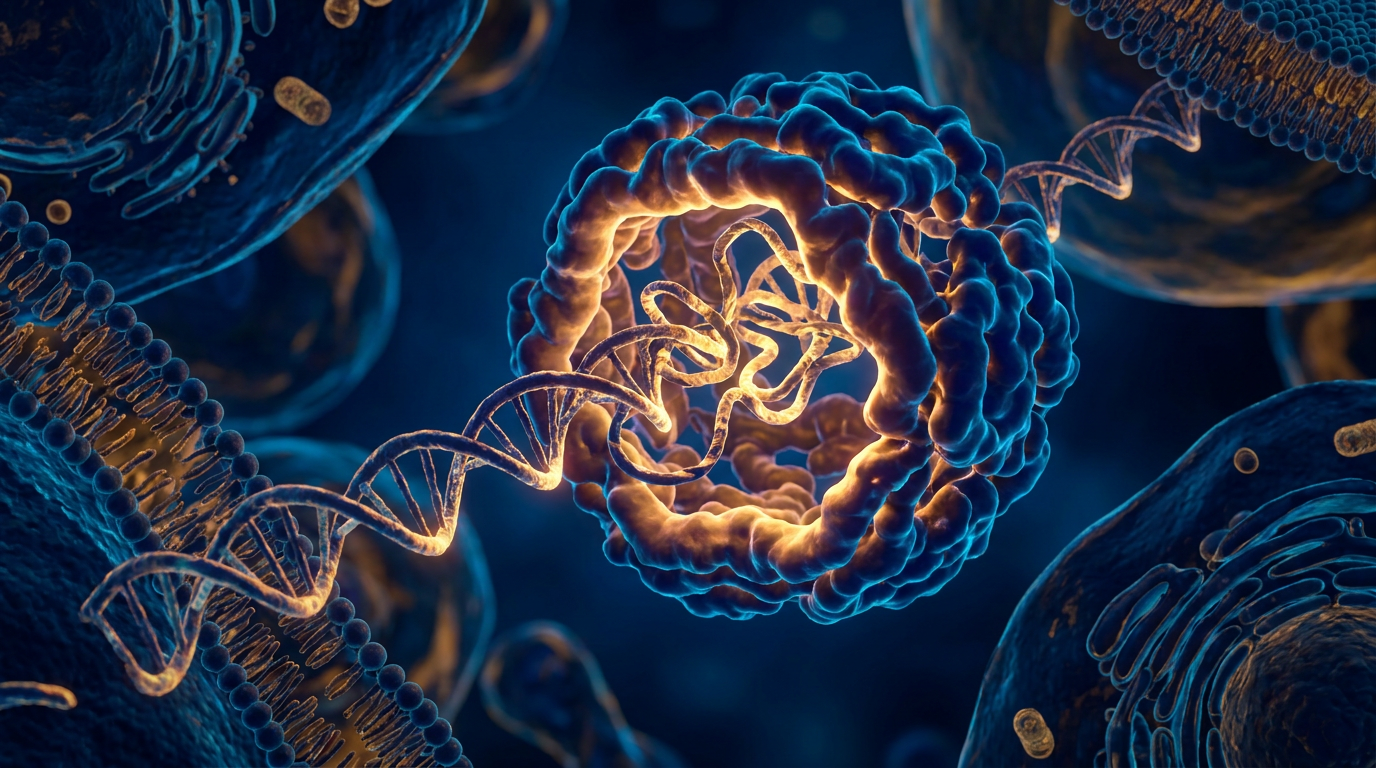
Every human is born with roughly 60 to 100 new genetic mutations that their parents did not possess. While the word "mutation" often conjures images of disease, dysfunction, or cinematic science fiction, the vast majority of these genetic alterations pass by completely unnoticed. For decades, biologists have puzzled over how complex organisms can tolerate such a constant, generation-over-generation influx of genetic errors without suffering catastrophic consequences. The answer, it turns out, lies in a hidden layer of cellular defense known as genetic buffering.[4]
At the heart of this defense system are "master proteins," formally known as molecular chaperones. As recently highlighted in Nature, biology has evolved remarkably clever ways to mask the effects of potentially harmful gene mutations. These master proteins act as a cellular quality-control team, constantly patrolling the microscopic environment to ensure that other proteins fold into their correct three-dimensional shapes, even when their underlying genetic blueprints are fundamentally flawed.[1]
To understand how this buffering works, one must look at the delicate mechanics of protein folding. Genes are essentially instruction manuals for building proteins, which are long, linear chains of amino acids. For a protein to function—whether it is digesting food, carrying oxygen, or fighting off viruses—that chain must fold into a precise, intricate shape. A genetic mutation often changes just a single amino acid in that chain, which can destabilize the entire protein and cause it to misfold.[3]
Misfolded proteins are not only useless to the organism; they can be actively dangerous. When proteins fail to achieve their correct shape, their sticky internal components are exposed. They can clump together into toxic aggregates, a process that is heavily implicated in severe neurodegenerative conditions like Alzheimer's, Huntington's, and Parkinson's diseases. Preventing this toxic buildup is a matter of life and death for the cell.[3]

This is where chaperone proteins, such as the extensively studied Hsp90 (Heat Shock Protein 90)—which makes up a staggering 1 to 2 percent of a cell's total protein mass—step in. When a mutated protein struggles to fold correctly, chaperones bind to it, stabilizing the fragile structure and physically guiding it into its functional shape. By doing so, the chaperone effectively hides the mutation from the organism's physical traits.[2][3]
When a mutated protein struggles to fold correctly, chaperones bind to it, stabilizing the fragile structure and physically guiding it into its functional shape.
The genetic error remains permanently embedded in the DNA, but its harmful physical consequences are entirely neutralized. These proteins are essentially acting as shock absorbers for the genome. By buffering the effects of mutations, chaperones allow organisms to accumulate a vast reservoir of hidden genetic diversity, known in evolutionary biology as cryptic genetic variation.[2][4]
Under normal, stress-free conditions, this cryptic variation remains invisible to natural selection because the chaperones are successfully doing their jobs. However, when an organism faces severe environmental stress—such as an extreme temperature spike, a period of starvation, or exposure to a novel pathogen—the cellular environment is thrown into chaos. The chaperones are suddenly diverted to handle the massive influx of stress-induced protein damage across the cell.[2][4]
When the chaperones are deployed to the front lines of an environmental crisis, they can no longer babysit the mutated proteins they were previously hiding. Suddenly, the buffer drops, and the hidden genetic variations are unmasked. This leads to a sudden burst of new physical traits appearing in the population. Evolutionary biologists believe this mechanism is a profound driver of evolution, providing a sudden influx of diversity exactly when a species needs to adapt rapidly to a changing environment.[2]

But this elegant biological system has a dark side, particularly when it comes to oncology. Tumors are inherently chaotic environments, riddled with thousands of genetic mutations that would normally trigger a healthy cell to self-destruct. To survive their own extreme genetic instability, cancer cells become heavily reliant on chaperone proteins. They dramatically upregulate the production of Hsp90 and other master proteins to keep their mutated, cancer-driving proteins functional and prevent cellular collapse.[3]
This phenomenon, known as "chaperone addiction," has made these master proteins a prime target for modern drug discovery. If researchers can develop drugs that selectively inhibit Hsp90 in cancer cells, they can effectively remove the tumor's genetic buffer. Without the chaperones to stabilize them, the mutated oncogenic proteins collapse, and the cancer cell dies. Crucially, healthy cells—which are not carrying a heavy load of mutated proteins—remain relatively unharmed by the treatment.[1][3]
The latest research is now mapping the complex, interconnected networks through which these master proteins operate. Scientists are discovering that chaperones do not just buffer individual, isolated proteins; they stabilize entire regulatory pathways and gene expression networks. This network-level buffering helps explain a long-standing medical mystery known as incomplete penetrance, where some individuals can carry known disease-causing mutations but never actually develop the associated symptoms.[1][4]

Unlocking the full potential of genetic buffering could revolutionize personalized medicine in the coming decades. By understanding an individual's unique chaperone capacity, doctors might one day predict whether a specific genetic mutation found in a DNA test will actually cause disease or remain harmlessly buffered. Furthermore, designing next-generation drugs that either enhance chaperone activity to stave off neurodegeneration or inhibit it to starve tumors represents one of the most promising frontiers in molecular biology today.[1][4]
How we got here
1998
Researchers first propose that the chaperone protein Hsp90 acts as an evolutionary capacitor in fruit flies.
2002
Studies in plants confirm that inhibiting Hsp90 reveals hidden genetic variation, supporting the buffering hypothesis.
2010s
The concept of 'chaperone addiction' in cancer gains traction, leading to the development of Hsp90 inhibitors for oncology.
June 2026
New research maps how master proteins buffer entire regulatory networks, inspiring novel drug discovery approaches.
Viewpoints in depth
Evolutionary Biologists
View genetic buffering as a mechanism that stores hidden genetic variation, driving adaptation during environmental stress.
For evolutionary biologists, chaperone proteins solve a long-standing paradox: how do species accumulate enough genetic diversity to evolve without being crippled by mutations in the meantime? They argue that master proteins act as an 'evolutionary capacitor.' By buffering the effects of mutations, chaperones allow cryptic genetic variation to build up safely over generations. When a severe environmental stressor hits—such as a sudden temperature spike or a new predator—the chaperones are diverted to handle the stress, dropping the buffer. This sudden unmasking of hidden traits provides the raw material for rapid natural selection.
Oncology Researchers
Focus on exploiting tumors' reliance on chaperone proteins to develop targeted cancer therapies.
Cancer researchers view master proteins through a therapeutic lens, focusing on a vulnerability known as 'chaperone addiction.' Because tumors are highly mutated, their internal proteins are inherently unstable and prone to misfolding. Oncologists argue that without an overabundance of chaperones like Hsp90, cancer cells would collapse under the weight of their own genetic errors. By developing drugs that specifically inhibit these master proteins, researchers aim to strip away the tumor's safety net, causing a catastrophic buildup of toxic, misfolded proteins that selectively kills the cancer while sparing healthy tissue.
Structural Biologists
Study the biophysical mechanics of how master proteins fold and stabilize mutated amino acid chains.
Structural biologists are primarily concerned with the physical and thermodynamic mechanics of protein folding. They investigate exactly how a chaperone protein recognizes a misfolded amino acid chain and the energetic costs required to force it into a functional shape. Their research highlights that buffering is not a magical fix, but a highly energy-dependent process that requires ATP. They point out that understanding the precise binding sites and structural changes involved in this process is crucial for designing the next generation of drugs that can either inhibit or enhance chaperone activity.
What we don't know
- It remains unclear exactly how many different chaperone proteins act as genetic buffers across the entire human genome.
- Researchers are still determining why some mutated proteins are easily buffered while others evade chaperone assistance and cause disease.
- The long-term evolutionary consequences of artificially manipulating genetic buffering with drugs are not yet fully understood.
Key terms
- Genetic buffering
- The ability of an organism to hide the physical effects of a genetic mutation, often through the action of specialized proteins.
- Chaperone protein
- A type of protein that assists in the correct folding and stabilization of other proteins, preventing them from clumping or misfolding.
- Hsp90
- Heat Shock Protein 90, one of the most abundant and widely studied chaperone proteins known for its role in genetic buffering.
- Cryptic genetic variation
- Genetic mutations that accumulate in a population without showing any physical effects until the organism is exposed to severe stress.
- Incomplete penetrance
- A phenomenon where individuals carry a genetic mutation associated with a disease but never actually develop the symptoms.
Frequently asked
What is a chaperone protein?
A chaperone is a specialized 'master protein' that helps other proteins fold into their correct three-dimensional shapes, preventing them from clumping or misfolding.
What is genetic buffering?
It is a cellular defense mechanism where chaperone proteins mask the physical effects of a genetic mutation, allowing the organism to function normally despite the genetic error.
Why do cancer cells need chaperone proteins?
Cancer cells have highly unstable, mutated genomes. They rely on an overabundance of chaperone proteins to keep their mutated proteins functioning and prevent the cell from dying.
Can we use this knowledge to create new drugs?
Yes. Researchers are developing drugs that inhibit chaperones to selectively kill cancer cells, and exploring ways to boost chaperones to treat neurodegenerative diseases.
Sources
Source coverage
4 outlets
3 viewpoints surfaced




[1]NatureStructural Biologists
These 'master' proteins protect us from deadly mutations — and could inspire new drugs
Read on Nature →[2]PLoS BiologyStructural Biologists
Chaperones as Genetic Buffers
Read on PLoS Biology →[3]National Institutes of HealthOncology Researchers
The multifaceted roles of HSP90 in genetic buffering
Read on National Institutes of Health →[4]Factlen Editorial TeamEvolutionary Biologists
Synthesis by Factlen editorial team
Read on Factlen Editorial Team →


Every angle. Every day.
Get science stories with full source coverage and perspective breakdowns delivered to your inbox.