
New Global Map Identifies 166,000 Square Kilometers of Climate-Resilient Coral Reefs
A comprehensive analysis of 45,000 marine surveys has located vast stretches of coral reefs capable of surviving ocean warming, offering a data-driven blueprint for ocean conservation.
By Factlen Editorial Team
- Marine Conservationists
- Argue that this data provides a clear roadmap for expanding Marine Protected Areas, shifting the narrative from despair to actionable triage.
- Climate Realists
- Acknowledge the discovery of refugia but emphasize that without aggressive global emissions reductions, extreme heat will eventually overwhelm even resilient corals.
- Local Ecosystem Managers
- Focus on mitigating immediate local threats like overfishing and pollution, which gives resilient reefs the breathing room they need to survive heat stress.
What's not represented
- · Coastal fishing communities whose livelihoods depend on these specific reefs
- · Tourism boards in nations hosting these climate refugia
Why this matters
By pinpointing exactly where coral reefs are naturally surviving extreme heat, governments and conservationists can stop guessing and direct limited funding to the marine habitats with the highest statistical probability of enduring the next century.
Key points
- Scientists have identified 166,000 square kilometers of coral reefs capable of surviving climate change.
- This figure is three times larger than previous estimates, offering new hope for ocean conservation.
- Resilience is driven by cooler local currents, deep-water upwelling, and biological adaptation to heat.
- Roughly 60 percent of these resilient reefs are located in Australia, the Bahamas, Cuba, Indonesia, and the Philippines.
- Only 28 percent of these climate-resilient reefs currently fall within Marine Protected Areas.
- Researchers urge governments to use this data to target conservation funding where it will be most effective.
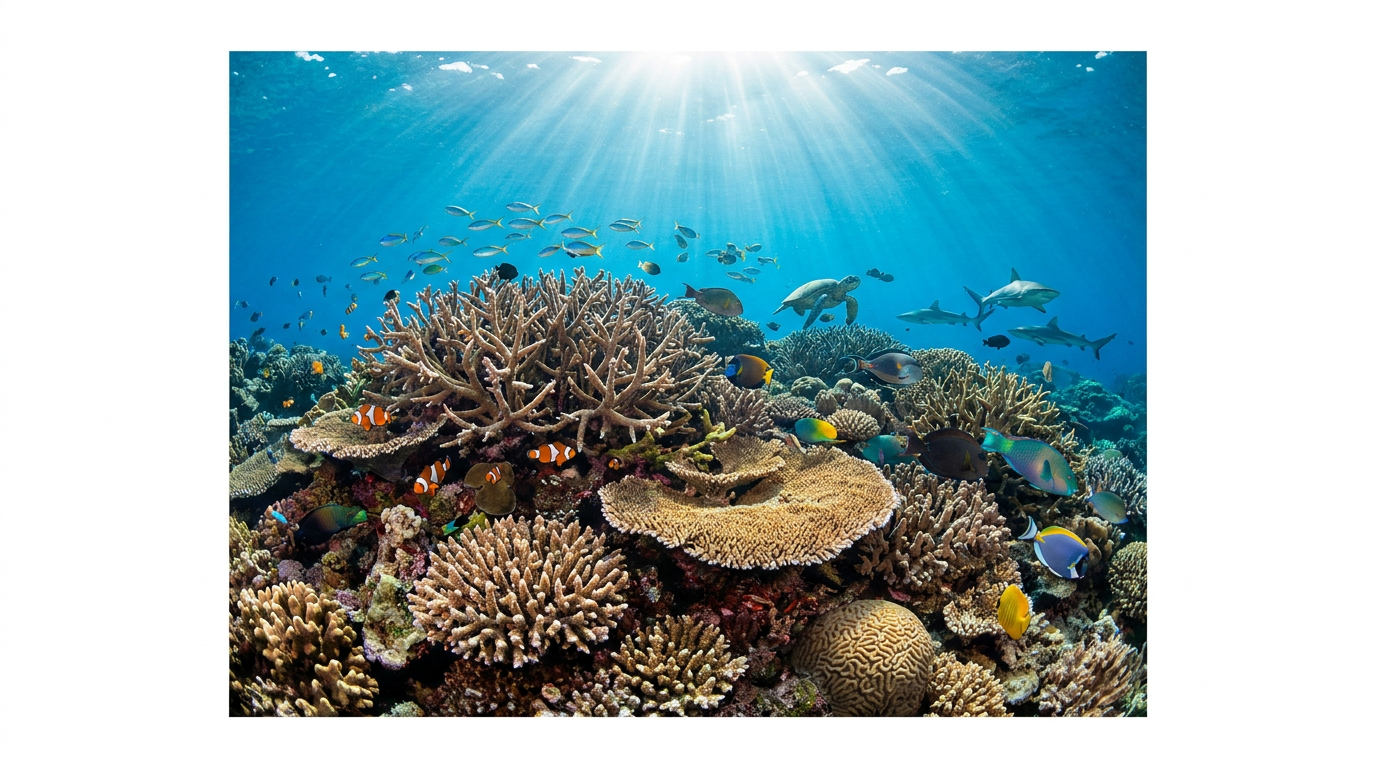
For years, the prevailing scientific narrative surrounding coral reefs has been one of inevitable decline, driven by marine heatwaves and mass bleaching events that leave vibrant ecosystems pale and starved. But a major new evidence review challenges the assumption that these vital marine habitats are entirely beyond saving.[1][4]
Presented at the Our Ocean Conference in Mombasa, Kenya, a sweeping new study has identified approximately 166,000 square kilometers (64,000 square miles) of climate-resilient coral reefs across 71 countries. This figure is three times larger than previous estimates, offering a tangible, data-backed map of where marine conservation can actually succeed.[2][3]
The research, led by the Wildlife Conservation Society (WCS) and Macquarie University, did not rely on isolated anecdotes. Instead, it synthesized more than 45,000 distinct coral surveys and field observations conducted between 1960 and 2025.[3][6][7]
By overlaying these decades of field observations with high-resolution oceanographic and climate data, researchers built a predictive model that maps reef endurance. The evidence points to two primary mechanisms that allow these specific reefs to survive while others perish: oceanographic shielding and biological adaptation.[2][4]
The first mechanism relies on geographic luck. The data shows that many surviving reefs are situated in "climate refugia"—areas where deep-water upwelling, cooler local currents, or natural shading buffer the corals from extreme surface temperatures.[1][5]
The second mechanism is biological. In regions without cooling currents, the evidence points to stony corals that have genetically adapted to heat stress, or entire reef ecosystems that demonstrate an accelerated capacity to bounce back after severe bleaching events.[3][4]
The geographic distribution of these resilient strongholds is highly concentrated. The study's mapping tool reveals that roughly 60 percent of the climate-resilient reefs are located in just five regions: Australia, the Bahamas, Cuba, Indonesia, and the Philippines.[3][6]

The geographic distribution of these resilient strongholds is highly concentrated.
Other notable pockets of resilience were documented in the Palau archipelago and along the coast of Kenya. Near Kenya's Kisite Marine Park, for example, local monitoring data showed rapid coral recovery following a severe bleaching event in 2024, aided heavily by community efforts to limit destructive fishing practices.[3][5]
For marine biologists, this data allows for a shift from passive observation to active ecological triage. Stacy Jupiter, executive director of the WCS's Global Marine Program, argues that the findings give governments the precise information required to deploy limited conservation funds to areas where reefs have the best possible chance of surviving.[2][6]
However, the spatial data also reveals a glaring vulnerability in current policy: only 28 percent of these identified climate-resilient reefs currently fall within formal Marine Protected Areas (MPAs). The vast majority remain exposed to local human stressors.[2][7]

As nations work toward the global "30 by 30" target—an international agreement to protect 30 percent of marine environments by the end of the decade—this study provides a literal blueprint for where to draw the boundaries to maximize long-term ecological returns.[2][6]
The researchers maintain transparent uncertainty regarding the limits of their model. Because the analysis is based on historical patterns up to 2025, the authors caution that it "may underestimate novel future states," such as the unprecedented ocean temperatures generated by a super El Niño event.[3][4]
Furthermore, temperature resilience does not equate to invincibility. Even the most heat-tolerant "super reefs" remain highly vulnerable to local human impacts, including agricultural runoff, plastic pollution, and coastal dredging.[4][5]

How we got here
1960–2025
Researchers collect more than 45,000 field observations of coral reef health and recovery across the globe.
2023–2024
Record-breaking marine heatwaves trigger severe global coral bleaching, devastating many unprotected reefs.
June 16, 2026
The Wildlife Conservation Society and Macquarie University present their findings on climate-resilient reefs at the Our Ocean Conference.
2030
The deadline for the global '30 by 30' initiative, which aims to protect 30 percent of the world's marine environments.
Viewpoints in depth
Marine Conservationists
Argue that this data provides a clear roadmap for expanding Marine Protected Areas.
For conservation organizations, the identification of 166,000 square kilometers of resilient reefs is a paradigm shift. Instead of treating all coral ecosystems as equally doomed, this data allows for a strategy of ecological triage. By overlaying the locations of these 'super reefs' with current conservation maps, organizations like the Wildlife Conservation Society are pushing governments to rapidly expand Marine Protected Areas to cover these specific coordinates, ensuring that limited funding is spent where it has the highest statistical probability of long-term success.
Climate Realists
Emphasize that without aggressive global emissions reductions, extreme heat will eventually overwhelm even resilient corals.
While acknowledging the utility of the new mapping data, climate scientists caution against viewing these refugia as a permanent solution. They point out that the study is based on historical temperature patterns and may underestimate the severity of future warming spikes, such as super El Niño events. From this perspective, local conservation and Marine Protected Areas can buy time, but they cannot ultimately save the oceans if global greenhouse gas emissions continue to drive baseline temperatures past the biological limits of even the most adaptable coral strains.
Local Ecosystem Managers
Focus on mitigating immediate local threats to give resilient reefs the breathing room they need to survive.
For the communities and park rangers managing these reefs on the ground, the focus is on controllable variables. Data from locations like Kenya's Kisite Marine Park demonstrates that corals can recover from severe heat stress if they are not simultaneously battling other threats. These managers advocate for strict enforcement against destructive fishing practices, agricultural runoff, and plastic pollution, arguing that reducing local stressors is the most effective way to help naturally resilient corals survive the compounding pressure of global warming.
What we don't know
- Whether these resilient reefs can withstand the unprecedented temperatures of a future 'super El Niño' event.
- How quickly governments will act to incorporate these newly identified refugia into formal Marine Protected Areas.
- The exact genetic mechanisms that allow certain stony corals to adapt to heat stress faster than others.
Key terms
- Climate refugia
- Areas where local environmental conditions, such as cooler currents, shield ecosystems from the broader impacts of global climate change.
- Coral bleaching
- A stress response where corals expel the symbiotic algae living in their tissues, causing them to turn white and risk starvation.
- Marine Protected Area (MPA)
- A designated region of the ocean where human activities like fishing, drilling, and dredging are restricted to conserve the natural environment.
- Upwelling
- An oceanographic process where deep, cold, and nutrient-rich water rises to the surface, often cooling local habitats.
- 30 by 30
- A global conservation target aiming to formally protect 30 percent of the planet's land and marine environments by the year 2030.
Frequently asked
Why are these specific coral reefs surviving?
They are either shielded by local oceanographic conditions, such as cooler deep-water currents and natural shading, or they have biologically adapted to recover quickly from heat stress.
Where are the resilient reefs located?
Roughly 60 percent are concentrated in Australia, the Bahamas, Cuba, Indonesia, and the Philippines, with other notable pockets in places like Kenya and Palau.
Does this mean coral reefs are safe from climate change?
No. Scientists warn that while these refugia offer hope, they could still be overwhelmed if global temperatures continue to rise unchecked, and they remain vulnerable to local pollution.
What needs to happen next?
Conservationists are urging governments to incorporate these resilient reef locations into their marine protection plans, as only 28 percent are currently safeguarded from human activity.
Sources
Source coverage
7 outlets
3 viewpoints surfaced







[1]The New York TimesLocal Ecosystem Managers
New Coral Study Identifies Areas Where Reefs Are Hanging On
Read on The New York Times →[2]ReutersClimate Realists
Scientists identify 64,000 sq miles of coral reef capable of surviving climate crisis
Read on Reuters →[3]The Straits TimesLocal Ecosystem Managers
Scientists found some coral reefs can survive climate change
Read on The Straits Times →[4]Inside Climate NewsClimate Realists
Unlocking the Secrets of 'Super Reefs' That Survive Ocean Warming
Read on Inside Climate News →[5]Carbon BriefMarine Conservationists
New coral study identifies areas where reefs are hanging on
Read on Carbon Brief →[6]Wildlife Conservation SocietyMarine Conservationists
New Study Identifies 166,000 Square Kilometers of Climate-Resilient Coral Reefs
Read on Wildlife Conservation Society →[7]Macquarie UniversityMarine Conservationists
Global study maps climate-resilient coral reefs
Read on Macquarie University →

More in science
See all 5 stories →Arctic Ecosystem
Arctic Ocean Crosses Irreversible Chemical Tipping Point, Starving Marine Food Web
6 sources
Genetic Buffering
The Hidden 'Master Proteins' Masking Our Deadliest Mutations
6 sources

Iron Age Britain
Scottish Iron Age Burial Reveals Unprecedented Ritual of Brain Removal and Bone Tools
8 sources
Every angle. Every day.
Get science stories with full source coverage and perspective breakdowns delivered to your inbox.