
Smart Bassinets vs. Traditional Bassinets: The Complete Trade-Off Analysis
As robotic bassinets promise exhausted parents more sleep for a premium price, a side-by-side comparison reveals the true trade-offs between high-tech soothing and traditional simplicity.
By Factlen Editorial Team
- Tech-Forward Parents
- Value automated soothing and sleep data to maximize rest and manage newborn exhaustion.
- Pediatric Safety Advocates
- Focus strictly on firm, flat surfaces and adherence to AAP guidelines, viewing tech as a secondary tool.
- Minimalist Traditionalists
- Prefer simple, cord-free environments and worry about babies becoming dependent on robotic motion.
- Neutral Analysts
- Evaluate the trade-offs between cost, convenience, and long-term utility without philosophical bias.
What's not represented
- · Low-income families who are entirely priced out of the smart bassinet market.
- · Child psychologists studying the long-term developmental impacts of algorithmic soothing.
Why this matters
Choosing between a smart and traditional bassinet is one of the most expensive and consequential decisions new parents make, directly impacting both their financial budget and their nightly sleep survival during the grueling newborn phase.
Key points
- Traditional bassinets offer a simple, cord-free, and highly affordable safe sleep space, typically costing between $100 and $300.
- Smart bassinets act as robotic night nurses, using microphones and motors to automatically soothe waking babies with motion and white noise.
- Premium smart sleepers like the Snoo and Cradlewise require a significant financial investment, ranging from $1,400 to $1,700.
- The American Academy of Pediatrics emphasizes that safe sleep requires a firm, flat surface, which both traditional and smart bassinets can provide.
- Smart bassinets may indirectly improve safety by reducing parental exhaustion, making caregivers less likely to resort to unsafe bed-sharing.
- The choice ultimately depends on a family's budget, their tolerance for sleep deprivation, and their comfort with nursery technology.
The arrival of a newborn brings immense joy and an equally immense sleep deficit. For decades, the solution for those first few months was a simple, traditional bassinet placed next to the parents' bed. Today, the baby gear market has been transformed by silicon and sensors, introducing smart bassinets that promise to act as a robotic night nurse. Parents are now faced with a high-stakes financial and lifestyle decision: stick to the analog basics or invest heavily in automated soothing technology.[1]
A traditional bassinet is fundamentally a safe, enclosed basket on legs. It provides a firm, flat sleeping surface that meets all standard safety regulations without requiring a Wi-Fi connection or a power outlet. These analog sleepers range from basic mesh-sided frames to beautifully crafted wooden cradles, but they all share the same core philosophy: they are passive environments designed solely to keep the baby safe while they rest.[7]
The case for the traditional bassinet centers on simplicity, portability, and cost-effectiveness. A high-quality standard bassinet typically costs between $100 and $300, making it an accessible choice for most families. Because they lack heavy motors and electronics, they are lightweight and easy to move from room to room. Furthermore, they do not require subscriptions, software updates, or proximity to a wall outlet, allowing parents to place them anywhere in the home.[3][7]

The case against the traditional bassinet involves the physical toll of manual labor. When a baby wakes up at two in the morning needing to be rocked back to sleep, the parent is the engine. Caregivers must lean over the side of the bed, manually pushing the bassinet or picking the baby up to sway them, which severely interrupts the parents' own sleep cycles. There is no automated intervention to soothe a fussing infant before they fully wake up.[1][8]
The evidence supporting traditional models is deeply rooted in established medical guidance. The American Academy of Pediatrics (AAP) emphasizes that safe sleep requires only a firm, flat surface, a tight-fitting sheet, and no loose bedding. Traditional bassinets perfectly meet these criteria without introducing complex variables. Furthermore, the AAP notes that room-sharing with a baby in a standard bassinet for the first six months can decrease the risk of Sudden Infant Death Syndrome (SIDS) by as much as 50 percent.[2][4]
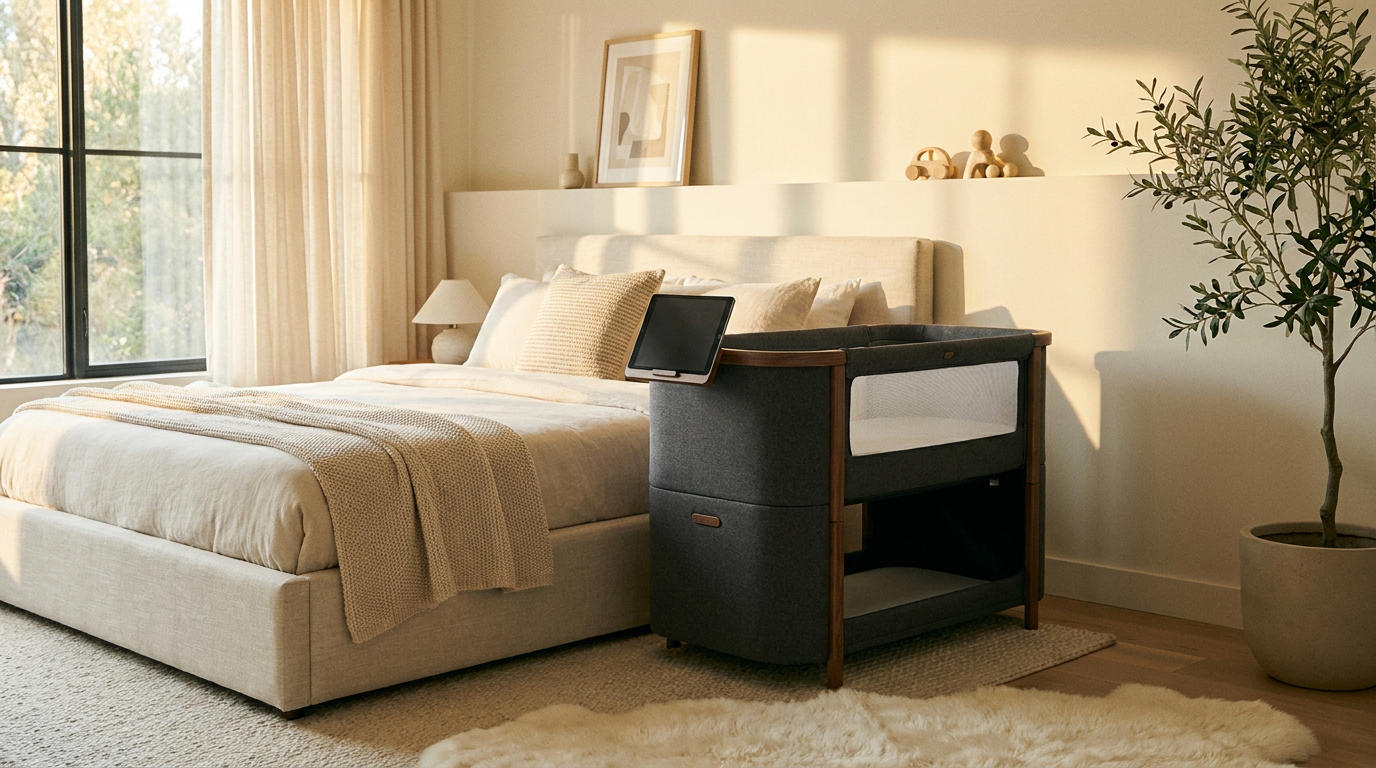
On the other end of the spectrum is the smart bassinet, a category pioneered by devices like the Happiest Baby Snoo and the Cradlewise. These tech-enabled sleepers take the basic concept of a safe sleep space and add features designed to mimic the sensory environment of the womb. They utilize built-in microphones and cameras to detect when a baby is stirring, automatically deploying a combination of white noise and physical motion to soothe the infant back to sleep.[3][6]

The case for the smart bassinet focuses on sleep preservation and automated intervention. By responding to early signs of fussiness with escalating levels of rocking or bouncing, these devices can often settle a baby before they escalate to a full cry. This extra set of hands can buy parents crucial hours of uninterrupted sleep. Additionally, companion apps provide detailed sleep tracking, allowing data-driven parents to analyze their baby's rest patterns and optimize their daily schedules.[6][8]
The case for the smart bassinet focuses on sleep preservation and automated intervention.
The case against the smart bassinet highlights the steep financial barrier and the risk of motion dependency. Premium smart sleepers cost between $1,400 and $1,700, a massive investment for a piece of furniture that a baby might outgrow in six months. Furthermore, some brands have introduced controversial subscription models that place advanced app features behind a paywall. There is also the concern that babies may become so accustomed to constant robotic motion that transitioning them to a stationary crib becomes a grueling ordeal.[6][8]
The evidence surrounding smart bassinets suggests they may indirectly improve overall safety by reducing parental exhaustion. A peer-reviewed article in New Jersey Pediatrics argued that while most parents know the AAP guidelines, severe sleep deprivation often leads them to make unsafe choices, such as bed-sharing or using inclined loungers. By providing an effective, evidence-backed tool to soothe infants, smart bassinets can help exhausted parents adhere more strictly to safe sleep practices.[5]
Within the smart bassinet market, a secondary comparison exists between the two heavyweights: the Snoo and the Cradlewise. The Snoo utilizes a side-to-side rocking motion and a built-in swaddle that clips into the bed, ensuring the baby remains safely on their back. However, it caps out at six months of use. The Cradlewise, conversely, uses an up-and-down bouncing motion and features a built-in night vision monitor. Crucially, the Cradlewise converts from a bassinet into a full crib, extending its lifespan to 24 months and altering the value proposition.[6][8]

This traditional approach fits well when families are working with a strict budget, living in smaller spaces, or traveling frequently. A standard bassinet is ideal for parents who prefer a low-tech nursery environment free of cords, Wi-Fi signals, and subscription fees. It is also the perfect choice for families who have a naturally calm baby that sleeps well without needing constant motion or intervention.[1][7]
This traditional approach does not fit when parents are facing severe sleep deprivation, lack a strong support system, or are returning to demanding jobs shortly after birth. For infants who suffer from colic or demand constant rocking to settle, a manual bassinet can leave caregivers physically exhausted and desperate for relief during the grueling overnight hours.[1][8]
The smart bassinet fits well when parents have the disposable income to invest in premium gear and prioritize maximizing their own sleep. It is highly effective for tech-comfortable families who appreciate data tracking and app integrations. For parents of fussy babies who respond well to white noise and rhythmic motion, a smart sleeper can genuinely act as a robotic night nurse, transforming the newborn experience.[3][6]

The smart bassinet does not fit when families are philosophically opposed to subscription models or worry about the long-term effects of mechanized soothing. It is an unnecessary expense for babies who already sleep soundly on a stationary surface. Additionally, because these units are heavy and require a constant power source, they are entirely unsuitable for families who need a portable sleep solution that can easily move around the house.[7][8]
Ultimately, the choice between a smart and traditional bassinet comes down to a family's budget, lifestyle, and tolerance for sleep disruption. Technology can offer a powerful tool to ease the transition into parenthood, but it cannot replace the fundamental safety principles of a firm, flat mattress and a clear sleep space. Whether powered by an algorithm or a parent's gentle hand, the best bassinet is simply the one that helps the whole family rest safely.[1][4]
How we got here
1990s
The AAP launches the 'Back to Sleep' campaign, establishing the modern baseline for safe infant sleep environments.
2016
Happiest Baby launches the Snoo Smart Sleeper, pioneering the robotic bassinet category and introducing automated soothing.
2020
Cradlewise introduces its convertible smart crib, adding built-in video monitoring and extending the lifespan of smart sleep technology to 24 months.
2022
The AAP updates its safe sleep guidelines, explicitly warning against inclined sleepers and reinforcing the need for flat, firm surfaces.
2025
Peer-reviewed studies begin exploring how smart bassinets might improve overall adherence to safe sleep practices by reducing parental exhaustion.
Viewpoints in depth
Tech-Forward Parents
Advocate for using technology to preserve parental sleep and sanity.
This camp argues that the physical and mental toll of newborn sleep deprivation is a modern crisis that technology can solve. By utilizing smart bassinets that automatically respond to cries with escalating motion and sound, parents can reclaim hours of lost sleep. They point out that a well-rested parent is a safer, more attentive caregiver, making the high financial cost of devices like the Snoo or Cradlewise a worthwhile investment in family health.
Pediatric Safety Advocates
Focus exclusively on the ABCs of safe sleep, regardless of the technology used.
Medical professionals and safety organizations emphasize that no amount of technology changes the fundamental rules of infant sleep: Alone, on their Back, in a bare Crib or bassinet. While they acknowledge that smart bassinets can be safe if they meet Consumer Product Safety Commission (CPSC) standards, they warn against relying on motion as a crutch. Their primary concern is ensuring parents do not introduce unsafe aftermarket add-ons or transition babies to unsafe sleep spaces out of desperation.
Minimalist Traditionalists
Prefer low-tech, analog solutions that foster natural sleep habits.
This perspective cautions against turning the nursery into a data center. Traditionalists argue that babies need to learn how to self-soothe without the intervention of robotic rocking or algorithmic white noise. They highlight the difficulty of transitioning a motion-dependent baby to a stationary crib at six months. For this camp, a simple, affordable mesh bassinet is not just a budget choice, but a philosophical preference for a simpler, cord-free parenting experience.
What we don't know
- It remains unclear how long-term reliance on automated robotic motion affects a child's ability to independently self-soothe in later toddlerhood.
- The exact impact of subscription paywalls on the resale value and accessibility of premium smart bassinets is still evolving in the secondary market.
- Whether insurance companies will eventually subsidize smart bassinets as medical devices to prevent postpartum depression and sleep deprivation is an ongoing debate.
Key terms
- Smart Bassinet
- An infant bed equipped with sensors, motors, and software that automatically detects crying and responds with soothing motion and sound.
- Traditional Bassinet
- A simple, analog infant bed that provides a safe, flat sleeping surface without any electronic components or automated features.
- AAP Safe Sleep Guidelines
- Recommendations by the American Academy of Pediatrics stating babies should sleep alone, on their backs, on a firm and flat surface.
- White Noise
- A consistent, ambient sound that masks background noise, often used in smart bassinets to mimic the auditory environment of the womb.
- Sleep Association
- A condition or object (like rocking or white noise) that a baby becomes accustomed to and relies upon to fall asleep.
Frequently asked
Are smart bassinets safe for newborns?
Yes, smart bassinets are safe as long as they provide a firm, flat sleeping surface and meet CPSC safety standards. However, the AAP stresses that the automated motion and sound are optional soothing features, not safety requirements.
How long can a baby sleep in a bassinet?
Most traditional and smart bassinets cap out at around six months, or when the baby begins to push up on their hands and knees. Some convertible models, like the Cradlewise, can transition into a crib and last up to 24 months.
Do smart bassinets prevent SIDS?
No bassinet can guarantee the prevention of SIDS. However, room-sharing with a baby in any safe bassinet for the first six months can reduce the risk of SIDS by up to 50 percent, according to the AAP.
Is the Snoo or Cradlewise better?
The Snoo is highly effective for the first six months with its side-to-side motion and secure swaddle. The Cradlewise offers a longer lifespan (up to 24 months) with an up-and-down bounce and a built-in camera, making it a better long-term investment for some families.
Sources
Source coverage
8 outlets
4 viewpoints surfaced








[1]Factlen Editorial TeamNeutral Analysts
Synthesis by Factlen editorial team
Read on Factlen Editorial Team →[2]American Academy of PediatricsPediatric Safety Advocates
Sleep-Related Infant Deaths: Updated 2022 Recommendations
Read on American Academy of Pediatrics →[3]ForbesTech-Forward Parents
The Best Bassinets, Tested And Reviewed By Parents
Read on Forbes →[4]HarborPediatric Safety Advocates
Smart Bassinet Safety: What Parents Need to Know
Read on Harbor →[5]Happiest Baby SciencePediatric Safety Advocates
Bridging the Gap to Help Parents Follow Safe Sleep Practices
Read on Happiest Baby Science →[6]FathercraftTech-Forward Parents
SNOO vs. Cradlewise: I've tested both… on the same kid
Read on Fathercraft →[7]BabylistMinimalist Traditionalists
How to Choose the Best Bassinet for Your Baby
Read on Babylist →[8]Sara LaughedTech-Forward Parents
Honest Cradlewise Review: Is the Smart Crib Worth It?
Read on Sara Laughed →

Every angle. Every day.
Get shopping stories with full source coverage and perspective breakdowns delivered to your inbox.