
The Evidence on School Smartphone Bans: Academic Gains, Enforcement Costs, and the Mental Health Myth
As 58% of countries implement national school phone bans, new long-term data reveals significant academic improvements for vulnerable students, but little impact on overall youth mental health.
By Factlen Editorial Team
- Academic Equity Advocates
- Argue that removing phones is a high-yield, low-cost intervention that significantly boosts test scores and closes the gap for low-achieving students.
- Mental Health Realists
- Emphasize that school bans do not solve the underlying youth mental health crisis because students simply compensate with heavier screen time at home.
- Implementation Pragmatists
- Focus on the severe administrative burden, disciplinary spikes, and the hundreds of hours teachers spend enforcing the bans.
What's not represented
- · Students subject to the bans
- · Parents managing post-school screen time
Why this matters
School districts globally are spending millions of hours and dollars enforcing smartphone bans. Understanding what these bans actually fix (test scores and attendance) versus what they don't (overall mental health) allows parents and educators to set realistic expectations and target interventions where they actually work.
Key points
- 58% of countries worldwide now enforce some form of national school smartphone ban.
- Strict bans lead to significant test score improvements, especially for low-achieving students.
- Unexcused absences drop notably when phones are removed from the school environment.
- Bans show little to no impact on overall youth mental health due to the 'compensation effect' at home.
- Enforcing the rules places a massive administrative and disciplinary burden on teachers.
In just three years, the global consensus on smartphones in classrooms has completely flipped. As of March 2026, 114 education systems—representing a remarkable 58% of countries worldwide—have implemented national bans on mobile phones in schools. This marks a staggering acceleration from June 2023, when less than a quarter of countries had such policies in place. The rapid adoption reflects mounting international concern over declining attention spans, rising absenteeism, and the broader influence of digital environments on children. But as the policy scales globally, the debate has shifted from whether schools should ban phones to what happens when they actually do.[1]
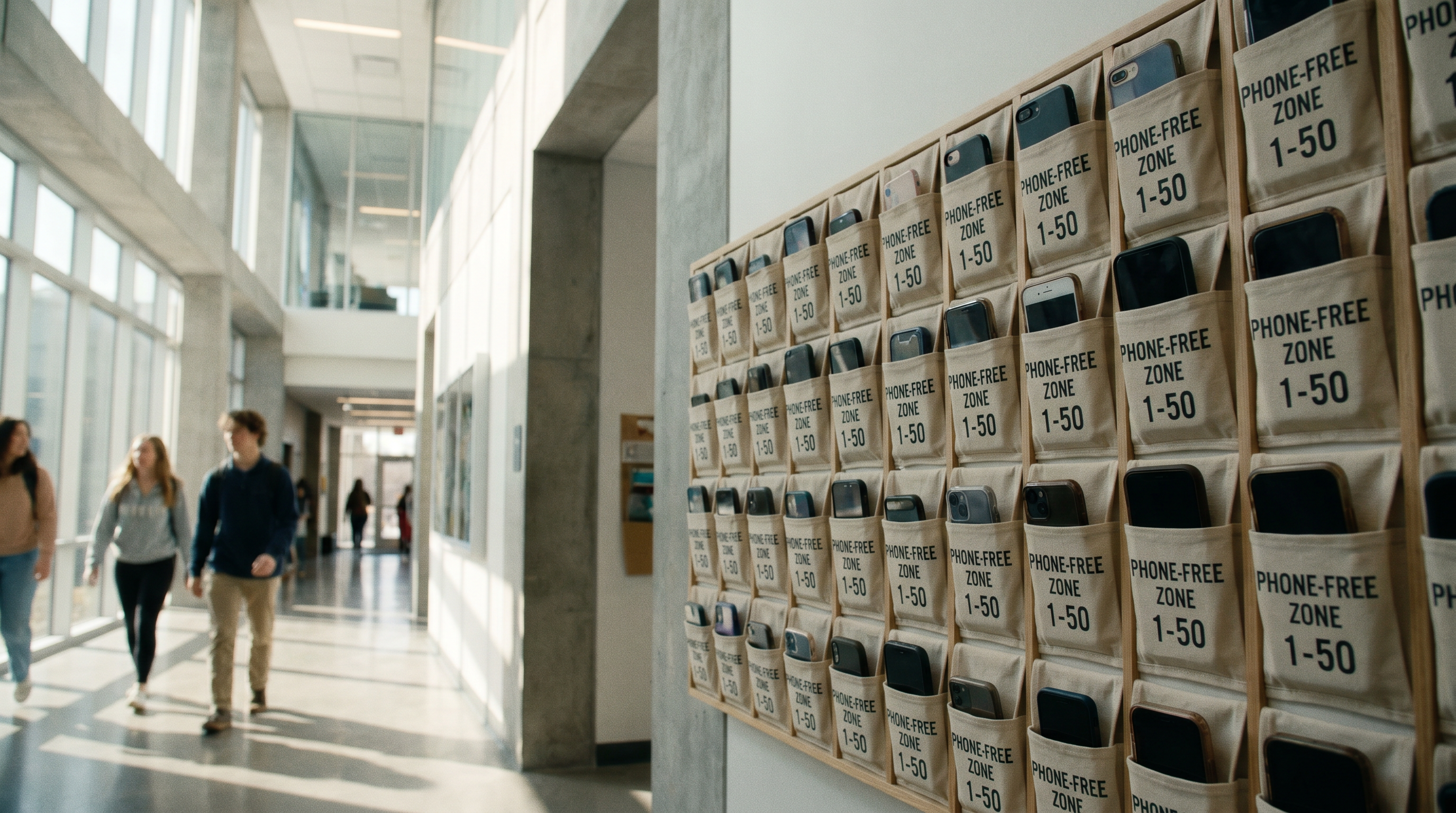
The rapid adoption of these restrictions, ranging from magnetic pouch systems in Florida to statutory bans in the United Kingdom, has frequently outpaced the academic research. Policymakers have largely acted on intuition and parental pressure, driven by a desperate need to address the youth mental health crisis and restore order to distracted classrooms. But as the first wave of long-term, post-implementation data finally arrives, a clearer and highly nuanced picture is emerging. The evidence pack suggests that while removing phones is a highly effective academic intervention that closes learning gaps, it is not the psychological panacea that many advocates had hoped for.[2][3][4][6][7]

The data reveals that not all bans are created equal, and implementation details dictate the outcomes. Policies generally fall into two distinct categories: "instructional-time" bans, which allow phone use in hallways and cafeterias, and "bell-to-bell" bans, which require devices to be silenced and stored in lockers or pouches for the entire day. The emerging consensus among education researchers is that instructional-time bans are nearly impossible to enforce, as the constant transition of devices in and out of pockets creates endless friction for teachers. The most significant academic and behavioral gains have been observed exclusively in districts that commit to the infrastructure and administrative friction required for strict bell-to-bell enforcement.[4][6]
The strongest and most consistent evidence supporting smartphone bans centers on academic performance, particularly for vulnerable and low-income students. A landmark 2025 working paper from the National Bureau of Economic Research analyzed a massive urban school district in Florida that implemented a strict, all-day ban. Researchers used a quasi-experimental design, tracking building-level smartphone activity data to verify that the bans were actually being followed. They found that during the second year of the ban—after an initial and turbulent adjustment period—student test scores increased significantly, with the most pronounced gains occurring in middle and high school settings.[2]
These academic gains are not isolated to the United States. Research analyzing the impact of bans in the United Kingdom found that prohibiting phones throughout the school day was associated with a 6.4% increase in national exam scores. Crucially, the researchers noted that the effects were twice as large for low-achieving students, while high-achieving students saw almost no change in their performance. This data suggests that low-performing students are significantly more susceptible to the multitasking distractions of a smartphone. Consequently, device removal serves as a low-cost, high-yield policy tool for closing educational equity gaps without requiring massive budget increases.[4][6]

Beyond standardized test scores, strict phone policies appear to fundamentally alter the physical presence and engagement of students. The Florida study documented a significant reduction in unexcused absences during the two years following the ban's implementation. Researchers posited that this increased attendance could explain as much as half of the observed test score improvements. Education policy experts note that rising absenteeism over the last decade has been closely correlated with phone usage, as digital socialization slowly replaces the need for in-person peer connection. By removing the digital alternative, schools are forcing students to re-engage with their physical environment.[2][4]
Beyond standardized test scores, strict phone policies appear to fundamentally alter the physical presence and engagement of students.
However, the evidence pack weakens considerably when evaluating the psychological and emotional benefits of school bans. While the public narrative often frames device removal as a direct cure for the youth mental health crisis, rigorous clinical studies show highly mixed and often disappointing results. A 2026 study published in the Lancet Regional Health found no evidence that restrictive phone policies in schools resulted in better overall mental health or reduced problematic social media use among adolescents. In fact, in schools with the strictest "full bans," students occasionally reported lower levels of student-teacher connectedness.[6][7]
The primary mechanism undermining these mental health benefits is known among researchers as the "compensation effect." While schools can successfully curb screen time and social media access during the seven hours of the school day, they are powerless to enforce those boundaries beyond the school gates. Multiple studies indicate that students simply compensate for their daytime digital sobriety with heavier, more concentrated phone use during evenings and weekends. Consequently, a student's total weekly screen time often remains entirely unchanged, leaving the underlying drivers of algorithmic anxiety, cyberbullying, and depression completely intact.[3][7]

There are minor, localized exceptions in the data regarding well-being. A 2024 university experiment that enforced a strict 21-day smartphone ban found that students fell asleep 20 minutes faster and gained an hour of sleep per night, leading to self-reported drops in anxiety. Yet, clinical researchers caution that short-term, self-reported studies often fail to capture long-term behavioral shifts. The broader consensus remains that while a school ban might provide a temporary daily reprieve from digital pressures, it does not alter the fundamental architecture of a teenager's digital life or their relationship with addictive platforms.[6][7]
The friction of enforcement is the most consistently documented downside of the policy shift, representing a massive hidden cost for school districts. Banning phones is not a passive rule that students automatically follow; it requires active, daily, and often confrontational policing by educators. During the first month of the Florida district's ban, student suspensions spiked by a staggering 25%. These elevated disciplinary rates persisted for the entire academic year before the student body finally settled into a "new steady state," highlighting the intense withdrawal period schools must weather.[2][6]
The administrative burden placed on teachers is equally severe. Research conducted in 2026 found that staff at English schools with restrictive pouch policies spent roughly 100 hours a week enforcing the rules—the equivalent of nearly three full-time staff members' working hours dedicated solely to phone confiscation and compliance. Tech companies and platform executives have pointed to this complexity when defending their products before parliamentary committees, arguing that outright bans are blunt, difficult-to-enforce instruments that fail to teach students the necessary digital literacy required for the modern workforce.[3][5]

Ultimately, the 2026 evidence pack requires policymakers, parents, and educators to separate academic outcomes from psychological ones. If the goal of a smartphone ban is to reclaim instructional time, reduce classroom distraction, and boost test scores for the most vulnerable students, the data strongly and unequivocally supports the intervention. It stands as one of the few proven, low-cost policy levers capable of moving the needle on academic equity and attendance in a post-pandemic educational landscape. For school boards weighing the disciplinary costs against the academic benefits, the long-term data suggests the friction is worth the fight.[2][4][6]
But if the primary goal is to solve the adolescent mental health crisis, school bans are wholly insufficient. They treat the symptom during school hours while leaving the underlying digital ecosystem untouched. As the global adoption rate climbs toward 60%, the consensus among researchers is shifting toward a more pragmatic view: schools must enforce the boundary to protect the integrity of learning, but society cannot expect teachers to single-handedly cure a technological addiction that resumes the moment the final bell rings. The ban is a necessary educational boundary, not a medical cure.[1][3][6][7]
How we got here
June 2023
UNESCO reports that less than 24% of countries have national smartphone bans in schools.
May 2023
Florida adopts the first statewide school cellphone ban in the United States.
January 2024
The Netherlands introduces a nationwide smartphone ban in secondary schools.
Late 2025
NBER publishes long-term data showing significant academic gains from the Florida bans.
March 2026
Global adoption of national school phone bans reaches 58% of all education systems.
Viewpoints in depth
Academic Equity Advocates
Argue that removing phones is a high-yield, low-cost intervention that significantly boosts test scores and closes the gap for low-achieving students.
This camp, heavily supported by economic and educational researchers, views the smartphone ban primarily through the lens of academic performance and equity. They point to data showing that high-achieving students are largely unaffected by the presence of phones, whereas low-achieving students suffer severe drops in focus and retention when devices are present. By removing the distraction entirely, schools can engineer a 6.4% boost in test scores without needing to overhaul curriculums or dramatically increase funding. For these advocates, the administrative friction of enforcing the ban is a small price to pay for leveling the educational playing field.
Mental Health Realists
Emphasize that school bans do not solve the underlying youth mental health crisis because students simply compensate with heavier screen time at home.
Clinical researchers and psychologists in this camp warn against viewing school bans as a medical intervention. They highlight the 'compensation effect,' where students simply shift their digital consumption to the evenings and weekends, resulting in no net reduction in weekly screen time. This perspective argues that while bans are useful for classroom management, they give parents and policymakers a false sense of security regarding the youth mental health crisis. They stress that the underlying drivers of anxiety—algorithmic feeds, cyberbullying, and unrealistic social pressures—remain fully active the moment a student leaves the school building.
Implementation Pragmatists
Focus on the severe administrative burden, disciplinary spikes, and the hundreds of hours teachers spend enforcing the bans.
Composed largely of teachers' unions, school administrators, and some tech industry voices, this camp highlights the hidden costs of the policy. They point out that a ban is only as effective as its enforcement, which currently requires educators to act as daily police officers. With data showing up to 100 hours a week spent on compliance in some schools, and initial suspension rates spiking by 25%, pragmatists argue that the policy places an unsustainable burden on already overworked staff. They advocate for better digital literacy education rather than blunt, confrontational prohibitions.
What we don't know
- Whether the academic gains observed in the first two years of a ban will compound over a student's entire educational career.
- How the 'compensation effect' at home might evolve as students find new ways to bypass parental screen-time controls.
- Whether the spike in disciplinary actions during the initial rollout disproportionately impacts long-term outcomes for minority students.
Key terms
- Bell-to-bell ban
- A strict policy prohibiting student access to smartphones from the morning arrival bell until dismissal, including during lunch and passing periods.
- Compensation effect
- A behavioral phenomenon where students make up for restricted digital access during the school day by heavily increasing their screen time at home.
- Quasi-experimental design
- A research method used to estimate the causal impact of a policy by comparing groups that experienced the intervention with similar groups that did not, often used when randomized trials are impossible.
- Difference-in-difference strategy
- A statistical technique that isolates the effect of a specific event—like a phone ban—by comparing the changes in outcomes over time between a treated group and a control group.
Frequently asked
Do smartphone bans actually improve test scores?
Yes. Multiple studies show significant academic gains, particularly for low-achieving and low-income students who are most susceptible to multitasking distractions.
Will a school ban improve my child's mental health?
The evidence is weak. While some students report better sleep, overall mental health metrics rarely improve because students compensate by using their phones more heavily at home.
What is the difference between a bell-to-bell ban and an instructional-time ban?
Bell-to-bell bans prohibit phone access for the entire day, including lunch and passing periods. Instructional-time bans only restrict phones during class, which researchers say are much harder to enforce.
Do bans lead to more students getting in trouble?
In the short term, yes. Data shows that suspensions and disciplinary actions can spike by up to 25% in the first month of a ban as students adjust to the new rules.
Sources
Source coverage
7 outlets
3 viewpoints surfaced







[1]UNESCO
Global Education Monitoring Report: Smartphones in Schools
Read on UNESCO →[2]National Bureau of Economic ResearchAcademic Equity Advocates
The Impact of Cell Phone Bans in Schools on Student Outcomes: Evidence from Florida
Read on National Bureau of Economic Research →[3]The GuardianImplementation Pragmatists
Mobile phone ban in schools is necessary, but enforcement is a challenge
Read on The Guardian →[4]Harvard Kennedy SchoolAcademic Equity Advocates
Many states are banning cellphones in schools. Is it working?
Read on Harvard Kennedy School →[5]The BMJMental Health Realists
TikTok, Meta, and Roblox deny their products are addictive for children as UK government announces school smartphone ban
Read on The BMJ →[6]Factlen Editorial Team
Synthesis by Factlen editorial team
Read on Factlen Editorial Team →[7]National Institutes of HealthMental Health Realists
Smartphone bans at schools and adolescents' well-being and social connectedness
Read on National Institutes of Health →

More in opinion
See all 12 stories →Workplace Culture
The Case for 'Slow Productivity': Why Doing Less Achieves More
8 sources

Future of Work
The 4-Day Workweek Debate: Evidence, Hidden Costs, and the Future of Productivity
8 sources

Slow Media
The Revival of the Letter to the Editor: How 'Slow Media' is Fixing Public Discourse
8 sources

Cancer Vaccines
The 2030 Prediction: How Personalized mRNA Vaccines Are Poised to Transform Oncology
7 sources

Every angle. Every day.
Get opinion stories with full source coverage and perspective breakdowns delivered to your inbox.