
The End-to-End AI Breakthrough Powering the 2026 Robotaxi Expansion
Autonomous vehicle manufacturers have abandoned traditional rule-based programming in favor of 'end-to-end' neural networks. This shift to AI models that learn from human driving data has unlocked a new wave of scalable Level 4 autonomy.
By Noor Saidi

In short
- The autonomous driving industry has shifted from modular, rule-based software to end-to-end neural networks.
- Instead of relying on human-written C++ code, new AI models process raw camera video directly into steering and braking commands.
- These Vision-Language-Action models learn the intuition of driving by analyzing millions of hours of human driving data.
Picture opening a ride app in 2026 and seeing a driverless car pull up at the curb. That scene is rapidly becoming commonplace across the United States as companies push ahead with massive expansions, adding thousands of new robotaxis to cities like Washington D.C., Miami, and Dallas. But behind this sudden acceleration in autonomous vehicle deployment lies a quiet, fundamental revolution in how these machines are built. The industry has largely abandoned the traditional way of programming cars, opting instead for a breakthrough that engineers are calling "ChatGPT for cars."[3]
For the better part of a decade, autonomous driving was bottlenecked by a software architecture known as the modular stack. In this old paradigm, engineers divided the monumental task of driving into separate, distinct modules: perception, planning, and control. The car's cameras would identify an object, hand that data to a planning module to decide what to do, and finally pass instructions to a control module to turn the steering wheel.[2]
The fatal flaw of the modular stack was its reliance on explicit, human-written rules. Engineers had to write hundreds of thousands of lines of C++ code to dictate the car's behavior in every conceivable scenario. They wrote rules like, "if the traffic light is red, apply the brakes," or "if a pedestrian steps into the crosswalk, yield."
However, the real world is infinitely complex and stubbornly refuses to follow rigid rules. A child hesitating on a curb, a construction worker waving traffic through a red light, or a plastic bag blowing across the highway all represent unpredictable edge cases. Rule-based systems struggled to interpret these nuances, leading to hesitant, robotic driving and a plateau in the industry's progress toward full Level 4 autonomy.[3]
The solution that has unlocked the current wave of robotaxi expansion is the "end-to-end" neural network. Instead of relying on human engineers to anticipate and code every possible scenario, an end-to-end system uses a single, massive artificial intelligence model to process sensor inputs directly into driving decisions.[2]
The mechanism is elegantly simple in concept, yet computationally staggering in execution. Raw pixels from the car's cameras go in, and control vectors—steering, acceleration, and braking—come out. There is no orchestrated object-detecting layer handing off data to a rigid planning module. Instead, the AI maintains the full context of the scene throughout the entire decision-making process.
To achieve this, these models are trained on millions of hours of video data collected from expert human drivers. Just as Large Language Models learned to write by consuming the internet, these end-to-end driving models learn to navigate by observing human behavior. They develop an intuition for driving, learning how to smoothly merge into heavy traffic or safely navigate around a double-parked delivery truck without needing an explicit rule for either scenario.
Tesla was one of the earliest pioneers to deploy this at scale, transitioning its Full Self-Driving architecture from a rules-based system to a pure end-to-end neural network, effectively deleting over 300,000 lines of handcrafted C++ code in the process. This shift marked a paradigm change from using software as a rigid instruction manual to using AI as a generalized logic engine.
The underlying technology powering this shift relies heavily on Vision-Language-Action (VLA) models and Large World Models. These advanced architectures allow the vehicle to semantically reason about its environment rather than just drawing bounding boxes around obstacles.
For example, a traditional system might identify a flashing light and a stopped vehicle, triggering a generic braking rule. A VLA model, however, can understand the semantic context that it is approaching an active fire scene, reasoning that it needs to not only slow down but potentially cross a double-yellow line to give emergency responders a wide berth.[3]
While the software architecture has proven revolutionary, the computational cost of processing these massive visual models in real-time has been a significant hurdle. Processing billions of parameters multiple times per second requires immense onboard computing power, which can drain electric vehicle batteries and increase manufacturing costs.[2]
Fortunately, 2026 has brought critical breakthroughs in computational efficiency. In a highly acclaimed paper accepted at the AAAI 2026 AI conference, researchers from XPeng and Peking University introduced FastDriveVLA, a novel visual token pruning framework.[1]
This framework allows the AI to "drive like a human" by focusing its processing power only on essential visual information while actively filtering out irrelevant data, such as empty sky or static background buildings. This targeted attention mechanism achieved a remarkable 7.5x reduction in computational load, proving that end-to-end models can be run efficiently on scalable consumer hardware.[1]
As the technology matures, global regulation is finally catching up to the AI revolution. For years, the deployment of advanced autonomy was constrained by fragmented, market-specific regulations that were originally written for rule-based software.
That changed in February 2026, when the UN Economic Commission for Europe formally adopted a landmark regulatory framework for automated driving systems. Shaped in part by AI startups like Wayve, this framework establishes the world's first globally aligned pathway to deploy end-to-end Embodied AI safely across international markets.
Crucially, this new regulatory approach is technology-agnostic. Rather than prescribing exactly how a system must be coded, it requires manufacturers to prove through rigorous safety cases that their AI performs at least as safely as a competent human driver. This outcome-focused regulation is the exact catalyst needed for Level 4 systems to scale globally.
Despite the immense progress, the transition to end-to-end AI is not without its challenges. The most prominent is the "black box" problem. Because neural networks learn complex patterns rather than following explicit rules, it can be incredibly difficult for engineers to pinpoint exactly why an AI made a specific mistake.[3]
If a traditional system brakes unnecessarily, an engineer can find the faulty line of code and rewrite it. If an end-to-end model makes the same mistake, debugging requires curating and feeding the model thousands of new video examples of similar scenarios to correct its intuition.[3]
To overcome this, the industry is leaning heavily on massive data center infrastructure and synthetic simulation. Companies utilize platforms like Nvidia's Omniverse to generate hyper-realistic virtual worlds, allowing them to test their neural networks against millions of rare edge cases before the software ever touches a public road.
As the automotive industry looks toward the end of the decade, the consensus is clear. According to recent surveys of mobility experts, end-to-end learning is no longer just a research experiment; it is the definitive foundation for the future of transportation. By abandoning rigid rules and teaching machines to truly understand the world, the long-promised era of scalable, safe autonomous driving has finally arrived.[2]
Definitions
- End-to-End Neural Network
- An AI architecture where a single model handles the entire process from receiving input data to generating the final output, without intermediate human-coded steps.
- Vision-Language-Action (VLA) Model
- An advanced AI system that combines visual understanding, semantic reasoning, and physical execution to navigate complex environments.
- Level 4 Autonomy
- A classification where a vehicle can handle all driving tasks within specific operating zones without any human intervention.
- Token Pruning
- A computational technique that filters out irrelevant visual data (like empty sky) so the AI can focus processing power on critical elements like pedestrians and vehicles.
Questions & answers
What does 'end-to-end' mean in autonomous driving?
It means a single artificial neural network processes raw sensor data (like camera video) and directly outputs driving commands (steering, braking), replacing separate modules for perception and planning.
Why did companies abandon traditional programming?
Traditional C++ code required engineers to write explicit rules for every possible driving scenario. The real world has too many unpredictable edge cases for rule-based systems to handle safely.
How do these AI models learn to drive?
They are trained on millions of hours of video data from human drivers, learning the 'intuition' of driving by observing how humans react to complex situations.
What is the 'black box' problem?
Because neural networks learn patterns rather than following explicit rules, it can be difficult for engineers to pinpoint exactly why the AI made a specific decision, making debugging more complex.
Analysis by camp
End-to-End AI Pioneers
Companies pushing for pure neural network architectures to solve autonomous driving.
Pioneers like Tesla, Wayve, and XPeng argue that the real world is too complex for 'if-then' programming. They believe that just as Large Language Models mastered text by consuming the internet, Vision-Language-Action models will master driving by consuming millions of hours of human driving video. To this camp, the only limit to Level 4 autonomy is the amount of high-quality training data and raw compute power.
Safety & Interpretability Advocates
Experts concerned about the lack of transparency in pure AI models.
Critics and traditional safety engineers point to the 'black box' nature of end-to-end systems. If a rule-based car makes a mistake, engineers can isolate the faulty line of code. If a neural network makes a mistake, the exact reasoning is hidden inside billions of parameters. This camp advocates for hybrid systems where a neural network handles perception and prediction, but a hard-coded deterministic system acts as an ultimate safety guardrail.
Compute Infrastructure Providers
The hardware ecosystem powering the AI transition.
For companies like Nvidia, the shift to end-to-end AI is primarily a compute challenge. Training these models requires massive data centers running continuous simulations and processing petabytes of video. This camp emphasizes that the bottleneck is no longer human engineering, but rather the silicon required to train Large World Models in the cloud and execute them efficiently on the edge hardware inside the vehicle.
- End-to-End AI Pioneers
- Companies pushing for pure neural network architectures to solve autonomous driving.
- Safety & Interpretability Advocates
- Experts concerned about the lack of transparency in pure AI models.
- Compute Infrastructure Providers
- The hardware ecosystem powering the AI transition.
Perspectives this story doesn't cover
- Urban Planners
- Professional Drivers
Sources
Source coverage
3 outlets
3 viewpoints surfaced



- [1]XPengEnd-to-End AI Pioneers
XPENG-PKU Research Breakthrough: FastDriveVLA
Read on XPeng → - [2]McKinsey & CompanySafety & Interpretability Advocates
Autonomous driving's future: End-to-end AI and regional tech stacks
Read on McKinsey & Company → - [3]Factlen Editorial TeamEnd-to-End AI Pioneers
Synthesis by Factlen editorial team
Read on Factlen Editorial Team →
More in Automotive & Transportation
See all →Robotaxi Rollout
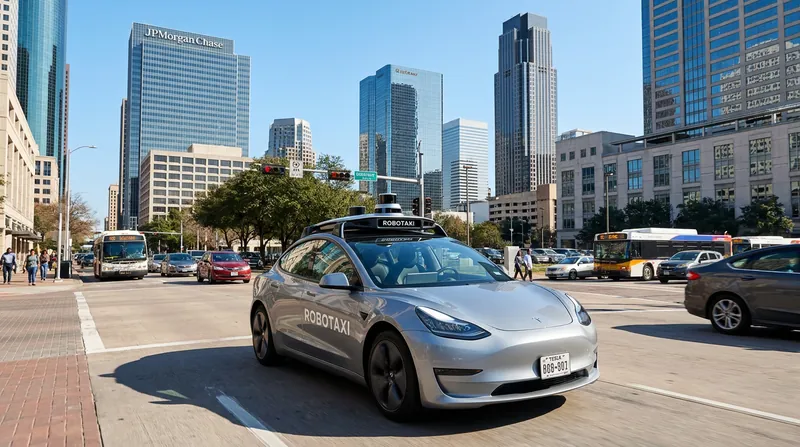
Tesla Launches Unsupervised, Paid Robotaxi Service in Dallas and Houston
4 sources
Delhi EV Mandate
New Delhi Approves Ban on New Petrol 2- and 3-Wheeler Registrations by 2028, Backed by EV Incentives
4 sources

Auto Tech Strategy
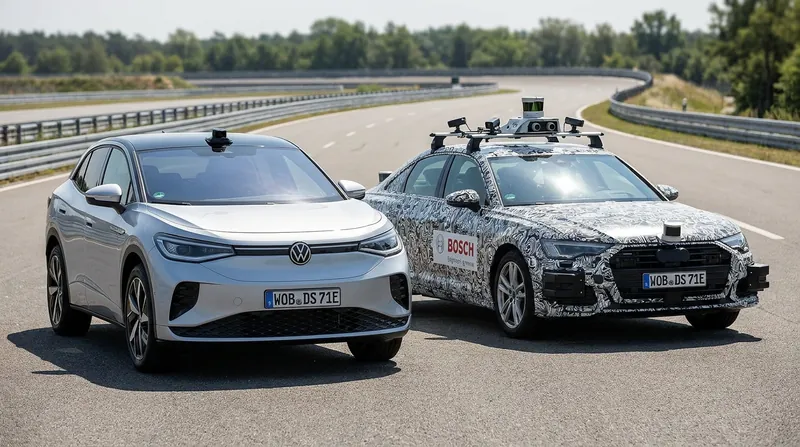
Volkswagen Scraps €1.5 Billion Autonomous Driving Alliance with Bosch Over Software Competitiveness
4 sources
Robotaxi Tech
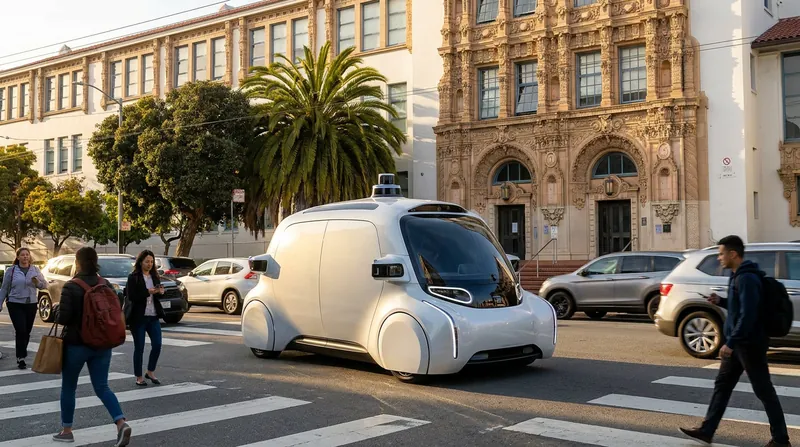
Waymo Recalls Nearly 4,000 Robotaxis After Software Failure Allows Entry Into Closed Freeway Construction Zones
4 sources
Comments
Every angle. Every day.
Get Automotive & Transportation stories with full source coverage and perspective breakdowns, free every day.