
The Chemistry of Clarified Cocktails: How Curdled Milk Creates Crystal-Clear Drinks
By intentionally curdling milk with citrus acid, bartenders are using centuries-old chemistry to strip the harsh tannins from spirits, resulting in perfectly clear, silky-smooth cocktails.
By Factlen Editorial Team
- Culinary Mixologists
- Value milk clarification as a precision tool to manipulate texture, strip harsh tannins, and create visually surprising drinks.
- Cocktail Historians
- Appreciate the technique as a living connection to 18th-century preservation methods and early aristocratic drinking culture.
- Home Bartenders
- View milk washing as an accessible, low-equipment kitchen chemistry project that elevates home entertaining and batch-prepping.
What's not represented
- · Dairy Farmers
- · Lactose-Intolerant Consumers
Why this matters
Understanding the science of milk clarification demystifies one of the most intimidating techniques in modern mixology, empowering home bartenders to use basic kitchen chemistry to elevate their drinks and extend the shelf life of fresh ingredients for months.
Key points
- Milk clarification uses the chemical reaction between dairy proteins and citrus acid to filter cocktails.
- When milk hits a pH of 4.6, casein proteins form curds that bind to bitter tannins and impurities.
- The curds are strained out, leaving a crystal-clear liquid that retains the milk's silky whey proteins.
- The technique strips out unstable organic compounds, allowing the fresh cocktail to last for months.
- Alternative milks can be used, but high-protein options like soy milk are required to form effective curds.
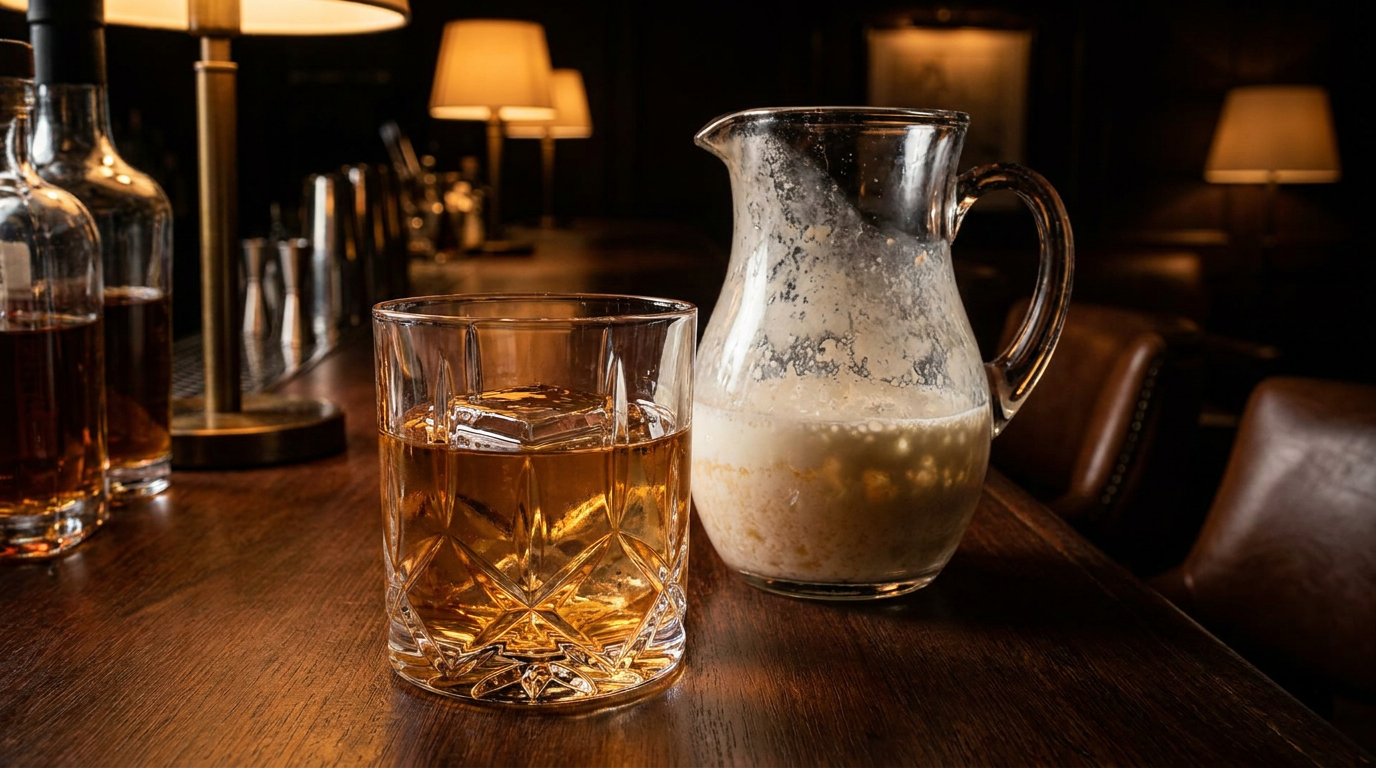
At first glance, the cocktail sitting on the bar looks like a glass of water poured over a single, perfectly square ice cube. But when you take a sip, your palate is hit with the complex, robust flavors of dark rum, spiced tea, and bright lemon juice. The liquid is completely transparent, yet it possesses a rich, velvety weight that coats the tongue. This sensory illusion is the result of a technique known as milk washing, or clarification, and it has become one of the most captivating trends in modern culinary mixology.[1][2]
The secret to achieving this crystal-clear perfection sounds entirely counterintuitive, if not slightly unappetizing: the bartender intentionally curdled milk inside the drink. By mixing an acidic cocktail batch with whole dairy milk, mixologists trigger a cascade of chemical reactions that strip away impurities, color, and harsh flavors. The resulting liquid is not only visually stunning but fundamentally altered on a molecular level, leaving behind a polished, shelf-stable elixir.[2][3]
While milk clarification feels like a modern molecular gastronomy trick, it is actually a centuries-old preservation method. Long before the invention of mechanical refrigeration, 18th-century households needed a way to keep citrus-based punches from spoiling. The earliest known written recipe for milk punch was penned by Mary Rockett in 1711, and the technique was famously utilized by Benjamin Franklin and Queen Victoria. By stripping out the unstable organic compounds that cause spoilage, our ancestors accidentally discovered a way to make harsh, unrefined spirits remarkably smooth.[1][4]
The magic of milk washing relies entirely on the behavior of casein, the primary protein found in mammalian milk. In its natural state, casein proteins are folded into compact, soluble structures. However, when introduced to an acidic environment—such as a cocktail containing lemon or lime juice—the pH of the milk rapidly drops. When the mixture reaches a pH of roughly 4.6, known as the isoelectric point, the casein proteins denature, lose their solubility, and violently clump together to form solid curds.[3][5]

These newly formed curds are not just passive lumps of dairy; they are highly active chemical magnets. Casein proteins carry a positive electrical charge, which causes them to aggressively bind to negatively charged particles suspended in the cocktail. Their primary targets are polyphenols—astringent, bitter compounds found in tea, coffee, wine, and the oak tannins of barrel-aged spirits like whiskey and dark rum. As the curds form, they physically trap these harsh molecules, pulling them out of the liquid solution.[2][5]
These newly formed curds are not just passive lumps of dairy; they are highly active chemical magnets.
Once the curdling process is complete, the mixture resembles a cloudy, unappealing soup. The next step is filtration, which requires immense patience. The liquid is poured slowly through a fine mesh strainer lined with a coffee filter or cheesecloth. The first few ounces that pass through will still be cloudy, but as the curds settle at the bottom of the filter, they form a dense "curd bed." This bed of proteins acts as a microscopic filtration matrix, catching even the finest pigments and impurities as the rest of the liquid slowly drips through.[3][6]

What emerges from the bottom of the filter is a translucent, brightly colored or entirely clear liquid. The heavy, gripping sensation of the oak tannins and the sharp, acidic bite of the citrus have been entirely stripped away, leaving a rounded, softened flavor profile. Because the unstable elements of the fresh juice have been removed and the alcohol content remains high, this clarified punch becomes incredibly shelf-stable, capable of sitting in a refrigerator for months or even years without degrading in quality.[1][4]
But clarity and preservation are only half of the milk-washing equation; the other half is texture. While the casein proteins are filtered out in the curds, the milk's whey proteins and dairy fats remain dissolved in the clear liquid. Whole milk contains roughly 3.5 percent fat, and because these dairy fats are soluble in alcohol, they wash seamlessly into the spirit. When consumed, these liquid fats spread out like a microscopic membrane across the palate, delivering the signature "silky" or "luscious" mouthfeel that defines a true milk punch.[2][6]
Executing the technique requires strict adherence to the order of operations. The golden rule of milk clarification is that the acidic cocktail must always be poured into the milk, never the other way around. If milk is poured into a highly acidic cocktail, the first drops of dairy will instantly curdle upon contact, creating tiny, ineffective curds. By pouring the cocktail into the milk, the pH of the dairy drops gradually and uniformly, producing the large, robust curds necessary to build an effective filtration raft.[5][6]
The rise of plant-based diets has led many modern bartenders to experiment with alternative milks, though the chemistry becomes significantly more complicated. Because the clarification process requires protein to form curds and fat to provide texture, not all vegan milks are created equal. Soy milk, which boasts roughly eight grams of protein and two percent fat per cup, mimics the chemical behavior of whole cow's milk most closely. Conversely, almond milk often lacks the necessary protein to form a solid curd bed, while coconut milk contains too much fat, which can leave an oily slick on the finished drink.[1][6]

While milk washing is a powerful tool, it is not without its culinary trade-offs. Because the casein proteins are so effective at stripping away polyphenols and flavor compounds, a clarified cocktail will always taste significantly milder than its unclarified counterpart. To compensate for this muting effect, mixologists must intentionally "over-season" their initial batches. A recipe destined for clarification requires sharper citrus, heavier spices, and more robust spirits than a standard shaken drink to ensure the final product retains its intended character.[2][5]
Today, milk clarification has evolved from a niche historical curiosity into a foundational technique taught in advanced bartending programs worldwide. It represents a perfect intersection of history, chemistry, and hospitality. By understanding the molecular dance between acid, protein, and polyphenols, drink makers can transform a chaotic, cloudy mixture of ingredients into a polished, unified experience that challenges the senses and delights the palate.[1][6]
How we got here
Late 1600s
Playwright and spy Aphra Behn makes the first known literary references to milk punch in England.
1711
Mary Rockett records the first known written recipe for milk punch, using lemons, brandy, and scalded milk.
1763
Benjamin Franklin encloses his own personal recipe for milk punch in a letter to James Bowdoin.
Mid-1800s
Queen Victoria issues a royal warrant to the company Nathaniel Whisson & Co. to supply milk punch to the royal household.
Early 2000s
Modern culinary mixologists rediscover the technique, shifting its purpose from preservation to texture manipulation.
Viewpoints in depth
Culinary Mixologists
Value milk clarification as a precision tool to manipulate texture, strip harsh tannins, and create visually surprising drinks.
For modern bartenders, milk washing is less about preservation and entirely about sensory manipulation. By understanding the exact isoelectric point of casein, mixologists can take highly aggressive, astringent ingredients—like over-steeped black tea, heavily charred barrel-aged rums, or sharp bitter liqueurs—and chemically strip their rough edges. The appeal lies in the visual paradox: serving a guest a drink that looks like a glass of water but carries the deep, complex flavor profile of a dark, heavy punch, all while delivering a velvety mouthfeel that cannot be achieved through standard shaking or stirring.
Cocktail Historians
Appreciate the technique as a living connection to 18th-century preservation methods and early aristocratic drinking culture.
Historians view clarified milk punch as a fascinating window into pre-industrial food science. Before the advent of mechanical refrigeration, combining fresh citrus juice with low-proof spirits was a recipe for rapid spoilage. By accidentally discovering that curdled milk proteins could strip out the unstable organic compounds that feed bacteria, 18th-century households created a shelf-stable beverage that could survive long ocean voyages or sit in a cellar for months. For this camp, making a milk punch today is a way of participating in a 300-year-old culinary tradition championed by figures like Benjamin Franklin and Queen Victoria.
Home Bartenders
View milk washing as an accessible, low-equipment kitchen chemistry project that elevates home entertaining and batch-prepping.
For the home mixology enthusiast, clarification represents the bridge between amateur drink-making and professional-grade craft. Unlike other molecular gastronomy techniques that require expensive centrifuges or liquid nitrogen, milk washing requires only a coffee filter, a bowl, and patience. Enthusiasts value the technique for its practicality in entertaining: because the final product is shelf-stable and perfectly diluted, a host can batch a complex, impressive cocktail days in advance and simply pour it over ice when guests arrive, eliminating the need to shake individual drinks during a party.
What we don't know
- Exactly how different plant-based protein structures (like oat or pea protein) interact with specific spirit tannins compared to mammalian casein.
- The precise threshold at which the muting effect of clarification permanently destroys the underlying flavor profile of highly delicate spirits like mezcal or gin.
Key terms
- Casein
- The primary family of proteins found in mammalian milk, which denature and coagulate into curds when exposed to acid.
- Isoelectric Point
- The specific pH level (around 4.6 for milk) at which a protein molecule carries no net electrical charge, causing it to lose solubility and clump together.
- Polyphenols
- A category of chemical compounds, including tannins, found in plants, tea, and wood barrels that contribute bitter and astringent flavors to a drink.
- Whey
- The liquid remaining after milk has been curdled and strained; it contains water-soluble proteins that give clarified cocktails their silky texture.
- Fat-Washing
- A related but distinct culinary technique where liquid fats (like butter or sesame oil) are infused into a spirit and then frozen and skimmed off to alter the spirit's texture.
Frequently asked
Does clarified milk punch taste like milk?
No. The casein proteins that taste like dairy are filtered out in the curds. The remaining whey proteins and fats provide a silky texture, but the drink tastes like the underlying cocktail ingredients, not like a glass of milk.
Can you use plant-based milk for clarification?
Yes, but results vary based on protein content. Soy milk is the most effective vegan alternative because its high protein content mimics cow's milk, allowing it to form the necessary curds for filtration.
Why does the cocktail have to be poured into the milk?
Pouring the acidic cocktail into the milk ensures the pH of the dairy drops slowly and uniformly, creating large curds. Pouring milk into acid shocks the dairy, creating tiny curds that fail to filter the drink properly.
How long does clarified milk punch last?
Because the clarification process strips out the unstable organic compounds that cause fresh juices to spoil, a milk-washed cocktail can last for several months to over a year when stored in the refrigerator.
Sources
Source coverage
6 outlets
3 viewpoints surfaced






[1]Wine EnthusiastCocktail Historians
The Science and History of Clarified Milk Punch
Read on Wine Enthusiast →[2]SevenFifty DailyCulinary Mixologists
The Science of Clarified Cocktails
Read on SevenFifty Daily →[3]Alcohol ProfessorHome Bartenders
The Science Behind Clarified Cocktails
Read on Alcohol Professor →[4]Food52Cocktail Historians
The 1711 Origins of Milk Punch
Read on Food52 →[5]The Double StrainerCulinary Mixologists
The Science Behind Milk Washing
Read on The Double Strainer →[6]Factlen Editorial TeamHome Bartenders
Synthesis by Factlen editorial team
Read on Factlen Editorial Team →

Every angle. Every day.
Get food drink stories with full source coverage and perspective breakdowns delivered to your inbox.