
The 3,500-Year-Old Culinary Science Fueling a Fine-Dining Renaissance
An ancient indigenous technique for processing corn is being reclaimed by modern chefs, unlocking profound nutritional benefits and elevating Mesoamerican cuisine.
By Factlen Editorial Team
- Culinary Traditionalists
- Chefs focused on restoring the authentic flavor and texture of Mesoamerican cuisine.
- Nutritional Scientists
- Researchers focused on the biochemical transformation and public health impacts of alkaline cooking.
- Heirloom Maize Advocates
- Agronomists and activists fighting to preserve agricultural biodiversity through market demand.
What's not represented
- · Industrial masa flour manufacturers
- · Everyday home cooks in rural Mexico
Why this matters
Understanding nixtamalization reveals how indigenous scientific wisdom solved complex nutritional challenges millennia before modern medicine. Its modern revival not only produces vastly superior food, but also provides a crucial economic lifeline to farmers preserving global agricultural biodiversity.
Key points
- Nixtamalization is a 3,500-year-old indigenous process of steeping dried corn in an alkaline solution.
- The chemical reaction dissolves the corn's tough outer hull and allows its starches to form a cohesive dough called masa.
- The process unlocks bound niacin (Vitamin B3), preventing the deadly nutritional disease known as pellagra.
- Alkaline steeping also destroys up to 100 percent of harmful mycotoxins that commonly contaminate dried grains.
- A new generation of fine-dining chefs is reviving the labor-intensive practice to elevate Mesoamerican cuisine.
- The restaurant demand for authentic nixtamalization provides an economic lifeline to indigenous farmers growing heirloom maize.
The humble corn tortilla is undergoing a fine-dining renaissance. In a desolate Houston strip mall, an 18-seat restaurant named Tatemó books out months in advance, recently earning a Michelin star for an eight-course tasting menu centered entirely around heritage corn. [1] In Austin, Nixta Taqueria earned a Michelin Bib Gourmand for its dedication to ancient maize preparation, while across the country, a new generation of chefs is elevating Mesoamerican cuisine by returning to its deepest roots. [2][3][1][2][3]
The secret behind this culinary elevation isn't just the meticulous sourcing of heirloom corn; it is a 3,500-year-old indigenous scientific process known as nixtamalization. [5] Without this ancient technique, dried field corn is largely devoid of flavor, difficult to digest, and chemically impossible to form into a cohesive dough. [6][5][6]
Nixtamalization is the process of cooking and steeping dried grain—most commonly maize—in an alkaline solution. [5] Traditionally, this high-pH bath is made by mixing water with calcium hydroxide, known as slaked lime or "cal," or sometimes with clean wood ash. [6][5][6]
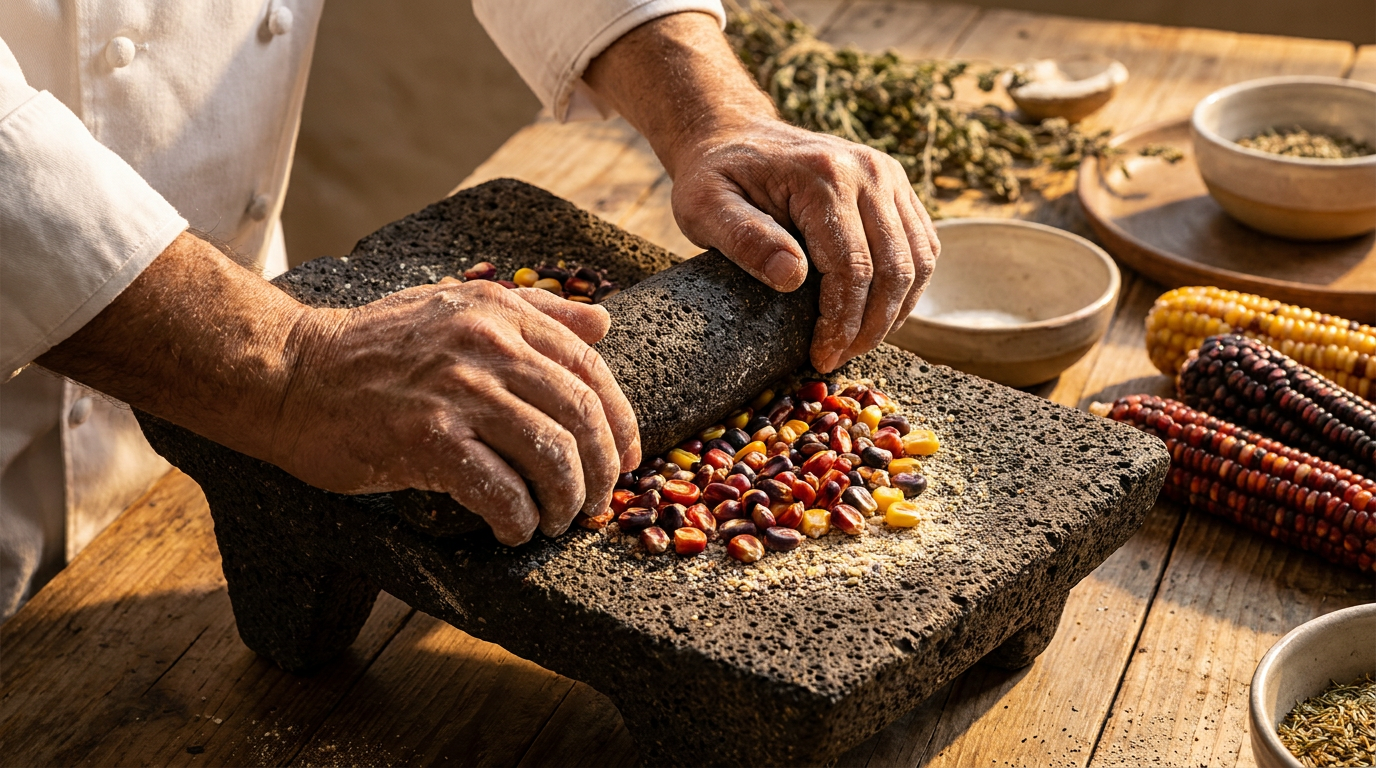
The physical transformation that occurs in this alkaline bath is profound. The high pH environment dissolves hemicellulose, the glue-like component that holds together the corn kernel's tough, fibrous outer hull, known as the pericarp. [5] After steeping for 12 to 14 hours, the corn is washed, and the dissolved skins slip right off, leaving behind a softened kernel. [6][5][6]
But the true magic of nixtamalization happens inside the kernel. The alkaline solution causes the corn's starches to partially gelatinize and breaks down some of the corn oil into natural emulsifying agents. [5] If you grind raw, untreated corn and mix it with water, you get a crumbly mush. Nixtamalization allows the proteins and starches to cross-link, creating a flexible, cohesive dough known as masa. [6][5][6]

This chemical reaction also fundamentally alters the grain's flavor profile. The process imparts a distinct earthy, almost floral aroma that is the unmistakable hallmark of authentic tortillas and tamales. [6] It is the primary reason a proper Mexican corn tortilla tastes entirely different from a slice of American cornbread.[6]
Beyond flavor and texture, nixtamalization is a nutritional miracle that shaped the course of human history. Raw corn is a remarkably poor staple food because its niacin (Vitamin B3) is chemically bound to the grain, rendering it biologically unavailable to humans during digestion. [5][5]
The alkaline bath liberates this bound niacin, along with tryptophan, an essential amino acid that the human body uses to synthesize even more niacin. [5] Furthermore, the use of calcium hydroxide infuses the corn with massive amounts of dietary calcium, a crucial benefit in pre-Hispanic diets that lacked dairy. [6][5][6]
The alkaline bath liberates this bound niacin, along with tryptophan, an essential amino acid that the human body uses to synthesize even more niacin.
The high pH of the steep also acts as a powerful food safety mechanism. The alkaline environment destroys up to 100 percent of aflatoxins—dangerous, cancer-causing mycotoxins produced by molds that commonly contaminate dried grains in warm climates. [5][5]

The vital importance of this process became tragically clear during the era of European colonization. When Spanish explorers brought corn back to Europe and the broader world in the 16th century, they exported the high-yielding seeds but ignored the indigenous science of nixtamalization, viewing it as an unnecessary cultural quirk. [4][4]
The result was a catastrophic public health crisis. Populations in Europe and the American South that adopted untreated corn as a primary staple crop were ravaged by pellagra, a horrific disease caused by severe niacin deficiency. [4][4]
Pellagra is characterized by the "four Ds": dermatitis, diarrhea, dementia, and eventually death. [4] For centuries, millions suffered from the disease, while indigenous populations in Mesoamerica—who consumed massive quantities of corn but always nixtamalized it—remained entirely immune. [4][5][4][5]
Two centuries of human suffering could have been avoided had colonizers respected and recorded the culinary wisdom of the Aztec and Maya civilizations. [4] It wasn't until the early 20th century that modern medicine finally understood the dietary link that indigenous cooks had mastered millennia earlier. [4][4]

In the modern industrial era, the artisanal practice of nixtamalization was largely sidelined by the demand for speed and scale. Mid-century food conglomerates introduced dry-milling and instant masa flours, which utilized chemical shortcuts to mimic the dough's texture while sacrificing its complex flavor, aroma, and optimal nutritional profile. [6][6]
Today's culinary revival is a direct rejection of those industrial shortcuts. Chefs like Emmanuel Chavez at Tatemó and Edgar Rico at Nixta Taqueria are importing heirloom maize directly from smallholder farmers in Mexico, performing the labor-intensive nixtamalization process in-house every single day. [1][2][1][2]
In Washington D.C., the Michelin-starred restaurant MITA utilizes ancestral nixtamalization alongside fermentation to push the boundaries of vegetable-forward Latin American cuisine. [3] For these chefs, the process is an act of cultural reclamation, proving that Mesoamerican techniques belong in the highest echelons of fine dining. [7][3][7]

This movement also serves a vital ecological purpose. By creating a high-value market for specific heritage corn varieties—like Oaxacan red, blue, and green maize—these restaurants provide an economic lifeline to indigenous farmers. [2][7] This financial support helps preserve agricultural biodiversity against the encroaching tide of monoculture farming. [7][2][7]
The implications of nixtamalization continue to expand beyond the restaurant world. Food scientists and agronomists are currently exploring how alkaline processing can be applied to other drought-resistant grains, such as sorghum, to improve nutritional outcomes in developing nations. [5][7][5][7]
From a bubbling pot of slaked lime to a Michelin-starred tasting menu, nixtamalization remains a profound testament to indigenous ingenuity. [7] It is a reminder that sometimes, the most advanced and life-saving culinary science in the world is thousands of years old. [7][7]
How we got here
1500 BCE
Ancient Mesoamerican cultures develop the nixtamalization process, using wood ash or heated limestone to treat maize.
16th Century
European colonizers export corn globally but ignore the alkaline processing technique, leading to widespread nutritional deficiencies.
1914
Dr. Joseph Goldberger begins research proving that the pellagra epidemic in the American South is a dietary deficiency linked to untreated corn.
Mid-20th Century
Industrial food conglomerates introduce instant masa flours, largely replacing the traditional, labor-intensive nixtamalization process.
2020s
A fine-dining renaissance emerges, with Michelin-starred restaurants returning to in-house nixtamalization using heirloom maize.
Viewpoints in depth
Culinary Traditionalists
Chefs and purveyors focused on restoring the authentic flavor and texture of Mesoamerican cuisine.
For modern chefs driving the masa renaissance, nixtamalization is primarily about sensory excellence and cultural respect. They argue that industrial instant-masa flours strip corn of its soul, resulting in flat, one-dimensional flavors. By importing heirloom landraces and performing the labor-intensive alkaline steeping in-house, they unlock the deeply earthy, floral aromas that defined pre-Hispanic diets. This camp views the extra labor not as a burden, but as a necessary homage to indigenous culinary wisdom.
Nutritional Scientists
Researchers focused on the biochemical transformation and public health impacts of alkaline cooking.
From a biochemical perspective, nixtamalization is viewed as one of the most significant food-processing discoveries in human history. Nutritional scientists emphasize the life-saving nature of the alkaline bath, which alters the molecular structure of the grain to make niacin (Vitamin B3) biologically available, preventing the deadly disease pellagra. Furthermore, researchers highlight the process's ability to destroy up to 100% of carcinogenic aflatoxins, pointing to nixtamalization as a highly effective, low-cost food safety intervention for grain-dependent populations globally.
Heirloom Maize Advocates
Agronomists and activists fighting to preserve agricultural biodiversity through market demand.
For agricultural advocates, the nixtamalization revival is a crucial tool for food sovereignty and environmental conservation. They point out that the global reliance on a few high-yield, monoculture corn varieties threatens ecological resilience. By creating a premium restaurant market for diverse, native maize varieties—such as Oaxacan green or blue corn—the nixtamalization trend provides a direct economic incentive for smallholder farmers to continue cultivating ancestral seeds, protecting genetic diversity from being wiped out by industrial agriculture.
What we don't know
- Exactly how ancient Mesoamericans first discovered the chemical benefits of alkaline steeping remains a mystery, though some theorize it began by boiling water with heated limestone rocks.
- It is unclear how quickly industrial food producers might adopt traditional nixtamalization techniques at scale to meet the growing consumer demand for authentic masa.
- Researchers are still studying the full extent to which nixtamalization can be optimized for other drought-resistant global grains like sorghum.
Key terms
- Nixtamalization
- The ancient process of cooking and steeping dried grain in an alkaline solution to improve nutritional value, flavor, and workability.
- Masa
- The pliable dough made from grinding nixtamalized corn, used as the foundation for tortillas and tamales.
- Pericarp
- The tough, fibrous outer hull of a corn kernel that is dissolved and washed away during the alkaline bath.
- Pellagra
- A deadly disease caused by a severe deficiency of niacin (Vitamin B3), historically common in populations that relied on untreated corn.
- Calcium Hydroxide
- Also known as slaked lime or 'cal,' the alkaline powder traditionally mixed with water to create the nixtamalization bath.
- Aflatoxins
- Dangerous, cancer-causing toxins produced by certain molds on agricultural crops, which are destroyed by the high pH of nixtamalization.
Frequently asked
Can I nixtamalize sweet corn from the grocery store?
No. Sweet corn is harvested too young and lacks the necessary starch structure. The process requires dried field corn or specific heirloom maize varieties.
What is the difference between nixtamal and masa?
Nixtamal refers to the whole corn kernels after they have been steeped in the alkaline solution and washed. Masa is the pliable dough created when that nixtamal is ground up.
Why didn't European colonizers use this process?
When Spanish explorers brought corn to Europe, they viewed the indigenous alkaline steeping process as an unnecessary cultural quirk rather than a vital scientific step, leaving the recipe behind.
Is hominy the same thing as nixtamalized corn?
Yes. Hominy is simply whole dried corn kernels that have undergone the nixtamalization process, often used whole in stews like pozole rather than being ground into dough.
Sources
Source coverage
7 outlets
3 viewpoints surfaced







[1]Fine Dining LoversCulinary Traditionalists
Emmanuel Chavez and the Michelin-Starred Masa of Tatemó
Read on Fine Dining Lovers →[2]NM GastronomeCulinary Traditionalists
Nixta Taqueria – Austin, Texas
Read on NM Gastronome →[3]James Beard FoundationCulinary Traditionalists
MITA: Redefining Latin American Cuisine
Read on James Beard Foundation →[4]Southern Foodways AllianceNutritional Scientists
The Pellagra Epidemic and the Lost Recipe of Corn
Read on Southern Foodways Alliance →[5]WikipediaNutritional Scientists
Nixtamalization
Read on Wikipedia →[6]MasiendaHeirloom Maize Advocates
The ABCs of Nixtamal
Read on Masienda →[7]Factlen Editorial TeamHeirloom Maize Advocates
Synthesis by Factlen editorial team
Read on Factlen Editorial Team →
Every angle. Every day.
Get food drink stories with full source coverage and perspective breakdowns delivered to your inbox.