
The 2026 Guide to EV Road Tripping: Range, Routing, and the NACS Revolution
With over 288,000 public charging ports now active in the U.S. and a unified charging standard taking hold, electric vehicle road trips have shifted from a logistical puzzle to a predictable, stress-free way to travel.
By Factlen Editorial Team
- EV Adopters & Enthusiasts
- View the current charging landscape as highly capable, emphasizing that proper app usage and route planning eliminate range anxiety.
- Infrastructure Providers
- Focus on the rapid expansion of the charging network, the shift toward NACS standardization, and the push for higher reliability.
- Automotive Industry
- Prioritize seamless integration, moving toward native NACS ports and built-in software to simplify the user experience for mass-market consumers.
What's not represented
- · Rural Business Owners
- · Gas Station Operators Transitioning to EV
Why this matters
As automakers adopt a universal charging plug and public infrastructure rapidly expands, millions of drivers are taking their first long-distance electric journeys. Understanding the mechanics of route planning and battery curves can save hours of travel time and eliminate range anxiety entirely.
Key points
- The U.S. public charging network has grown to over 288,000 ports, making EV road trips highly accessible.
- The industry-wide adoption of the NACS plug allows most non-Tesla EVs to access the vast Supercharger network.
- Drivers should use a combination of ABRP for routing, PlugShare for verifying charger status, and built-in navigation for battery pre-conditioning.
- Charging from 20% to 80% is significantly faster than waiting for a full 100% charge at public fast chargers.
- Booking hotels or rentals with Level 2 destination chargers allows drivers to wake up with a full battery every morning.
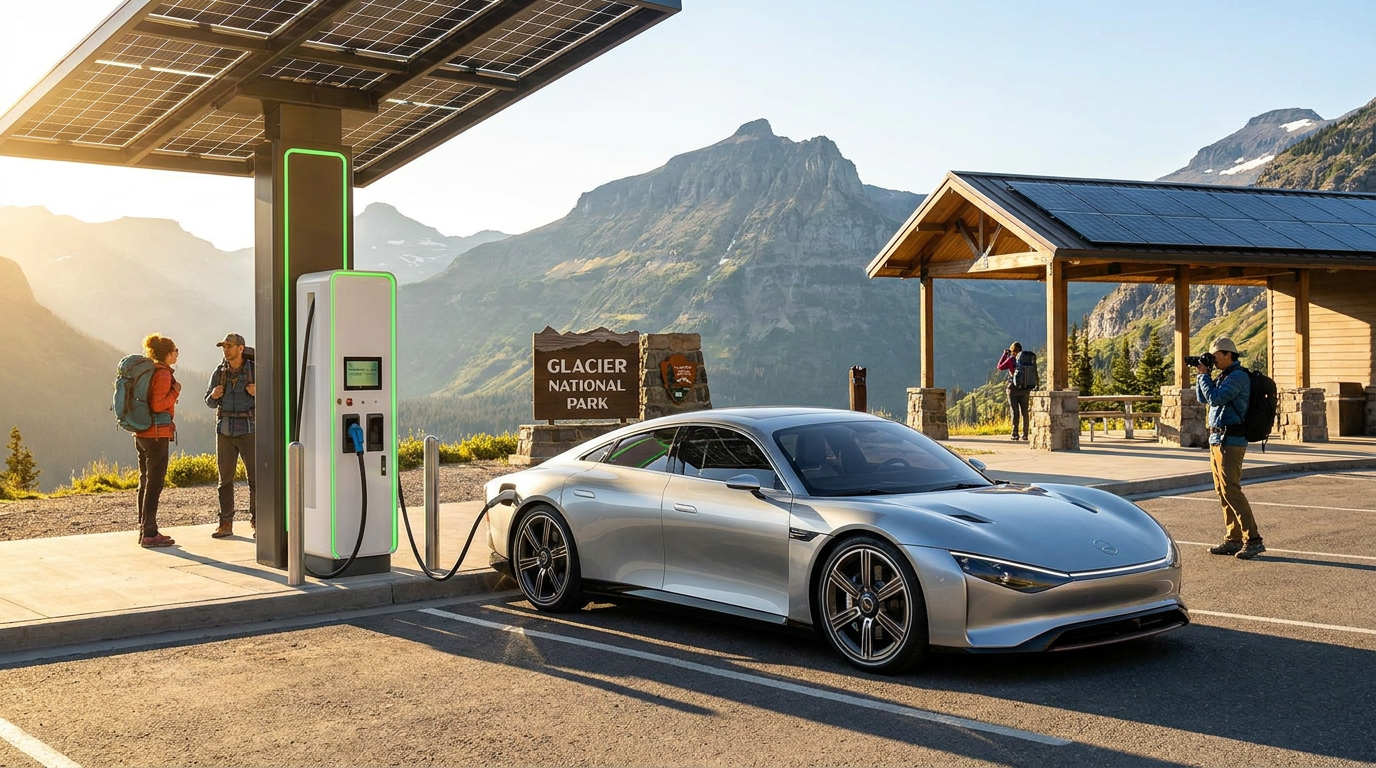
For years, the great American road trip in an electric vehicle was viewed as an extreme sport. Early adopters mapped out their routes with the precision of a military operation, praying that the single charging station in a rural town would be operational when they arrived. But by the summer of 2026, the landscape has fundamentally shifted. The U.S. public charging network has swelled to more than 288,000 ports, reaching into retail centers, rural highways, and even remote National Parks.[1][8]
Coupled with modern EVs that routinely offer 250 to 350 miles of range per charge, the math of long-distance travel has changed. A 500-mile journey now typically requires just one or two stops—comparable to the rhythm of driving a gasoline-powered car. Yet, while the physical infrastructure is finally in place, the psychology of the EV road trip still requires a slight adjustment. Success no longer depends on finding a charger, but rather on understanding how to use the network efficiently.[1][8]

The most significant catalyst for this new era of frictionless travel is the widespread adoption of the North American Charging Standard (NACS). Originally developed by Tesla as a proprietary connector for its Supercharger network, the design was opened to the industry and formalized as SAE J3400. In a rare moment of industry consensus, nearly every major automaker—from Ford and General Motors to Hyundai and Rivian—agreed to abandon the older Combined Charging System (CCS) in favor of NACS.[2][5][6]
For drivers hitting the road in 2026, this standardization is a game-changer. It effectively unlocks tens of thousands of highly reliable Tesla Superchargers for non-Tesla owners. Many newer models, such as the 2026 Cadillac Optiq and upcoming 2027 Chevrolet Blazer EV, are rolling off assembly lines with native NACS ports built directly into the vehicle. For the millions of EVs already on the road with older CCS ports, automakers have distributed approved adapters that seamlessly bridge the gap.[2][6]
This hardware convergence means drivers can finally stop worrying about whether a plug will fit their car and start focusing on the journey itself. However, navigating an EV road trip still requires a different toolkit than a traditional gas-powered drive. Industry experts and veteran drivers universally recommend a "three-app strategy" to ensure a predictable, stress-free experience, transforming range anxiety into quiet confidence.[3][8]
The first pillar of this strategy is A Better Route Planner (ABRP), a highly sophisticated application built specifically for electric travel. Unlike standard mapping software, ABRP allows users to input their exact vehicle model, starting battery percentage, and destination. The software then calculates the optimal route, factoring in elevation changes, weather, and the specific charging speeds of stations along the way. It tells the driver exactly where to stop and precisely how many minutes to spend plugged in.[3][4]

The second pillar is PlugShare, a crowdsourced platform that functions much like Waze for EV chargers. While ABRP builds the macro itinerary, PlugShare provides ground-truth verification. Before departing, savvy drivers check recent user check-ins at their planned stops to ensure the chargers are online, delivering full power, and not blocked by construction. This peer-to-peer intelligence is crucial for avoiding the frustration of arriving at a broken station.[3][4][7]
The second pillar is PlugShare, a crowdsourced platform that functions much like Waze for EV chargers.
The final pillar is the vehicle's built-in navigation system. Once the route is planned and verified, entering the next charging stop into the car's native GPS serves a vital mechanical purpose: battery pre-conditioning. When an EV knows it is approaching a DC fast charger, it automatically heats or cools the battery pack to the optimal temperature. This thermal management ensures the vehicle can accept electricity at the maximum possible rate the moment it is plugged in, shaving precious minutes off the stop.[3][4]
Understanding how fast that electricity flows is the next major learning curve for new EV road-trippers. Unlike a gas tank, which fills at a constant rate until it clicks off, an EV battery charges on a curve. The process is often compared to pouring water into a glass: you can pour very quickly when the glass is empty, but you must slow down to a trickle as it nears the brim to avoid spilling.[4]
In practical terms, this means an EV can often charge from 10% to 80% in roughly 20 to 30 minutes at a high-speed DC fast charger. However, pushing that battery from 80% to 100% can take just as long, if not longer, as the vehicle's software deliberately throttles the energy flow to protect the battery cells from overheating and degradation. Therefore, waiting for a 100% charge at a public fast charger is widely considered a rookie mistake.[4][7]

The most efficient way to cross the country is to "hop" between chargers, arriving with a low battery (around 10% to 20%), charging rapidly to 80%, and getting back on the highway. Two 20-minute stops are almost always faster than one 60-minute stop. This rhythm naturally aligns with human needs—providing just enough time to use the restroom, grab a coffee, or stretch your legs before the car is ready to go.[4][7]
Drivers must also account for environmental variables that gas cars largely ignore. Climbing steep mountain passes consumes significantly more energy than cruising on flat terrain, while freezing temperatures can temporarily reduce a battery's efficiency. Conversely, descending a mountain actually adds range back to the vehicle through regenerative braking. Factoring in a 20% battery buffer when planning routes through extreme weather or rugged terrain provides a comfortable safety net.[4][7]
While DC fast chargers are the workhorses of the highway, Level 2 "destination chargers" are the secret weapon of the EV road trip. Found at hotels, Airbnbs, and campgrounds, these slower chargers take several hours to fill a battery. By booking accommodations with Level 2 access, drivers can plug in overnight and wake up to a 100% charge every morning. This not only saves valuable daytime hours but is often provided for free by the host.[4][8]

Cost remains a dynamic factor. Public DC fast charging typically averages around $0.53 per kilowatt-hour—noticeably more expensive than charging at home, though generally still cheaper than gasoline for an equivalent journey. By mixing in free or low-cost Level 2 charging at hotels and municipal lots, drivers can significantly reduce the overall financial footprint of their vacation.[1]
As the industry looks ahead, the focus is shifting from merely planting more plugs in the ground to refining the user experience. Networks are prioritizing uptime, deploying advanced monitoring systems to detect outages automatically, and building pull-through stalls to accommodate EVs towing trailers. With the hardware standardized and the software perfected, the electric road trip has finally shed its experimental status, offering a quiet, clean, and highly capable way to explore the open road.[2][5][8]
How we got here
Late 2022
Tesla opens its proprietary charging connector design to the public, renaming it the North American Charging Standard (NACS).
Mid 2023
Major automakers, including Ford and General Motors, announce they will abandon CCS and adopt the NACS standard.
Early 2024
Automakers begin distributing NACS-to-CCS adapters to existing EV owners, unlocking the Supercharger network.
June 2024
The NACS design is officially formalized by SAE International as the SAE J3400 standard.
2025–2026
New EV models from various manufacturers begin rolling off assembly lines with native NACS ports built directly into the vehicles.
Viewpoints in depth
EV Adopters & Enthusiasts
View the current charging landscape as highly capable, emphasizing that proper app usage and route planning eliminate range anxiety.
For veteran electric vehicle drivers, the narrative that EVs are unsuitable for long road trips is an outdated myth from a decade ago. This camp emphasizes that modern vehicles with 300 miles of range, combined with a dense network of fast chargers, have fundamentally solved the hardware problem. They argue that any lingering 'range anxiety' is actually just a lack of education about how to use the available software tools. By leaning heavily on routing apps like A Better Route Planner and verifying charger status on PlugShare, enthusiasts maintain that an EV road trip is not only possible but often more relaxing than driving a gas car, as the required charging stops naturally enforce healthy driving breaks.
Infrastructure Providers
Focus on the rapid expansion of the charging network, the shift toward NACS standardization, and the push for higher reliability.
Charging network operators and infrastructure developers view 2026 as a turning point from rapid, chaotic expansion to standardized reliability. For years, the industry struggled with fragmented plug standards and software handshakes that led to broken chargers and frustrated drivers. Providers argue that the industry-wide alignment on the NACS (SAE J3400) standard is the crucial mechanism that will lower deployment costs and improve uptime. Their current focus is on building larger, multi-stall hubs with pull-through access for towing, and integrating real-time telemetry so that a broken charger is automatically flagged and repaired before a driver ever encounters it.
Automotive Industry
Prioritize seamless integration, moving toward native NACS ports and built-in software to simplify the user experience for mass-market consumers.
Automakers recognize that while early adopters were willing to juggle three different smartphone apps and heavy adapters to make a road trip work, the mass market will not tolerate that friction. The automotive industry's perspective is centered on invisible integration. By building native NACS ports into 2026 and 2027 models, and baking advanced route planning and battery pre-conditioning directly into the car's dashboard software, manufacturers aim to make the EV road trip indistinguishable from a traditional drive. Their goal is a 'plug and charge' reality where the driver simply enters a destination, and the car handles all the complex math, routing, and payment automatically.
What we don't know
- How quickly older, less reliable CCS charging stations will be retrofitted or replaced with native NACS hardware by third-party networks.
- Whether the surge in EV adoption will lead to significant queuing and wait times at popular charging hubs during peak holiday travel weekends in 2026.
Key terms
- NACS (North American Charging Standard)
- The charging connector originally developed by Tesla, now adopted as the industry standard (SAE J3400) by nearly all major automakers in North America.
- CCS (Combined Charging System)
- The older, bulkier fast-charging standard used by most non-Tesla EVs prior to the industry-wide shift to NACS.
- DC Fast Charging (Level 3)
- High-voltage public chargers capable of adding hundreds of miles of range in 20 to 30 minutes, primarily used for highway road trips.
- Level 2 Charging
- Slower charging typically found at homes, hotels, and workplaces, which takes several hours to fully recharge a battery overnight.
- Battery Pre-conditioning
- A software feature that automatically heats or cools the EV's battery to the optimal temperature as it approaches a fast charger, ensuring the fastest possible charging speed.
- Charging Curve
- The rate at which an EV battery accepts electricity, which is very fast when the battery is low but slows down significantly as it approaches 100%.
Frequently asked
Do I need an adapter to use Tesla Superchargers?
If you drive a non-Tesla EV built before 2025 with a CCS port, you will likely need an automaker-approved NACS adapter. Many 2026 models are now being built with native NACS ports that plug in directly.
Why shouldn't I charge my EV to 100% on a road trip?
EV batteries charge on a curve to protect the cells. The vehicle accepts energy very quickly up to 80%, but severely throttles the speed for the final 20%, making it faster to simply drive to the next station.
How much does it cost to charge an EV on a road trip?
Public DC fast charging averages around $0.53 per kWh, which is generally cheaper than gas but more expensive than home charging. Utilizing free Level 2 chargers at hotels can lower the overall cost.
How does cold weather affect an EV road trip?
Freezing temperatures can reduce battery efficiency and range. Drivers should plan for more frequent stops, use seat heaters instead of cabin air heating, and rely on built-in navigation to pre-condition the battery before charging.
Sources
Source coverage
8 outlets
3 viewpoints surfaced








[1]EV ConnectInfrastructure Providers
Planning a Road Trip? Here's What You Need to Know About Charging on the Go
Read on EV Connect →[2]GreenCarsInfrastructure Providers
The Charging Plug Conversation Finally Gets Practical
Read on GreenCars →[3]HealVannaEV Adopters & Enthusiasts
The best EV route planning apps for 2026
Read on HealVanna →[4]Plug In AmericaEV Adopters & Enthusiasts
The Ultimate Guide to EV Road Trip Planning
Read on Plug In America →[5]Charging USAInfrastructure Providers
One Plug to Rule Them All? Charging Networks Align on NACS
Read on Charging USA →[6]AutoblogAutomotive Industry
GM's new Blazer EV will adopt Tesla's NACS ports
Read on Autoblog →[7]DriveSparkEV Adopters & Enthusiasts
Practical EV Travel Strategies for Easy Charging
Read on DriveSpark →[8]Factlen Editorial TeamAutomotive Industry
Synthesis by Factlen editorial team
Read on Factlen Editorial Team →


Every angle. Every day.
Get travel stories with full source coverage and perspective breakdowns delivered to your inbox.