
The Resurgence of 'Third Places': How Communities Are Curing the Loneliness Epidemic
As the health impacts of digital isolation become undeniable, a grassroots movement is rebuilding the physical spaces where casual community thrives.
By Factlen Editorial Team
- Public Health Officials
- Focus on the biological and mental health impacts of isolation.
- Urban Sociologists
- Focus on the structural decline of accessible, non-commercial spaces.
- Community Builders
- Focus on grassroots solutions and the creation of new gathering rituals.
- Cultural Analysts
- Focus on the shift from digital consumption back to in-person authenticity.
What's not represented
- · Commercial Real Estate Developers
- · City Zoning Planners
- · Digital Platform Architects
Why this matters
As the loneliness epidemic drives measurable declines in public health and civic engagement, the revival of 'third places' offers a tangible, grassroots solution. Understanding how to find and build these spaces empowers individuals to improve their own longevity while repairing the social fabric of their neighborhoods.
Key points
- The U.S. faces a loneliness epidemic with health risks comparable to smoking 15 cigarettes a day.
- Sociologists attribute this isolation to the decline of 'third places'—neutral gathering spots outside of home and work.
- Urban sprawl, remote work, and the commercialization of public spaces have eroded traditional community infrastructure.
- A grassroots movement is actively rebuilding these spaces through run clubs, reading parties, and community workshops.
- Third places serve as crucial training grounds for civic engagement and pluralism.
In an era defined by frictionless digital connectivity, a profound paradox has emerged: humanity has never been more accessible, yet individuals have rarely felt more isolated. Public health officials and sociologists are increasingly sounding the alarm on a pervasive "loneliness epidemic" that cuts across demographics, geographies, and income brackets.[1][8]
The consequences of this isolation extend far beyond emotional distress; they represent a severe biological threat. A major meta-analysis published in PLOS Medicine revealed that the health risks associated with chronic loneliness are comparable to smoking 15 cigarettes a day. Furthermore, older adults who maintain strong social integration exhibit a 54 percent lower risk of developing hypertension, alongside reduced inflammation and better overall cardiovascular control.[1][2]
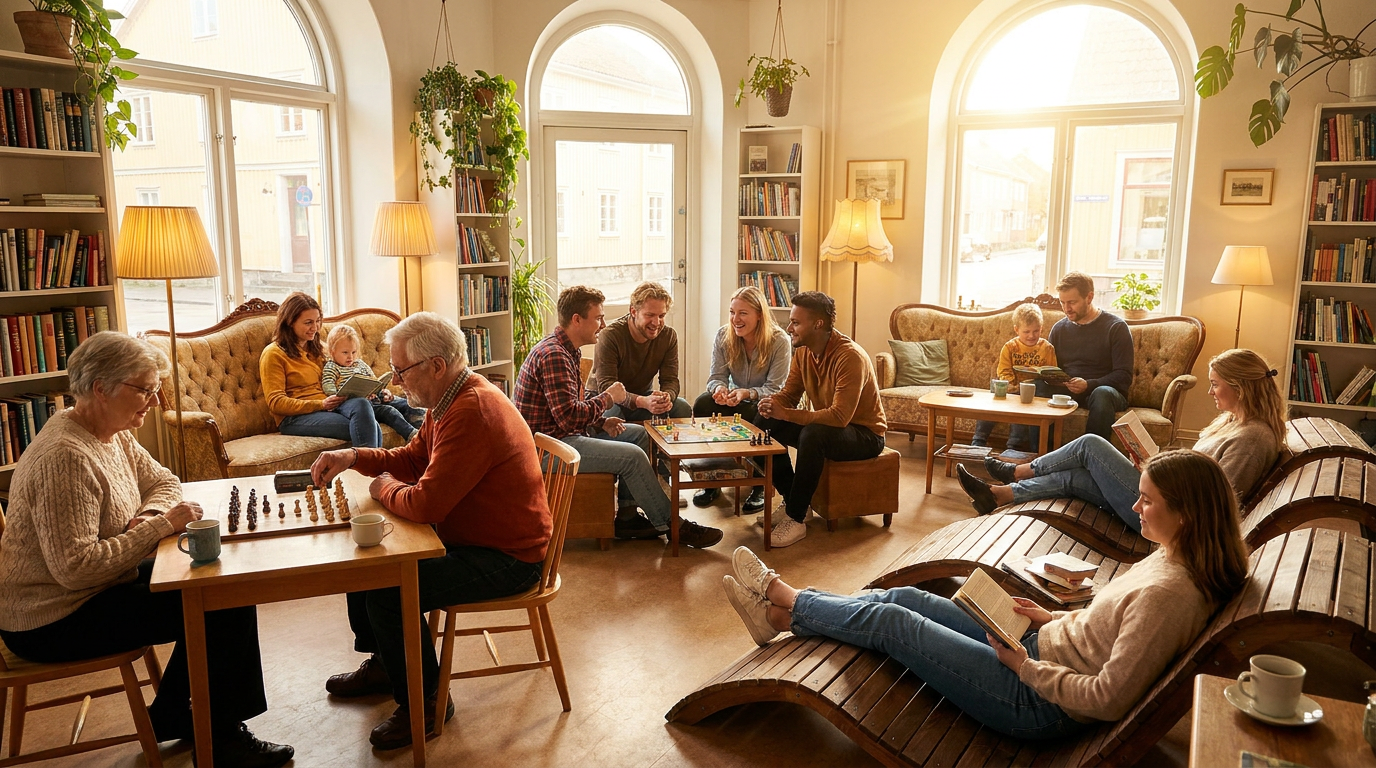
To understand how society arrived at this point of fragmentation, urban sociologists point to the systematic dismantling of the "third place." Coined in 1989 by American sociologist Ray Oldenburg in his book The Great Good Place, the term describes the informal public gathering spaces that exist outside of the home (the "first place") and the workplace (the "second place").[3][4]

Third places are the anchors of community life. They are defined by a specific set of characteristics: they operate on neutral ground where people are free to come and go, they act as a social leveler where a person's professional or economic status does not matter, and their primary activity is simply conversation. Historically, these spaces took the form of the ancient Greek agora, the European coffeehouse, the local pub, or the neighborhood barbershop.[4][8]
Over the past several decades, however, the infrastructure that supported these casual interactions has steadily eroded. Urban sprawl, car-centric city planning, and the rising cost of commercial real estate have made it increasingly difficult for low-margin, community-focused businesses to survive.[6][8]
The spaces that replaced them operate on a fundamentally different economic model. Modern coffee shops are frequently optimized for rapid turnover and mobile orders rather than lingering conversations. Co-working spaces require expensive memberships, and social media platforms harvest user attention for profit while systematically preventing the kind of serendipitous, cross-class interactions that define true community.[8]
The shift to remote work further accelerated this decline. For millions of professionals, the second place (the office) dissolved into the first place (the home), entirely removing the daily commute and the casual "water cooler" interactions that once provided a baseline of social contact.[4][8]

The COVID-19 pandemic acted as a breaking point, shuttering community centers, libraries, and recreational leagues. According to the American Psychiatric Association, a quarter of U.S. residents reported feeling lonelier in 2024 than they did before the lockdowns, and a recent American Social Capital Survey found that half of Americans seldom or never visited a public park in the past year.[3][6]
The COVID-19 pandemic acted as a breaking point, shuttering community centers, libraries, and recreational leagues.
Yet, in response to this structural deficit, a quiet but powerful resurgence is underway. Driven largely by Generation Z and Millennials who are experiencing digital fatigue, people are actively logging off and pioneering new forms of in-person connection.[7]
This grassroots movement is replacing the passive consumerism of traditional venues with active, participatory communities. Urban centers are seeing a massive proliferation of run clubs, street-skating groups, and silent reading parties. These gatherings require no financial buy-in; their only currency is consistent attendance.[5][7]
The defining feature of these new third places is the ritual of repetition. Sociologists note that adult friendships rarely form from a single, high-stakes meeting; they grow out of "weak ties" forged by seeing the same faces repeatedly in a low-pressure environment. The modern formula for community building has become remarkably simple: same time, same spot, open door.[8]

Specialized spaces are also emerging to address specific demographic crises. The "male loneliness epidemic," driven by the decline of fraternal organizations and collective labor, is being countered by initiatives like "Men's Sheds." These community workshops allow men to gather and work on practical projects together, providing a "shoulder-to-shoulder" environment that bypasses the awkwardness of traditional face-to-face support groups.[2]
Traditional civic institutions are also adapting to meet this renewed demand. Public libraries, long considered the quintessential non-commercial third place, are evolving beyond quiet study areas. Many are transforming their spaces to host maker laboratories, repair cafés, and community discussion groups, actively encouraging the informal interactions that Oldenburg championed.[3][6]
Similarly, historic athletic organizations and reading rooms are experiencing a renaissance. Spaces like San Francisco's South End Rowing Club or Brooklyn's Free Black Women's Library serve as vital hubs where diverse groups of people can gather, share resources, and build collective identity outside the pressures of the corporate world.[5]
The importance of these spaces extends beyond individual mental health; they are fundamental to the functioning of a healthy democracy. Third places serve as a low-stakes training ground for citizenship.[4][6]

In a shared physical environment, people are forced to coexist with neighbors who possess different incomes, ages, and political views. They learn to navigate minor disagreements, share resources, and view others as complex human beings rather than flattened online avatars or voting statistics.[6][8]
For those who cannot access physical third places due to geographic isolation, disability, or immunocompromised status, digital alternatives have become a vital lifeline. Online gaming environments, dedicated Discord servers, and niche forums can replicate the "regulars" dynamic of a local café, offering genuine connection and a sense of belonging.[8]
Ultimately, the resurgence of the third place highlights a profound cultural shift. Society is recognizing that community is not a passive resource that exists by default; it is an infrastructure that must be intentionally built, protected, and maintained. Reversing the loneliness epidemic will require more than individual effort—it demands the collective reclamation of the spaces where life happens between home and work.[8]
How we got here
1989
Sociologist Ray Oldenburg coins the term 'third place' in his book The Great Good Place, identifying the crucial role of informal public gathering spots.
2010s
The rise of the digital economy and remote work begins to blur the lines between home and work, while commercial spaces increasingly optimize for rapid turnover.
2020–2021
Global pandemic lockdowns force the closure of physical social infrastructure, severely exacerbating feelings of isolation and accelerating the loneliness epidemic.
2023
The U.S. Surgeon General officially declares loneliness a public health epidemic, calling for the restoration of community spaces.
2025–2026
A grassroots resurgence takes hold as Gen Z and Millennials actively log off, forming run clubs, reading parties, and new communal rituals to rebuild in-person connection.
Viewpoints in depth
Public Health Advocates
Viewing third places primarily as a medical necessity to combat the biological impacts of isolation.
From a public health perspective, the loneliness epidemic is treated with the same urgency as obesity or substance abuse. Medical anthropologists and health officials emphasize that social isolation triggers measurable biological responses, including elevated cortisol levels, increased inflammation, and a higher risk of cardiovascular disease. For this camp, funding and protecting accessible community spaces is not just a matter of civic enrichment, but a critical preventative healthcare strategy.
Urban Sociologists
Focusing on the structural and architectural design of cities that either foster or fracture community.
Sociologists and urban planners argue that the decline of community is a direct result of the built environment. They point to zoning laws that separate residential areas from commercial hubs, the prioritization of car traffic over pedestrian walkways, and the privatization of public space. This perspective advocates for 'multimodality' and mixed-use zoning, arguing that true third places cannot thrive unless neighborhoods are physically designed to encourage spontaneous, walkable interactions.
Grassroots Community Builders
Emphasizing individual agency and the creation of new, non-traditional gathering rituals.
Rather than waiting for urban infrastructure to change or commercial spaces to become affordable, this camp focuses on immediate, low-cost solutions. Organizers of run clubs, silent reading parties, and pop-up supper clubs argue that a third place doesn't require a permanent building or a business model. Instead, they believe community is generated through the simple, reliable ritual of showing up at the same time and place, proving that social infrastructure can be built entirely through human commitment.
What we don't know
- Whether city planners will adapt zoning laws quickly enough to support the creation of new, affordable community spaces.
- How the long-term shift toward remote work will permanently alter the geographic distribution of third places.
- If digital third places can fully replicate the biological and psychological benefits of in-person interaction over a lifetime.
Key terms
- Third Place
- A sociological term for a social environment separate from the home (first place) and the workplace (second place) where informal community gathering occurs.
- Social Infrastructure
- The physical spaces and organizations—such as libraries, parks, and community centers—that shape the way people interact and build relationships.
- Weak Ties
- Casual acquaintances or familiar strangers in one's social network, which sociologists identify as crucial for a sense of belonging and community.
- Multimodality
- In urban planning, the ability of a single space to serve multiple functions, such as a coffee shop that also hosts open mic nights or community meetings.
- Men's Sheds
- Community-based workshops where men gather to work on practical projects together, designed to foster social connection in a low-pressure environment.
Frequently asked
What makes a location a true third place?
A true third place operates on neutral ground where people can come and go freely. It acts as a social leveler where status doesn't matter, and its primary activity is casual conversation rather than productivity or consumption.
Can a digital space count as a third place?
Yes. For individuals who face geographic isolation, mobility issues, or health constraints, online communities like Discord servers or multiplayer games can provide the same sense of regular, low-stakes connection.
Why are traditional third places disappearing?
Factors include car-centric urban sprawl, the rising cost of commercial real estate that forces businesses to prioritize rapid turnover, and the shift toward remote work and digital entertainment.
How does loneliness affect physical health?
Chronic loneliness triggers biological stress responses. Research shows it carries health risks comparable to smoking 15 cigarettes a day, increasing the likelihood of hypertension, inflammation, and premature mortality.
Sources
Source coverage
8 outlets
4 viewpoints surfaced








[1]Exploring HealthPublic Health Officials
The Rise of the Loneliness Crisis
Read on Exploring Health →[2]Sociology.orgUrban Sociologists
Male Loneliness Epidemic: Causes, Consequences, and Solutions
Read on Sociology.org →[3]Boston UniversityPublic Health Officials
Why Third Places Are a Radical Solution to Contemporary Issues
Read on Boston University →[4]WikipediaUrban Sociologists
Third place
Read on Wikipedia →[5]Smithsonian MagazineCommunity Builders
How Third Places Build Community
Read on Smithsonian Magazine →[6]Washington MonthlyUrban Sociologists
Reinvigorating Third Places in Our Communities
Read on Washington Monthly →[7]Seen & UnseenCommunity Builders
Gen Z and the Rebirth of Third Places
Read on Seen & Unseen →[8]Factlen Editorial TeamCultural Analysts
Synthesis by Factlen editorial team
Read on Factlen Editorial Team →
Every angle. Every day.
Get lifestyle stories with full source coverage and perspective breakdowns delivered to your inbox.