
SpaceX Completes Record $75 Billion IPO, Pushing Valuation Past $2 Trillion
SpaceX made a historic debut on the Nasdaq, raising $75 billion in the largest initial public offering ever recorded and crowning CEO Elon Musk as the world's first trillionaire.
By Factlen Editorial Team
- Growth Optimists
- Investors focused on SpaceX's monopoly in satellite internet and its massive addressable market.
- Space Industrialists
- Advocates viewing the IPO as the necessary funding mechanism for interplanetary expansion and space infrastructure.
- Valuation Skeptics
- Analysts cautioning against the company's lack of profitability and unprecedented revenue multiples.
What's not represented
- · Traditional Telecommunications Competitors
- · Environmental Groups Monitoring Launch Impacts
- · NASA and Government Regulators
Why this matters
By transitioning from a closely guarded private entity to a publicly traded behemoth, SpaceX has opened the booming space economy to everyday retail investors. The sheer scale of the offering will force major index funds to buy in, meaning millions of Americans will soon hold a stake in the company's Mars ambitions through their standard retirement accounts.
Key points
- SpaceX raised a record-breaking $75 billion in its Nasdaq debut, surpassing Saudi Aramco for the largest IPO in history.
- Shares surged 19 percent on the first day of trading, pushing the company's total valuation to $2.1 trillion.
- The massive valuation officially made CEO Elon Musk the world's first trillionaire, with a net worth of $1.1 trillion.
- More than 4,400 current and former SpaceX employees became millionaires overnight due to the stock's performance.
- The company bypassed traditional IPO pricing models, offering a fixed $135 share price and allocating 30 percent to retail investors.
- Despite $18.7 billion in 2025 revenue, SpaceX remains unprofitable, posting a $4.28 billion net loss in Q1 2026.
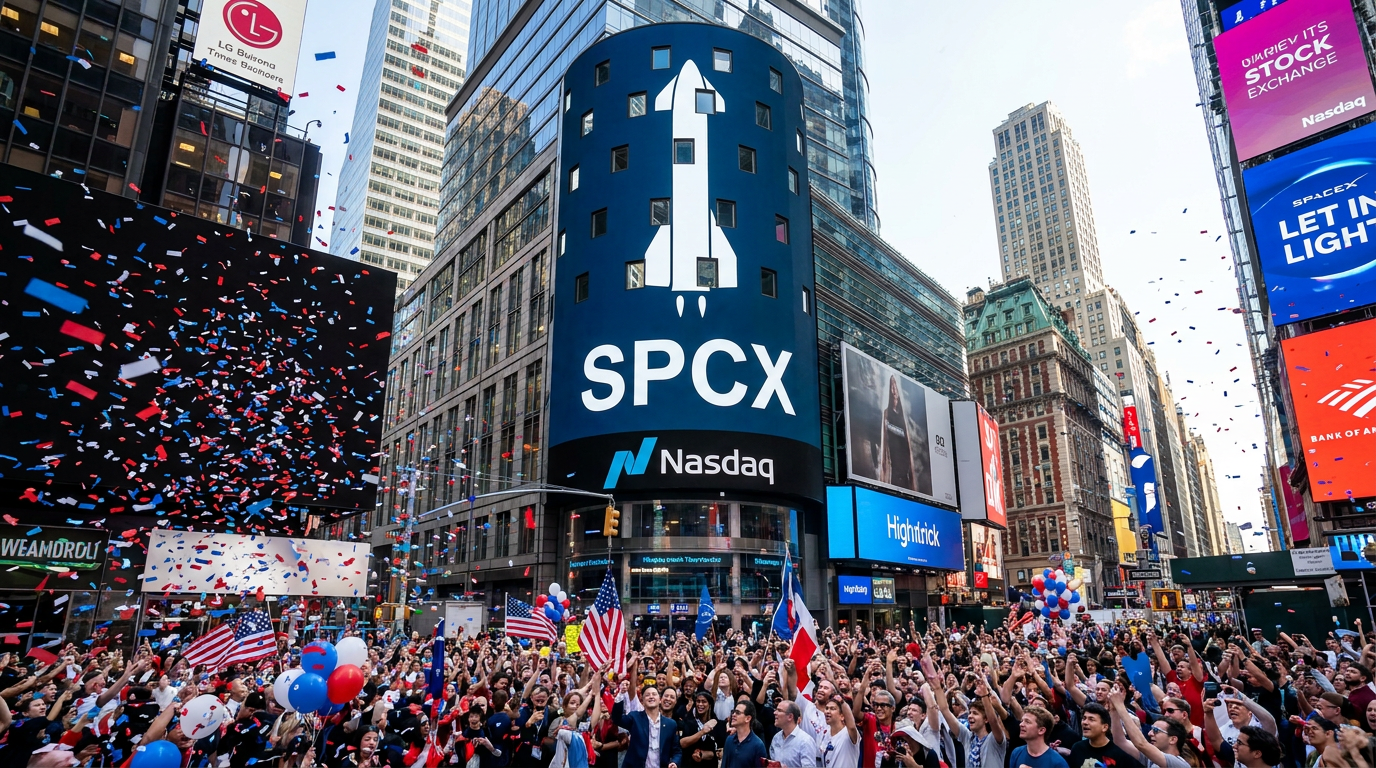
Space Exploration Technologies Corp. made history on Friday, executing the largest initial public offering in the history of global financial markets. Trading under the ticker symbol SPCX on the Nasdaq, the aerospace giant successfully raised $75 billion, blowing past the most optimistic Wall Street projections. To contextualize the magnitude of the offering, the capital raise dwarfs the previous global record held by Saudi Aramco, which raised $29.4 billion in 2019, and Alibaba's $25 billion debut in 2014. The debut fundamentally reshapes the public equity landscape, instantly positioning the rocket manufacturer and satellite internet provider as one of the most valuable corporations on Earth. The sheer scale of the capital raise underscores a massive shift in investor appetite toward deep-tech and space infrastructure, moving beyond traditional software and consumer electronics.[2][3][5]
The stock's price action on its first day of trading reflected intense, pent-up demand from both institutional and retail buyers. SpaceX priced its shares at a fixed $135 late Thursday, but the stock opened at $150 shortly before noon on Friday. Throughout the afternoon, shares surged as high as $176.52 before settling at a closing price of $160.95. That 19 percent first-day pop delivered immediate gains to early buyers and signaled that the broader market was more than willing to absorb the massive influx of new equity. By the time the closing bell rang, SpaceX boasted a market capitalization of roughly $2.1 trillion. This staggering valuation makes it the seventh-largest company in the world, leapfrogging established titans like Broadcom and Tesla, and placing it in the elite tier of mega-cap technology stocks.[3][4]
The record-shattering valuation has profoundly altered the global wealth rankings, officially crowning CEO Elon Musk as the world's first trillionaire. According to the company's S-1 filing, Musk retained a 42 percent equity stake in SpaceX and an overwhelming 85 percent of the voting power, ensuring his continued absolute control over the company's strategic direction. With the stock's Friday surge, Musk's personal fortune is now estimated at $1.1 trillion. In an address to employees at the company's Starbase headquarters in Texas, Musk reiterated his long-term vision, stating that the capital will be used to make humanity multiplanetary and ultimately establish a self-sustaining colony on Mars.[2][3]

The financial windfall extends far beyond the chief executive, triggering a historic wealth-creation event for the company's workforce. More than 4,400 current and former SpaceX employees became millionaires overnight, with approximately 400 early engineers and executives securing stakes worth $100 million or more. The sudden injection of liquidity is already sending shockwaves through local economies where the company operates. In South Texas, near the Starbase launch facility, real estate analysts note that SpaceX employees now possess enough paper wealth to theoretically purchase every single residential home in their local municipality, setting the stage for a massive localized economic boom.[2][7]
Behind the scenes, the mechanics of the IPO were as unconventional as the company's reusable rockets. SpaceX entirely bypassed the traditional Wall Street bookbuilding process—a standard procedure where underwriters gauge institutional demand to establish a price range over several weeks. Instead, the company handed the market a fixed, take-it-or-leave-it price of $135 per share. Furthermore, retail investors were earmarked for a highly unusual 30 percent of the total float, roughly three times the standard allocation for a mega-cap offering. This populist approach to the allocation allowed everyday traders to participate heavily in the debut, driving the massive oversubscription that saw demand exceed $250 billion.[6]
Behind the scenes, the mechanics of the IPO were as unconventional as the company's reusable rockets.
The public release of SpaceX's financial documents provided Wall Street with its first transparent look at the economics of the modern space race. The company reported $18.7 billion in total revenue for 2025, representing a 33 percent year-over-year increase. The undisputed engine of this growth is Starlink, the company's satellite internet constellation, which accounted for $11.4 billion—or 61 percent—of total sales. With over 4,000 operational satellites in low-Earth orbit, Starlink has transitioned from a capital-intensive research project into a highly lucrative recurring revenue stream, providing the financial bedrock necessary to fund the company's more speculative deep-space ambitions.[5][6]

Despite the impressive top-line growth, valuation skeptics are quick to point out a glaring reality: SpaceX remains deeply unprofitable. The company posted a $4.28 billion net loss in the first quarter of 2026 alone, bringing its accumulated deficit to over $41 billion. These losses are primarily driven by massive capital expenditures related to the depreciation of the Starlink constellation and heavy investments in artificial intelligence infrastructure. At its current $2.1 trillion valuation, SpaceX is trading at roughly 94 times its 2025 revenue—a multiple that has virtually no precedent among the world's most valuable companies, especially when compared to highly profitable peers like Apple and Alphabet.[4][6]
Investors, however, appear more than willing to overlook the near-term losses in favor of the company's sprawling total addressable market and its deep ties to the artificial intelligence boom. The recent integration of Musk's AI startup, xAI, into the broader SpaceX ecosystem has fundamentally altered how Wall Street values the firm. Rather than viewing it solely as an aerospace manufacturer, institutional buyers are pricing in the potential for SpaceX to operate solar-powered AI data centers in orbit. By moving compute infrastructure into space, the company aims to bypass the severe terrestrial energy constraints currently bottlenecking the global AI industry.[2][4]
The $75 billion war chest secured through the IPO will directly fund the company's most ambitious and capital-intensive projects. Chief among these is the continued development of the Starship spacecraft, the fully reusable super-heavy lift launch vehicle designed to carry massive payloads and human crews into deep space. Starship is the linchpin of Musk's ultimate goal to establish a permanent, self-sustaining human presence on Mars. With public market capital now flowing freely into the company's coffers, the timeline for these interplanetary missions is expected to accelerate, transforming theoretical space exploration into a tangible, publicly funded enterprise.[4]

Looking ahead, the sheer size of SpaceX guarantees its rapid inclusion in major stock indices, including the Nasdaq 100 and the Russell indices. This impending index inclusion will force passive mutual funds and exchange-traded funds to purchase billions of dollars in SPCX shares, providing a structural floor for the stock price. As these funds absorb the shares, millions of everyday Americans will soon find themselves holding a stake in the company's interplanetary ambitions through their standard 401(k) retirement accounts. Ultimately, the SpaceX IPO represents a watershed moment, successfully bridging the gap between science fiction and mainstream financial markets.[1][4]
How we got here
December 2025
A private tender offer values SpaceX at roughly $84 per share on a split-adjusted basis.
April 1, 2026
SpaceX confidentially files its S-1 paperwork with the Securities and Exchange Commission.
May 20, 2026
The SEC publicly discloses the S-1, revealing $18.7 billion in 2025 revenue and massive AI investments.
June 11, 2026
SpaceX finalizes its IPO price at a fixed $135 per share, bypassing traditional bookbuilding.
June 12, 2026
SPCX debuts on the Nasdaq, opening at $150 and closing up 19 percent, pushing the valuation to $2.1 trillion.
Viewpoints in depth
The Growth Optimists
Investors focused on SpaceX's monopoly in satellite internet and its massive addressable market.
For bullish investors, SpaceX is not just a rocket company; it is an infrastructure monopoly in the making. Proponents argue that Starlink's $11.4 billion in recurring revenue proves the viability of space-based internet, effectively capturing a massive segment of the global telecommunications market. Furthermore, optimists point to the company's plans for orbital AI data centers as a multi-trillion-dollar opportunity. They argue that traditional valuation metrics are useless for a company that is actively expanding the total addressable market of the human economy into low-Earth orbit and beyond.
The Profitability Skeptics
Analysts cautioning against the company's lack of profitability and unprecedented revenue multiples.
Skeptics acknowledge the technological marvels of SpaceX but balk at the $2.1 trillion valuation. They point to the $4.28 billion net loss in the first quarter of 2026 as evidence of an unsustainable cash burn rate, driven by the constant need to replace depreciating Starlink satellites and fund the Starship program. At 94 times revenue, critics argue the stock is priced for absolute perfection. They warn that unlike highly profitable tech giants such as Apple or Microsoft, SpaceX is entirely dependent on continuous capital injections, making it highly vulnerable to any future macroeconomic downturns or launch failures.
The Space Industrialists
Advocates viewing the IPO as the necessary funding mechanism for interplanetary expansion and space infrastructure.
For the aerospace and defense sectors, the IPO is viewed through a strategic lens rather than a purely financial one. Industry advocates argue that colonizing Mars and building a robust space economy requires capital on a scale that private markets can no longer support. By tapping into the $75 billion public market, SpaceX has secured the sovereign-level funding required to maintain Western dominance in space. This camp views the IPO as a critical national security and civilizational milestone, ensuring that the infrastructure for the next century of space exploration is fully capitalized.
What we don't know
- How the stock will perform once the initial retail enthusiasm cools and institutional lock-up periods expire.
- Whether the company can achieve profitability in the near term given the massive capital requirements of the Starship program.
- How traditional aerospace competitors and international space agencies will respond to SpaceX's massive new public war chest.
Key terms
- Initial Public Offering (IPO)
- The process of offering shares of a private corporation to the public in a new stock issuance, allowing the company to raise capital from public investors.
- Market Capitalization
- The total dollar market value of a company's outstanding shares of stock, calculated by multiplying the current share price by the total number of outstanding shares.
- Float
- The regular shares a company has issued to the public that are available for investors to trade, excluding closely held shares owned by insiders.
- Bookbuilding
- The traditional process where underwriters attempt to determine the price at which an IPO will be offered by assessing institutional demand, which SpaceX bypassed in favor of a fixed price.
- S-1 Filing
- The initial registration form for new securities required by the SEC for public companies, which provides a detailed look at a company's business model and financials.
Frequently asked
How much money did SpaceX raise in its IPO?
SpaceX raised $75 billion by selling 555.6 million shares at $135 each, making it the largest initial public offering in history.
Is SpaceX a profitable company?
No. While SpaceX generated $18.7 billion in revenue in 2025, it reported a net loss of $4.28 billion in the first quarter of 2026 due to heavy investments in infrastructure and Starlink.
What is Elon Musk's net worth after the IPO?
Following the successful debut, Elon Musk's net worth surged past $1.1 trillion, making him the world's first trillionaire.
Can retail investors buy SpaceX stock?
Yes. SpaceX is trading on the Nasdaq under the ticker symbol SPCX. Unusually for a mega-cap IPO, 30 percent of the initial float was allocated directly to retail investors.
Sources
Source coverage
7 outlets
3 viewpoints surfaced






[1]MarketWatchGrowth Optimists
How Elon Musk nailed the SpaceX IPO: ‘I’m not sure that this could have gone much better’
Read on MarketWatch →[2]The GuardianGrowth Optimists
SpaceX makes largest ever stock market debut, making Elon Musk world's first trillionaire
Read on The Guardian →[3]ForbesGrowth Optimists
SpaceX Opens At $150—Surging 20% After Largest IPO Ever (Live Updates)
Read on Forbes →[4]CBS NewsValuation Skeptics
SpaceX stock soars 19% on first day of trading following record-breaking $75 billion IPO
Read on CBS News →[5]ReutersSpace Industrialists
SpaceX Files for Record $75 Billion IPO on Nasdaq, Selling 555.6 Shares at $135 Each
Read on Reuters →[6]BitMEX ResearchValuation Skeptics
SpaceX IPO Guide: S-1 Breakdown, Valuation & Trading Strategy
Read on BitMEX Research →SpaceX employees now have enough wealth on paper to buy every home in this Texas city
Read on MarketWatch Real Estate →



Every angle. Every day.
Get finance stories with full source coverage and perspective breakdowns delivered to your inbox.