
Meta Quest 3 vs. Apple Vision Pro: The 2026 Mixed Reality Trade-Off
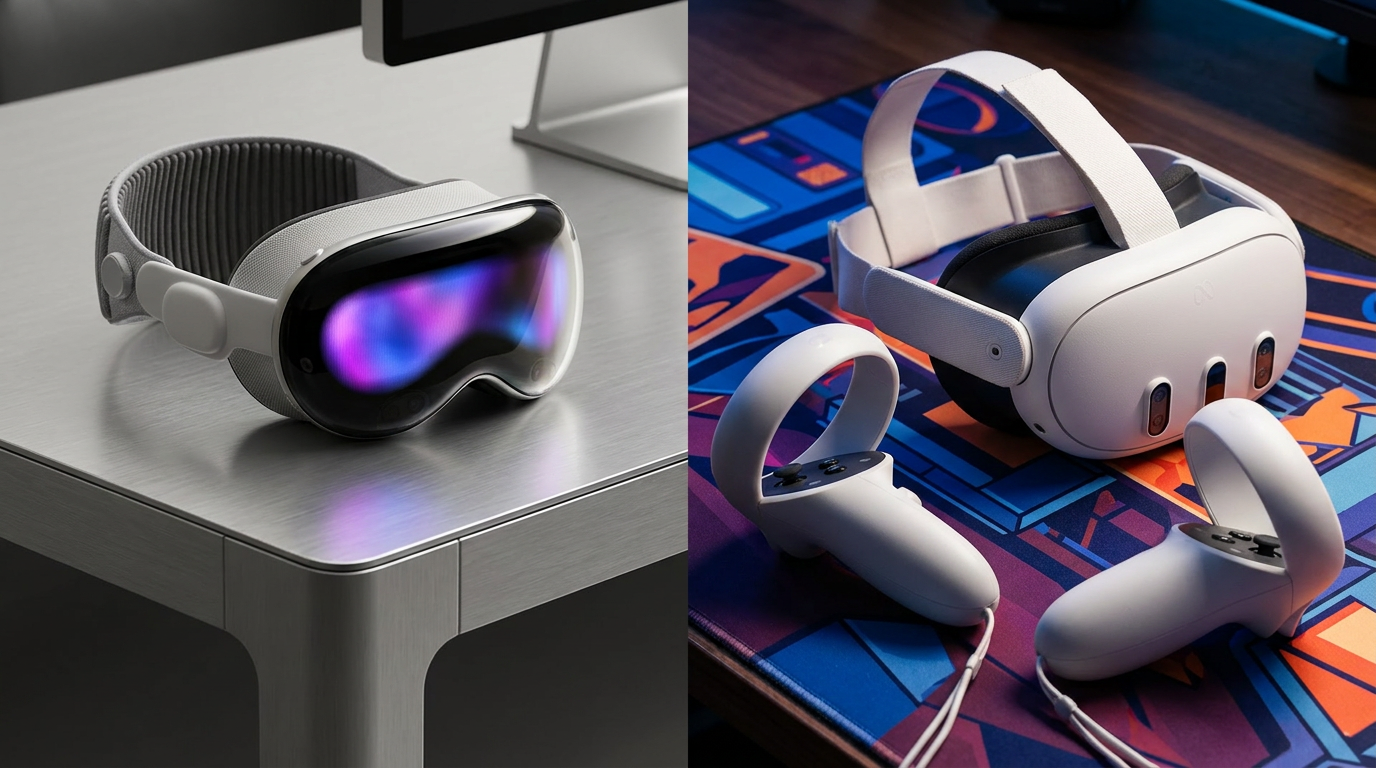
While Apple's Vision Pro dominates in display fidelity and ecosystem integration, the Meta Quest 3 offers superior comfort, gaming libraries, and shared-use practicality at a fraction of the cost.
By Factlen Editorial Team
- Consumer Tech Analysts
- Focused on ecosystem integration, display technology, and daily friction.
- Enterprise Integrators
- Focused on deployment scale, training efficiency, and return on investment.
- Immersive Gaming Advocates
- Focused on interactive software libraries, haptic feedback, and physical movement.
What's not represented
- · Budget-constrained educational institutions
- · Physical therapists using VR for rehab
Why this matters
Choosing the right mixed reality headset dictates whether your investment becomes a daily productivity driver or an expensive paperweight. Understanding the specific trade-offs between Apple's premium ecosystem and Meta's accessible versatility is crucial for both enterprise deployments and personal use.
Key points
- The Apple Vision Pro excels in visual clarity, text readability, and seamless Mac integration, making it ideal for solo productivity.
- The Meta Quest 3 dominates in interactive gaming, physical comfort, and shared-device practicality at a fraction of the cost.
- Vision Pro's 650-gram weight and tethered battery significantly limit its comfort during extended use compared to the 515-gram Quest 3.
- Enterprise deployments heavily favor the Quest 3 for scalable training, reserving the Vision Pro for specialized, high-stakes visual tasks.
- Lack of physical motion controllers on the Vision Pro severely restricts its appeal to traditional virtual reality gamers.
Two years after Apple redefined the premium headset market, the mixed reality landscape of 2026 has settled into a fascinating and highly competitive duopoly. The Apple Vision Pro and the Meta Quest 3 represent fundamentally different philosophies about what face-mounted computers should actually do. While both devices offer full-color passthrough augmented reality and fully immersive virtual environments, their target audiences and daily utility diverge sharply. Consumers and enterprise buyers are no longer asking which headset is objectively better in a vacuum, but rather which specific set of hardware and software trade-offs aligns best with their daily workflow, budget, and entertainment habits.[7]
At its core, the Apple Vision Pro is engineered as a spatial computer designed to integrate seamlessly into an existing ecosystem, while the Meta Quest 3 operates as a versatile, standalone virtual reality console. Apple’s approach prioritizes passive media consumption, high-fidelity productivity, and frictionless connectivity with MacBooks and iPhones, treating the headset as an extension of the user's existing digital life. Conversely, Meta’s strategy focuses heavily on interactive gaming, physical movement, and accessible social experiences. This foundational split dictates every hardware choice, from display technology to controller design, creating a stark contrast in how each device performs under real-world conditions.[1][7]
The primary argument for the Apple Vision Pro centers entirely on its unparalleled visual fidelity and ecosystem integration. Apple equipped the headset with dual micro-OLED displays that pack a staggering twenty-three million pixels, achieving a pixel density that effectively eliminates the screen-door effect common in older headsets. This hardware allows the device to function as a legitimate replacement for multiple physical monitors. Users can anchor massive, crystal-clear virtual screens in their physical space, making it the only headset currently on the market where reading small text or working in complex spreadsheets for hours feels entirely natural.[3][5]

The evidence supporting Apple’s productivity claims is robust, particularly for creative professionals and remote workers already entrenched in the Apple ecosystem. Reviewers and enterprise testers consistently note that the Vision Pro’s foveated rendering—which dynamically sharpens the exact spot the user is looking at while softening the periphery—works flawlessly to maintain performance. Furthermore, the passthrough cameras are sharp enough to allow users to read physical smartphone screens or interact with their physical environment without removing the headset. For tasks requiring pixel-perfect clarity, such as medical imaging review or high-end design, the Vision Pro stands alone.[3][4]
The argument against the Vision Pro is anchored by its severe ergonomic and financial trade-offs. Weighing in at six hundred and fifty grams, the headset places significant strain on the user's neck and face, with many early adopters reporting discomfort after just forty-five minutes of continuous use. The device also relies on a tethered external battery pack that provides only two hours of power, limiting mobility. Furthermore, the complete lack of physical controllers severely restricts its gaming capabilities, as hand-tracking alone cannot provide the tactile feedback or rapid precision required for most interactive virtual reality titles.[3][4]
The case for the Meta Quest 3 is built entirely on its exceptional versatility, physical comfort, and unmatched value proposition for the average consumer. Priced at a mere fraction of Apple’s premium offering, the Quest 3 delivers a highly capable mixed reality experience powered by the efficient Snapdragon XR2 Gen 2 chip. Meta’s inclusion of physical, haptic-enabled controllers makes it an interactive powerhouse, allowing users to engage deeply with the largest library of virtual reality games and fitness applications currently available. The headset is entirely self-contained, with the battery built directly into the strap, offering true wireless freedom for active users who want to move around their physical space without worrying about snagging a power cable.[1][2]
Evidence of the Quest 3’s practical superiority emerges clearly in enterprise training and active entertainment scenarios. At five hundred and fifteen grams, it is significantly lighter and better balanced than the Vision Pro, allowing for extended sessions of gaming or physical movement without severe fatigue. Enterprise deployment data from 2026 shows that organizations heavily favor the Quest 3 for shared-use environments, such as training centers, because the hardware is easily adjustable for different users and does not require the highly personalized light seals and prescription inserts that complicate sharing an Apple Vision Pro.[4]
Evidence of the Quest 3’s practical superiority emerges clearly in enterprise training and active entertainment scenarios.
The primary argument against the Meta Quest 3 focuses on its display limitations and less refined software ecosystem. The device utilizes LCD panels with a resolution of roughly two thousand by two thousand pixels per eye. While sharp enough for gaming, this resolution falls short for intensive text-based productivity, requiring users to scale up font sizes to avoid eye strain. Additionally, the LCD technology exhibits noticeable light bleed and cannot produce the true, deep blacks seen on Apple’s OLED screens, which slightly diminishes the immersion during dark cinematic scenes. The passthrough cameras, while functional in color, often display grain and distortion in low-light environments.[3][5]

When evaluating entertainment, the trade-off becomes a choice between passive luxury and active engagement. The Apple Vision Pro operates as the ultimate private cinema, offering an unmatched experience for watching three-dimensional movies or spatial video in pristine high dynamic range. However, its gaming library remains sparse and largely limited to casual titles. The Meta Quest 3, by contrast, thrives on active participation. Its precise motion controllers and massive catalog of immersive titles—ranging from competitive shooters to virtual golf—make it the definitive choice for users who want to play rather than merely watch.[5][6]
In enterprise environments, the comparison hinges on scale versus precision. Data from immersive technology integrators reveals that development for the Vision Pro takes significantly longer and costs more due to its newer platform and smaller developer pool. However, for specialized scenarios like surgical preparation or precision engineering, Apple's visual clarity is non-negotiable. Conversely, the Quest 3 is the undisputed champion of scalable training. Its lower cost, mature mobile device management tools, and shared-device capabilities make it dramatically more practical for onboarding large numbers of employees across manufacturing or retail sectors.[4][6]
The financial disparity between the two devices cannot be overstated and fundamentally alters the value equation. At nearly three thousand five hundred dollars, the Vision Pro represents a luxury investment, often requiring additional spending for custom optical inserts and protective cases. The Meta Quest 3, starting at under five hundred dollars, democratizes mixed reality. Even when fully outfitted with premium head straps, extended battery packs, and upgraded facial interfaces, the Meta ecosystem remains thousands of dollars cheaper, offering a return on investment that is vastly easier to justify for both casual consumers and budget-conscious IT departments.[2][4]
The Apple Vision Pro fits exceptionally well when a user requires a portable, multi-monitor workstation that integrates flawlessly with a MacBook and the broader Apple ecosystem. It is the unequivocally correct choice for affluent early adopters, spatial computing developers, and professionals whose daily workflow demands reading dense text or manipulating high-resolution visual assets in a virtual space. It also serves as the ultimate luxury device for frequent travelers seeking a private, high-fidelity cinematic experience on airplanes or in hotel rooms, provided they are willing to manage the tethered battery pack and can justify the premium price tag.[3][5]

Conversely, the Apple Vision Pro does not fit when the primary goal is active gaming, fitness, or shared household use. Its heavy, fragile glass design and complete lack of motion controllers make it entirely unsuitable for fast-paced virtual reality experiences where physical movement is required. Furthermore, it is a poor choice for public deployment or training centers where multiple users need to quickly swap the headset, as the device is intimately tied to a single user's biometric data, Apple ID, and specific facial geometry.[4][6]
The Meta Quest 3 fits perfectly when a user wants a versatile, do-it-all headset that excels at interactive entertainment, physical fitness, and casual social experiences. It is the ideal choice for dedicated gamers, families looking for a shared virtual reality console for the living room, and enterprise managers needing to deploy scalable, immersive training modules to hundreds of employees. Its highly accessible price point, robust physical motion controllers, and massive software library make it the most practical and enjoyable entry point into mixed reality for the vast majority of the global population.[1][2]
The Meta Quest 3 does not fit when a user intends to replace their physical laptop screens for eight straight hours of daily, text-heavy productivity. The LCD displays, while impressive for the price point, simply lack the extreme pixel density required to prevent eye strain during prolonged reading or detailed spreadsheet work. Additionally, users who are deeply entrenched in the Apple ecosystem and expect seamless, native integration with their iPhones and MacBooks will find Meta’s software workarounds and third-party streaming applications somewhat cumbersome and frustrating by comparison.[3][7]
How we got here
June 2023
Apple officially announces the Vision Pro at WWDC, introducing the concept of spatial computing to the public.
October 2023
Meta releases the Quest 3, bringing full-color passthrough and the Snapdragon XR2 Gen 2 chip to the mass market.
February 2024
The Apple Vision Pro officially launches in the United States at a starting price of $3,499.
Early 2025
Apple releases a minor M5 processor bump for the Vision Pro, while Meta continues to dominate the consumer gaming market with the Quest ecosystem.
Mid 2026
Enterprise adoption data reveals a clear split, with Quest 3 dominating scalable training and Vision Pro securing niche high-fidelity use cases.
Viewpoints in depth
Enterprise Integrators
Focused on deployment scale, training efficiency, and return on investment.
For corporate IT departments and training facilities, the evaluation metric is rarely about pure graphical fidelity. Integrators argue that the Meta Quest 3's ability to be easily shared among dozens of employees without custom optical inserts makes it the only viable choice for scaled deployments. However, they concede that for niche, high-stakes environments like surgical planning or aerospace engineering, the Vision Pro's pixel-perfect passthrough justifies its exorbitant cost and single-user limitations.
Consumer Tech Analysts
Focused on ecosystem integration, display technology, and daily friction.
Tech analysts view the Vision Pro as a glimpse into the future of spatial computing, heavily praising its micro-OLED displays and seamless hand-tracking. They argue that Apple has successfully solved the resolution problem that plagued earlier headsets. Yet, they remain highly critical of the device's weight and tethered battery, noting that the Quest 3, despite its cheaper LCD panels, offers a much more frictionless daily experience simply because it is comfortable enough to wear for hours.
Immersive Gaming Advocates
Focused on interactive software libraries, haptic feedback, and physical movement.
The gaming community remains largely dismissive of the Vision Pro due to its lack of dedicated motion controllers. Gamers argue that hand-tracking, no matter how precise, cannot replicate the tactile satisfaction of pulling a virtual trigger or swinging a digital golf club. They champion the Quest 3 as the undisputed king of the medium, pointing to its massive, mature library of interactive titles and its ability to connect wirelessly to high-end PCs for enthusiast-grade virtual reality experiences.
What we don't know
- Whether Apple will release a significantly cheaper, non-Pro version of the Vision headset to compete directly with Meta's pricing.
- How quickly Meta can improve its native productivity software to rival Apple's seamless ecosystem integration.
- If third-party developers will eventually find a way to bring complex, controller-free gaming experiences to the Vision Pro platform.
Key terms
- Spatial Computing
- A term popularized by Apple to describe technology that blends digital content with the physical world, emphasizing productivity and seamless integration over traditional virtual reality gaming.
- Passthrough
- A feature that uses external cameras on the headset to display a real-time video feed of the user's physical surroundings inside the digital display.
- Micro-OLED
- An advanced display technology used in the Vision Pro that packs millions of pixels into a tiny area, offering exceptional sharpness and true black levels.
- Foveated Rendering
- A rendering technique that uses eye-tracking to render the exact spot the user is looking at in high resolution while lowering the quality of peripheral areas to save processing power.
- Screen-Door Effect
- A visual artifact in older or lower-resolution headsets where the unlit spaces between pixels become visible, making it look like the user is viewing the world through a mesh screen.
Frequently asked
Can the Meta Quest 3 connect to a Mac?
Yes, the Quest 3 can connect to a Mac using third-party applications like Immersed or Horizon Workrooms, though the integration is not as seamless or high-resolution as the Vision Pro's native Mac Virtual Display feature.
Does the Apple Vision Pro have VR games?
The Vision Pro supports some casual games and Apple Arcade titles, but it lacks a robust library of immersive, controller-based virtual reality games compared to the Meta Quest ecosystem.
Which headset is better for watching movies?
The Apple Vision Pro is significantly better for watching movies due to its micro-OLED displays, which offer true blacks, high dynamic range, and a pixel density that eliminates the screen-door effect.
Do I need a Meta account to use the Quest 3?
Yes, setting up and using the Meta Quest 3 requires an active Meta account to access the store and manage device settings.
Sources
Source coverage
7 outlets
3 viewpoints surfaced







[1]PCMagConsumer Tech Analysts
The Best VR Headsets for 2026
Read on PCMag →[2]VR EddieImmersive Gaming Advocates
Apple Vision Pro vs Meta Quest 3 Comparison
Read on VR Eddie →[3]Multicore BlogConsumer Tech Analysts
Apple Vision Pro: the 2026 review
Read on Multicore Blog →[4]AgileSoftLabsEnterprise Integrators
Meta Quest 3 or Apple Vision Pro? Enterprise MR Headset Comparison
Read on AgileSoftLabs →[5]VR WaveImmersive Gaming Advocates
Apple Vision Pro vs Meta Quest 3: Which is Better?
Read on VR Wave →[6]AutoVRseEnterprise Integrators
Meta Quest 3 vs Apple Vision Pro: Enterprise Training Comparison
Read on AutoVRse →[7]Factlen Editorial TeamConsumer Tech Analysts
Synthesis by Factlen editorial team
Read on Factlen Editorial Team →

Every angle. Every day.
Get meta stories with full source coverage and perspective breakdowns delivered to your inbox.