
How Open-Source Intelligence (OSINT) Empowers Everyday Citizens to Verify the News
Digital forensics and open-source intelligence are democratizing fact-checking, allowing anyone with an internet connection to debunk misinformation and hold power accountable.
By Factlen Editorial Team
- Citizen Investigators
- Advocates for using public data to democratize journalism and hold power accountable.
- Cybersecurity Professionals
- Focuses on OSINT as a critical operational tool for network defense and threat intelligence.
What's not represented
- · Privacy Advocates concerned about the mass aggregation of public data for surveillance
- · Traditional intelligence agencies adapting to the public availability of classified-grade insights
Why this matters
As deepfakes and misinformation flood the internet, the ability to independently verify claims is becoming a crucial survival skill. Understanding how open-source intelligence works empowers readers to critically evaluate the news they consume and protect their own digital footprints from malicious actors.
Key points
- Open-source intelligence (OSINT) involves analyzing publicly available data to generate actionable insights.
- Citizen journalism collectives use OSINT to verify conflict zone footage and debunk misinformation.
- The OSINT lifecycle includes planning, collection, processing, analysis, and dissemination.
- Cybersecurity teams rely on OSINT to identify network vulnerabilities and monitor threat actors.
- Hackers weaponize the same public data to craft highly targeted social engineering attacks.
- The democratization of digital forensics is shifting the power of verification from institutions to the public.
In an era where misinformation can spread globally in seconds, a powerful counter-movement has emerged from the corners of the internet. It is no longer just government spy agencies or elite newsrooms that hold the tools to verify global events. Today, everyday citizens, armed with nothing more than a laptop and an internet connection, are uncovering war crimes, tracking corporate data breaches, and debunking viral hoaxes. This democratization of truth-finding is driven by Open-Source Intelligence, or OSINT, a methodology that is fundamentally reshaping how society processes information.[8]
OSINT is the systematic collection, evaluation, and analysis of publicly available information to answer specific questions or extract actionable insights. While the concept of gathering public intelligence dates back to the 1941 formation of the Foreign Broadcast Monitoring Service, the digital age has propelled OSINT into a league of its own. Today, the digital footprint left by billions of connected devices provides a rich tapestry of data that anyone can legally access and analyze.[3][6]
Unlike classified intelligence disciplines such as HUMINT (human intelligence) or SIGINT (signals intelligence), OSINT relies entirely on overt sources. These include traditional news media, public government records, academic publications, and commercial satellite imagery. Crucially, it also encompasses the vast expanse of user-generated content on social media platforms, online forums, and even the unindexed corners of the deep web.[1][3][6]
The process of transforming this raw data into verifiable intelligence follows a structured lifecycle. It begins with planning and defining specific objectives, followed by the meticulous collection of data from disparate public sources. Analysts then process this information—often translating languages or converting file formats—before evaluating it for authenticity and relevance. The final step is dissemination, where the actionable intelligence is shared with stakeholders or the public.[5]

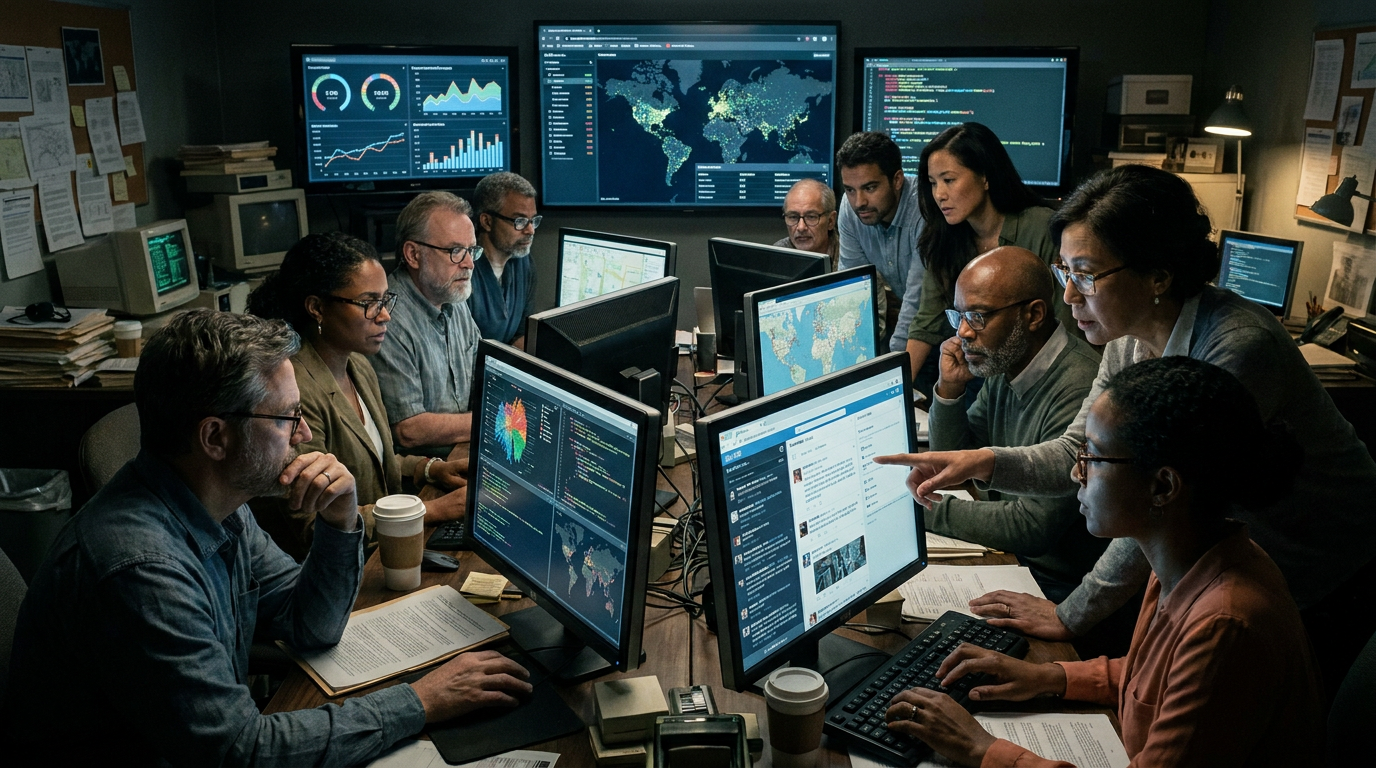
One of the most visible and impactful applications of OSINT has been in the realm of citizen journalism. The pioneer of this movement is Bellingcat, an independent investigative collective founded in 2014 by British blogger Eliot Higgins. Operating initially from his home in Leicester, Higgins demonstrated that a single individual could verify complex geopolitical events using free tools like Google Earth and YouTube.[2]
Bellingcat's methodology relies heavily on crowdsourcing and digital forensics to separate fact from fiction in conflict zones. By analyzing the metadata of social media videos, cross-referencing shadows to determine the time of day, and matching background landmarks with satellite imagery, these citizen investigators have achieved remarkable breakthroughs. Their work has provided crucial evidence in high-profile cases, from the downing of Malaysia Airlines Flight 17 to the use of chemical weapons in the Syrian Civil War.[2]
The collective's success stems from its radical transparency. Bellingcat publishes not only its findings but also detailed guides and case studies, teaching others how to replicate their techniques. They maintain open-source toolkits on platforms like GitHub, offering the public access to specialized software for archiving web pages, searching satellite imagery, and tracking aircraft. This collaborative approach has cultivated a global community of volunteers dedicated to holding power accountable.[2][7]

The collective's success stems from its radical transparency.
Beyond journalism, OSINT has become a foundational pillar of modern cybersecurity. For corporate defense teams, the ability to view their organization from the perspective of an external attacker is invaluable. Security professionals routinely conduct OSINT assessments to identify unauthorized data leaks, evaluate employee information security, and locate vulnerabilities such as unpatched software or misconfigured servers.[3][4]
During active security incidents, OSINT provides critical context. By analyzing public threat databases, security advisories, and chatter on hacker forums, incident response teams can better understand the tactics of cybercriminals and anticipate their next moves. This proactive intelligence gathering allows organizations of all sizes to enhance their security posture without relying solely on expensive proprietary feeds.[5]
However, the accessibility of open-source intelligence presents a dual-use dilemma. The same techniques used by journalists to expose corruption and by security teams to patch vulnerabilities are routinely weaponized by threat actors. Cybercriminals leverage OSINT to conduct extensive reconnaissance on their targets, gathering personal details from social media and corporate websites to craft highly convincing social engineering and phishing campaigns.[3]
Hackers also scour public code repositories and cloud environments for exposed credentials, encryption keys, or architectural blueprints. This reality underscores a critical lesson for the digital age: information published on the internet, no matter how seemingly innocuous, can be aggregated and analyzed to reveal sensitive insights. Consequently, managing one's digital footprint has become a vital component of personal and corporate security.[3][6][8]

Despite these risks, the net impact of OSINT on society remains overwhelmingly positive. In a media ecosystem increasingly polluted by deepfakes and algorithmic echo chambers, the ability to independently verify claims is more important than ever. OSINT provides a factual anchor, empowering individuals to move beyond passive consumption and actively participate in the pursuit of truth.[8]
The ethos of open-source investigation is also influencing major technology platforms. Initiatives like community-driven fact-checking and crowdsourced context notes draw heavily on OSINT principles, allowing users to collaboratively debunk falsehoods in real-time. This shift from centralized authority to decentralized verification represents a profound evolution in how public knowledge is established and maintained.[8]
As artificial intelligence tools become more sophisticated, the field of OSINT will inevitably evolve. Machine learning algorithms are already being deployed to sift through massive datasets, identify patterns, and flag anomalies faster than any human analyst. Yet, the core of open-source intelligence will remain deeply human, relying on critical thinking, curiosity, and a moral commitment to uncovering the truth.[2][8]
Ultimately, the rise of OSINT proves that transparency is a powerful antidote to deception. By equipping everyday citizens with the skills and tools to interrogate the digital world, open-source intelligence is not just changing journalism and cybersecurity; it is democratizing the very nature of truth.[8]
How we got here
1941
The Foreign Broadcast Monitoring Service is formed, laying the early groundwork for open-source intelligence.
July 2014
Eliot Higgins founds Bellingcat, pioneering the use of OSINT for citizen journalism.
April 2014
Citizen investigators publish open-source evidence of chemical weapons use in the Syrian Civil War.
2022
Bellingcat is named International News Media Organisation of the Year for its innovative digital forensics.
Viewpoints in depth
Citizen Investigators
Advocates for using public data to democratize journalism and hold power accountable.
For citizen journalists and collectives like Bellingcat, OSINT represents a fundamental shift in how truth is established. They argue that the monopoly on intelligence gathering has been broken, allowing anyone with an internet connection and critical thinking skills to verify global events. By crowdsourcing investigations and publishing open-source toolkits, this camp believes that radical transparency can effectively counter state-sponsored propaganda, debunk viral misinformation, and provide irrefutable evidence of human rights abuses in conflict zones.
Cybersecurity Professionals
Focuses on OSINT as a critical operational tool for network defense and threat intelligence.
In the corporate and national security sectors, OSINT is viewed primarily as a defensive necessity. Security analysts argue that organizations must understand their public digital footprint to anticipate and mitigate cyberattacks. By monitoring dark web forums, public code repositories, and social media, they can identify unpatched vulnerabilities and exposed credentials before threat actors exploit them. However, this camp also acutely recognizes the dual-use nature of OSINT, warning that the exact same public data is routinely weaponized by hackers for targeted social engineering and phishing campaigns.
What we don't know
- How privacy legislation will adapt to regulate the mass aggregation of public data by private entities.
- The full extent to which artificial intelligence will automate and accelerate open-source investigations.
Key terms
- OSINT
- Open-Source Intelligence; the practice of collecting and analyzing publicly available data to generate actionable insights.
- Geolocation
- The process of identifying the real-world geographic location of an object, person, or event shown in a photo or video.
- Digital Forensics
- The recovery and investigation of material found in digital devices or online platforms, often used to verify digital media.
- Social Engineering
- The psychological manipulation of people into performing actions or divulging confidential information, often aided by OSINT.
- Deep Web
- Parts of the internet not indexed by standard search engines, which can still be legally accessed for research.
Frequently asked
Is gathering OSINT legal?
Yes, OSINT relies exclusively on publicly available and overt sources, making it a legal practice for journalists, researchers, and security teams.
Do I need special software to conduct open-source investigations?
While specialized tools exist, many foundational OSINT investigations are conducted using free, accessible platforms like Google Earth, standard search engines, and social media.
How do hackers use OSINT?
Cybercriminals use OSINT to gather personal and technical information about their targets, which they then use to craft highly convincing phishing emails or exploit unpatched software.
What is the difference between OSINT and regular web searching?
OSINT applies a structured intelligence lifecycle—planning, collection, processing, analysis, and dissemination—to raw data to answer specific, high-stakes questions.
Sources
Source coverage
8 outlets
2 viewpoints surfaced







[1]WikipediaCitizen Investigators
Open-source intelligence
Read on Wikipedia →Bellingcat
Read on Wikipedia →[3]IBMCybersecurity Professionals
What is open source intelligence (OSINT)?
Read on IBM →[4]Trend MicroCybersecurity Professionals
What Does OSINT Stand For?
Read on Trend Micro →[5]Rapid7Cybersecurity Professionals
What is open source intelligence (OSINT)?
Read on Rapid7 →[6]Recorded FutureCybersecurity Professionals
What Is Open Source Intelligence (OSINT)?
Read on Recorded Future →[7]GitHubCitizen Investigators
Bellingcat Open Source Toolkit
Read on GitHub →[8]Factlen Editorial TeamCitizen Investigators
Synthesis by Factlen editorial team
Read on Factlen Editorial Team →

Every angle. Every day.
Get meta stories with full source coverage and perspective breakdowns delivered to your inbox.