
Steam Deck OLED vs. ROG Ally X: The 2026 Handheld PC Comparison
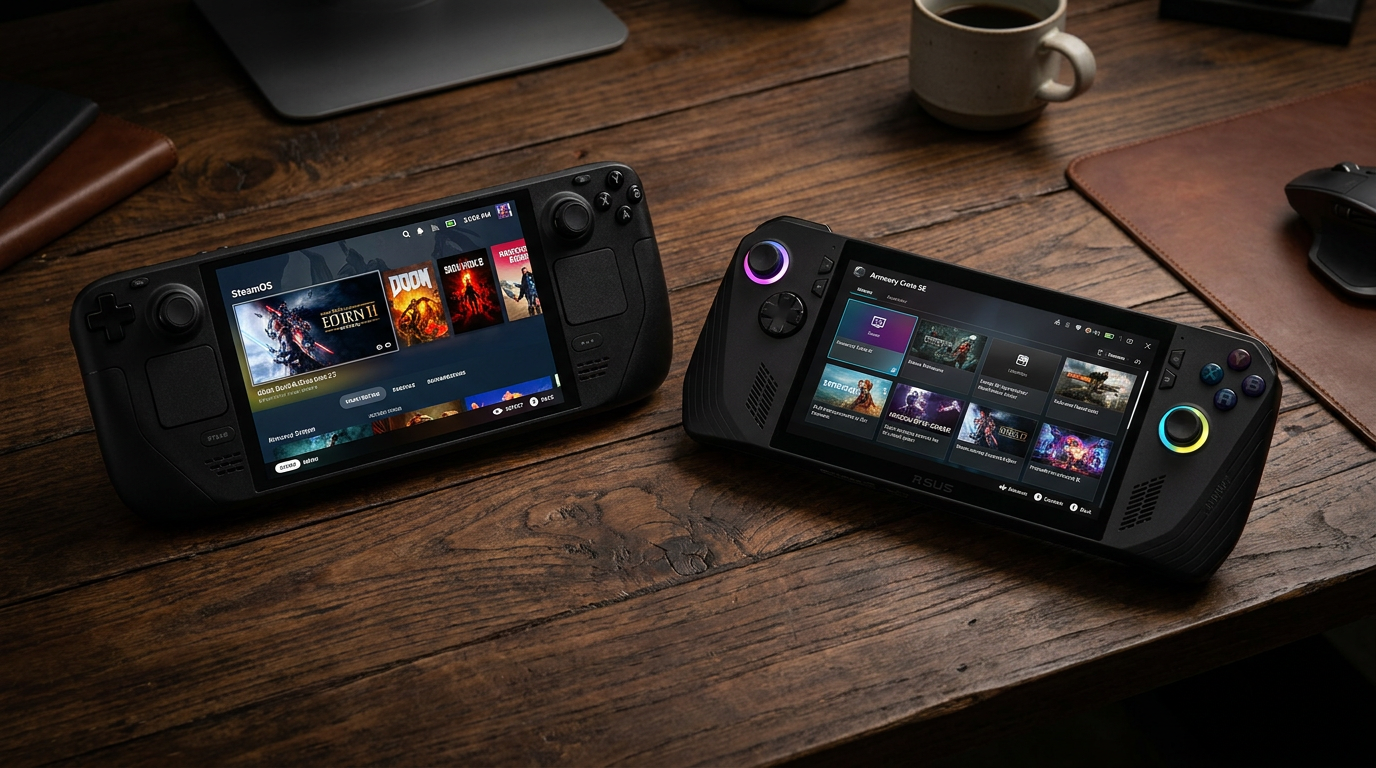
As portable gaming hardware matures, the choice between Valve's Steam Deck OLED and ASUS's ROG Ally X comes down to a fundamental trade-off between console-like efficiency and raw Windows power.
By Factlen Editorial Team
- Console Purists
- Gamers who value seamless UI, sleep-wake reliability, and battery efficiency over raw graphics.
- Power Enthusiasts
- Users who prioritize maximum frame rates, Windows flexibility, and modding freedom.
- Hybrid Pragmatists
- Buyers who weigh the specific use-case conditions before declaring a winner.
What's not represented
- · Game Developers optimizing for fixed hardware
- · Budget-conscious buyers priced out of premium handhelds
Why this matters
Choosing the right handheld PC is a significant investment. Understanding the trade-off between seamless console-like efficiency and raw Windows power ensures you buy the device that actually fits your gaming habits.
Key points
- The Steam Deck OLED excels in battery efficiency, comfort, and providing a frictionless, console-like experience via SteamOS.
- The ASUS ROG Ally X dominates in raw performance, offering higher frame rates and a massive 80Wh battery.
- Windows 11 on the Ally X allows native access to Xbox Game Pass and anti-cheat multiplayer games, but lacks the seamless sleep-mode of SteamOS.
- The Steam Deck's OLED screen provides superior contrast and HDR, while the Ally X's IPS panel offers a sharper 1080p resolution and 120Hz VRR.
- Neither device is objectively superior; the right choice depends entirely on a player's specific library and travel habits.
The handheld PC market in 2026 has matured from a niche enthusiast experiment into a mainstream gaming category. The gap between desktop performance and portable convenience has effectively vanished, leaving buyers with a wealth of powerful options.[3][6]
At the center of this year's landscape is a heavyweight showdown between two defining devices: Valve's Steam Deck OLED and the ASUS ROG Ally X. Rather than a simple battle of specifications, this rivalry represents a clash of fundamental design philosophies.[4][5]
On one side of the spectrum sits the Steam Deck OLED, a device that prioritizes a curated, console-like experience. Valve has doubled down on efficiency, relying on its custom Linux-based SteamOS to eliminate the friction typically associated with PC gaming.[2][4]
On the other side is the ASUS ROG Ally X, a handheld built for raw power and absolute flexibility. Running a full installation of Windows 11, it acts as a miniaturized desktop computer, refusing to lock players into a single storefront.[4][5]

The most immediate physical difference lies in their displays, where buyers must choose between fidelity and pixel density. The Steam Deck features a 7.4-inch HDR OLED screen running at 1280x800 resolution with a 90Hz refresh rate, delivering perfect blacks and vibrant contrast.[5][6]
Conversely, the ROG Ally X utilizes a 7-inch IPS panel that pushes a sharper 1920x1080 resolution at a blistering 120Hz. Crucially, it includes Variable Refresh Rate (VRR) technology, which smooths out frame drops in demanding titles—a feature the Steam Deck lacks.[1][5]
When it comes to raw performance, the evidence heavily favors ASUS. Equipped with top-tier AMD Ryzen silicon and 24GB of high-speed RAM, the Ally X can power through modern AAA releases that make the Steam Deck stumble.[1][5]
Benchmark testing reveals that at balanced 15-watt profiles, the Ally X consistently pushes higher frame rates, often achieving 42 to 50 frames per second in heavy titles where the Steam Deck hovers in the mid-30s.[4][5]

However, this performance advantage introduces a significant trade-off in battery life. ASUS equipped the Ally X with a massive 80-watt-hour battery—substantially larger than the Steam Deck's 50-watt-hour capacity—but the power-hungry Windows environment and aggressive chipset drain it rapidly under load.[4][5]
However, this performance advantage introduces a significant trade-off in battery life.
The Steam Deck OLED counters with unparalleled efficiency at lower wattages. For independent games, older titles, and emulation, the device can sip as little as seven watts, allowing for unplugged sessions that stretch for hours beyond what the Ally X can manage.[4][5]
Software ecosystems present another stark contrast. SteamOS provides a seamless, sleep-and-wake functionality that mirrors the Nintendo Switch, allowing players to suspend a game instantly and resume days later without crashing.[2][4]
Windows 11 on the Ally X cannot match this sleep-mode reliability, often waking up in bags or struggling to suspend heavy applications. Yet, Windows is the only way to natively access Xbox Game Pass, the Epic Games Store, and titles requiring kernel-level anti-cheat software like popular multiplayer shooters.[1][4]

Ergonomics and thermal management also divide the two camps. The Steam Deck is physically larger but distributes its weight comfortably, while its cooling system is tuned to remain quiet and keep heat away from the player's hands.[2][3]
The Ally X, while more compact, runs noticeably hotter and louder when pushed to its maximum thermal design power. Players seeking top-tier frame rates must accept the reality of holding a device that feels like a hard-working PC.[4][5]
Storage and upgradeability offer different paths. The Ally X comes standard with a one-terabyte drive and supports standard M.2 2280 SSDs, making user upgrades cheap and straightforward. The Steam Deck relies on the smaller, slightly more expensive 2230 drive format.[2][5]

Ultimately, the Steam Deck OLED fits well when a buyer wants a frictionless, pick-up-and-play experience, values long battery life for travel, and primarily plays games within the Steam ecosystem. It does not fit when a player relies on subscription services or competitive multiplayer shooters.[4][5]
The ROG Ally X fits well when a user demands the highest possible portable frame rates, wants the freedom to install any launcher or mod, and plans to frequently play plugged into a wall or docked to a monitor. It does not fit when a buyer wants a simple interface or maximum unplugged longevity.[4][5]
How we got here
Feb 2022
Valve launches the original Steam Deck, proving the viability of the modern handheld PC.
Jun 2023
ASUS releases the first ROG Ally, introducing Windows 11 and 120Hz screens to the form factor.
Nov 2023
Valve releases the Steam Deck OLED, vastly improving battery life and display quality.
Mid 2024
ASUS launches the ROG Ally X, doubling down on battery size and RAM to fix the original's flaws.
2026
The market matures into a clear duopoly of philosophies: SteamOS efficiency versus Windows power.
Viewpoints in depth
The Console Purists' View
Advocates for the Steam Deck's streamlined, friction-free approach.
This camp argues that a handheld device should disappear into the background, allowing the game to take center stage. They point to SteamOS's flawless sleep-and-wake functionality and the OLED model's incredible low-wattage efficiency as the true markers of a portable console. For these users, the clunkiness of navigating Windows 11 with a joystick and the rapid battery drain of high-end chips defeat the purpose of playing on the go.
The Power Enthusiasts' View
Champions of the ROG Ally X's raw performance and open ecosystem.
Power users maintain that a PC should act like a PC, regardless of its form factor. They value the Ally X's ability to push past 40 frames per second in demanding AAA titles and praise the inclusion of 24GB of RAM. More importantly, they argue that being locked out of Xbox Game Pass, the Epic Games Store, and major anti-cheat multiplayer games makes the Steam Deck too restrictive for a primary gaming device.
The Hybrid Pragmatists' View
Users who weigh the specific use-case conditions before declaring a winner.
This perspective emphasizes that neither device is objectively superior. Pragmatists note that the Ally X is the undisputed champion for players who frequently game near an outlet or dock their device to a monitor. Conversely, they recommend the Steam Deck OLED for frequent travelers and indie game enthusiasts, arguing that the 'best' handheld is simply the one that matches the buyer's daily routine.
What we don't know
- How Valve's eventual 'Steam Deck 2' will respond to the massive performance gains seen in the latest Windows handhelds.
- Whether Microsoft will release a dedicated, lightweight 'Windows Handheld Mode' to fix the clunky desktop UI on 7-inch screens.
- How upcoming ARM-based processors might disrupt the current AMD-dominated handheld market in late 2026.
Key terms
- APU
- Accelerated Processing Unit, a single chip combining both the central processor and graphics processor.
- SteamOS
- A Linux-based operating system developed by Valve, designed specifically for gaming and navigating with a controller.
- VRR
- Variable Refresh Rate, a display technology that syncs the screen to the game's frame rate to eliminate stuttering and screen tearing.
- TDP
- Thermal Design Power, the maximum amount of heat a system is designed to dissipate, often used to measure how much electrical power a handheld is using.
Frequently asked
Can the Steam Deck play Xbox Game Pass games?
Not natively. You can stream Game Pass titles via the cloud, but installing them directly requires installing Windows on the device, which removes the benefits of SteamOS.
Does the ROG Ally X have better battery life?
Despite having a much larger 80Wh battery, the Ally X often drains faster under heavy load due to its powerful chip and Windows OS. The Steam Deck OLED remains the winner for unplugged longevity.
Which handheld is better for multiplayer games?
The ROG Ally X. Many popular multiplayer shooters use kernel-level anti-cheat software that is incompatible with the Steam Deck's Linux-based operating system.
Sources
Source coverage
6 outlets
3 viewpoints surfaced






[1]Tom's HardwarePower Enthusiasts
Best Handheld Gaming PCs 2026: Windows and Steam Decks tested
Read on Tom's Hardware →[2]Rock Paper ShotgunConsole Purists
The best handheld PCs
Read on Rock Paper Shotgun →[3]PCMagConsole Purists
Steam Deck and Beyond: The Best Handheld Gaming PCs for 2026
Read on PCMag →[4]EnebaHybrid Pragmatists
ROG Ally vs Steam Deck: A Complete Breakdown Before You Buy
Read on Eneba →[5]Windows ForumPower Enthusiasts
Steam Deck OLED vs ROG Ally X: Handheld PC Showdown 2026
Read on Windows Forum →[6]DroiXHybrid Pragmatists
The Best Handheld Gaming PCs: Your Ultimate 2026 Buying Guide
Read on DroiX →


Every angle. Every day.
Get shopping stories with full source coverage and perspective breakdowns delivered to your inbox.