
How Bridging Algorithms Are Rewiring the Fight Against Misinformation
Decentralized fact-checking systems are using 'bridging algorithms' to find consensus across political divides, offering a powerful alternative to traditional engagement algorithms.
By Factlen Editorial Team
- Algorithmic Optimists
- Researchers who view bridging algorithms as a highly effective, scalable solution to misinformation.
- System Auditors
- Analysts focused on the vulnerabilities and blind spots of consensus-based moderation.
- Civic Technologists
- Advocates for using bridging algorithms to enhance democratic participation and policy-making.
What's not represented
- · Professional Fact-Checkers
- · Marginalized Communities disproportionately affected by delayed moderation
Why this matters
As social media platforms move away from professional fact-checkers, the algorithms governing community-driven moderation will dictate what information millions of people trust. Understanding how these systems work is essential for navigating the modern internet and recognizing how technology can be used to build consensus rather than division.
Key points
- Bridging algorithms reward content that gains approval from users who typically disagree.
- This approach bypasses the trust deficit associated with top-down, professional fact-checking.
- Notes approved by bridging algorithms reduce engagement with misinformation by up to 34 percent.
- The requirement for cross-partisan consensus can cause significant delays in publishing corrections.
For the past decade, the internet has been governed by a single, overriding mathematical imperative: engagement. Algorithms designed to maximize human attention quickly learned that outrage, tribalism, and polarization are the most effective ways to keep users scrolling. This architecture fundamentally altered how society communicates, rewarding the most extreme voices while burying nuanced debate. But a quiet architectural revolution is now taking root across the web. A new class of recommendation systems, known as "bridging algorithms," is proving that social platforms can be engineered to reward consensus rather than division. By fundamentally changing what gets amplified, these algorithms offer a blueprint for a healthier digital public square.[7]
This shift is most visible in the high-stakes realm of decentralized fact-checking. For years, major social media platforms relied heavily on top-down moderation, employing armies of professional fact-checkers to label or remove false claims. While generally accurate, this institutional approach suffered from a severe and growing trust deficit. Highly partisan users often viewed these top-down fact-checks as biased censorship orchestrated by out-of-touch elites, causing them to dig deeper into their ideological trenches. The traditional model was correct on the facts, but it was failing to persuade the very people who most needed to see the corrections.[3]
Crowdsourcing the truth seemed like a logical alternative to corporate moderation, but simple majority-rule voting systems have a fatal flaw: they inherently reward the largest echo chamber. If a platform or a specific forum is dominated by one political faction, a basic upvote system will simply amplify that faction's worldview, burying dissenting facts regardless of their accuracy. In a polarized environment, relying on a simple majority to determine the truth is a recipe for mob rule, where the loudest and most coordinated groups can easily manipulate the narrative to suit their biases.[5]
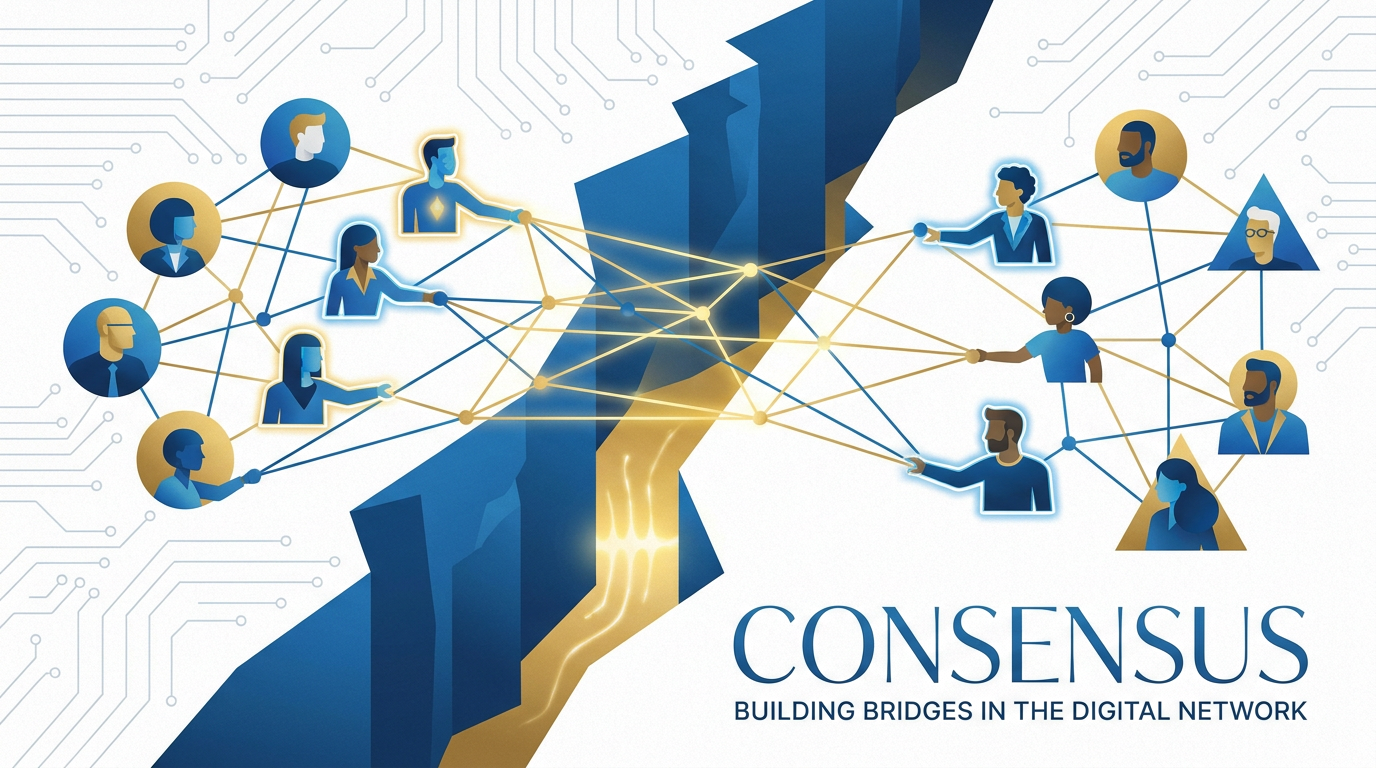
Bridging algorithms solve this vulnerability by fundamentally changing the math behind how votes are counted. Instead of simply asking, "How many total people liked this?", these systems ask a much more sophisticated question: "Who exactly is liking this?" The algorithm's primary goal is to identify content that earns genuine approval from users who typically disagree with one another. By shifting the focus from the volume of engagement to the diversity of the engagement, bridging algorithms filter out partisan cheerleading and elevate information that holds up across different worldviews.[5][7]

Under the hood, these systems rely on a complex mathematical technique known as matrix factorization. The algorithm continuously analyzes the voting history of all users on the platform to identify "latent factors"—hidden behavioral patterns that group users into ideological clusters. Importantly, the system does not ask for a user's political party, nor does it scan their posts for keywords. It only knows that User A and User B almost never upvote the same fact-checks. By mapping these historical disagreements, the algorithm builds a multidimensional map of the community's divides.[5]
The magic of the bridging algorithm happens when a piece of content successfully spans that established divide. If a proposed fact-check or contextual note receives upvotes from both User A's cluster and User B's cluster, the algorithm recognizes a rare moment of cross-partisan consensus. It interprets this as a strong signal that the note is universally helpful, factual, and well-reasoned, rather than just another piece of partisan ammunition. Only when this specific cross-ideological threshold is met is the note elevated and published for the broader public to see.[1][5]
The most prominent and widely studied deployment of this technology is X's Community Notes feature, which replaced the platform's traditional moderation team. When a contributor proposes a contextual note for a potentially misleading post, that note remains completely hidden from the public. It is only visible to other contributors, who rate it as helpful or unhelpful. The note remains invisible until it crosses a specific "helpfulness" threshold—a score that is driven entirely by the bridging algorithm's demand for cross-partisan agreement.[1]
The most prominent and widely studied deployment of this technology is X's Community Notes feature, which replaced the platform's traditional moderation team.
The real-world results of this algorithmic shift have been striking. According to a comprehensive study published in the Proceedings of the National Academy of Sciences (PNAS), notes selected by the bridging algorithm had a massive impact on the spread of false information. The researchers found that the presence of a community-approved note reduced users' likelihood of liking or reposting the misleading content by 25 to 34 percent, effectively breaking the viral momentum of fake news before it could reach a wider audience.[2]

Furthermore, the social friction of being corrected by a diverse community—rather than a faceless corporate moderator—appears to change user behavior at the source. Researchers at the University of Rochester conducted a natural experiment comparing posts with public notes against those where notes remained hidden. They found that authors of misleading posts were 32 percent more likely to voluntarily delete their own content when a public Community Note was attached, suggesting that peer-driven correction carries a unique psychological weight.[1]
The psychological framing of these systems is vital to their success. Because the corrections are presented neutrally as "readers added context," they bypass the defensive, tribal reflexes that are so often triggered by traditional moderation labels. This collaborative framing builds immense trust among users. A rigorous review of COVID-19 related notes—a highly polarized topic—found them to be 97 percent accurate when evaluated by medical professionals, proving that decentralized crowds can rival expert analysis when the right algorithmic incentives are firmly in place.[5]
The potential of bridging algorithms extends far beyond the realm of social media fact-checking. Civic technology platforms like Pol.is use similar mathematical principles to facilitate large-scale democratic consultations. In Taiwan, Pol.is has been deployed to map out public opinion on contentious digital policies, visually clustering users based on their votes and specifically highlighting the nuanced policy statements that bridge the gaps between opposing camps. This allows lawmakers to draft legislation based on actual consensus rather than assumed division.[6][7]
However, the system is not without its significant vulnerabilities. A comprehensive analysis conducted by the Institute for Strategic Dialogue (ISD) identified a critical limitation in the model, which researchers have dubbed the "Trust-Consensus Paradox." The paradox highlights that the very mechanism that makes bridging algorithms so trustworthy—the strict requirement for cross-partisan agreement—also makes them inherently sluggish and unresponsive during fast-moving crises. When a topic is highly controversial, getting opposing sides to agree on a set of facts is a painstaking process.[3]
Because it takes time for a diverse enough group of users to see, evaluate, and agree on a proposed note, the ISD found a median delay of 15 hours between a misleading post going live and a helpful note finally appearing. In the hyper-viral ecosystem of modern social media, 15 hours is an eternity. The vast majority of a post's views, likes, and shares happen in its first few hours, meaning the bridging algorithm often arrives long after the damage has been done.[3]

The paradox deepens significantly when dealing with highly polarizing topics. If a piece of misinformation is perfectly engineered to trigger intense partisan loyalty, the algorithm may never find the cross-ideological consensus required to publish a correction. In these highly charged cases, the bridging requirement effectively paralyzes the moderation system. Because the algorithm refuses to publish without diverse support, it can leave obvious and harmful falsehoods completely unchecked simply because the community is too divided to agree on basic reality.[3]
Even when consensus is successfully reached, it can be remarkably fragile. A 2026 study presented at The Web Conference analyzed over 430,000 Community Notes and found that 30 percent of displayed notes eventually lose their "helpful" status and disappear from public view. The researchers discovered that once a note becomes public, it often attracts a swarm of highly partisan users who coordinate to downvote it, destabilizing the initial consensus and forcing the algorithm to retract the correction.[4]
To combat this post-display polarization and address the speed limitations, researchers suggest that platforms will need to evolve toward hybrid moderation models. By combining the rapid response capabilities of professional, institutional fact-checkers for acute viral threats with the long-tail trust-building of community bridging algorithms, platforms could theoretically cover both the immediate viral spikes and the slow-burn narrative shifts. This layered approach would ensure that dangerous misinformation is caught quickly, while still allowing the community to build consensus over time.[3][4]
Despite these growing pains and technical hurdles, the rise of bridging algorithms represents a profoundly optimistic shift in how we build and manage digital spaces. For the first time at scale, platforms are proving that technology does not have to be a mirror reflecting our deepest divisions. By intentionally coding for common ground, we can engineer an internet that actually helps us understand one another, offering a powerful antidote to the outrage economy and paving the way for a more collaborative digital future.[7]
How we got here
Jan 2021
Twitter launches Birdwatch, an early prototype of community-driven fact-checking.
Nov 2022
Birdwatch is rebranded to Community Notes and expanded globally.
2023 - 2024
Academic studies confirm the bridging algorithm successfully reduces engagement with misinformation.
April 2025
Meta begins replacing its third-party fact-checking program with a similar community-driven model.
Early 2026
Researchers identify the 'Trust-Consensus Paradox,' highlighting the speed limitations of consensus models.
Viewpoints in depth
Algorithmic Optimists
Researchers who view bridging algorithms as a highly effective, scalable solution to misinformation.
This camp points to the hard data showing that community-driven notes actively change user behavior. By requiring cross-partisan agreement, bridging algorithms bypass the defensive reflexes that users often exhibit when corrected by top-down institutional fact-checkers. They argue that the 32 percent increase in post deletions and the high accuracy rates prove that crowds can self-regulate when given the right mathematical incentives.
System Auditors
Analysts focused on the vulnerabilities and blind spots of consensus-based moderation.
Auditors warn that the system's greatest strength is also its fatal flaw. Because bridging algorithms require agreement from opposing ideological clusters, they are inherently slow, taking a median of 15 hours to publish a note. Furthermore, on highly polarizing topics where consensus is impossible, the algorithm fails to act at all, allowing obvious falsehoods to spread unchecked. They advocate for hybrid models that keep professional fact-checkers in the loop.
Civic Technologists
Advocates for using bridging algorithms to enhance democratic participation and policy-making.
For this group, fact-checking is just the beginning. They focus on platforms like Pol.is, which use bridging algorithms to map public opinion and find consensus on contentious civic issues. They argue that if we can code algorithms to find common ground on social media, we can use the same technology to draft better legislation, resolve community disputes, and rebuild trust in democratic institutions.
What we don't know
- Whether bridging algorithms can be optimized to act faster without losing the cross-partisan trust they rely on.
- How effectively these algorithms will scale across different languages and cultural contexts outside of the US and Europe.
Key terms
- Bridging Algorithm
- A recommendation system that prioritizes content receiving positive feedback from users who typically disagree with one another.
- Matrix Factorization
- A mathematical technique used by algorithms to uncover hidden patterns or 'latent factors' in how users vote, identifying ideological clusters.
- Engagement Algorithm
- The traditional social media model that promotes content based on raw interactions like clicks and shares, often rewarding polarizing material.
- Trust-Consensus Paradox
- The phenomenon where requiring broad cross-partisan agreement makes fact-checks highly trusted but too slow to catch rapidly spreading misinformation.
Frequently asked
Do bridging algorithms censor content?
No. They do not remove posts; instead, they attach context or elevate helpful notes when diverse groups of users agree on the facts.
How does the system know my political beliefs?
It doesn't ask for your politics. It looks at your voting history on notes and groups you with users who vote similarly, identifying ideological clusters mathematically.
Can coordinated groups manipulate the votes?
It is difficult. Because the algorithm requires agreement from historically opposed clusters, a coordinated attack by one ideological group will not trigger a note's publication.
Sources
Source coverage
7 outlets
3 viewpoints surfaced







[1]University of RochesterAlgorithmic Optimists
The most effective online fact-checkers? Your peers
Read on University of Rochester →[2]PNASAlgorithmic Optimists
Community notes reduce engagement with and diffusion of false information online
Read on PNAS →[3]Institute for Strategic DialogueSystem Auditors
The trust-consensus paradox: why decentralized fact-checking faces challenges on polarizing topics
Read on Institute for Strategic Dialogue →[4]The Web Conference (WWW '26)System Auditors
Consensus Stability of Community Notes on X
Read on The Web Conference (WWW '26) →[5]LSE Impact BlogAlgorithmic Optimists
Do Community Notes work?
Read on LSE Impact Blog →[6]Computational Democracy ProjectCivic Technologists
Testing Deliberative Technologies to Identify Optimal Use
Read on Computational Democracy Project →[7]Factlen Editorial TeamCivic Technologists
Synthesis by Factlen editorial team
Read on Factlen Editorial Team →
Every angle. Every day.
Get meta stories with full source coverage and perspective breakdowns delivered to your inbox.