
How Neuroaesthetics is Turning Interior Design into a Science of Well-Being
Advances in brain imaging are proving that interior design choices directly alter our biology. The emerging field of neuroaesthetics is transforming how homes and offices are built to lower stress and improve mental health.
By Factlen Editorial Team
- Evidence-Based Designers
- Argue that interior design should be treated as a clinical health prescription backed by biometric data.
- Public Health Advocates
- View neuroarchitecture as a critical tool for preventative mental healthcare and collective resilience.
- Traditional Aesthetes
- Value the scientific validation but caution against reducing the artistic soul of design to pure biological algorithms.
What's not represented
- · Low-Income Housing Developers
- · Neurodivergent Individuals
Why this matters
By understanding how light, texture, and geometry physically alter brain chemistry, you can design your home to actively lower your daily stress, improve your sleep, and boost your mental health.
Key points
- Neuroaesthetics uses brain imaging to prove that interior design directly impacts physical and mental health.
- Thoughtfully designed spaces can reduce stress hormones by up to 20 percent.
- Biodynamic lighting that mimics the sun is crucial for maintaining healthy circadian rhythms.
- Curvilinear shapes and natural wood textures activate the brain's pleasure and comfort centers.
- The interior design industry is shifting from intuitive aesthetics to evidence-based health prescriptions.
Humans evolved outdoors, spending millennia in constant dialogue with shifting light, moving air, and natural textures. Yet today, the average person spends nearly 90 percent of their life inside static, climate-controlled boxes. The mismatch between our evolutionary biology and modern indoor environments is profound, subtly taxing our nervous systems in ways we are only just beginning to understand.[2][6]
For decades, interior design was treated as a purely aesthetic or functional pursuit. It was a matter of matching fabrics, maximizing square footage, or satisfying an architect's creative ego. If a room felt "off," it was considered a subjective failure of taste rather than a biological hazard.[2][6]
That paradigm is shifting rapidly. Enter neuroaesthetics: the scientific study of how beauty, nature, and spatial design physically alter our brains and bodies. By merging neuroscience with architecture, researchers are proving that our environments are not just passive backdrops to our lives, but active participants in our biological well-being.[5][6]
The concept traces its roots back to the mid-20th century. When virologist Jonas Salk was struggling to develop the polio vaccine, he retreated to the historic city of Assisi, Italy. He credited the city's classical architecture and serene environment with clearing his mental block and allowing his ideas to flow.[6]
Convinced that the built environment could actively foster creativity and focus, Salk partnered with architect Louis Kahn to build the Salk Institute in 1965. It became the foundational monument of what is now called neuroarchitecture—the application of neuroaesthetics to the spaces we inhabit.[6]
Today, the field has moved from anecdotal intuition to hard clinical data. Advances in functional magnetic resonance imaging (fMRI) and wearable biometric sensors allow scientists to measure exactly what happens to the human body when it encounters specific design elements.[5][6]
The biological responses are immediate and measurable. Thoughtfully designed spaces can trigger a 15 to 20 percent reduction in stress hormones like cortisol. Heart rates slow, blood pressure drops, and the brain releases serotonin and dopamine, creating the physiological foundation for why a room simply feels good to be in.[5]

At the forefront of this research is the International Arts + Mind Lab (IAM Lab) at Johns Hopkins University. Led by Susan Magsamen, the lab treats aesthetics not as a luxury, but as a fundamental biological need that can enhance human potential and accelerate healing across populations.[1][3]
At the forefront of this research is the International Arts + Mind Lab (IAM Lab) at Johns Hopkins University.
One of the most critical elements studied by neuroaesthetics is light. Light is the primary synchronizer of the human circadian rhythm. A home or office that ignores natural light cycles effectively condemns its occupants to chronic fatigue, disrupted sleep, and elevated anxiety.[1][6]
To combat this, evidence-based designers are implementing biodynamic lighting. These systems emulate the sun, shifting from cool, blue-toned light in the morning to stimulate alertness, to warm, amber tones in the evening to promote melatonin production and prepare the brain for rest.[6]

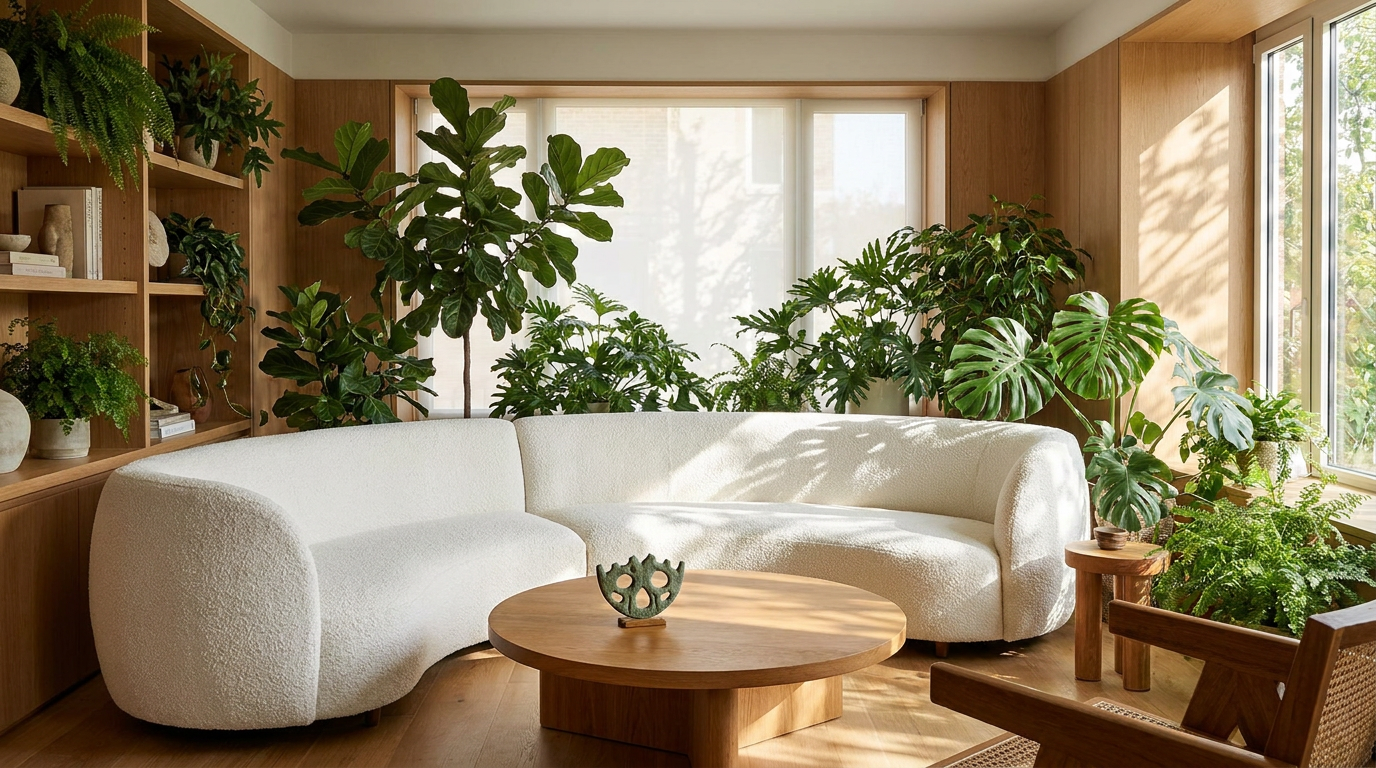
Texture and geometry also play a surprisingly powerful role in brain chemistry. Studies show that the human brain processes sharp, jagged angles as subtle threats, triggering low-level anxiety. In contrast, curvilinear spaces and rounded furniture activate the brain's pleasure centers.[6]
Materiality matters just as much. When people touch or even look at natural wood grain or woven fabrics, it stimulates the somatosensory cortex, producing feelings of warmth and belonging. This is the scientific backbone of biophilic design—the practice of weaving nature back into the built environment.[4][6]
The National Institutes of Health has documented the broad-spectrum therapeutic effects of biophilic design. Visual access to greenery, indoor plants, and natural light has been shown to lower anxiety, improve working memory, and even accelerate patient recovery times in hospitals.[4]

The implications for commercial and residential real estate are staggering. In the workplace, neuroaesthetic principles are being used to reduce employee burnout and boost cognitive performance. In healthcare, "spatial prescriptions" are being developed to help patients heal faster by manipulating their physical surroundings.[1][2]
But the most intimate application remains the home. Designers are increasingly acting as alternative health resources, moving away from conversations about fleeting trends and focusing instead on how a bedroom's acoustics or a living room's layout can regulate a client's nervous system.[2][5]
Soft, natural tones like muted greens and blues have been clinically shown to calm the psyche, while vibrant reds and yellows stimulate energy. By mapping these responses, designers can craft specific emotional ecosystems for different areas of a house, tailoring the environment to the exact needs of the inhabitants.[6]

How we got here
1965
Jonas Salk and Louis Kahn open the Salk Institute, pioneering the concept of neuroarchitecture.
Late 1990s
Advances in fMRI technology allow scientists to measure the brain's real-time physiological response to beauty.
2019
Johns Hopkins University and Google debut 'A Space for Being,' an installation proving design's physical effect on the body.
2026
Neuroaesthetics becomes a formalized certification for interior designers, shifting the industry toward evidence-based health outcomes.
Viewpoints in depth
Evidence-Based Designers
Professionals who view interior design as a measurable health intervention.
This camp argues that the era of designing purely for visual appeal is over. Armed with fMRI data and biometric sensors, these designers treat space as a clinical prescription. They prioritize measurable outcomes—like lowered blood pressure, reduced cortisol, and improved sleep metrics—over subjective artistic expression, believing that designers have a biological responsibility to their clients.
Public Health Advocates
Experts focused on the built environment's role in population-level wellness.
For public health officials and researchers, neuroarchitecture is a scalable tool for preventative care. Because humans spend 90 percent of their time indoors, optimizing these environments with biophilic design and circadian lighting is seen as a highly effective way to combat chronic societal stress, accelerate hospital recovery times, and improve collective resilience without relying solely on medication.
Traditional Aesthetes
Designers who value scientific validation but protect the artistic soul of the craft.
While welcoming the validation that their work improves lives, traditionalists caution against reducing interior design to a purely biological algorithm. They argue that the magic of a beautifully curated room cannot always be captured by a heart-rate monitor, and that intuition, cultural context, and personal expression remain vital components of creating a home that truly resonates with its owner.
What we don't know
- How to effectively scale these neuroaesthetic principles into affordable, low-income housing developments.
- The precise long-term neurological impacts of spending decades in environments entirely devoid of biophilic elements.
Key terms
- Neuroaesthetics
- The scientific study of how beauty, art, and design physically affect the brain and body.
- Neuroarchitecture
- The application of neuroscience to the built environment to optimize spaces for human health and behavior.
- Biophilic Design
- An approach that incorporates natural materials, light, and plants to reconnect humans with nature indoors.
- Biodynamic Lighting
- Artificial lighting systems designed to mimic the natural progression of sunlight to support circadian rhythms.
- Somatosensory Cortex
- The area of the brain that processes sensory input like touch and texture, activated by natural materials like wood.
Frequently asked
Do I need expensive furniture to apply neuroaesthetics?
No. Simple changes like maximizing natural light, decluttering, and adding house plants can significantly lower cortisol levels without a major budget.
How does room shape affect mood?
Brain imaging shows that curvilinear spaces and rounded edges activate areas associated with pleasure, while sharp angles can trigger subtle stress responses.
Is this just another term for color psychology?
While color is a factor, neuroaesthetics goes much deeper, using medical imaging to measure how light, texture, acoustics, and spatial layout physically alter heart rate and brain chemistry.
Sources
Source coverage
6 outlets
3 viewpoints surfaced






[1]Design MilkTraditional Aesthetes
John Hopkins University's IAM Lab publishes a report calling for the development of a new interdisciplinary Neuroarchitecture sector
Read on Design Milk →[2]Untapped JournalTraditional Aesthetes
Are Architects Paying Attention Yet? The state of design and its intersection with the science of human experience
Read on Untapped Journal →[3]Johns Hopkins MedicinePublic Health Advocates
Center for Applied Neuroaesthetics
Read on Johns Hopkins Medicine →[4]National Institutes of HealthPublic Health Advocates
Integrating digital health and biophilic design
Read on National Institutes of Health →[5]Science in DesignEvidence-Based Designers
Interior Design Education in Neuroaesthetics, Biophilia & Health-Based Design
Read on Science in Design →[6]Factlen Editorial TeamEvidence-Based Designers
Synthesis by Factlen editorial team
Read on Factlen Editorial Team →
Every angle. Every day.
Get home stories with full source coverage and perspective breakdowns delivered to your inbox.