
The Science of the Maillard Reaction: How Heat and Chemistry Create Flavor
The secret to restaurant-quality food lies in the Maillard reaction, a chemical cascade that transforms proteins and sugars into complex flavors. Understanding how to manage heat and moisture can drastically elevate your home cooking.
By Factlen Editorial Team
- Food Scientists
- Focus on the precise molecular pathways, temperature thresholds, and pH levers that dictate flavor compound generation.
- Modernist Cooks
- Advocate for manipulating the reaction through chemical interventions to maximize flavor without overcooking.
- Culinary Traditionalists
- Rely on sensory cues like the sound of the sizzle and the smell of the pan rather than exact thermometry.
What's not represented
- · Dietary Health Advocates (focusing on acrylamides)
Why this matters
Understanding the Maillard reaction is the single most effective way to elevate your home cooking. By mastering the science of heat and moisture, you can reliably transform bland ingredients into restaurant-quality meals with deep, complex flavors.
Key points
- The Maillard reaction is a chemical process between amino acids and reducing sugars that creates complex savory flavors.
- Rapid browning requires surface temperatures between 285°F and 330°F.
- Surface moisture prevents browning because water cannot exceed 212°F without turning to steam.
- Unlike caramelization, which only involves sugars, the Maillard reaction requires proteins.
- Alkaline environments, such as those created by baking soda or lye, drastically accelerate the browning process.
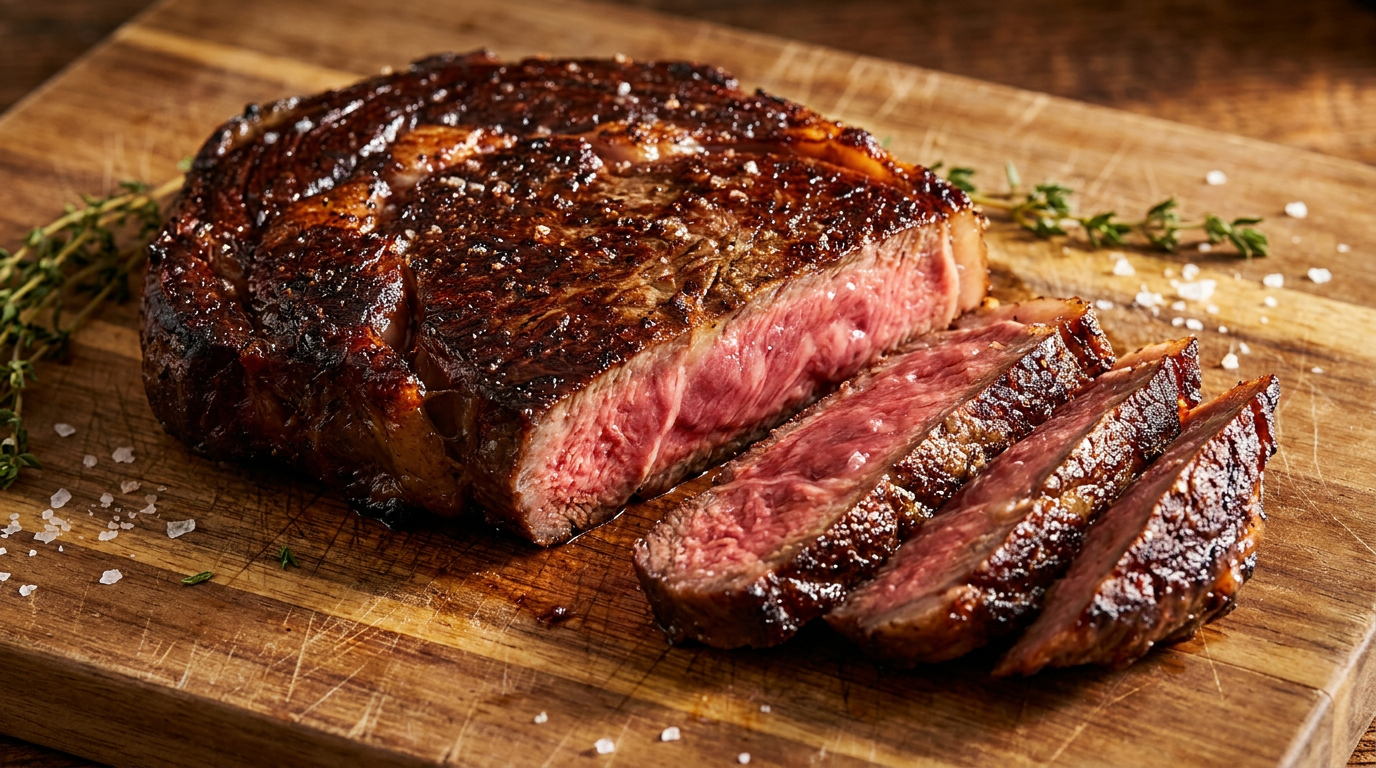
The sensory difference between a boiled steak and a seared one is profound. One is gray, rubbery, and bland; the other boasts a rich, mahogany crust that smells of roasted nuts and savory depth. This transformation is not magic, nor is it simply the result of "sealing in the juices." It is the product of the most important chemical process in the culinary arts: the Maillard reaction. Understanding this mechanism is the single most effective way to elevate home cooking from adequate to exceptional.[1][6]
First described in 1912 by French chemist Louis-Camille Maillard, the reaction was initially discovered while he was attempting to reproduce protein synthesis in a laboratory. He observed that when amino acids and sugars were heated together, the mixture turned brown and emitted complex aromas. Today, food scientists recognize this non-enzymatic browning as the engine behind the flavor of baked bread, roasted coffee, toasted marshmallows, and seared meats.[3][6]
At its core, the Maillard reaction is a condensation reaction between the free amino group of an amino acid (the building blocks of proteins) and the carbonyl group of a reducing sugar, such as glucose or fructose. When subjected to heat, these molecules fuse to form an unstable intermediate called a glycosylamine. This compound rapidly undergoes a structural shift known as the Amadori rearrangement, kicking off a cascading chain of secondary chemical reactions.[3]
The final output of this cascade is not a single compound, but a chaotic, beautiful mixture of hundreds of volatile and non-volatile molecules. These include pyrazines, which deliver nutty and roasted notes; furans, which provide sweet, caramel-like aromas; and diacetyl, which imparts a rich buttery flavor. Simultaneously, the reaction produces melanoidins—large, brown, non-volatile polymers that give cooked foods their characteristic dark crust.[3][6]

While the chemistry of the Maillard reaction can technically occur at room temperature—slowly developing the complex flavors of aged cheeses or black garlic over months—it requires significant heat to happen on a practical cooking timescale. The reaction rate roughly doubles for every 10 degrees Celsius it increases. In a kitchen setting, browning becomes practically rapid only when the surface temperature of the food reaches the window of 285°F to 330°F (140°C to 165°C).[1][3]
This temperature threshold introduces the greatest enemy of the Maillard reaction: moisture. Because water boils and turns to steam at 212°F (100°C) at sea level, any liquid water present on the surface of food acts as a thermal ceiling. As long as the surface is wet, its temperature cannot climb high enough to trigger rapid browning. The heat energy is entirely consumed by the phase change of water into steam, effectively boiling the food in its own juices.[1][5]
This temperature threshold introduces the greatest enemy of the Maillard reaction: moisture.
This physics principle dictates one of the most crucial rules of cooking: ingredients must be dry before they hit the pan. Patting a steak dry with a paper towel removes surface moisture, allowing the meat's exterior to immediately cross the 285°F threshold upon contacting hot oil. Conversely, overcrowding a skillet traps the steam released by the cooking food, blanketing the ingredients in a humid microclimate that suppresses the Maillard reaction entirely.[1][2]
A common point of confusion in the kitchen is the distinction between the Maillard reaction and caramelization. While both processes result in browning and are triggered by heat, they are fundamentally different chemical events. Caramelization is the thermal decomposition of sugars in the strict absence of proteins. It requires higher temperatures to initiate—typically around 320°F (160°C) for standard table sugar (sucrose)—and yields a purely sweet, nutty, and slightly bitter flavor profile.[2][4]

The Maillard reaction, by contrast, absolutely requires the presence of amino acids. It is the interaction between these proteins and sugars that generates the savory, meaty, and complex "umami" notes that caramelization alone cannot produce. In many culinary applications, such as baking a chocolate chip cookie or roasting carrots, both reactions occur simultaneously, layering sweet caramel notes over a savory Maillard foundation.[3][4]
Beyond heat and moisture, cooks can manipulate the Maillard reaction by adjusting the pH of the cooking environment. The reaction proceeds significantly faster in alkaline (basic) conditions. This chemical quirk is famously exploited in the creation of traditional Bavarian pretzels, which are dipped in a highly alkaline lye solution before baking. The elevated pH supercharges the amino acids on the dough's surface, resulting in a deep mahogany crust in minutes.[3][6]
Home cooks can utilize this alkaline hack safely by employing baking soda. Adding a small pinch of baking soda to a pot of sliced onions will drastically accelerate their browning, reducing the time required to make deeply flavored caramelized onions. Similarly, a touch of baking soda in a pressure cooker can help brown the vegetables for a pureed soup, developing roasted flavors even in a wet environment.[1][6]

However, the pursuit of the perfect crust has an upper limit. If the temperature of the food exceeds 355°F (180°C), the Maillard reaction gives way to pyrolysis—the chemical decomposition of organic material by extreme heat. Pyrolysis destroys the delicate flavor compounds generated earlier, replacing them with harsh, bitter, and acrid notes. Visually, the food transitions from a rich brown to a charred black.[1][3]
Managing this delicate balance between moisture, temperature, and time is the hallmark of culinary mastery. Modernist techniques, such as searing a steak with a high-output blowtorch or deep-frying it for a few seconds before a low-temperature sous-vide bath, are entirely designed around optimizing the Maillard reaction while minimizing internal overcooking.[1][7]
Ultimately, the kitchen is a laboratory, and every meal is an experiment in applied chemistry. By understanding that browning is not simply a color change but a complex molecular cascade, cooks can stop relying on guesswork. Controlling surface moisture, managing pan temperatures, and knowing when to leverage pH adjustments transforms the Maillard reaction from a happy accident into a reliable, repeatable tool for building profound flavor.[7]
Viewpoints in depth
Food Scientists
Focus on the precise molecular pathways and chemical levers of flavor.
For food scientists, cooking is an exercise in applied chemistry. They view the Maillard reaction not as a single event, but as a complex cascade of molecular rearrangements. By isolating variables like pH, reducing sugar types, and exact temperature thresholds, they seek to map the exact pathways that produce specific volatile compounds, allowing for the precise engineering of flavors in both home and commercial kitchens.
Modernist Cooks
Advocate for manipulating the reaction through technological and chemical interventions.
The modernist culinary movement embraces the science of browning to bypass traditional cooking limitations. These chefs utilize tools like blowtorches, precise immersion circulators (sous-vide), and alkaline washes to decouple the browning of the exterior from the cooking of the interior. Their goal is to maximize the Maillard reaction's flavor generation without sacrificing the perfect texture of the underlying food.
Culinary Traditionalists
Rely on sensory cues and classic techniques to achieve the perfect sear.
Traditional chefs and home cooks often achieve perfect Maillard browning without ever measuring surface temperatures. They rely on deeply ingrained sensory feedback: the aggressive sizzle that indicates moisture has evaporated, the visual gradient of the crust turning from golden to mahogany, and the distinct roasted aroma that signals the reaction is peaking. For them, mastering the pan is an intuitive art rather than a strict chemical formula.
What we don't know
- While the primary pathways of the Maillard reaction are understood, the exact composition of the hundreds of trace volatile compounds produced varies wildly depending on the specific food matrix.
- Food scientists are still mapping the precise molecular structure of many melanoidins, the complex brown pigments generated at the end of the reaction.
Key terms
- Maillard reaction
- A chemical reaction between amino acids and reducing sugars that gives browned food its distinctive flavor.
- Caramelization
- The thermal decomposition of sugars under high heat, producing sweet, nutty flavors without the involvement of proteins.
- Melanoidins
- The brown, high-molecular-weight polymers formed at the end of the Maillard reaction that give cooked foods their dark color.
- Reducing sugar
- A type of sugar, such as glucose or fructose, that has a free reactive group capable of interacting with amino acids.
- Pyrolysis
- The chemical decomposition of organic materials at elevated temperatures, commonly recognized in cooking as burning or charring.
Frequently asked
Why doesn't boiled food turn brown?
Water boils at 212°F (100°C), which caps the surface temperature of the food. The Maillard reaction requires temperatures around 285°F (140°C) to occur rapidly.
Is the Maillard reaction the same as caramelization?
No. Caramelization is the breakdown of sugars alone under high heat. The Maillard reaction requires both sugars and amino acids (proteins) to interact.
How can I speed up browning in the kitchen?
Pat your ingredients completely dry before cooking, ensure your pan is preheated, and consider adding a tiny pinch of baking soda to increase the pH.
Does the Maillard reaction only happen at high heat?
It can happen at room temperature, but it takes months or years. Aged cheeses and black garlic develop their complex flavors through slow Maillard reactions.
Sources
Source coverage
7 outlets
3 viewpoints surfaced







[1]Modernist CuisineFood Scientists
The Maillard Reaction
Read on Modernist Cuisine →[2]Food RepublicCulinary Traditionalists
The Real Difference Between The Maillard Reaction And Caramelization
Read on Food Republic →[3]Formul.ioFood Scientists
Maillard Reaction vs Caramelization: Temperatures Compared
Read on Formul.io →[4]ChowhoundCulinary Traditionalists
What's The Difference Between The Maillard Reaction And Caramelization?
Read on Chowhound →[5]Science FareCulinary Traditionalists
Frying, boiling and the Maillard reaction
Read on Science Fare →[6]Nutrition Therapy InstituteFood Scientists
The Maillard Reaction: Why Food Tastes So Good
Read on Nutrition Therapy Institute →[7]Factlen Editorial TeamModernist Cooks
Synthesis by Factlen editorial team
Read on Factlen Editorial Team →
Every angle. Every day.
Get food drink stories with full source coverage and perspective breakdowns delivered to your inbox.