
The 2026 Guide to Motorcycle ARAS: How Radar and AI Are Transforming Rider Safety
Advanced Rider Assistance Systems (ARAS) are moving from premium touring bikes to the mainstream, bringing adaptive cruise control, blind-spot detection, and multi-sensory alerts to two wheels.
By Factlen Editorial Team
- Industry Analysts & Media
- Focus on market adoption, integration challenges, and the evolution of the riding experience.
- Safety System Developers
- Focus on sensor fidelity, AI predictive analytics, and the ultimate goal of zero motorcycle fatalities.
- Motorcycle Manufacturers
- Focus on integrating safety tech seamlessly without compromising the bike's aesthetic or performance.
What's not represented
- · Insurance Companies
- · Motorcycle Training Instructors
Why this matters
For decades, motorcycle safety relied entirely on passive gear and human reflexes. The arrival of miniaturized radar and AI assistance means riders can now buy bikes that actively predict and prevent collisions, fundamentally changing the risk calculation of riding.
Key points
- Advanced Rider Assistance Systems (ARAS) use miniaturized radar and AI to provide 360-degree safety monitoring for motorcycles.
- New features like Group Ride Assist allow adaptive cruise control to function safely within staggered motorcycle formations.
- Multi-sensory alerts combining visual LEDs and auditory helmet warnings are solving the challenge of communicating with riders at highway speeds.
- While currently limited to premium models, the technology is expected to trickle down as sensor costs decrease.
Motorcycling has always been an exercise in raw physics and rider intuition, relying heavily on human reflexes to navigate a chaotic and often inattentive road environment. But as the industry moves deeper into 2026, the landscape of two-wheeled safety is undergoing a fundamental shift from passive protection to active accident prevention. For decades, the pinnacle of motorcycle safety meant better helmets, abrasion-resistant leathers, and anti-lock brakes. Today, the focus has shifted to intelligent systems designed to predict and avoid collisions before the rider even needs to brace for impact.[5]
The catalyst for this transformation is the rapid maturation of Advanced Rider Assistance Systems (ARAS). Originally developed to keep passenger cars in their lanes and out of rear-end collisions, these sensor suites have been painstakingly adapted to handle the unique dynamics of motorcycles. Unlike a car, a motorcycle leans into corners, rapidly changes pitch under hard acceleration, and occupies a much smaller footprint on the asphalt. Translating automotive safety algorithms to a vehicle that relies on gyroscopic stability required a complete rethinking of how sensors interpret the road.[5][6]
At the heart of modern ARAS is a network of miniaturized radar sensors, high-definition cameras, and artificial intelligence. Companies like Bosch and Continental have developed second-generation radar units that are specifically tailored for the physical constraints of two wheels. These new sensors are 30 percent smaller, significantly lighter, and more power-efficient than their predecessors, allowing motorcycle designers to seamlessly integrate them into front fairings and rear fenders without ruining the bike's aerodynamics or aggressive aesthetic appeal.[3]
These sensors feed a constant stream of real-time data to the motorcycle's Engine Control Unit (ECU) and Inertial Measurement Unit (IMU), creating a 360-degree digital safety net around the rider. By continuously monitoring the speed and trajectory of surrounding traffic, the system can anticipate hazards that the human eye might miss. According to accident research estimates from Bosch, the widespread adoption of radar-based assistance systems could eventually prevent one in six motorcycle accidents globally.[1][6]

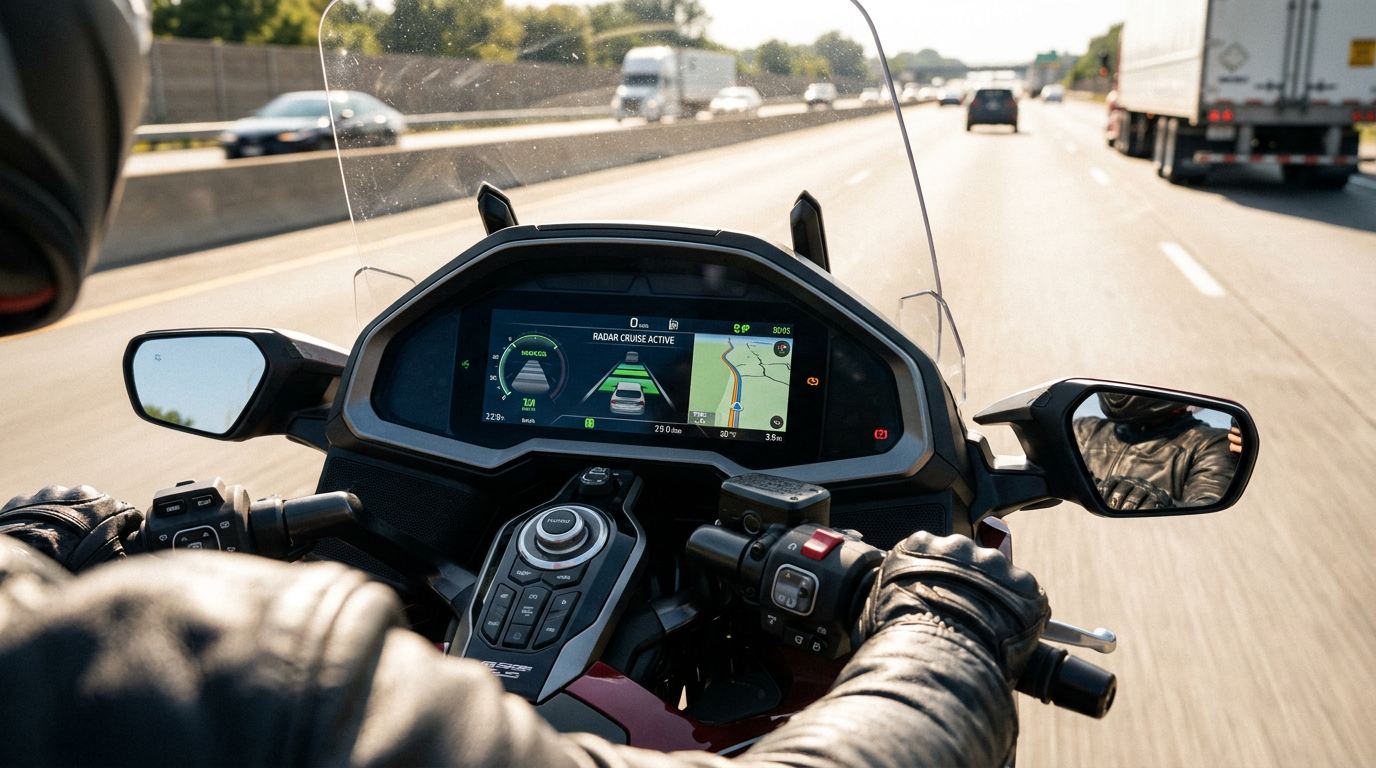
The most prominent and widely adopted feature of this technological wave is Adaptive Cruise Control (ACC). While early iterations of motorcycle ACC simply maintained a set distance from the vehicle ahead on open highways, the 2026 generation introduces sophisticated Stop-and-Go functionality. This allows the motorcycle to handle the tedious micro-adjustments required in heavy, crawling traffic, significantly reducing the mental and physical fatigue that often leads to rider errors at the end of a long touring day.[3]
This Stop-and-Go capability is particularly transformative when paired with the new Automated Manual Transmissions (AMT) appearing on flagship adventure bikes, such as the 2025 KTM Super Adventure S. With the system engaged, the motorcycle can autonomously bring itself to a complete halt behind a stopping car. When traffic begins to move again, the rider simply presses a confirmation button on the switchgear, and the bike smoothly accelerates back to the target speed without the rider ever needing to touch the clutch or throttle.[3]
However, early ACC systems struggled with a deeply ingrained motorcycling tradition: group riding. Because automotive radar algorithms are designed to track a vehicle in the center of the lane, they would become confused by the staggered formations that motorcycle groups use to maximize visibility and braking distance. If a rider engaged standard ACC in a group, the radar might lock onto a distant car rather than the offset motorcycle immediately ahead.[1][3]
However, early ACC systems struggled with a deeply ingrained motorcycling tradition: group riding.
To solve this specific two-wheeled problem, Bosch introduced Group Ride Assist (GRA). Using advanced algorithms and a new radar chirp sequence that provides higher fidelity measurements of distance and angle, the system can now track multiple motorcycles simultaneously. GRA recognizes the staggered pattern of the group and adjusts the bike's speed to maintain a natural, safe distance from the offset riders ahead, allowing touring groups to utilize cruise control without breaking formation.[1][3]

Beyond cruising comfort, ARAS provides critical collision avoidance tools that operate silently in the background until they are desperately needed. Forward Collision Warning (FCW) constantly monitors the closing speed of vehicles ahead, utilizing predictive analytics to assess risk. If the system detects that a frontal impact is imminent, it can automatically prepare the braking system for maximum pressure and deliver a haptic or visual warning to the rider. This intervention gives the motorcyclist precious fractions of a second to initiate evasive maneuvers or apply emergency braking.[4]
Simultaneously, rear-facing radar units enable Blind Spot Detection (BSD) and Rear-end Collision Warning (RCW). If a vehicle enters the rider's blind spot, LED indicators mounted on the mirror stems illuminate to warn against a lane change. If a rear impact is predicted—a terrifying scenario for any motorcyclist stopped at a traffic light—the system can rapidly flash the motorcycle's hazard lights to alert the distracted driver approaching from behind.[4][7]
Communicating these digital threats to a human rider presents a unique and highly specific engineering challenge. Unlike a quiet, climate-controlled car cabin where a driver can easily hear a warning chime, a motorcycle cockpit is a chaotic environment exposed to extreme wind noise, engine vibration, and intense sunlight. A subtle dashboard icon or a quiet beep is entirely useless to a rider traveling at highway speeds while wearing a heavily insulated full-face helmet and protective earplugs. Safety systems must therefore find ways to demand immediate attention without causing the rider to panic or lose control.[2]
Innovators like RiderDome are tackling this Human-Machine Interface (HMI) problem by utilizing multi-sensory alert systems. By combining high-intensity visual LEDs mounted directly in the rider's peripheral vision with auditory warnings piped via Bluetooth into helmet communicators, the system ensures that critical safety alerts cut through the sensory overload of riding. This dual-sensory approach bridges the gap between real-time risk detection and immediate human response.[2]

Currently, these advanced safety systems are largely confined to the upper echelons of the global motorcycle market. Premium touring and heavyweight adventure models—such as the supercharged Kawasaki Ninja H2 SX, the Ducati Multistrada V4 S, and the Indian Chieftain PowerPlus—serve as the industry's early adopters. These high-margin flagship motorcycles are best positioned to absorb the significant research, development, and hardware costs associated with complex radar integration, offering the technology to affluent buyers who prioritize long-distance comfort and safety.[7][8]
Market analysts note that the high cost of radar units, electronic actuators, and complex software remains a significant barrier for entry-level and mid-capacity motorcycles. Price-sensitive consumers in these segments are often unwilling to pay a premium for electronic aids. However, as sensor technology continues to miniaturize and economies of scale take hold across the industry, ARAS is expected to follow the path of ABS, eventually trickling down to everyday commuter bikes.[6]

Looking ahead, the convergence of ARAS with Vehicle-to-Everything (V2X) communication promises to push motorcycle safety even further. By allowing motorcycles to digitally communicate with surrounding cars, traffic lights, and smart infrastructure, riders will soon receive warnings about hazards lurking around blind corners or hidden behind large trucks. This predictive capability effectively gives riders the ability to see through solid objects, mitigating one of the greatest risks of motorcycling: the unseen threat.[6]
While some purists may balk at the idea of a digital co-pilot, the philosophy behind motorcycle ARAS remains distinctly different from automotive autonomy. The goal is not to take control away from the rider or dilute the visceral thrill of the open road. Instead, these systems are designed to enhance situational awareness and provide a critical safety net, ensuring that the freedom of motorcycling doesn't come at the expense of returning home safely.[2][5]
How we got here
2020
Ducati introduces the Multistrada V4, the first production motorcycle equipped with front and rear radar.
2024
Bosch unveils its second-generation radar sensors, reducing size by 30% and adding Group Ride Assist.
2025
Automated Manual Transmissions (AMT) paired with radar enable true Stop-and-Go cruise control on flagship adventure bikes.
2026
ARAS technology begins standardizing across premium touring segments, with manufacturers exploring lane-keeping and V2X integration.
Viewpoints in depth
Safety System Developers
Focus on sensor fidelity, AI predictive analytics, and the ultimate goal of zero motorcycle fatalities.
For technology companies like Bosch and Continental, the motorcycle represents the final frontier of road safety. Because motorcyclists lack the steel cage and crumple zones of a car, developers argue that active accident prevention is the only way to significantly reduce fatalities. Their focus is on increasing sensor fidelity, miniaturizing hardware, and refining AI algorithms to predict human error before it results in a collision. They view ARAS not as a luxury, but as a moral imperative that should eventually become mandated standard equipment, much like ABS.
Motorcycle Manufacturers
Focus on integrating safety tech seamlessly without compromising the bike's aesthetic or performance.
Brands like Kawasaki, KTM, and Indian recognize that their customers buy motorcycles for the visceral thrill and aesthetic appeal of the machine. Their primary challenge is packaging bulky radar units and complex wiring harnesses into sleek fairings without ruining the bike's design. Manufacturers are highly sensitive to rider feedback, ensuring that electronic interventions feel natural and can be easily disabled or adjusted, preserving the raw mechanical connection that defines the motorcycling experience.
Traditionalist Riders
Skeptical of electronic intervention, arguing that relying on screens degrades fundamental riding skills.
A vocal segment of the motorcycling community remains deeply skeptical of ARAS. Traditionalists argue that the essence of riding is self-reliance and hyper-awareness. They express concern that features like adaptive cruise control and blind-spot monitoring will breed complacency, causing riders to rely on digital safety nets rather than performing physical head-checks and maintaining proper following distances. For this camp, the creeping automation of motorcycles threatens to dilute the very freedom they seek on two wheels.
What we don't know
- How quickly the cost of radar hardware will drop enough to make ARAS standard on sub-$10,000 commuter motorcycles.
- Whether future iterations of ARAS will introduce active steering intervention, a feature manufacturers have historically avoided due to the complex physics of leaning.
Key terms
- ARAS
- Advanced Rider Assistance Systems; a suite of electronic safety features designed to help motorcyclists anticipate and avoid hazards.
- Adaptive Cruise Control (ACC)
- A radar-based system that automatically adjusts the motorcycle's speed to maintain a safe distance from the vehicle ahead.
- Blind Spot Detection (BSD)
- A safety feature that uses rear-facing radar to monitor adjacent lanes and alerts the rider to hidden vehicles via mirror-mounted LEDs.
- Inertial Measurement Unit (IMU)
- An electronic device that measures the motorcycle's lean angle, acceleration, and pitch to optimize safety interventions.
- V2X Communication
- Vehicle-to-Everything technology that allows motorcycles to digitally share safety data with other vehicles and traffic infrastructure.
Frequently asked
Can ARAS take control of the motorcycle?
No. Unlike some automotive systems, motorcycle ARAS is designed to enhance rider awareness and provide warnings, leaving the ultimate control and steering entirely to the rider.
Does adaptive cruise control work in group rides?
Yes, newer 2026 systems feature 'Group Ride Assist' which uses advanced algorithms to track multiple motorcycles in a staggered formation without breaking the group's spacing.
Are these safety systems available on affordable bikes?
Currently, radar-based ARAS is mostly found on premium touring and adventure motorcycles due to high component costs, but the technology is expected to trickle down to mid-weight bikes in the coming years.
Sources
Source coverage
8 outlets
3 viewpoints surfaced







[1]Bosch MobilitySafety System Developers
Advanced rider assistance systems: Enhancing safety and convenience for motorcyclists
Read on Bosch Mobility →[2]RiderDomeSafety System Developers
Understanding Motorcycle ARAS and RiderDome's Multi-Sensory Alert System
Read on RiderDome →[3]Cycle WorldIndustry Analysts & Media
Testing Bosch's latest Advanced Rider Assistance Systems
Read on Cycle World →[4]AumovioSafety System Developers
Enhancing Safety and Comfort on Your Motorcycle with Continental ARAS
Read on Aumovio →[5]Nagoya MotorIndustry Analysts & Media
Key Motorcycle Safety Features Expected in 2026
Read on Nagoya Motor →[6]Intel Market ResearchIndustry Analysts & Media
Motorcycle ARAS Market: Trends, Challenges, and V2X Integration
Read on Intel Market Research →Indian Motorcycle Working On Advanced ARAS
Read on Cycle World →[8]KawasakiMotorcycle Manufacturers
Ninja H2 SX: Advanced Rider Assistance Systems (ARAS)
Read on Kawasaki →


Every angle. Every day.
Get shopping stories with full source coverage and perspective breakdowns delivered to your inbox.