
The Green Collar Boom: How Vocational Training is Powering the Renewable Transition
Wind turbine technicians and solar installers are the fastest-growing jobs in the economy, driving a resurgence in vocational training and apprenticeships.
By Factlen Editorial Team
- Labor Economists
- Focuses on the statistical growth, wages, and macroeconomic shifts driven by the renewable transition.
- Global Energy Agencies
- Views the labor market as a mathematical bottleneck to climate goals, emphasizing the need to train millions globally.
- Workforce Developers
- Emphasizes removing barriers to entry through paid apprenticeships and localized vocational training.
- Industry Employers
- Concerned with the acute shortage of specialized labor and the integration of digital skills into physical trades.
What's not represented
- · Fossil fuel workers transitioning to new industries
- · Local community members living near utility-scale projects
Why this matters
The transition to renewable energy is creating millions of high-paying, accessible jobs that do not require a four-year college degree. For workers seeking stable careers and students avoiding massive tuition debt, the skilled green trades offer a lucrative and future-proof pathway.
Key points
- Wind turbine technicians and solar installers are the two fastest-growing occupations in the U.S.
- Global renewable energy employment reached a record 16.6 million in 2024.
- The industry faces a severe labor shortage, with 90% of solar employers struggling to hire.
- Vocational schools are pivoting to 9-month certificates and paid apprenticeships to train workers.
- The International Energy Agency estimates 40 million workers will be needed globally by 2050.
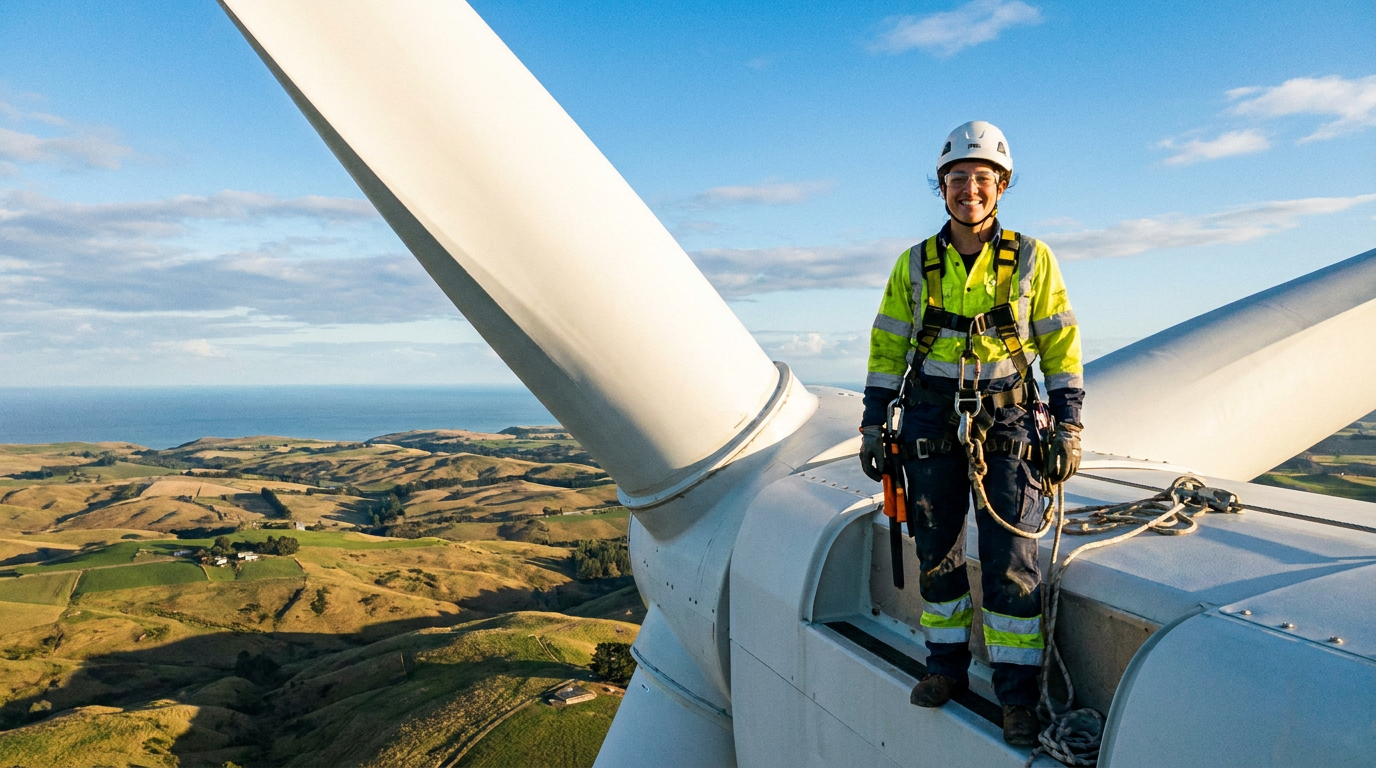
The fastest-growing job in the United States does not require a bachelor's degree, does not take place in an office, and frequently involves climbing 300 feet into the air. As the global economy races to decarbonize, the labor market is undergoing a profound structural shift. The defining career trajectory of the 2020s is not the software developer, but the green-collar tradesperson.[1]
The numbers paint a stark picture of where the modern economy is heading. According to the Bureau of Labor Statistics, employment for wind turbine service technicians is projected to grow by an astonishing 50 percent between 2024 and 2034. Hot on its heels is the role of solar photovoltaic installer, which is expected to expand by 42 percent over the same decade. These two occupations are growing at roughly 14 times the average rate for all U.S. jobs.[2][5][6]
This surge is driven by a combination of massive federal investments, such as the Inflation Reduction Act, and aggressive net-zero pledges from Fortune 500 companies. The transition from fossil fuels to renewable sources is no longer just a policy goal; it is a physical construction megaproject. Building the infrastructure of the 21st century requires a specialized workforce capable of turning blueprints into operational power grids.[1][5]

The day-to-day reality of these roles blends traditional mechanical aptitude with advanced technical diagnostics. Wind turbine technicians are responsible for maintaining the complex hydraulic, braking, and electrical systems housed inside the nacelle at the top of a turbine. Solar installers, meanwhile, must master electrical wiring, structural mounting, and weatherproofing, often while navigating steep residential rooftops or sprawling utility-scale solar farms.[5]
This boom is not confined to the United States. A joint 2026 report by the International Renewable Energy Agency (IRENA) and the International Labour Organization found that the global renewable energy workforce reached a record 16.6 million people in 2024. Solar photovoltaic systems remain the dominant employer worldwide, accounting for 7.3 million of those jobs, heavily concentrated in the Asia-Pacific region.[3]
However, this rapid expansion has created a severe bottleneck: the world is running out of hands to build the transition. In 2024, 90 percent of solar employers reported struggling to fill open construction labor roles. Project developers are finding that while capital is abundant and technology is ready, the sheer lack of trained tradespeople is causing project delays and driving up costs.[8]

The macro-level math is daunting. The International Energy Agency estimates that the global renewable sector will need to train and deploy 40 million workers by 2050 to meet international net-zero targets. If the global community cannot build a workforce capable of deploying clean energy at scale, the physical reality of the energy transition will stall, regardless of how much funding is allocated.[1][4]
To close this gap, the education sector is rapidly pivoting away from traditional four-year degrees toward accelerated vocational models. Trade schools and community colleges are rolling out specialized nine-month certificate programs that cover solar, wind, and geothermal systems. For wind technicians, the Global Wind Organisation has established rigorous international safety and technical training standards, certifying over 190,000 workers globally to handle the unique hazards of the job.[5][8]
To close this gap, the education sector is rapidly pivoting away from traditional four-year degrees toward accelerated vocational models.
Apprenticeships have emerged as the gold standard for green-collar training, offering an "earn-while-you-learn" model that bypasses the student debt crisis. Rather than paying for tuition, workers are hired as pre-apprentices, receiving classroom instruction alongside paid, on-the-job training. This model is particularly effective for drawing workers from adjacent industries, such as traditional power plants or refineries, who already possess foundational construction knowledge.[1][5][8]

Crucially, these vocational pathways are being leveraged to drive economic equity. Organizations like Sustainable Georgia Futures have utilized climate solution grants to pilot pre-certification programs specifically for residents of marginalized communities. By paying trainees to attend classes and providing wrap-around services like meals and childcare, these programs remove the financial barriers that typically prevent low-income individuals from entering the skilled trades.[7]
This intentional focus on inclusive workforce development is yielding measurable results. Between 2021 and 2023, minority employment in the U.S. renewable energy sector grew by 18 percent, significantly outpacing the overall growth rate of the industry. For many communities, the green transition represents a generational opportunity to build wealth through stable, high-paying careers that cannot be outsourced.[1]
Despite the optimism, the green-collar boom carries distinct challenges, starting with geography. Wind energy jobs are heavily concentrated in the American Midwest and Texas, while solar opportunities cluster in the Sunbelt. Workers often must be willing to travel extensively or relocate to where the utility-scale projects are being built, making it a difficult lifestyle for those seeking rooted, local employment.[5]
The sector is also highly sensitive to political winds. Clean energy hiring is inextricably linked to federal and state policies, such as tax credits and renewable portfolio standards. When policies shift or subsidies are threatened, billions of dollars in planned projects can be canceled overnight, injecting a layer of volatility that traditional trades like plumbing or residential electrical work do not face.[5]

Furthermore, the physical toll of the work cannot be understated. These are demanding, hazardous occupations that require working in extreme weather conditions, performing heavy lifting, and operating in confined spaces. The long-term sustainability of a career in the field often depends on a worker's ability to eventually transition into management, inspection, or system design roles as they age.[1][5]
Looking ahead, the green-collar worker of the late 2020s will need to be as comfortable with software as they are with a wrench. The rise of smart grids, automated robotic assembly, and complex battery storage systems—such as the shift toward lithium iron phosphate batteries—requires a workforce that can seamlessly merge physical construction with digital integration.[8]
Ultimately, the renewable energy transition is not just an environmental imperative; it is the largest job-creation engine of the modern era. By elevating vocational training and treating workforce strategy as a critical global priority, the economy is redefining what a successful career looks like—proving that saving the planet is, fundamentally, a blue-collar job.[1][4]
How we got here
2022
The Inflation Reduction Act passes, injecting billions into clean energy and accelerating domestic hiring.
2024
Global renewable energy employment reaches a record 16.6 million workers.
Early 2025
The IEA releases occupation-level estimates, highlighting a severe global skills gap.
Late 2025
The Global Wind Organisation reports over 190,000 technicians certified to meet surging demand.
2026
Wind turbine technicians and solar installers solidify their positions as the fastest-growing U.S. jobs.
Viewpoints in depth
Workforce Developers
Advocates for accessible, debt-free pathways into the middle class.
Educators and workforce advocates view the green transition as a generational wealth-building opportunity for workers without college degrees. They focus on removing barriers to entry through paid apprenticeships, localized training, and wrap-around services like childcare. Their primary goal is ensuring that marginalized communities are not left behind in the clean energy boom.
Global Energy Agencies
Focuses on the macro-level human capital required to hit climate targets.
Organizations like the IEA and IRENA view the labor market as a mathematical bottleneck to global climate goals. Their primary concern is scaling training infrastructure internationally to hit the 40 million worker target by 2050. They warn that without a massive, coordinated effort to upskill the global workforce, physical infrastructure projects will stall regardless of available funding.
Industry Employers
Prioritizes immediate project execution and technical competency.
Construction firms and project developers are focused on the acute, immediate shortage of specialized labor. They are increasingly concerned with the integration of digital and AI skills into physical trades, as modern grids require workers who can handle both heavy machinery and complex software. For employers, the labor shortage directly translates to project delays and lost revenue.
What we don't know
- How future changes to federal tax credits might impact long-term hiring projections.
- Whether the vocational education system can scale fast enough to meet the 40 million worker target by 2050.
- How the physical toll of these jobs will affect worker retention over a 20-to-30-year career span.
Key terms
- Green-Collar Job
- A working-class occupation in the environmental or renewable energy sectors, typically requiring specialized vocational training rather than a four-year degree.
- Solar Photovoltaic (PV) Installer
- A tradesperson who assembles, installs, and maintains solar panel systems on roofs or other structures.
- Wind Turbine Service Technician
- A specialized mechanic who inspects, diagnoses, and repairs the mechanical, electrical, and hydraulic systems of wind turbines.
- Decentralized Renewable Energy (DRE)
- Stand-alone power systems, like community micro-grids, that operate independently of the main national grid.
- Lithium Iron Phosphate (LFP)
- A type of battery chemistry increasingly used in grid-scale energy storage, requiring specific handling and installation expertise.
Frequently asked
Do I need a college degree to work in renewable energy?
No. The fastest-growing roles, like solar installers and wind technicians, require vocational training, apprenticeships, or two-year associate degrees rather than four-year bachelor's degrees.
How much do wind turbine technicians make?
As of 2024, the median annual wage for wind turbine service technicians in the U.S. was $62,580, though experienced technicians and union workers can earn significantly more.
Are green-collar jobs physically demanding?
Yes. Wind technicians regularly climb hundreds of feet and work in confined spaces, while solar installers perform heavy lifting and weatherproofing on rooftops.
Where are the most renewable energy jobs located?
In the U.S., wind jobs are heavily concentrated in the Midwest and Texas, while solar jobs are abundant in the Sunbelt, though both are expanding nationally.
Sources
Source coverage
8 outlets
4 viewpoints surfaced








[1]Factlen Editorial TeamLabor Economists
Synthesis by Factlen editorial team
Read on Factlen Editorial Team →[2]Bureau of Labor StatisticsLabor Economists
Fastest Growing Occupations
Read on Bureau of Labor Statistics →[3]International Renewable Energy AgencyGlobal Energy Agencies
Renewable Energy and Jobs: Annual Review
Read on International Renewable Energy Agency →[4]International Energy AgencyGlobal Energy Agencies
World Energy Employment 2025
Read on International Energy Agency →[5]TradeColleges.orgWorkforce Developers
The Two Fastest-Growing Jobs in America Are in the Trades
Read on TradeColleges.org →[6]USAFactsLabor Economists
What are the fastest-growing jobs in the US?
Read on USAFacts →[7]CSRWireWorkforce Developers
Sustainable Georgia Futures Pilots Solar Apprenticeship Program
Read on CSRWire →[8]iRecruitIndustry Employers
2026 Renewable Energy Workforce Crisis: Key Statistics and Challenges
Read on iRecruit →

Every angle. Every day.
Get education stories with full source coverage and perspective breakdowns delivered to your inbox.