
Women's Club Soccer Enters a New Financial Stratosphere in 2026
Record-breaking attendance, purpose-built stadium expansions, and surging commercial revenues are cementing women's soccer as a major global sports business.
By Factlen Editorial Team
- Commercial Optimists
- The women's game is a standalone moneymaker.
- Grassroots Advocates
- The wealth gap threatens the broader soccer ecosystem.
- League Executives
- Purpose-built stadiums and expansion are the ultimate growth engines.
What's not represented
- · Lower-tier players
- · Independent youth academies
Why this matters
The transition of women's club soccer from a growth-stage initiative to a billion-dollar global industry means unprecedented pay for female athletes, massive infrastructure investments in local cities, and a permanent shift in the sports broadcasting landscape.
Key points
- The NWSL opened its 2026 season with record attendance, highlighted by a 63,004-fan crowd for the Denver Summit.
- The top 15 European women's clubs generated a record €158 million in cumulative revenue during the 2024/25 season.
- Arsenal Women topped the global revenue list at €25.6 million, driven heavily by matchday income at the Emirates Stadium.
- Kansas City is proposing a $1.4 billion expansion to CPKC Stadium after selling out 27 consecutive matches.
- Player compensation has surged, highlighted by Catarina Macario's record $8 million contract with the San Diego Wave.
- The rapid financial growth has widened the gap between elite clubs and lower-tier teams struggling with rising operational costs.
The narrative of women's soccer has definitively shifted. For decades, the sport relied on the quadrennial bump of the FIFA Women's World Cup to capture public attention and drive fleeting investment. But by the summer of 2026, the club game has entirely rewritten the financial and cultural playbook. Across the United States and Europe, domestic leagues are shattering attendance records, securing massive broadcast deals, and driving unprecedented commercial revenue that proves the sport is a standalone economic powerhouse.[4]
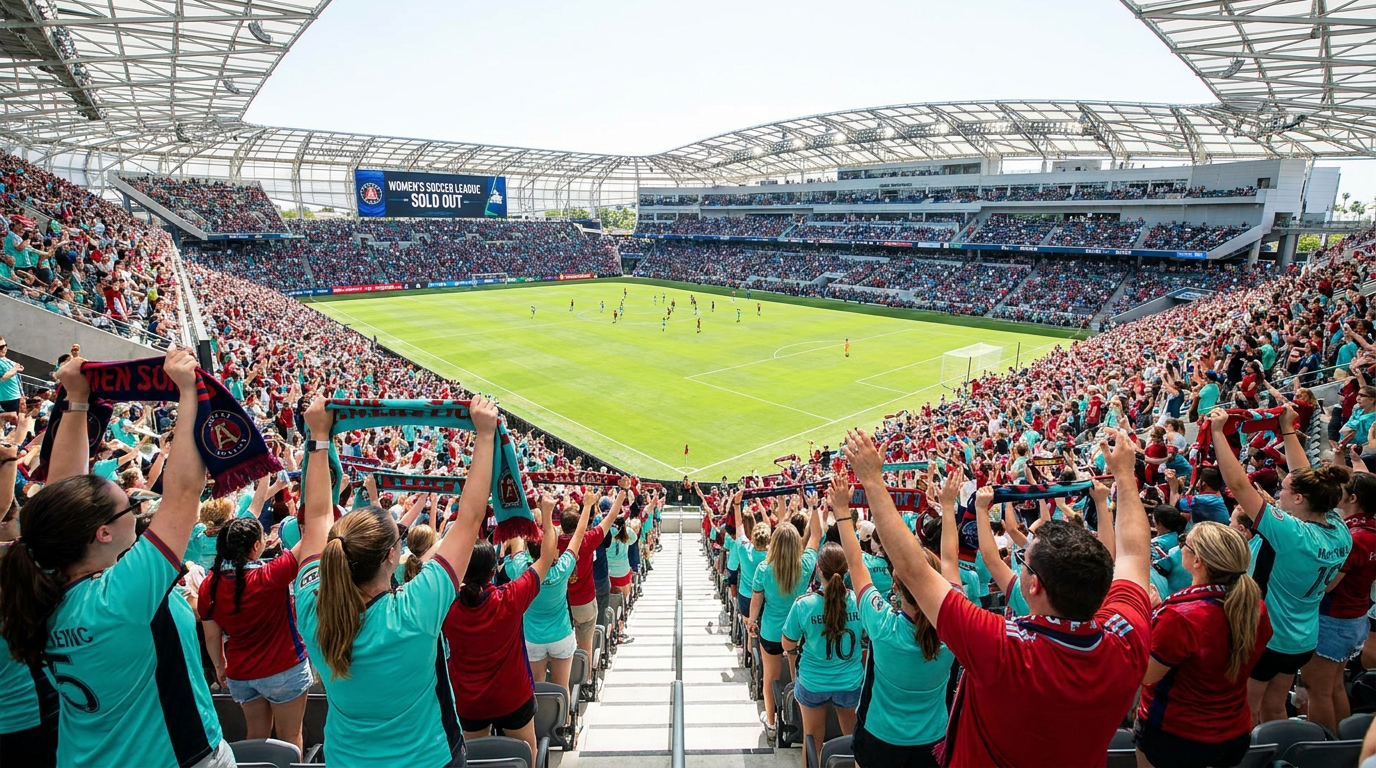
The National Women's Soccer League (NWSL) opened its 2026 season by obliterating its previous benchmarks. Opening weekend drew 129,202 fans across eight matches, averaging over 16,150 per game. Expansion franchises led the charge, proving that new markets are hungry for top-tier women's sports: Boston Legacy FC welcomed 30,207 fans for its inaugural match, while the Denver Summit hosted a staggering 63,004 fans at Mile High Stadium, setting a new single-game NWSL attendance record.[2][4][7]
"They met the moment with ambition, from how they marketed the game, to how they showed up across the city," noted observers of Denver's massive debut. The league's growth is no longer confined to traditional soccer hotbeds or scaled-down venues. By filling NFL-sized stadiums, clubs are proving that the appetite for women's professional sports can scale to the largest arenas in the country, fundamentally changing how franchises approach ticketing and marketing.[2]

This surge in ticket sales is matched by a boom in purpose-built infrastructure. In 2024, the Kansas City Current opened CPKC Stadium, the world's first stadium built exclusively for a women's professional sports team. The $117 million privately funded venue has been a resounding success, selling out 27 consecutive regular-season matches and creating one of the most intimidating home-field advantages in global soccer.[4][6]
The demand in Kansas City has been so overwhelming that local officials are already planning its next phase. A proposed $1.4 billion ordinance aims to expand CPKC Stadium's capacity from 11,500 to 18,000 seats, while developing the surrounding riverfront district into a massive entertainment hub. The venue has become a blueprint for how dedicated facilities can transform the matchday experience and generate reliable, localized revenue without sharing profits with primary male tenants.[6]
The demand in Kansas City has been so overwhelming that local officials are already planning its next phase.
Across the Atlantic, European clubs are seeing a similar financial explosion. According to the 2026 Deloitte Football Money League report, the top 15 revenue-generating women's clubs generated a cumulative €158 million ($183.7 million) for the 2024/25 season, a 35% year-over-year increase. For the first time in the report's history, the average revenue of these elite clubs exceeded €10 million, signaling a permanent shift in the European sports economy.[3][5]

Arsenal Women topped the global rich list, generating €25.6 million ($29.8 million) in revenue, narrowly edging out domestic rivals Chelsea (€25.4 million) and Spain's Barcelona (€22 million). Arsenal's success was heavily driven by matchday income, bolstered by their strategy of hosting regular matches at the 60,000-seat Emirates Stadium and implementing tiered ticketing models that consistently draw massive crowds.[3]
Commercial partnerships remain the primary engine of this financial growth. Deloitte's analysis revealed that commercial revenue accounts for 72% of the top 15 clubs' total income. High-profile brands are increasingly viewing women's soccer not as a charitable diversity initiative, but as a highly lucrative demographic with fiercely loyal consumers who actively support the brands that invest in their teams.[3][5]
The influx of capital is fundamentally changing player compensation and the global transfer market. In the NWSL, Catarina Macario recently signed with the San Diego Wave on a contract worth an estimated $8 million through 2030, believed to be the largest total contract value in women's soccer history. The deal utilized the league's new high-impact player rule, allowing teams to compete globally for premier talent.[1]

Globally, spending on transfer fees in women's football increased by over 83% year-over-year, according to recent data. Clubs are no longer waiting for players' contracts to expire to secure free transfers; they are actively buying out contracts, with top-tier teams spending millions on agent fees and transfer sums to build championship-contending rosters.[8]
However, this rapid professionalization is creating a stark divide within the sport. While elite clubs like Arsenal, Chelsea, and top NWSL franchises operate in a new financial stratosphere, lower-tier teams are struggling to keep pace. Reports indicate that while top clubs are breaking transfer records, some second-division clubs face existential financial threats due to the rising costs of competing and maintaining professional standards.[8]
Despite these growing pains, the overall trajectory of women's club soccer points toward a sustainable, highly profitable future. With broadcast revenues expected to rise, new stadiums breaking ground, and player compensation reaching unprecedented heights, the sport has firmly established itself as a cornerstone of the global sports and entertainment industry, moving far beyond its historical reliance on international tournaments.[1][5]
How we got here
April 2013
The National Women's Soccer League (NWSL) plays its inaugural match.
March 2024
CPKC Stadium opens in Kansas City as the world's first stadium purpose-built for a women's professional sports team.
January 2026
Deloitte reports that the top 15 women's clubs generated a record €158 million in cumulative revenue.
April 2026
The NWSL's Denver Summit shatters the league attendance record with 63,004 fans at Mile High Stadium.
Viewpoints in depth
Commercial Optimists
The women's game is a standalone moneymaker.
Financial analysts and commercial directors point to the Deloitte Money League data as proof that women's soccer no longer needs to be subsidized by men's clubs. With commercial revenue making up 72% of top club income, brands are seeing massive returns on investment. This camp argues that the focus should remain on premium matchday experiences and global broadcast rights to continue driving the sport's independent financial viability.
Grassroots Advocates
The wealth gap threatens the broader soccer ecosystem.
While celebrating the success of top-tier athletes, grassroots organizers and lower-division executives warn of a growing chasm. As transfer fees jump by 83% and agent fees skyrocket, smaller clubs without billionaire backers or massive stadiums are being priced out of the sport. This perspective argues for better revenue-sharing models and solidarity payments to ensure the entire pyramid benefits from the sport's commercial explosion.
Infrastructure Proponents
Purpose-built stadiums are the ultimate growth engine.
League executives and urban planners emphasize that controlling the physical venue is the key to long-term sustainability. The success of Kansas City's CPKC Stadium proves that when women's teams don't have to share ticket, concession, and parking revenues with primary male tenants, their profit margins soar. This camp advocates for heavy municipal and private investment in dedicated facilities as the primary catalyst for franchise valuation growth.
What we don't know
- Whether the proposed $1.4 billion CPKC Stadium expansion will receive full city council approval.
- How the global transfer market will stabilize as player wages continue to rise exponentially.
Key terms
- Deloitte Football Money League
- An annual profile of the highest revenue-generating soccer clubs globally, widely used as an industry benchmark for financial health.
- Division One Sanctioning
- The highest level of professional soccer classification granted by U.S. Soccer, requiring specific standards for stadium capacity, market size, and financial backing.
- Transfer Fee
- Financial compensation paid by one club to another to secure the playing rights of an athlete still under contract.
Frequently asked
Which women's soccer club generates the most revenue?
According to the 2026 Deloitte Football Money League, Arsenal Women top the list with €25.6 million in annual revenue, driven heavily by matchday ticket sales at the Emirates Stadium.
What is the attendance record for an NWSL match?
The Denver Summit set the single-game attendance record in April 2026, hosting 63,004 fans at Mile High Stadium for their inaugural home game.
Why is Kansas City expanding its stadium?
CPKC Stadium, the first purpose-built venue for a women's pro team, has sold out every regular-season match since opening in 2024. The city is proposing a $1.4 billion expansion to increase capacity to 18,000 seats.
Sources
Source coverage
8 outlets
3 viewpoints surfaced







[1]Sports Business JournalCommercial Optimists
NWSL sets opening weekend attendance records; Macario signs record deal
Read on Sports Business Journal →[2]The GuardianGrassroots Advocates
NWSL newcomers attract more than 60,000 fans to Mile High Stadium
Read on The Guardian →[3]SportsProCommercial Optimists
Arsenal top women's soccer rich list with €25.6m revenues
Read on SportsPro →[4]Just Women's SportsLeague Executives
NWSL shatters opening weekend attendance records
Read on Just Women's Sports →[5]DeloitteCommercial Optimists
Deloitte Football Money League 2026: Women's clubs revenue analysis
Read on Deloitte →[6]Stadium JourneyLeague Executives
CPKC Stadium Expansion Proposal Would Increase Capacity to 18,000
Read on Stadium Journey →[7]National Women's Soccer LeagueLeague Executives
NWSL Sets Opening Weekend Attendance Record to Kick Off 2026 Season
Read on National Women's Soccer League →Women's football transfer window: the haves and have-nots
Read on The Guardian →

More in sports
See all 8 stories →Fighter Safety
How Science and Regulation Are Ending MMA's Dangerous Weight-Cutting Era
0 sources

NBA Finals
New York Knicks Win First NBA Championship in 53 Years, Defeating Spurs in Five Games
0 sources

Board Tech
The Physics of Snowboard Profiles: How Camber, Rocker, and Hybrids Actually Work
0 sources

NWSL Expansion
NWSL Capitalizes on World Cup Fever With Record Attendance and 'Summer of Soccer' Tour
0 sources

Every angle. Every day.
Get sports stories with full source coverage and perspective breakdowns delivered to your inbox.