
Personalized mRNA Cancer Vaccines Show Durable 5-Year Efficacy in Landmark Trials
Five-year clinical data confirms that custom-built mRNA vaccines significantly reduce the risk of recurrence and metastasis in melanoma and pancreatic cancer. The breakthrough signals a paradigm shift toward eliminating microscopic residual disease.
By Factlen Editorial Team
- Clinical Oncologists
- Focused on the durable survival data and the necessity of combining vaccines with checkpoint inhibitors.
- Immunologists & Pathologists
- Focused on the biological mechanisms, T-cell clonality, and the challenge of tumor heterogeneity.
- Biotech Industry
- Focused on scaling the manufacturing process, expanding clinical pipelines, and reducing turnaround times.
- Evidence Synthesis
- Evaluating the broad clinical impact and future trajectory of personalized cancer therapies.
What's not represented
- · Patients navigating the high cost and limited trial access
- · Regulatory agencies evaluating bespoke, N=1 therapeutics
Why this matters
For decades, advanced cancer treatment relied on blunt tools like chemotherapy. The proven long-term success of personalized mRNA vaccines means patients with high-risk cancers now have a highly targeted therapy that trains their own immune system to prevent the disease from returning, fundamentally altering survival odds.
Key points
- Five-year data shows mRNA-4157 combined with pembrolizumab cuts melanoma recurrence risk by 49%.
- The combination therapy reduced the risk of distant metastasis by 59% compared to immunotherapy alone.
- Phase 1 trials in pancreatic cancer demonstrated six-year survival in patients who mounted a T-cell response.
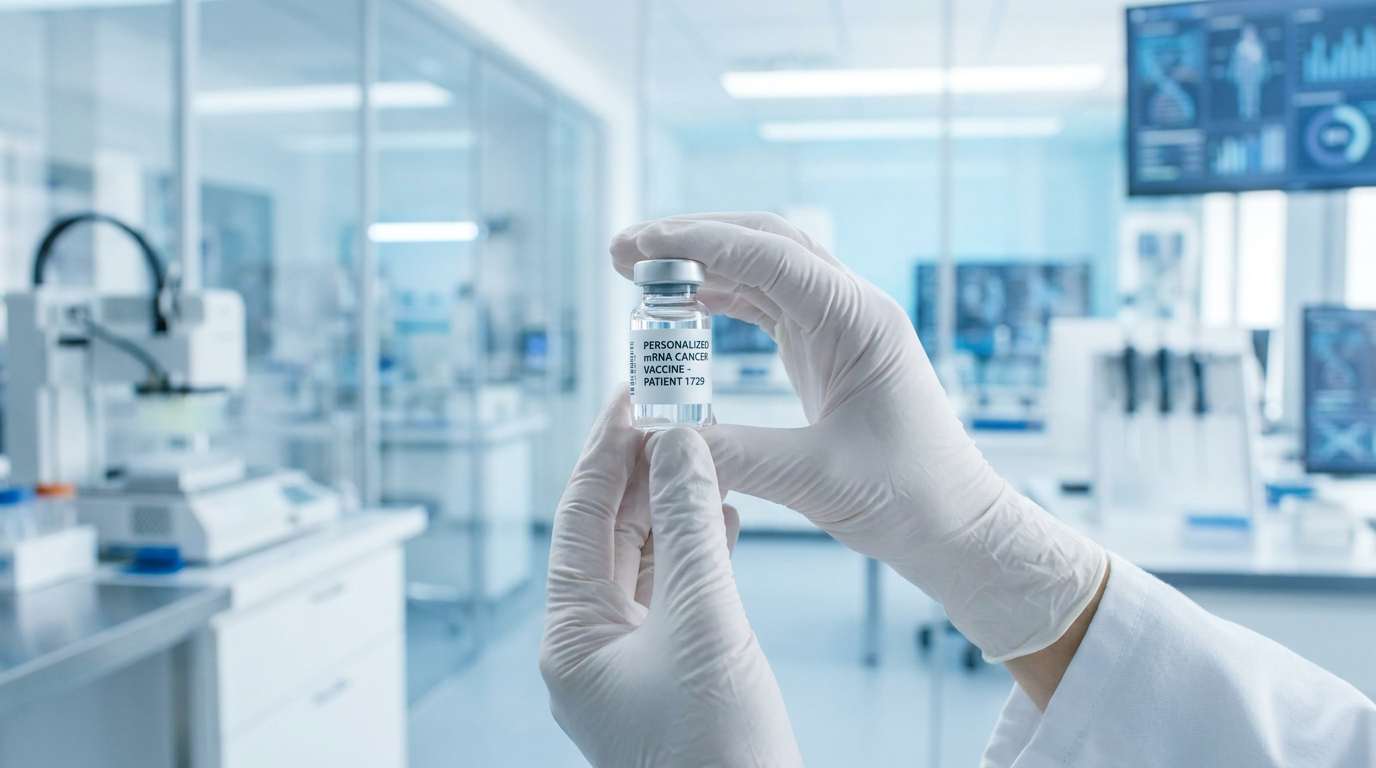
- The vaccines are custom-built for each patient by sequencing their tumor to identify unique neoantigens.
- Manufacturing turnaround times currently average 30 to 45 days, presenting a logistical challenge for rapid deployment.
For decades, the concept of a cancer vaccine remained a frustrating frontier in oncology—theoretically sound, but clinically elusive. Today, the landscape has fundamentally shifted. Driven by the rapid maturation of messenger RNA (mRNA) technology, personalized cancer vaccines are demonstrating unprecedented, durable efficacy in clinical trials.[6]
The most definitive evidence to date arrived in June 2026 at the American Society of Clinical Oncology (ASCO) Annual Meeting. A planned five-year follow-up of the KEYNOTE-942 phase 2b trial revealed that an investigational mRNA vaccine (mRNA-4157, or intismeran autogene) combined with the immunotherapy drug pembrolizumab (Keytruda) reduced the risk of melanoma recurrence or death by 49% compared to pembrolizumab alone.[1]
Even more critically for long-term survival, the combination therapy reduced the risk of the cancer spreading to distant organs—distant metastasis—by 59%. This sustained benefit at the five-year mark signals that the immune system is retaining a long-term memory of the tumor, a milestone that oncologists view as a paradigm shift for high-risk, resected melanoma.[1][6]
To understand this breakthrough, it is necessary to examine the mechanism of action. Unlike traditional preventative vaccines, these are therapeutic treatments custom-built for a single patient. The process begins after a surgeon removes the patient's tumor. The tumor tissue is genetically sequenced to identify "neoantigens"—unique, mutated proteins present only on the surface of the cancer cells, not on healthy tissue.[4]

Using advanced algorithmic models, scientists select the most immunogenic neoantigens—the ones most likely to trigger a robust immune response. For mRNA-4157, up to 34 of these patient-specific neoantigens are encoded into a single synthetic mRNA strand.[1][5]
This mRNA is encapsulated in a lipid nanoparticle (LNP) to protect it from degrading in the bloodstream. Once injected into the patient's muscle, the LNPs deliver the mRNA into antigen-presenting cells. These cells read the mRNA instructions, manufacture the neoantigen proteins, and display them on their surface to train the body's T-cells to hunt down any remaining microscopic cancer cells.[4]

The evidence extends beyond melanoma. At the American Association for Cancer Research (AACR) meeting in April 2026, researchers presented long-term data from a phase 1 trial of a personalized mRNA vaccine for pancreatic cancer—a disease notoriously resistant to immunotherapy.[2]
In that cohort of 16 patients, eight mounted a substantial T-cell immune response to the vaccine. Remarkably, six of those eight responders were still alive at the six-year follow-up mark, with many remaining completely recurrence-free. For a cancer with a historical five-year survival rate of roughly 13%, these durable responses suggest that mRNA vaccines can successfully prime the immune system to eliminate microscopic residual disease even in "cold" tumors.[2][6]
In that cohort of 16 patients, eight mounted a substantial T-cell immune response to the vaccine.
The clinical pipeline is expanding rapidly. BioNTech is currently advancing multiple mRNA cancer immunotherapies, including BNT116 for non-small cell lung cancer (NSCLC). Recent trial expansions have included cohorts testing the vaccine in combination with targeted therapies, yielding objective response rates that have prompted phase 2 and phase 3 trial initiations across a broad range of solid tumors.[3]
Despite these clinical triumphs, significant uncertainties and logistical hurdles remain. The primary biological challenge is tumor heterogeneity. Cancers are highly mutable, and genetic variations can lead to differing neoantigen expressions across different parts of the same tumor.[5]

If a vaccine targets a "subclonal" mutation—one present in only a fraction of the cancer cells—the non-targeted cells can evade the immune response and continue to grow, a process known as immune editing. Identifying the most stable, "clonal" neoantigens remains a complex computational challenge.[5][6]
Furthermore, the tumor microenvironment is inherently immunosuppressive. This is why personalized mRNA vaccines are almost universally administered alongside immune checkpoint inhibitors like pembrolizumab. The vaccine acts as the ignition, generating the specific T-cells, while the checkpoint inhibitor removes the brakes the tumor places on the immune system.[4][6]

Logistically, the manufacturing process is a race against time. Currently, it takes approximately 30 to 45 days from the time of tumor resection to the delivery of the customized vaccine. For patients with aggressive, fast-growing cancers, this window can be dangerously long. Scaling this bespoke manufacturing process to serve hundreds of thousands of patients globally will require unprecedented supply chain innovations.[5][6]
Yet, the translational data provides profound optimism. Blood analyses from the five-year KEYNOTE-942 update showed that patients receiving the mRNA vaccine maintained sustained, novel T-cell clones that were directly associated with a lower risk of recurrence.[1]
This durable immune surveillance represents the holy grail of oncology: a treatment that not only attacks the cancer present today but stands guard against its return for years to come. As phase 3 trials mature, personalized mRNA vaccines are poised to transition from experimental marvels to foundational pillars of standard cancer care.[6]
How we got here
2020
The rapid development of COVID-19 vaccines globally validates the safety and delivery mechanisms of mRNA technology.
April 2023
Initial phase 2b data for KEYNOTE-942 shows a 44% reduction in melanoma recurrence at the two-year mark.
April 2026
Researchers at AACR present data showing six-year survival in pancreatic cancer patients who responded to a personalized mRNA vaccine.
June 2026
The five-year update of the KEYNOTE-942 trial confirms durable efficacy, showing a 59% reduction in distant metastasis.
Viewpoints in depth
Clinical Oncologists' View
Prioritizing long-term survival data and combination regimens.
For practicing oncologists, the excitement surrounding mRNA vaccines is anchored entirely in the five-year survival curves. Historically, many promising immunotherapies have failed to prevent late-stage recurrences. The KEYNOTE-942 data, showing a sustained 59% reduction in distant metastasis, proves that the vaccine is generating a durable memory T-cell response. Oncologists emphasize that these vaccines are not standalone cures; they must be paired with checkpoint inhibitors like pembrolizumab to overcome the tumor's natural immune defenses.
Immunologists' View
Focusing on neoantigen selection and tumor evasion.
Immunologists view the mRNA vaccine as an elegant but complex biological engineering challenge. Their primary concern is 'immune editing'—the phenomenon where a tumor mutates to stop expressing the specific neoantigens targeted by the vaccine, allowing the cancer to evade the immune system and regrow. To combat this, researchers are heavily reliant on advanced AI algorithms to identify 'clonal' mutations that are present across all of a patient's cancer cells, rather than 'subclonal' mutations that only exist in a fraction of the tumor.
Biotech & Manufacturing View
Solving the logistical bottleneck of personalized medicine.
From an industry perspective, the science is proven, but the supply chain is the next frontier. Creating a bespoke drug for a single patient in 30 to 45 days requires a flawless logistical pipeline from the operating room to the sequencing lab, the mRNA synthesis facility, and back to the infusion clinic. Biotech leaders are investing heavily in automated, decentralized manufacturing hubs to reduce this turnaround time, which is critical for patients with aggressive cancers who cannot afford to wait months for adjuvant therapy.
What we don't know
- Whether the manufacturing process can be scaled and accelerated to serve hundreds of thousands of patients globally.
- How effectively the vaccines can overcome immune evasion in highly mutated, heterogeneous tumors.
- The long-term efficacy of mRNA vaccines as a standalone treatment without the addition of checkpoint inhibitors.
Key terms
- Neoantigen
- A novel, abnormal protein formed by tumor-specific genetic mutations that the immune system can recognize as foreign.
- Adjuvant therapy
- Additional cancer treatment given after primary treatment, such as surgery, to lower the risk of the cancer returning.
- Immune checkpoint inhibitor
- A type of drug that blocks proteins (like PD-1) that normally act as brakes on the immune system, allowing T-cells to attack cancer.
- Lipid nanoparticle (LNP)
- A microscopic fat bubble used to safely encapsulate and deliver fragile mRNA molecules into human cells.
- Tumor heterogeneity
- The presence of different genetic profiles and mutations within different cells of the same tumor.
Frequently asked
Are these vaccines preventative like the HPV vaccine?
No. These are therapeutic vaccines, meaning they are custom-built to treat a patient who has already been diagnosed with cancer and undergone surgery.
How long does it take to make a personalized vaccine?
Currently, the manufacturing process takes about 30 to 45 days from the time the tumor is biopsied to when the vaccine is injected into the patient.
What are the side effects of the mRNA cancer vaccine?
The vaccines are generally well-tolerated. Most side effects are mild to moderate, similar to COVID-19 vaccines (such as fatigue and injection site pain), and they do not significantly increase the severe side effects of checkpoint inhibitors.
Will this replace chemotherapy?
Not immediately. mRNA vaccines are currently being tested as an adjuvant therapy (post-surgery) in combination with immunotherapies, though they may eventually reduce the need for broad-spectrum chemotherapy in certain cancers.
Sources
Source coverage
6 outlets
4 viewpoints surfaced






[1]Journal of Clinical OncologyClinical Oncologists
Intismeran Autogene Plus Pembrolizumab Versus Pembrolizumab Alone in High-Risk Resected Melanoma: 5-Year Update of the Randomized Phase 2b KEYNOTE-942 Study
Read on Journal of Clinical Oncology →[2]American Association for Cancer ResearchClinical Oncologists
Pancreatic Cancer mRNA Vaccine Shows Promising Results in Early Clinical Trial: 6-Year Follow-up
Read on American Association for Cancer Research →[3]BioNTech SEBiotech Industry
BioNTech Provides Business and Pipeline Updates at 43rd Annual J.P. Morgan Healthcare Conference
Read on BioNTech SE →[4]Royal College of PathologistsImmunologists & Pathologists
An update on mRNA cancer vaccines
Read on Royal College of Pathologists →[5]Binaytara FoundationBiotech Industry
Top 8 Takeaways on mRNA Cancer Vaccines and Personalized Immunotherapy Development
Read on Binaytara Foundation →[6]Factlen Editorial TeamEvidence Synthesis
Synthesis by Factlen editorial team
Read on Factlen Editorial Team →


Every angle. Every day.
Get science stories with full source coverage and perspective breakdowns delivered to your inbox.