
The Gas Station in Space: How Orbital Refueling Unlocks the Moon and Mars
To return humans to the Moon, NASA and SpaceX must master the unprecedented challenge of transferring super-cooled cryogenic propellants in microgravity.
By Factlen Editorial Team
- Space Agency Planners
- View orbital refueling as the mandatory critical path for establishing a sustainable human presence on the Moon and Mars.
- Commercial Launch Providers
- See cryogenic fluid management as a solvable engineering challenge that unlocks unprecedented payload capacities and economies of scale.
- Aerospace Traditionalists
- Point to the high risk and complexity of requiring multiple consecutive, flawless tanker launches just to execute a single lunar mission.
What's not represented
- · Environmental groups concerned about the atmospheric impact of rapid-cadence tanker launches
- · International space agencies developing competing lunar architectures
Why this matters
Mastering in-space refueling is the mandatory prerequisite for the Artemis lunar landings and all future deep-space human exploration. If engineers can reliably transfer propellant in orbit, humanity is no longer constrained by the fuel a single rocket can lift off the Earth.
Key points
- NASA's Artemis program requires transferring super-cooled rocket fuel in space to reach the Moon.
- SpaceX must launch multiple Starship tankers to fill an orbital depot before the lunar lander can depart.
- Microgravity causes liquids to float, requiring 'settling maneuvers' to push fuel to the bottom of tanks.
- Extreme temperature swings in space cause cryogenic fuels to boil off, requiring complex thermodynamic management.
- SpaceX successfully demonstrated internal tank-to-tank fluid transfer during recent Starship flight tests.
- A full ship-to-ship orbital refueling demonstration is targeted for 2025 or 2026.
The next giant leap for human space exploration will not be a revolutionary new rocket engine or a breakthrough in lightweight materials. It will be a gas station in low Earth orbit. For decades, the fundamental limit on space travel has been the "tyranny of the rocket equation"—the inescapable physics dictating that every pound of payload requires exponentially more fuel to lift it off the ground. To reach the Moon or Mars, a spacecraft must carry all the propellant it needs for the entire round trip, severely restricting how much cargo and crew it can actually transport.[6][7]
Orbital refueling shatters this paradigm. By launching a spacecraft into orbit nearly empty, and then sending up separate tanker flights to fill its tanks in space, engineers can decouple the launch from the deep-space journey. This architecture is the critical path for NASA’s Artemis program, which aims to return humans to the lunar surface. Without the ability to transfer super-cooled liquid propellants in microgravity, the ambitious lunar architectures proposed by both SpaceX and Blue Origin simply cannot function.[4][6]
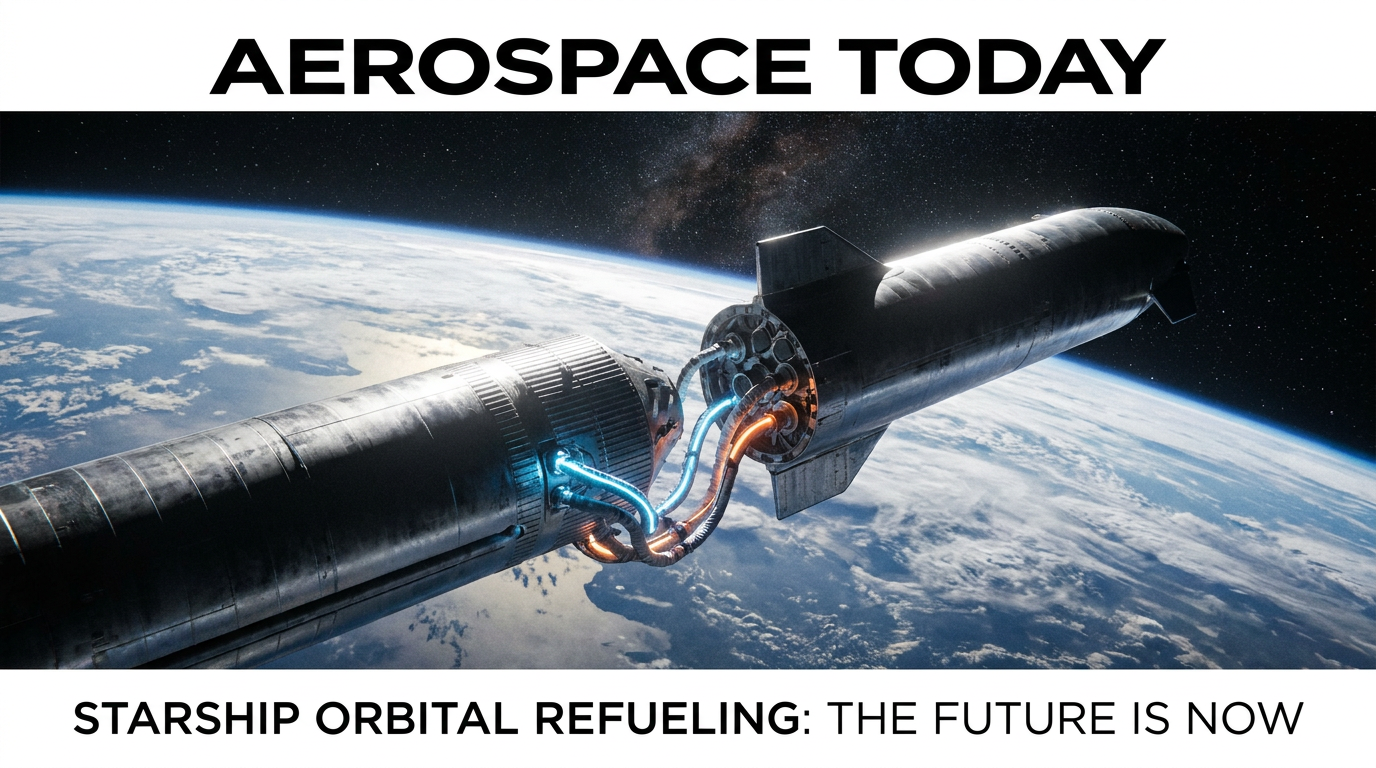
The scale of this logistical relay is unprecedented. Under NASA's current plan, SpaceX’s Starship Human Landing System (HLS) will serve as the vehicle that ferries astronauts from lunar orbit down to the Moon's surface. But to get the massive HLS to the Moon in the first place, SpaceX must launch a dedicated propellant depot into low Earth orbit. Following that, a rapid cadence of Starship tankers—estimated by NASA to be anywhere from 8 to 16 consecutive flights—will launch to fill the depot. Finally, the HLS will dock with the depot, top off its 1,200-ton tanks, and ignite its engines for the Moon.[1][3]

While the concept sounds straightforward, the execution involves solving some of the most complex fluid dynamics problems in modern aerospace engineering. On Earth, gravity neatly pulls liquid to the bottom of a tank, ensuring that pipes and pumps always draw fluid, not gas. In the microgravity environment of low Earth orbit, fluids do not settle. Instead, liquid oxygen and liquid methane float in chaotic, suspended blobs, clinging to the tank walls through surface tension.[2][7]
If a valve opens while the propellant is floating, it is just as likely to vent precious liquid into space as it is to transfer it to another ship. To solve this, engineers utilize a technique called a "settling maneuver." By firing small thrusters, the spacecraft creates a tiny amount of artificial gravity—often just a fraction of a percent of Earth's pull. This micro-acceleration gently forces the floating liquid to pool at the bottom of the tank, covering the transfer valves and allowing the fluid to be pushed into the receiving vehicle.[2][5]

But microgravity is only half the battle; the other half is thermodynamics. Next-generation heavy-lift rockets rely on cryogenic propellants, specifically liquid oxygen and liquid methane, which offer vastly superior performance compared to traditional room-temperature fuels like kerosene. However, these fluids must be kept at brutally cold temperatures—liquid oxygen boils at −297 degrees Fahrenheit, and liquid methane at −259 degrees Fahrenheit.[3][7]
But microgravity is only half the battle; the other half is thermodynamics.
In the vacuum of space, a spacecraft is subjected to extreme temperature swings. The side facing the sun bakes in intense solar radiation, while the side in the shadow plunges into deep freezes. If the cryogenic propellants absorb too much heat, they begin to boil off, turning from a dense liquid into a highly pressurized gas. If the pressure climbs too high, the spacecraft must vent the gas into space to prevent the tanks from rupturing, resulting in a direct loss of fuel.[3][5][6]
Transferring these volatile fluids between two spacecraft exacerbates the boil-off problem. When super-cooled liquid flows into a relatively warm, empty receiving tank, it immediately flashes into vapor. To prevent this, engineers must execute a "non-vented fill," a delicate process that involves pre-chilling the receiving tank to a target temperature before the main transfer begins, ensuring the liquid remains stable throughout the pumping process.[6]

Recognizing that orbital refueling is the linchpin of the Artemis program, NASA has heavily subsidized the development of Cryogenic Fluid Management (CFM) technologies. In 2020, the agency awarded hundreds of millions of dollars in "Tipping Point" contracts to private industry to buy down the technical risks. SpaceX received $53.2 million to demonstrate the transfer of 10 metric tons of liquid oxygen between tanks, while United Launch Alliance (ULA) and Lockheed Martin received funds to test smart propulsion systems and liquid hydrogen storage.[1]
SpaceX has already begun checking off these milestones. During the third and fourth integrated flight tests of the Starship vehicle in early 2024, the company successfully demonstrated an internal propellant transfer. While coasting in space, Starship shifted thousands of pounds of super-cooled liquid oxygen from a smaller header tank into the main propellant tank. This internal test validated the settling maneuvers and the basic plumbing required for fluid transfer in microgravity.[3][4][7]
The next major hurdle is a full ship-to-ship transfer. Targeted for 2025 or 2026, this demonstration will require SpaceX to launch two Starships, dock them back-to-back in low Earth orbit, and use a pressure differential to force propellant from the tanker into the receiving ship. It is a high-stakes orbital ballet that has never been attempted at this scale, and its success is a mandatory prerequisite before NASA will allow astronauts to board the HLS.[4]

SpaceX is not the only company racing to master this technology. Rocket Lab, in partnership with Eta Space, is preparing to launch the LOXSAT mission, a dedicated satellite designed to spend nine months in orbit testing 11 different cryogenic fluid management technologies, including boil-off reduction and precise level gauging. Similarly, Blue Origin’s Blue Moon lander, selected by NASA for the Artemis V mission, will rely heavily on its own orbital refueling architecture.[4][5]
The implications of mastering in-space cryogenic transfer extend far beyond the Artemis lunar landings. If the aerospace industry can reliably and affordably establish propellant depots in low Earth orbit, the entire solar system opens up. Spacecraft will no longer be constrained by the fuel they can carry off the launch pad. They can launch heavy scientific payloads, dock at an orbital gas station, and depart for Mars, Europa, or the asteroid belt with fully topped-off tanks. It is the foundational infrastructure required to turn humanity into a truly spacefaring civilization.[6][7]
How we got here
2020
NASA awards a $53.2 million Tipping Point contract to SpaceX to develop cryogenic fluid management technology.
April 2021
NASA selects SpaceX's Starship as the Human Landing System for Artemis III, cementing orbital refueling into the mission architecture.
March 2024
SpaceX successfully demonstrates internal tank-to-tank cryogenic transfer during Starship Flight 3.
2025-2026
Targeted timeline for the first full ship-to-ship orbital refueling demonstration in low Earth orbit.
Viewpoints in depth
Space Agency Planners
View orbital refueling as the mandatory critical path for establishing a sustainable human presence on the Moon and Mars.
For NASA architects, the math of deep space exploration is uncompromising. Without orbital refueling, missions are severely mass-constrained, limiting the amount of scientific equipment, habitat infrastructure, and crew that can be sent to the lunar surface. By investing heavily in Cryogenic Fluid Management (CFM) technologies through Tipping Point contracts, planners believe they are solving the fundamental bottleneck of spaceflight. Once the infrastructure of orbital depots is established, it permanently lowers the barrier to entry for the entire solar system.
Commercial Launch Providers
See cryogenic fluid management as a solvable engineering challenge that unlocks unprecedented payload capacities and economies of scale.
Companies like SpaceX, Blue Origin, and Rocket Lab view orbital refueling not as an insurmountable risk, but as a standard operational procedure waiting to be perfected. They argue that just as mid-air refueling revolutionized military aviation, in-space refueling will revolutionize the aerospace economy. By mastering settling maneuvers and non-vented fills, these providers aim to decouple the launch vehicle's size from the mission's scope, allowing them to sell massive payload delivery services to both government and commercial clients.
Aerospace Traditionalists
Point to the high risk and complexity of requiring multiple consecutive, flawless tanker launches just to execute a single lunar mission.
Skeptics within the traditional aerospace community highlight the sheer operational fragility of the refueling architecture. Because cryogenic fuels boil off over time, the 8 to 16 tanker launches required to fill a depot must happen in rapid succession. If a launch is scrubbed due to weather or technical issues, the fuel already in orbit continues to vent into space, potentially jeopardizing the entire mission timeline. They argue that relying on a chain of unprecedented, back-to-back orbital rendezvous maneuvers introduces a massive amount of compound risk compared to a traditional single-launch architecture.
What we don't know
- The exact number of Starship tanker launches that will ultimately be required to fully fuel the Human Landing System.
- How efficiently boil-off can be mitigated during the weeks-long process of filling an orbital depot.
- Whether the rapid launch cadence required for the Artemis refueling architecture can be sustained without weather or technical delays.
Key terms
- Cryogenic Fluid Management (CFM)
- The storage, transfer, and measurement of super-cooled liquid propellants in the microgravity environment of space.
- Boil-off
- The loss of cryogenic propellant when it absorbs heat from the sun or spacecraft and turns from a liquid into a pressurized gas.
- Settling Maneuver
- Firing small thrusters to create a slight acceleration, forcing floating liquid to the bottom of a tank so it can be pumped.
- Non-vented Fill
- A delicate transfer process that involves pre-chilling a receiving tank to prevent incoming super-cooled liquid from instantly flashing into vapor.
Frequently asked
Why can't we just build a bigger rocket that doesn't need refueling?
The 'tyranny of the rocket equation' means adding more fuel requires exponentially more fuel just to lift it off the Earth, making single-launch lunar missions severely mass-constrained.
Has orbital refueling ever been done before?
Satellites and the ISS have been refueled with stable, room-temperature propellants, but transferring super-cooled cryogenic fuels in microgravity is a first-of-its-kind challenge.
What happens if a tanker launch fails or is delayed?
The architecture requires a rapid cadence of launches; if delayed too long, the propellant already stored in the orbital depot could boil off, jeopardizing the mission timeline.
Why use cryogenic fuels if they are so difficult to manage?
Cryogenic propellants like liquid oxygen and liquid methane offer vastly superior thrust and efficiency compared to traditional room-temperature fuels, which is required for heavy-lift deep space missions.
Sources
Source coverage
7 outlets
3 viewpoints surfaced







[1]NASASpace Agency Planners
NASA Announces 2020 Tipping Point Selections for Cryogenic Fluid Management
Read on NASA →[2]American Institute of Aeronautics and AstronauticsAerospace Traditionalists
In-Space Cryogenic Propellant Transfer Guidelines
Read on American Institute of Aeronautics and Astronautics →[3]Payload SpaceCommercial Launch Providers
SpaceX Advances Toward Propellant Transfer Test
Read on Payload Space →[4]MashableAerospace Traditionalists
How SpaceX's Starship will refuel in space for NASA's moon missions
Read on Mashable →[5]The Motley FoolCommercial Launch Providers
NASA and Rocket Lab May Figure Out In-Space Fueling Before SpaceX Does
Read on The Motley Fool →[6]Ohio State UniversityAerospace Traditionalists
Thermodynamic Analysis of On-Orbit Cryogenic Refueling
Read on Ohio State University →[7]Factlen Editorial TeamSpace Agency Planners
Synthesis by Factlen editorial team
Read on Factlen Editorial Team →
Every angle. Every day.
Get transportation stories with full source coverage and perspective breakdowns delivered to your inbox.