
New Evidence Narrows the Timeline for AMOC Ocean Current Collapse
A wave of 2026 research reveals the Atlantic Meridional Overturning Circulation is weakening faster than previously modeled, prompting financial institutions and policymakers to prepare for severe cascading climate impacts.
By Factlen Editorial Team
- Earth System Scientists
- Researchers focused on the physical thresholds, early warning signals, and cascading global consequences of an AMOC collapse.
- Financial Risk Analysts
- Institutions translating deeply uncertain climate tipping points into actionable economic metrics and immediate cash-loss risks.
- Regional Policymakers
- Governments preparing for the localized, extreme impacts of a halted ocean circulation, such as severe cooling in Northern Europe.
What's not represented
- · Coastal communities in the Global South facing compounded sea-level rise
- · Agricultural sectors in Northern Europe facing immediate adaptation costs
Why this matters
An AMOC collapse would fundamentally alter global weather, plunging Northern Europe into severe cold while accelerating sea-level rise on the US East Coast. As financial institutions begin pricing this risk into global markets, the economic impacts will be felt long before the physical tipping point is crossed.
Key points
- New 2026 models project the Atlantic Meridional Overturning Circulation (AMOC) could weaken by up to 50% by 2100.
- An AMOC collapse would trigger severe localized cooling in Northern Europe while accelerating sea-level rise along the US East Coast.
- If the Southern Ocean flips to a carbon source, it could add 0.2°C of additional global warming independent of human emissions.
- Major financial institutions, including J.P. Morgan, are now advising investors to price climate tipping points as immediate cash-loss risks.
- Current atmospheric CO2 levels have already surpassed the 350 ppm threshold where AMOC recovery becomes physically impossible.
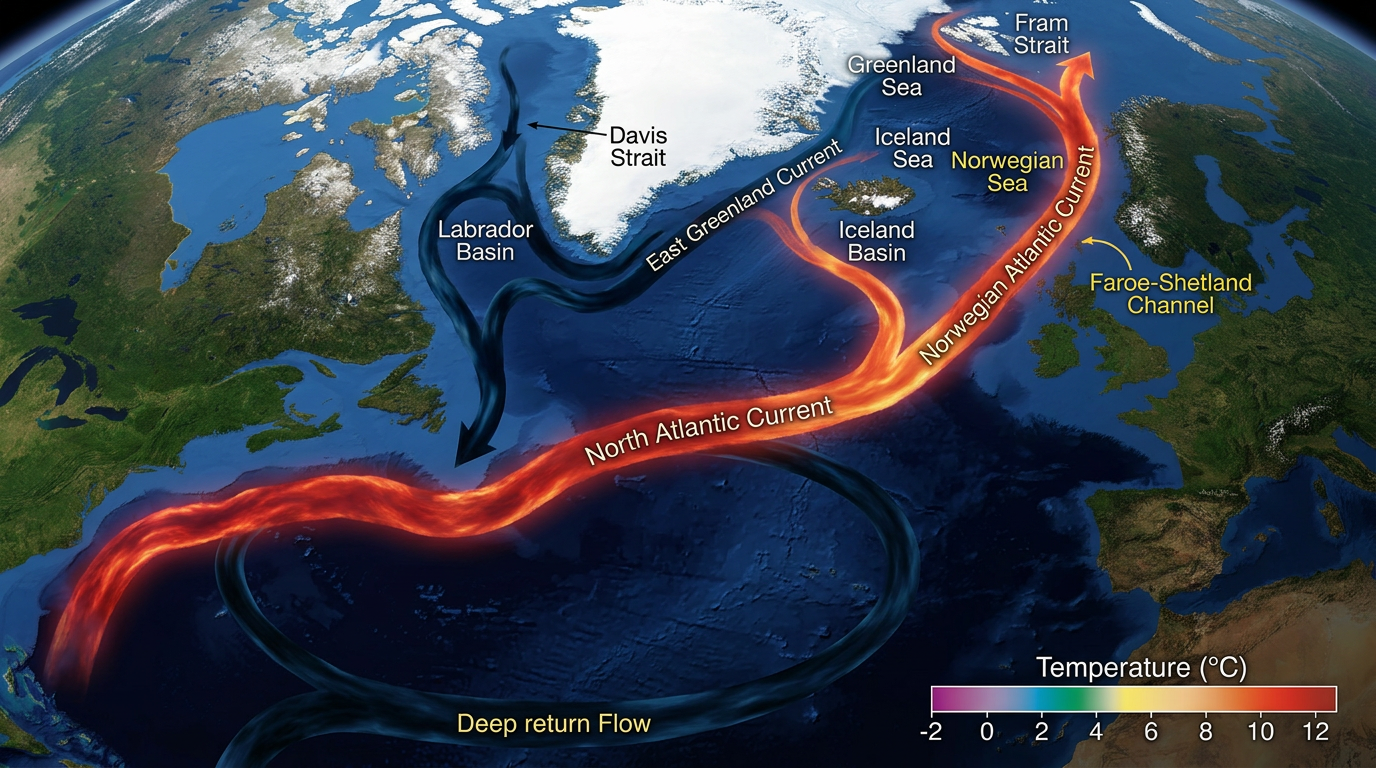
The Atlantic Meridional Overturning Circulation (AMOC)—the vast system of ocean currents that regulates Earth's climate by transporting warm water north and cold water south—is showing unprecedented signs of instability. A wave of peer-reviewed research and institutional reports published in the first half of 2026 has fundamentally shifted the scientific consensus. What was once viewed as a low-probability tail risk for the 22nd century is now being modeled as an accelerating, quantifiable threat with cascading global consequences.[7]
The most definitive observational evidence to date arrived in May 2026 from the University of Miami Rosenstiel School. Analyzing nearly two decades of deep-ocean measurements, researchers documented a steady, broad-scale decline in the AMOC along the western boundary of the Atlantic, stretching from the subtropics to the mid-latitudes. Because the slowdown spans such a vast area, oceanographers conclude it reflects a systemic shift in the Atlantic Ocean's circulation rather than a temporary natural variation.[5]
This observational data aligns with alarming new predictive models. A major 2026 paper published in Science Advances combined real-world ocean observations with advanced climate simulations, concluding that the circulation could weaken by approximately 50% by the end of this century. This projection is significantly more severe than earlier model averages, including those relied upon in previous Intergovernmental Panel on Climate Change (IPCC) assessments, which had assessed a near-term collapse as unlikely.[2]
The physical mechanism driving this weakening is deeply tied to global temperature rise. As the planet warms, melting ice sheets in Greenland and the Arctic dump massive volumes of fresh water into the North Atlantic. This fresh water is less dense than the salty seawater it replaces, which disrupts the sinking process that drives the AMOC's continuous conveyor belt. As the sinking slows, the entire global circulation system loses momentum.[5][7]

If the AMOC crosses a critical tipping point, the consequences will not be isolated to the Atlantic. A landmark April 2026 study from the Potsdam Institute for Climate Impact Research (PIK), published in Nature Communications Earth & Environment, modeled the cascading effects of an AMOC shutdown. The researchers found that a collapse would trigger a massive reorganization of global carbon sinks, fundamentally altering the planet's carbon cycle.[1]
Specifically, the PIK study demonstrated that an AMOC collapse could flip the Southern Ocean from a vital carbon sink into a carbon source. This reversal would release vast amounts of stored ocean carbon into the atmosphere over hundreds of years. According to the researchers, this feedback loop alone would add between 0.17°C and 0.27°C of additional global warming, independent of human emissions.[1]
The irreversibility of this process is perhaps the most stark finding in the 2026 literature. The PIK researchers noted that at atmospheric carbon dioxide levels of 350 parts per million (ppm) or higher, the AMOC enters a bistable regime. In this state, if the circulation collapses, it stays in the 'off' position and cannot recover in the long run. With current global CO2 levels hovering around 430 ppm, the physical door to a stable recovery may already be locking behind us.[1]

The irreversibility of this process is perhaps the most stark finding in the 2026 literature.
The regional impacts of a weakened or collapsed AMOC would be severe and highly uneven. In February 2026, the Nordic Council published a comprehensive policy assessment declaring AMOC tipping an existential security threat to Northern Europe. While the rest of the globe continues to warm, a halted AMOC would drastically reduce the heat transported to the North Atlantic, plunging the Nordic countries and parts of Western Europe into a significantly colder climate.[3]
This localized cooling would devastate regional agriculture, strain energy grids, and disrupt livelihoods across Northern Europe. The Nordic Council's report emphasized that these impacts would differ entirely from—and in some cases directly oppose—the standard warming trajectories that local governments have spent the last decade preparing for.[3]
Across the Atlantic, the consequences would manifest differently. A weaker AMOC is projected to cause significant sea-level rise along the Eastern Seaboard of the United States, threatening major coastal cities and infrastructure. Additionally, the altered ocean temperatures would shift global precipitation patterns and likely intensify hurricane activity in the Atlantic basin, compounding the extreme weather risks already driven by baseline global warming.[5]

Despite the strengthening evidence, deep uncertainty remains regarding the exact timing of a potential collapse. While the weakening trend is clear and statistically significant, predicting the precise moment a complex Earth system crosses a non-linear tipping point is notoriously difficult. The lack of historical analogues means that scientists are operating in uncharted territory, relying on early warning signals like the persistent cooling anomaly in the subpolar North Atlantic.[7]
This deep uncertainty has historically kept climate tipping points out of traditional financial and macroeconomic models. However, that paradigm shifted in May 2026 when J.P. Morgan became one of the first major global banks to formally address AMOC instability and other climate tipping points in its financial risk modeling.[4][6]
In a report titled 'Climate Intuition: Decision-making under deep uncertainty,' Dr. Sarah Kapnick, J.P. Morgan's global head of Climate Advisory, argued that the deeply uncertain nature of these events is no longer an excuse to ignore them. The bank warned institutional investors that tipping points will accelerate impacts on businesses and economies in non-linear ways that standard discounted cash flow analyses fail to capture.[4]
J.P. Morgan's guidance advises companies to treat climate tipping points as immediate cash-loss risks. To combat the uncertainty of timing and magnitude, the bank recommends utilizing tail-risk analysis and tabletop scenario exercises borrowed from national security frameworks. This marks a critical evolution: treating Earth system collapse not just as an environmental tragedy, but as a hard financial variable that must be priced into long-term capital allocation.[4][6]

On the policy front, the scientific community is calling for an urgent upgrade to global monitoring capabilities. The Nordic Council report stressed the need for long-term funding to sustain and operationalize key observational networks in the Atlantic. The goal is to build a dedicated AMOC early warning system that seamlessly couples real-time Earth observations with advanced predictive model simulations.[3]
Ultimately, the 2026 research consensus underscores a dual mandate for global policymakers. First, preventing further warming is paramount; any additional temperature rise or prolonged overshoot of the 1.5°C target exponentially increases the risk of triggering an irreversible collapse. Second, governments must develop highly flexible adaptation strategies capable of succeeding across divergent future trajectories—preparing simultaneously for a uniformly warming world and the localized extreme cooling of an AMOC shutdown.[1][3][7]
How we got here
2004
The RAPID mooring array is deployed in the Atlantic, providing the first continuous, direct measurements of the AMOC.
2015
A landmark study identifies a persistent 'cold blob' in the subpolar North Atlantic as an early warning signal of AMOC slowdown.
2021
The IPCC's 6th Assessment Report concludes AMOC weakening is very likely, but assesses a full collapse before 2100 as unlikely.
Early 2024
Physics-based early warning signals indicate the AMOC is approaching a critical tipping point faster than previously modeled.
May 2026
J.P. Morgan issues guidance to institutional investors to begin pricing AMOC collapse and other tipping points as immediate financial risks.
Viewpoints in depth
Earth System Scientists
Researchers projecting the physical thresholds and global consequences of an AMOC collapse.
This camp relies on complex Earth system models to simulate how the influx of fresh water from melting ice sheets disrupts the Atlantic's density-driven currents. Their 2026 findings emphasize that tipping points are not isolated events but interconnected cascades. They argue that crossing the AMOC threshold would fundamentally alter the global carbon cycle, such as flipping the Southern Ocean into a carbon source, thereby locking in additional warming regardless of future human emissions.
Financial Risk Analysts
Institutions translating deeply uncertain climate tipping points into actionable economic metrics.
Historically, financial models have struggled to price in non-linear, unprecedented events like an AMOC collapse. This perspective argues that relying on standard discounted cash flow analysis is no longer sufficient. By treating tipping points as immediate cash-loss risks and utilizing tail-risk scenarios, these analysts aim to force corporations and investors to allocate capital toward resilience today, rather than waiting for scientific certainty on the exact timing of a collapse.
Regional Policymakers
Governments preparing for the localized, extreme impacts of a halted ocean circulation.
For policymakers in Northern Europe, an AMOC collapse represents an existential security threat that defies standard global warming preparations. This camp advocates for a dual-track adaptation strategy: preparing for baseline warming while simultaneously building resilience against the severe regional cooling that a halted AMOC would bring. They are urgently calling for dedicated funding to establish an early warning system based on real-time ocean observations.
What we don't know
- The precise year or decade the AMOC will cross the critical tipping point into full collapse.
- How quickly the cascading effects, such as the Southern Ocean flipping to a carbon source, will manifest after a collapse.
- Whether current global adaptation funding can be mobilized fast enough to build early warning systems before the threshold is breached.
Key terms
- Atlantic Meridional Overturning Circulation (AMOC)
- A major system of ocean currents that acts as a conveyor belt, moving warm surface water toward the poles and cold deep water toward the equator.
- Tipping Point
- A critical threshold in an Earth system where a small change can trigger a rapid, self-reinforcing, and often irreversible shift to a new state.
- Bistable Regime
- A state where a system can exist in one of two stable conditions; for the AMOC, this means it could permanently lock into an 'off' state if it collapses.
- Discounted Cash Flow
- A traditional financial valuation method that estimates the value of an investment based on its expected future cash flows, which struggles to account for sudden climate shocks.
- Carbon Sink
- A natural environment, like the ocean or a forest, that absorbs more carbon dioxide from the atmosphere than it releases.
Frequently asked
What is the AMOC?
The Atlantic Meridional Overturning Circulation (AMOC) is a massive system of ocean currents that transports warm water north and cold water south, playing a critical role in regulating Earth's climate.
Why is the AMOC weakening?
Global warming is causing ice sheets in Greenland and the Arctic to melt, dumping fresh water into the North Atlantic. This less dense water disrupts the sinking process that drives the circulation.
Will an AMOC collapse cause an ice age?
No, but it would cause severe localized cooling in Northern Europe and parts of Western Europe, even as the rest of the planet continues to warm.
When could a collapse happen?
The exact timing remains deeply uncertain. While the current is steadily weakening, predicting the precise moment it crosses the tipping point is difficult, though new models suggest significant weakening by 2100.
Sources
Source coverage
7 outlets
3 viewpoints surfaced







[1]Nature CommunicationsEarth System Scientists
AMOC collapse could turn Southern Ocean into carbon source, adding 0.2°C to global warming
Read on Nature Communications →[2]Science AdvancesEarth System Scientists
Observation-based early-warning signals for a collapse of the Atlantic Meridional Overturning Circulation
Read on Science Advances →[3]Nordic CouncilRegional Policymakers
A Nordic Perspective on AMOC Tipping
Read on Nordic Council →[4]J.P. MorganFinancial Risk Analysts
Climate Intuition: Tipping points: Decision-making under deep uncertainty
Read on J.P. Morgan →[5]ScienceDailyEarth System Scientists
Scientists say a critical Atlantic ocean current is weakening and the world could feel the impact
Read on ScienceDaily →[6]ESG TodayFinancial Risk Analysts
JP Morgan becomes one of the first banks to look at climate tipping points
Read on ESG Today →[7]Factlen Editorial TeamEarth System Scientists
Synthesis by Factlen editorial team
Read on Factlen Editorial Team →


Every angle. Every day.
Get science stories with full source coverage and perspective breakdowns delivered to your inbox.