
Trackless Trams: The 'Virtual Rail' Tech Reshaping Public Transit
Autonomous Rapid Transit (ART) systems are replacing expensive light rail projects in cities worldwide, offering the capacity and smooth ride of a train at a fraction of the infrastructure cost.
By Factlen Editorial Team
- Urban Planners & Proponents
- View ART as a revolutionary middle-ground that delivers the economic benefits of transit-oriented development without the crippling upfront costs of light rail.
- Municipal Governments
- Attracted to the technology primarily for its rapid deployment timeline and low capital expenditure, allowing them to fulfill transit promises within single election cycles.
- Transit Skeptics & Purists
- Argue that ART is merely a proprietary, rebranded electric bus that still requires dedicated lanes and heavy road reinforcement to function effectively.
What's not represented
- · Road maintenance crews who must manage the asphalt wear
- · Disability advocates assessing the platform boarding gaps
Why this matters
For decades, mid-sized cities have been trapped between cheap, low-capacity buses and prohibitively expensive light rail. Trackless trams offer a middle path that could rapidly decarbonize urban transit without bankrupting municipal governments.
Key points
- Trackless trams (ART) use optical sensors and LiDAR to follow painted lines on the road instead of physical steel rails.
- The vehicles are fully electric, battery-powered, and can fast-charge in 10 minutes at terminal stations.
- Proponents estimate ART costs roughly one-tenth the price of traditional light rail to install.
- Major deployments are underway in Southeast Asia, including Malaysia's Kuching and Indonesia's new capital, Nusantara.
- Critics argue the vehicles are simply glorified buses and warn that their heavy weight requires expensive road reinforcements.
Urban planners face a brutal mathematical reality: growing cities desperately need high-capacity mass transit, but traditional light rail has become staggeringly expensive. Laying steel tracks and stringing overhead catenary wires through dense urban corridors can take years of disruptive construction and cost upwards of $50 million to $130 million per kilometer. As a result, many ambitious transit projects are quietly shelved, leaving commuters stuck in worsening traffic.[2][8]
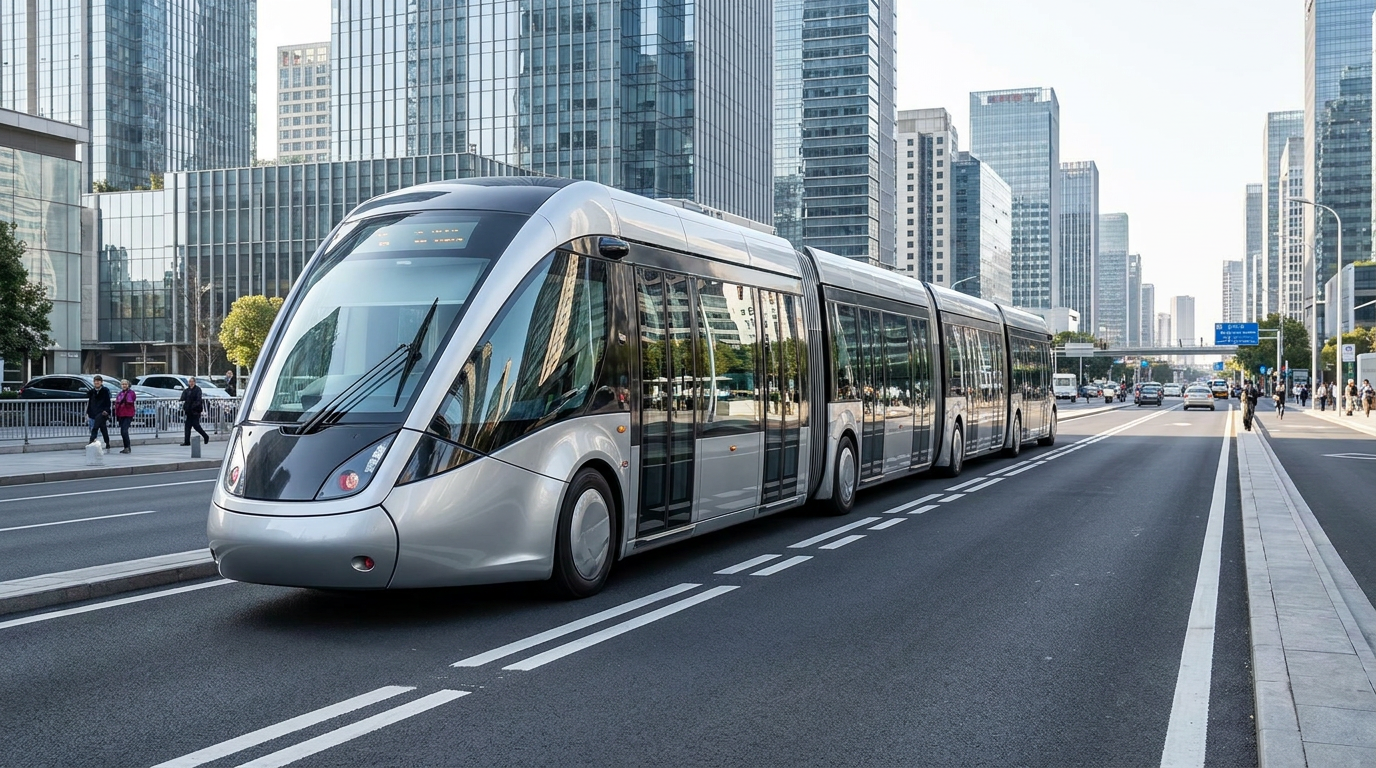
Enter Autonomous Rapid Transit (ART), more commonly known as the "trackless tram." Developed over the last decade by China's state-owned rail manufacturer CRRC, the technology is designed to split the difference between a bus and a train. It offers the sleek, multi-carriage design and high passenger capacity of a light rail system, but operates entirely on rubber tires, eliminating the need to dig up city streets.[1][2]
The mechanism behind the trackless tram relies on a suite of technologies borrowed from autonomous vehicles. Instead of physical steel rails, the tram follows a "virtual track"—typically double-dashed white lines painted on the asphalt. An array of optical sensors, LiDAR, and GPS positioning allows the vehicle's onboard computers to steer along these lines with centimeter-level accuracy.[1][2]

While a human driver remains in the cabin to monitor systems and take over in emergencies, the vehicle handles the precise alignment autonomously. This precision is crucial: it allows the multi-carriage vehicle to navigate narrow urban corridors and pull up perfectly flush with station platforms, ensuring seamless boarding for wheelchairs and strollers.[1][5]
Power delivery is another area where ART diverges from traditional trams. The vehicles are fully electric and battery-powered, removing the visual clutter and infrastructure burden of overhead wires. They utilize a rapid-charging system where the batteries are topped up via overhead pantographs at terminal stations. A quick 10-minute charge can provide enough power for roughly 25 kilometers of operation.[1][8]
For passengers, the most noticeable difference from a standard articulated bus is the ride quality. Trackless trams utilize active suspension and stabilization technology adapted directly from high-speed rail. This mitigates the sway, swerve, and jerkiness typical of bus rides, allowing passengers to stand comfortably or read without motion sickness. A standard three-carriage ART vehicle can carry over 300 passengers, rivaling the capacity of a traditional tram.[1][2][5]
The primary driver of global interest, however, is cost. Proponents estimate that trackless trams can be deployed for roughly $6 million to $10 million per kilometer—a fraction of the cost of light rail. Because the infrastructure requirements are largely limited to painting lines, building station platforms, and installing charging nodes, a city can theoretically deploy a trackless tram network as fast as its permitting process allows.[1][2][6]

Proponents estimate that trackless trams can be deployed for roughly $6 million to $10 million per kilometer—a fraction of the cost of light rail.
This economic calculus is already reshaping transit master plans in Southeast Asia. In Indonesia, President Joko Widodo recently championed the technology for Nusantara, the country's under-construction capital city. Noting that traditional Mass Rapid Transit (MRT) costs roughly $145 million per kilometer and Light Rail Transit (LRT) costs $45 million, Widodo highlighted that a single trackless tram trainset costs just $4.5 million, with minimal associated infrastructure costs.[4]
Malaysia is also betting heavily on the technology. The state of Sarawak is currently constructing the Kuching Urban Transportation System (KUTS), a $1.5 billion project that will rely entirely on hydrogen-powered and electric ART vehicles rather than the initially proposed light rail. Scheduled to begin phased operations in late 2025 and 2026, the 69-kilometer network will feature 35 stations and serve as a massive real-world test for the technology outside of China.[3]
Western nations are beginning to run their own trials. In Australia, the City of Stirling in Perth recently took delivery of a 30-meter trackless tram to test along a 7-kilometer stretch of Scarborough Beach Road. Researchers involved in the trial, including Curtin University sustainability professor Peter Newman, argue that the technology could be a "game changer" for mid-tier transit, encouraging transit-oriented development along corridors that currently rely on cars.[2][5]
Despite the enthusiasm, the technology faces fierce skepticism from traditional transit advocates. The most common critique is definitional: critics argue that a rubber-tired vehicle running on asphalt without physical rails is, by definition, simply a bus. When a trackless tram trial was launched in Lahore, Pakistan, in 2025, it went viral on social media, with millions of users mocking the "tram" label and calling it a rebranded electric bus.[7][8]

Transit purists often label ART a "gadgetbahn"—a flashy technological distraction that fails to solve the fundamental geometry of urban transport. They point out that to achieve the speed and reliability of a train, a trackless tram still requires a dedicated, grade-separated right-of-way. If an ART vehicle is forced to share a lane with mixed car traffic, it will get stuck in the exact same congestion as a standard city bus.[6][8]
There are also hidden infrastructure costs that challenge the "one-tenth the cost" claims. A fully loaded trackless tram is exceptionally heavy. Because its autonomous steering ensures its wheels follow the exact same path down to the centimeter on every single trip, the repeated stress can quickly cause "rutting"—deep grooves worn into standard asphalt. Cities deploying ART often find they must heavily reinforce the roadbed with concrete, significantly driving up the initial capital costs.[6][8]
Furthermore, the market is currently dominated by a single manufacturer, raising concerns about vendor lock-in. If a city builds its transit network around CRRC's proprietary optical guidance and charging systems, it may be entirely dependent on that single company for replacement parts, software updates, and future fleet expansions over the system's 25-year lifespan.[1][8]

Ultimately, the success of the trackless tram may depend on cities adjusting their expectations. It is not a magic bullet that makes light rail obsolete, nor is it merely a standard bus with a sleek paint job. Instead, it represents a highly advanced form of Bus Rapid Transit (BRT)—one that leverages modern sensors and battery tech to deliver a premium passenger experience at a price point that many growing cities can actually afford.[2][5][8]
How we got here
2017
China's CRRC unveils the first Autonomous Rapid Transit (ART) prototype in Zhuzhou.
2018
The first commercial ART line officially opens to the public in Zhuzhou, China.
2022
The Australian city of Stirling announces plans to trial the technology to relieve urban congestion.
2024
Indonesian President Joko Widodo tests an ART system in the under-construction capital of Nusantara.
2025
Malaysia's Sarawak state begins receiving ART vehicles for its $1.5 billion Kuching Urban Transportation System.
Viewpoints in depth
Urban Planners & Proponents
Advocates see ART as a financial lifeline for mid-sized cities priced out of the light rail market.
For proponents, the trackless tram solves the central dilemma of modern urban planning: how to build high-quality transit without bankrupting the city. They argue that by eliminating the need to dig up streets for rails and overhead wires, ART allows municipalities to deploy extensive networks in a fraction of the time. Furthermore, advocates like Peter Newman emphasize that the rail-like ride quality and sleek design help overcome the 'stigma' of buses, encouraging real-estate developers to invest in transit-oriented development along the corridors just as they would for a permanent train line.
Transit Skeptics & Purists
Critics argue the technology is a proprietary distraction that fails to solve the geometry of traffic.
Transit purists often dismiss ART as a 'gadgetbahn'—a flashy technological solution in search of a problem. They point out that the primary advantage of a train is its dedicated right-of-way, not its steel wheels. If a city is willing to carve out a dedicated lane for a trackless tram, it could achieve the exact same results by running high-capacity articulated buses in that lane for even less money. Skeptics also warn of vendor lock-in; because the optical guidance and rapid-charging systems are proprietary to CRRC, cities may find themselves trapped in expensive, monopolistic maintenance contracts for decades.
Municipal Governments
Local leaders view the technology as a pragmatic, fast-to-deploy alternative to decades-long mega-projects.
For mayors and city councils, the appeal of ART is highly political. Traditional light rail projects often take a decade to plan, fund, and build, meaning the politician who champions the project rarely gets to cut the ribbon, but suffers the public backlash from years of disruptive road construction. Trackless trams offer a way to deliver a 'rail-like' transit upgrade within a single election cycle. By utilizing existing road infrastructure and avoiding deep excavation, local governments can show immediate progress on decarbonization and traffic reduction without taking on massive municipal debt.
What we don't know
- How quickly the heavy, precisely-steered vehicles will degrade standard asphalt roads over a decade of use.
- Whether the proprietary technology will eventually be standardized across multiple manufacturers to prevent vendor lock-in.
- If the 'rail-like' design will actually spur the same level of permanent real-estate investment as physical light rail tracks.
Key terms
- Autonomous Rapid Transit (ART)
- The official industry term for trackless trams, developed by Chinese manufacturer CRRC, combining bus flexibility with rail-like capacity.
- LiDAR
- Light Detection and Ranging; a remote sensing method that uses pulsed lasers to measure distances and map the vehicle's surroundings in 3D.
- Pantograph
- An apparatus mounted on the roof of an electric vehicle to collect power through contact with an overhead charging station.
- Right-of-Way
- A dedicated lane or physical corridor reserved exclusively for public transit vehicles, preventing them from being slowed down by car traffic.
- Gadgetbahn
- A pejorative term used by transit planners to describe overly complex, proprietary transportation technologies that fail to improve upon conventional trains or buses.
Frequently asked
Is a trackless tram just a bus?
Technically, yes. Because it runs on rubber tires on standard asphalt and lacks physical rails, it is legally and mechanically a type of bus. However, its multi-carriage design, autonomous optical guidance, and high-speed rail suspension make the passenger experience closer to a train.
How does it steer without tracks?
The vehicle uses optical cameras, LiDAR, and GPS to read double-dashed white lines painted on the road. The onboard computer automatically steers the wheels to follow these lines with centimeter-level precision.
How is it powered?
ART vehicles are fully electric. They use advanced lithium-titanate batteries that can be fast-charged in about 10 minutes at terminal stations via an overhead pantograph, providing enough power for a 25-kilometer route.
Does it still get stuck in traffic?
Yes, if it is placed in mixed traffic. To achieve the speed and reliability of a train, trackless trams require dedicated, grade-separated lanes where private cars are not allowed.
Sources
Source coverage
8 outlets
3 viewpoints surfaced








[1]World Economic ForumUrban Planners & Proponents
What Are Trackless Trams And How Do They Work?
Read on World Economic Forum →[2]City MonitorUrban Planners & Proponents
Combining the best of high-speed trains and autonomous-vehicle tech
Read on City Monitor →[3]WikipediaMunicipal Governments
Kuching Urban Transportation System
Read on Wikipedia →[4]Jakarta GlobeMunicipal Governments
New Capital's Trackless Tram is Much Cheaper than MRT, LRT: Jokowi
Read on Jakarta Globe →[5]RenewEconomyUrban Planners & Proponents
Neither a train nor a bus, the trackless tram provides an opportunity to do public transport better
Read on RenewEconomy →[6]Public Transport Association of CanberraTransit Skeptics & Purists
Claim #1: Trackless trams are one-tenth the cost of light rail
Read on Public Transport Association of Canberra →[7]Hindustan TimesTransit Skeptics & Purists
Trackless tram gets trolled as Pakistan's Maryam Nawaz launches South Asia's first SART system
Read on Hindustan Times →[8]Factlen Editorial TeamTransit Skeptics & Purists
Synthesis by Factlen editorial team
Read on Factlen Editorial Team →
Every angle. Every day.
Get automotive stories with full source coverage and perspective breakdowns delivered to your inbox.