
The Rise of Astrotourism: How Dark Sky Sanctuaries Are Saving the Night
As light pollution erases the stars from urban skies, travelers are flocking to certified Dark Sky Sanctuaries, driving an astrotourism boom that is revitalizing remote rural economies.
By Factlen Editorial Team
- Conservationists and Astronomers
- Advocates focused on preserving the night sky as a critical natural and scientific resource.
- Rural Communities and Developers
- Stakeholders leveraging dark skies to build sustainable local economies.
- The Astrotourism Industry
- Tour operators and travel agencies capitalizing on the experiential travel boom.
- Independent Analysts
- Editorial synthesis evaluating the intersection of travel trends and environmental policy.
What's not represented
- · Indigenous communities whose ancestral lands host new observatories
- · Local wildlife conservationists managing the influx of nighttime foot traffic
Why this matters
The loss of the night sky disrupts human circadian rhythms and devastates nocturnal ecosystems. By turning pristine darkness into a valuable economic asset, astrotourism provides a financial incentive for communities to reverse light pollution and protect the natural world.
Key points
- Astrotourism is surging, with 62% of travelers planning dark-sky trips in the coming years.
- The Bortle Scale measures night sky brightness, with Class 1 representing pristine, shadow-casting starlight.
- DarkSky International has certified over 250 protected places, safeguarding 160,000 square kilometers of land.
- Sanctuaries are the rarest certification, reserved for the world's most fragile and isolated dark sites.
- The trend is driving vital socio-economic development to remote, rural communities that lack traditional tourism infrastructure.
- Preserving dark skies also protects nocturnal ecosystems and human circadian rhythms from the harms of light pollution.
The travel landscape in 2026 is increasingly defined not by what visitors can see on the ground, but by what they can see in the sky. Astrotourism—the practice of traveling specifically to observe celestial events and pristine night skies—has transitioned from a niche hobby for amateur astronomers into a mainstream global industry. Recent industry data indicates that 62% of surveyed travelers are planning trips to dark-sky destinations in the coming years, driven by a desire for awe, digital disconnection, and natural wonder.[5]
This surge in demand is largely a reaction to the modern urban environment. Today, the vast majority of the global population lives under a persistent dome of artificial skyglow, severing a connection to the cosmos that defined human history for millennia. As light pollution continues to erase the stars from city skies, true darkness has become a rare and highly sought-after commodity, prompting a new wave of experiential travel.[7]
To understand what travelers are searching for, one must look to the Bortle Scale. Created in 2001 by amateur astronomer John E. Bortle, the nine-level numeric system provides a standardized way to measure the brightness of the night sky. Before its publication, observers relied on vague descriptions, but the Bortle Scale introduced precise, naked-eye metrics to quantify light pollution and evaluate the quality of an observing site.[2]

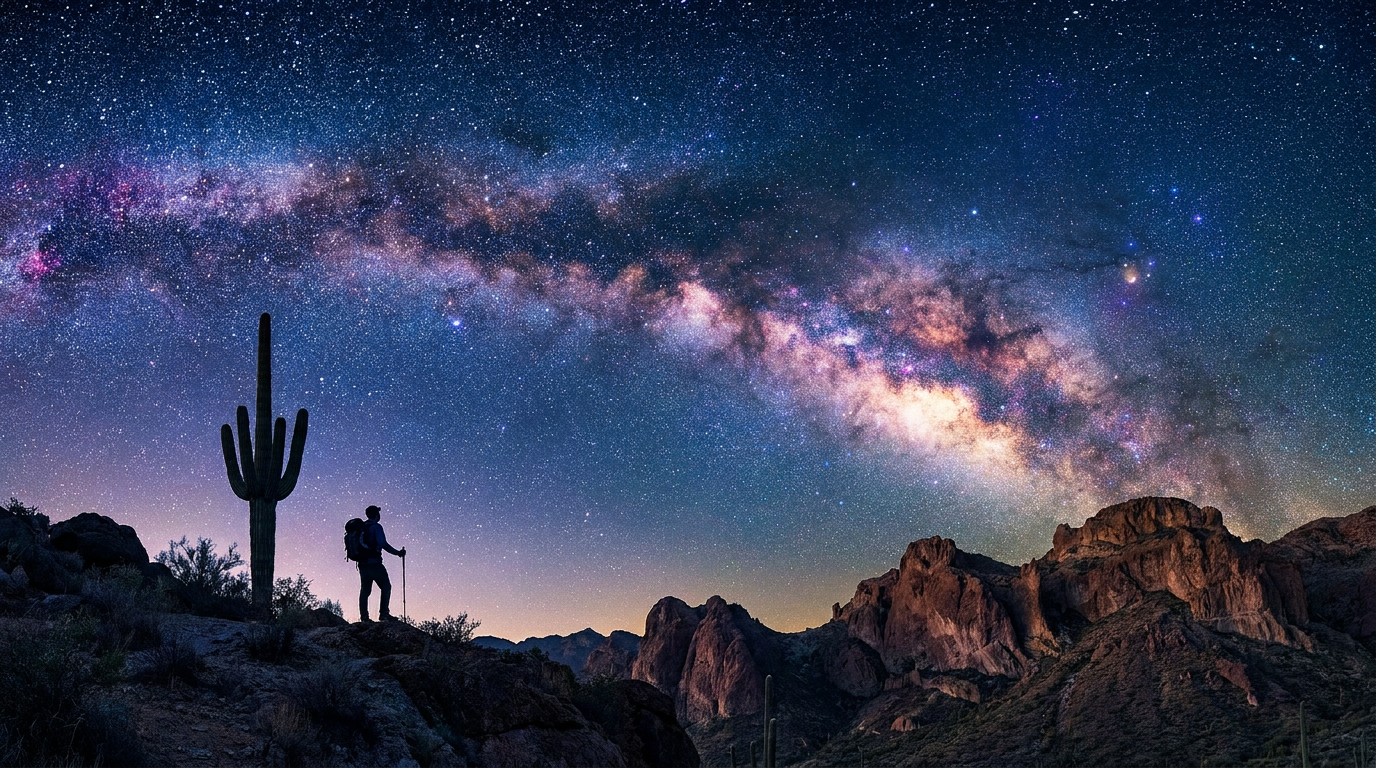
At the bottom of the scale is Class 9, representing the heavily light-polluted skies of an inner city where only the moon and a few bright planets are visible. At the very top is Class 1: an excellent, pristine dark-sky site. Under a Class 1 sky, the Milky Way is so vivid that it casts visible shadows on the ground, and distant galaxies like M33 can be seen clearly with the naked eye. Finding a Class 1 sky today requires traveling to the most remote corners of the globe.[2][7]
The global effort to protect these remaining pockets of darkness is spearheaded by DarkSky International. Originally founded as the International Dark-Sky Association, the organization manages a rigorous certification program that has recognized over 250 protected places across 22 countries. Together, these certified locations safeguard more than 160,000 square kilometers of land and night sky from encroaching light pollution.[1]
Achieving Dark Sky certification is not simply a matter of being located in a remote area; it is an active, ongoing conservation commitment. The application process typically takes one to three years and requires communities to implement strict outdoor lighting ordinances, retrofit existing fixtures, and conduct continuous night-sky monitoring. If a certified location fails to maintain these standards, its status can be revoked.[1]
The certification program is divided into several tiers, including Dark Sky Communities, Parks, and Reserves, each tailored to different levels of public access and surrounding population density. However, the most prestigious and fragile designation is the International Dark Sky Sanctuary. Sanctuaries are situated in the most isolated locations on Earth, possessing an exceptional quality of starry nights that are fiercely protected for their scientific and natural value.[1]

However, the most prestigious and fragile designation is the International Dark Sky Sanctuary.
A prime example of this extreme isolation is Aotea, or Great Barrier Island, located off the coast of New Zealand's North Island. In 2015, it became the first island in the world to receive Dark Sky Sanctuary status. With no reticulated electricity supply, the island's residents rely entirely on solar and wind power, naturally eliminating the threat of artificial light pollution and preserving a sky that frequently registers as a perfect Bortle Class 1.[6]
Beyond the sheer beauty of the cosmos, the rise of astrotourism is proving to be a powerful economic engine for rural areas. Many remote regions lack the traditional infrastructure—such as luxury resorts or historical monuments—needed to attract mass tourism. However, their geographic isolation provides them with an abundant supply of naturally dark skies, transforming a perceived lack of development into a highly marketable asset.[3]
In places like Sutherland, South Africa, the intersection of astronomy and tourism has catalyzed profound socio-economic development. The establishment of astronomical observatories and the subsequent influx of astrotourists have led to a dramatic increase in local accommodations and guided tour operations. This new micro-economy has generated substantial revenue and created jobs in areas historically plagued by high unemployment and poverty.[4]

Organizations like the Office of Astronomy for Development are actively working to democratize these benefits, ensuring that the revenue generated by astrotourism empowers local residents rather than exclusively enriching outside developers. By training locals as stargazing guides and incorporating indigenous starlore into the tourism narrative, rural communities can build sustainable livelihoods while preserving their cultural heritage.[3][4]
The benefits of preserving dark skies extend far beyond human economics; they are critical to ecological health. Artificial light pollution wreaks havoc on nocturnal ecosystems, disrupting the migratory patterns of birds, confusing nocturnal pollinators, and altering predator-prey dynamics. By enforcing strict lighting regulations, Dark Sky Sanctuaries create vital safe havens for wildlife.[1][7]
These regulations are guided by the Five Principles of Responsible Outdoor Lighting, which dictate that light should only be used when necessary, directed only where needed, and kept as dim as possible. Furthermore, the principles emphasize the use of warmer color temperatures, as blue-rich white light is particularly harmful to both nocturnal creatures and human circadian rhythms.[1]

The astrotourism boom is currently being accelerated by a series of spectacular celestial events. The solar maximum cycle of 2024 and 2025 produced historic aurora displays visible at unusually low latitudes, sparking widespread public interest in the night sky. Looking ahead, the travel industry is already mobilizing for the total solar eclipses of August 2026 and August 2027, which are expected to draw record numbers of tourists to the path of totality.[5]
As the industry grows, the ultimate challenge will be balancing accessibility with conservation. The very act of bringing tourists to fragile Dark Sky Sanctuaries introduces the risk of developing the infrastructure that causes light pollution in the first place. Yet, if managed carefully, astrotourism offers a rare environmental victory: a reminder that the loss of the night sky is a completely reversible form of pollution, requiring nothing more than the collective will to turn off the lights.[4][7]
How we got here
2001
The International Dark-Sky Association launches the Dark Sky Places program, with Flagstaff, Arizona as the first certified city.
Feb 2001
Amateur astronomer John E. Bortle publishes the 9-level Bortle Scale in Sky & Telescope magazine.
2015
Aotea / Great Barrier Island in New Zealand becomes the first island in the world to receive Dark Sky Sanctuary status.
2024–2025
A peak in the solar maximum cycle triggers spectacular global aurora displays, pushing astrotourism into the mainstream.
Aug 2026
A highly anticipated total solar eclipse across Iceland, Greenland, and Spain is projected to drive record astrotourism travel.
Viewpoints in depth
The Conservationist View
Advocates focused on preserving the night sky as a critical natural and scientific resource.
For the scientific and conservation communities, the night sky is an endangered ecosystem. They argue that light pollution is not just an aesthetic loss, but a profound ecological threat that disrupts bird migrations, confuses nocturnal pollinators, and alters predator-prey dynamics. Astronomers also rely on pristine skies to peer into the deep universe. For this camp, astrotourism is a means to an end: by giving the dark sky an economic value, they can incentivize local governments to pass strict lighting ordinances and protect the nocturnal environment from encroaching urbanization.
The Rural Development View
Stakeholders leveraging dark skies to build sustainable local economies.
Many rural areas lack the infrastructure, beaches, or historical monuments that typically draw massive tourist crowds. However, their isolation provides a unique asset: absolute darkness. For these communities, astrotourism is a vital engine for socio-economic development. By offering guided stargazing, indigenous starlore storytelling, and specialized accommodations, remote towns can create jobs and combat poverty. Their primary focus is ensuring that the economic benefits remain local, rather than being extracted by outside developers who swoop in to build luxury eco-lodges.
The Travel Industry View
Tour operators and travel agencies capitalizing on the experiential travel boom.
The travel industry views astrotourism as one of the fastest-growing niches in the post-pandemic world. Driven by travelers seeking awe, digital detoxes, and profound connections to nature, operators are packaging celestial events—like meteor showers, auroras, and eclipses—into high-value itineraries. This camp is focused on accessibility, logistics, and marketing, often working to bridge the gap between rugged, remote sanctuaries and the comfort expectations of modern experiential travelers.
What we don't know
- Whether rural infrastructure can handle the sudden influx of tourists without degrading the very environments they come to see.
- How the rapid deployment of low-earth orbit satellite constellations will impact ground-based astrotourism long-term.
Key terms
- Astrotourism
- A form of experiential travel focused on visiting destinations with pristine dark skies to observe celestial events and astronomical phenomena.
- Bortle Scale
- A nine-level scale created in 2001 that measures the brightness of the night sky and the observability of celestial objects.
- Dark Sky Sanctuary
- A highly remote location certified by DarkSky International that possesses an exceptional quality of starry nights and is fiercely protected from light pollution.
- Light Pollution
- The inappropriate or excessive use of artificial outdoor light, which washes out the night sky and disrupts natural ecosystems.
- Skyglow
- The diffuse, glowing dome of light seen over populated areas at night, caused by artificial light scattering in the atmosphere.
Frequently asked
What is the difference between a Dark Sky Park and a Sanctuary?
A Dark Sky Park is typically a protected public land with good accessibility and lighting policies. A Sanctuary is much more remote, harder to access, and represents the most fragile and pristine dark sites on Earth.
What is the Bortle Scale?
The Bortle Scale is a nine-level numeric system used to measure the brightness of the night sky. Class 1 represents a perfectly dark, pristine sky, while Class 9 represents the heavily light-polluted sky of an inner city.
How does light pollution affect the environment?
Artificial light disrupts the circadian rhythms of both humans and wildlife. It can alter predator-prey dynamics, confuse nocturnal pollinators, and fatally disorient migrating birds.
Do I need an expensive telescope for astrotourism?
No. Under a true dark sky (Bortle Class 1 or 2), the Milky Way, meteor showers, and even some distant galaxies are clearly visible to the naked eye. Basic binoculars are often enough to enhance the view.
Sources
Source coverage
7 outlets
4 viewpoints surfaced







[1]DarkSky InternationalConservationists and Astronomers
International Dark Sky Places Program and Certification
Read on DarkSky International →[2]Sky & TelescopeConservationists and Astronomers
Light Pollution and Astronomy: The Bortle Dark-Sky Scale
Read on Sky & Telescope →[3]Office of Astronomy for DevelopmentRural Communities and Developers
Empowering Rural Communities through Astrotourism
Read on Office of Astronomy for Development →[4]arXivRural Communities and Developers
Sustainable, local socio-economic development through Astronomy
Read on arXiv →[5]Expats TravelingThe Astrotourism Industry
Dark Skies, Eclipses, and Aurora Travel
Read on Expats Traveling →[6]Aotea Great Barrier Island Dark Sky SanctuaryThe Astrotourism Industry
Dark Sky Sanctuaries & Astrotourism in New Zealand
Read on Aotea Great Barrier Island Dark Sky Sanctuary →[7]Factlen Editorial TeamIndependent Analysts
Synthesis by Factlen editorial team
Read on Factlen Editorial Team →
Every angle. Every day.
Get travel stories with full source coverage and perspective breakdowns delivered to your inbox.