
The Physics and Biomechanics Behind Badminton's 500 km/h Jump Smash
The badminton jump smash is the fastest projectile strike in all of sports, relying on a complex kinetic chain and unique aerodynamic properties. Here is how athletes generate record-breaking speeds and why the shuttlecock's design makes returning them humanly possible.
By Factlen Editorial Team
- Sports Biomechanists
- Focus on the kinetic chain, muscle sequencing, and injury prevention in elite athletes.
- Material Scientists
- Analyze the aerodynamics of the shuttlecock and the carbon-fiber engineering of modern rackets.
- Badminton Governing Bodies
- Track official speed records and regulate equipment standards to maintain the balance of the game.
What's not represented
- · Amateur players struggling to master the technique
- · Racket manufacturers' R&D departments
Why this matters
Understanding the biomechanics of the jump smash reveals the extraordinary athletic demands of elite badminton, transforming how spectators appreciate the sport and offering insights into human kinetic potential.
Key points
- The badminton jump smash is the fastest projectile strike in sports, with records exceeding 565 km/h.
- Power is generated through a kinetic chain, starting in the legs and multiplying through torso rotation and forearm pronation.
- Modern carbon-fiber rackets and high-tension strings act as a trampoline, maximizing energy transfer.
- The shuttlecock's 16 feathers create massive aerodynamic drag, causing it to decelerate rapidly.
- This rapid deceleration is what allows defenders to react to and return shots that leave the racket at over 400 km/h.
When discussing the fastest projectiles in sports, casual observers often point to golf drives, which can exceed 300 kilometers per hour, or professional tennis serves that routinely top 230 kilometers per hour. However, the undisputed king of projectile velocity belongs to a sport often mischaracterized as a gentle backyard pastime: badminton. In the elite professional circuit, the shuttlecock leaves the racket at speeds that defy intuition, transforming the game into a high-stakes battle of split-second reflexes.[1][6]
The current Guinness World Record for the fastest badminton smash in a controlled environment sits at an astonishing 565 kilometers per hour (351 miles per hour), set by India's Satwiksairaj Rankireddy. Even in live tournament play, elite male players regularly execute jump smashes exceeding 400 kilometers per hour, while top female players routinely break the 350-kilometer-per-hour barrier. To put this in perspective, a professional badminton smash travels significantly faster than a Formula 1 car at top speed.[1]
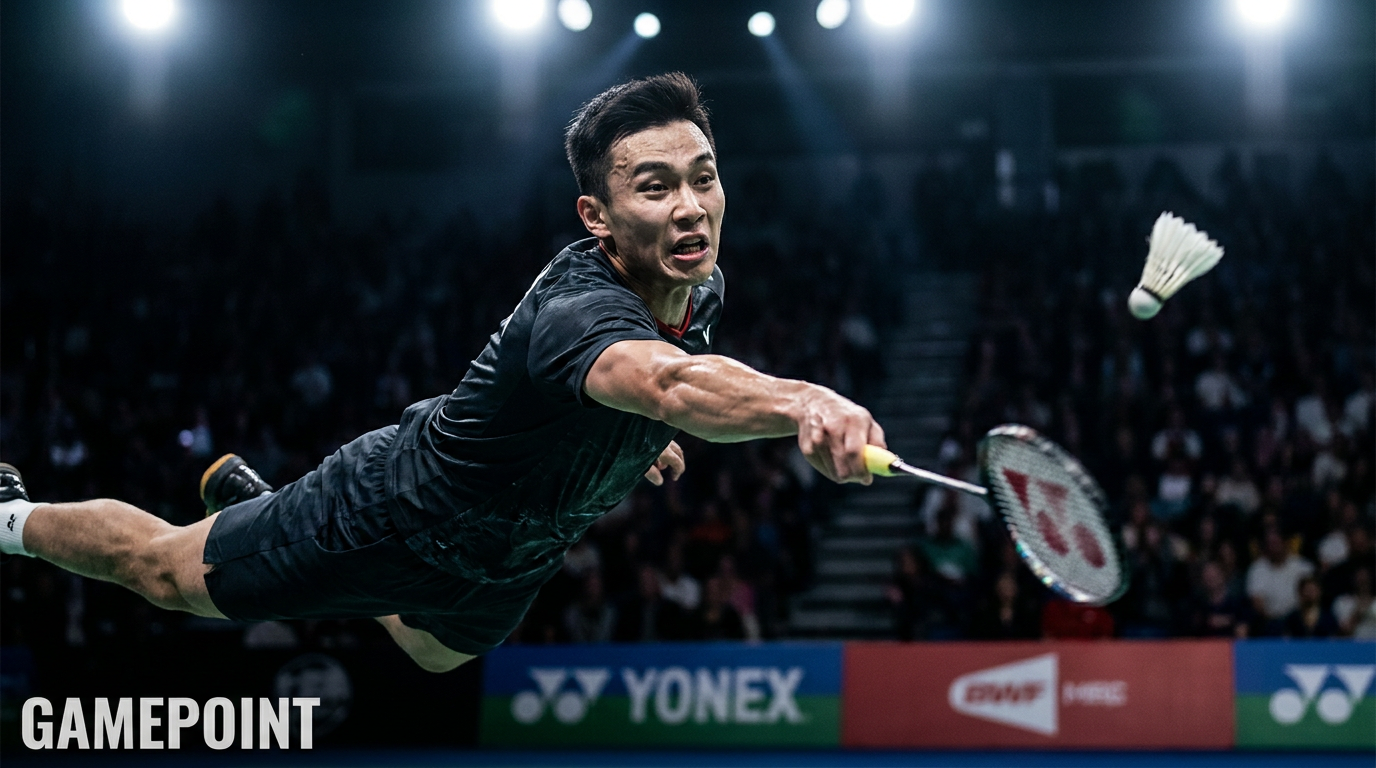
To understand how a five-gram object made of cork and goose feathers can achieve such extraordinary velocity, sports scientists look to a biomechanical principle known as the kinetic chain. Generating a 500 km/h strike does not originate in the arm or the wrist; it begins in the ground. The jump smash is a full-body explosive movement that requires perfect synchronization of multiple muscle groups firing in a precise sequence.[2][6]
The sequence initiates as the player leaps into the air, arching their back to create a bow-like tension across their core and abdominal muscles. At the apex of the jump, the rotation of the hips initiates the forward movement, transferring rotational energy up through the torso. This energy travels into the shoulder, which acts as a hinge, violently whipping the upper arm forward toward the incoming shuttlecock.[2]
Following the shoulder rotation comes the elbow extension, but the most critical phase of the kinetic chain occurs in the forearm. A movement known as forearm pronation—a rapid inward twisting motion, similar to turning a doorknob with explosive force—acts as a velocity multiplier for the racket head. This pronation is responsible for a significant percentage of the final racket head speed.[2][5]
Finally, the wrist snaps just milliseconds before impact. This sequential firing—from the large, powerful muscles of the legs and core to the smaller, faster muscles of the forearm and wrist—creates a whip effect. By the time the kinetic energy reaches the racket head, it has been amplified at every joint, resulting in maximum possible velocity at the exact moment of contact.[2][6]

However, human biomechanics alone cannot fully explain a 500 km/h projectile. The equipment plays an equally vital role in this physics equation. Modern badminton rackets are marvels of material science, constructed from high-modulus graphite, carbon fiber, and proprietary resins that offer an extreme strength-to-weight ratio. A professional racket typically weighs between 80 and 90 grams, allowing for incredibly fast swing speeds.[4]
However, human biomechanics alone cannot fully explain a 500 km/h projectile.
When the racket is swung, the flexible carbon-fiber shaft bends backward during the acceleration phase. Just before impact, the shaft snaps forward, returning to its original shape and adding its own mechanical velocity to the player's swing. Simultaneously, the string bed—often strung at tensions exceeding 30 pounds—acts like a trampoline. This coefficient of restitution transfers maximum kinetic energy directly into the cork base of the shuttlecock.[4][6]
Once the shuttlecock leaves the racket, a completely different field of physics takes over: aerodynamics. The shuttlecock is a highly unusual sports projectile. A standard Badminton World Federation (BWF) approved shuttlecock is meticulously crafted from exactly 16 overlapping goose feathers, embedded into a rounded cork base covered in thin leather.[3]
This unique cone-shaped design makes the shuttlecock a highly drag-intensive object. The feathers act essentially as a parachute. While the shuttlecock leaves the racket at over 400 km/h, it does not maintain this speed. Instead, it decelerates exponentially due to immense air resistance. The aerodynamic drag coefficient of a shuttlecock is vastly higher than that of a smooth sphere like a golf ball or tennis ball.[3][4]
By the time a 400 km/h smash crosses the net and reaches the defending player on the opposite side of the court, its speed has often dropped to below 100 km/h. This rapid, non-linear deceleration is the only reason the sport is playable at the elite level. If a shuttlecock maintained its initial velocity in the way a baseball does, human reaction times—which hover around 0.2 seconds—would be entirely insufficient to track and return the shot.[3][6]

The physical toll of generating this immense power repeatedly is a major focus for modern sports medicine. Elite singles players may perform hundreds of jump smashes over the course of a grueling three-game match. This places extreme, repetitive stress on the shoulder capsule, the patellar tendon in the knee, and the Achilles tendon during the explosive takeoff and high-impact landing phases.[5]
To mitigate these risks, sports scientists and biomechanists use advanced motion capture technology to optimize players' landing mechanics. Training regimens now heavily emphasize core stability, plyometrics, and eccentric muscle strengthening to help athletes absorb the shock of landing on one leg after delivering a maximum-effort rotational strike in mid-air.[2][5]
The evolution of the jump smash also reflects the tactical evolution of badminton. In the era of wooden rackets, the smash was a finishing move used sparingly due to the heavy equipment. Today, with ultra-light carbon frames, the jump smash is used continuously to dictate rallies, force weak returns, and break down an opponent's defensive structure through sheer physical pressure.[6]

As racket technology continues to advance and sports science refines human conditioning, the ultimate speed limit of the badminton smash remains an open question. Researchers debate whether the limiting factor will ultimately be the tensile strength of racket strings or the biological limits of the human shoulder joint.[4][6]
For now, the jump smash stands as a perfect synthesis of human athleticism and physical engineering. It is a split-second explosion of kinetic energy that defines the modern game, offering spectators a breathtaking display of power that is unmatched anywhere else in the sporting world.[6]
How we got here
Pre-1980s
Players use heavy wooden rackets, making the jump smash a rare, energy-intensive finishing move.
1980s-1990s
The introduction of lightweight carbon-fiber and graphite rackets allows players to jump smash more frequently.
2013
Malaysia's Tan Boon Heong sets a controlled-environment smash record of 493 km/h.
July 2023
India's Satwiksairaj Rankireddy shatters the Guinness World Record with a 565 km/h smash.
Viewpoints in depth
Sports Biomechanists
Focus on the kinetic chain and the physical toll the smash takes on the human body.
Biomechanists view the jump smash as a marvel of human kinetic sequencing, but also a primary vector for injury. They emphasize that power generation must start from the ground up; players who rely too heavily on their shoulder or arm without proper hip rotation risk severe rotator cuff and elbow injuries. Current research in this field heavily utilizes 3D motion capture to analyze the asymmetric landing forces placed on the non-dominant leg, aiming to develop targeted plyometric training that protects the patellar and Achilles tendons during the hundreds of landings required in a single match.
Material Scientists
Analyze the interplay between racket engineering and shuttlecock aerodynamics.
For material scientists and physicists, the badminton smash is a study in extremes. They focus on the 'trampoline effect' of the string bed and the flex-profile of the carbon-fiber shaft, which must be engineered to bend and snap back in a fraction of a second. Equally fascinating to this camp is the shuttlecock itself. Fluid dynamics experts study how the 16 overlapping feathers create a unique drag coefficient that causes the projectile to decelerate exponentially—a non-linear flight path that is entirely distinct from the parabolic arcs seen in baseball or golf.
Elite Coaches
Focus on the tactical deployment of the smash and the conditioning required to sustain it.
At the elite coaching level, the sheer speed of the smash is taken as a given; the focus shifts to endurance and tactical timing. Coaches train players to use the jump smash not just as a guaranteed point-winner, but as a tool to create pressure and force weak defensive lifts from the opponent. The modern training regimen is designed to build the cardiovascular and muscular endurance necessary to execute a 400 km/h jump smash with the exact same biomechanical precision in the 60th minute of a match as in the first.
What we don't know
- The absolute biological limit of human shoulder rotation speed before tissue failure occurs.
- Whether future synthetic shuttlecocks will perfectly replicate the unique aerodynamic drag of natural goose feathers.
Key terms
- Kinetic Chain
- The sequence of body segments and joints working together to transfer energy from the ground up through the body to the racket.
- Forearm Pronation
- The inward rotational movement of the forearm, essential for generating the final burst of speed in a racket swing.
- Coefficient of Restitution
- A measure of the elasticity of a collision; in badminton, how efficiently the string bed returns energy to the shuttlecock.
- Aerodynamic Drag
- The force of air resistance that opposes the motion of an object, which is exceptionally high for a feathered shuttlecock.
Frequently asked
Is a badminton smash really faster than a golf drive?
Yes. While a professional golf drive maxes out around 340 km/h, elite badminton smashes regularly exceed 400 km/h, with the world record sitting at 565 km/h.
How can players return a 400 km/h shot?
The feathers on a shuttlecock create immense aerodynamic drag. A shuttlecock leaving the racket at 400 km/h will decelerate to under 100 km/h by the time it reaches the defending player.
What is forearm pronation?
It is the rapid inward twisting of the forearm just before impact. This biomechanical movement acts as a velocity multiplier and is crucial for generating top racket speeds.
Sources
Source coverage
6 outlets
3 viewpoints surfaced




[1]Badminton World FederationBadminton Governing Bodies
Rankireddy, Tan Smash Guinness World Records Title
Read on Badminton World Federation →[2]Sports BiomechanicsSports Biomechanists
Kinematic analysis of the kinetic chain in the badminton jump smash
Read on Sports Biomechanics →[3]Journal of Sports SciencesMaterial Scientists
Aerodynamic trajectory of a badminton shuttlecock
Read on Journal of Sports Sciences →[4]Physics WorldMaterial Scientists
The complex physics of the shuttlecock
Read on Physics World →[5]National Institutes of HealthSports Biomechanists
Upper limb injury prevention in elite badminton players
Read on National Institutes of Health →[6]Factlen Editorial TeamBadminton Governing Bodies
Synthesis by Factlen editorial team
Read on Factlen Editorial Team →

Every angle. Every day.
Get sports stories with full source coverage and perspective breakdowns delivered to your inbox.