
The Quiet Race to Replace Diesel: Why Hydrogen and Battery Trains Are Splitting the Tracks
As railways push to eliminate diesel on non-electrified routes, a fierce competition has emerged between hydrogen fuel cells and advanced battery-electric trains. While batteries are winning short-haul regional routes, hydrogen is finding its niche in heavy freight and remote corridors.
By Factlen Editorial Team
- Battery-Electric Advocates
- Argue that direct use of electricity via batteries is far more efficient than the hydrogen conversion cycle.
- Hydrogen Rail Developers
- Focus on the operational range and fast refueling times that batteries currently cannot match.
- Freight & Heavy Rail Operators
- Prioritize duty cycles and pulling power for heavy-duty industrial applications.
- Neutral Analysts
- Advocate for a portfolio approach tailored to the specific physics of each route.
What's not represented
- · Local communities living near diesel rail yards
- · Green hydrogen producers and infrastructure developers
Why this matters
Rail is already the most efficient way to move people and goods, but eliminating its remaining diesel emissions is crucial for global climate goals. Understanding which technology wins where reveals how the future of heavy transport will actually be powered.
Key points
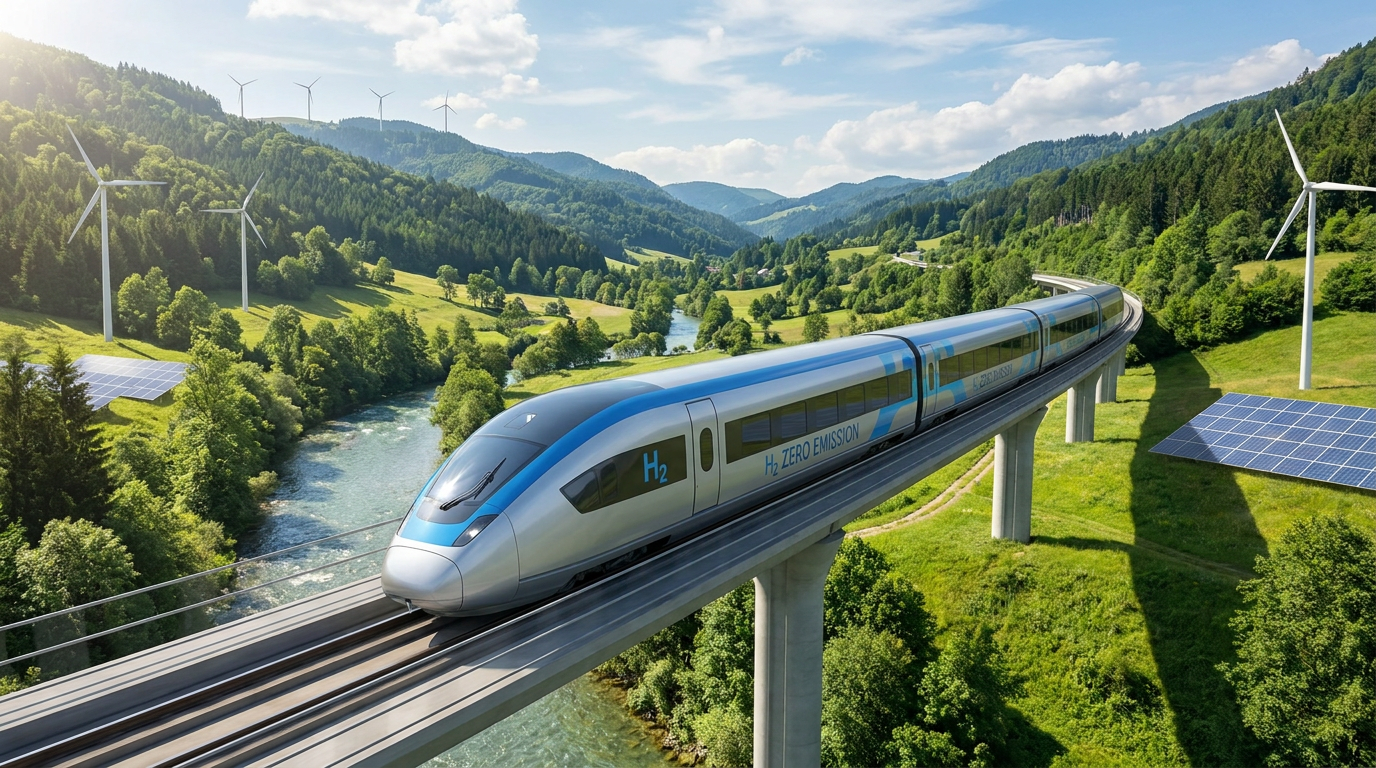
- Hydrogen trains generate onboard electricity by combining hydrogen and oxygen, emitting only water vapor.
- Early pioneer Germany has recently pivoted toward battery-electric trains for regional routes due to lower energy conversion losses.
- Batteries are increasingly favored for short-haul routes where trains can easily recharge at stations.
- Hydrogen retains a strong advantage for long-distance routes, heavy freight, and areas with weak electrical grids.
- India, Italy, and Spain are actively deploying new hydrogen rail projects in 2026 for specific, hard-to-electrify corridors.
Rail transport is already the poster child for clean mobility, but it harbors a dirty secret: a massive percentage of regional and freight lines still run on diesel. Electrifying every mile of track with overhead catenary wires is prohibitively expensive, requiring bridge modifications, tunnel expansions, and complex grid upgrades.[3][6]
For years, the rail industry has searched for a "drop-in" zero-emission replacement for diesel locomotives on these remote or low-traffic routes. Two primary contenders have emerged in the 2020s: hydrogen fuel cell trains and battery-electric multiple units (BEMUs).[2][3]
The hydrogen train mechanism is elegant. It is essentially an electric train that generates its own power onboard. Hydrogen gas stored in high-pressure tanks is fed into a fuel cell, where it reacts with oxygen drawn from the outside air.[4][6]
This chemical reaction produces electricity to drive the traction motors, with the only byproduct being pure water vapor. In operation, a hydrogen train is virtually silent, offering the smooth acceleration of an electric locomotive without the need for continuous overhead wires.[4][5]

Alstom pioneered this space with the Coradia iLint, which debuted in Germany in 2018. By 2022, the German state of Lower Saxony was running the world's first fully hydrogen-powered passenger route, replacing 15 diesel trains and proving the technology could work in daily revenue service.[4][6]
However, the transition has not been entirely smooth. By late 2024 and into 2025, Germany began pulling many of its hydrogen trains out of service, and regional operators signaled that future orders would lean toward battery-electric models instead.[1][6]
The issue was not the train technology itself, but the physics and economics of the hydrogen energy chain. Creating green hydrogen, compressing it, transporting it to rural depots, and converting it back into electricity onboard results in significant energy losses. When regional rail authorities ran the numbers, they found that hydrogen was often the most expensive way to run an electric train.[1][3]
Simultaneously, battery technology improved faster than anticipated. Modern battery-electric trains can now handle medium-distance regional routes by charging at strategic nodes or running under partial overhead wires, offering a cheaper and simpler alternative to complex hydrogen logistics.[2][3]

Simultaneously, battery technology improved faster than anticipated.
As a result, the industry consensus has shifted. Battery trains are increasingly viewed as the default replacement for diesel on short and medium regional passenger lines, where energy efficiency and grid integration are paramount.[1][3]
But hydrogen rail is far from dead; it is simply finding its specific, high-value niche. Hydrogen retains a massive advantage in energy density over lithium-ion batteries, making it the superior choice for routes where trains must travel long distances without stopping, or where the local power grid cannot support megawatt-scale fast chargers.[3][7]
This dynamic is playing out globally in 2026. In May 2026, India's Ministry of Railways approved a massive 10-coach hydrogen trainset for the 90-kilometer Jind–Sonipat corridor. Billed as the longest broad-gauge hydrogen train in the world, it relies on a dedicated 3,000-kilogram green hydrogen plant built specifically for the route.[1][6]
Italy is also pushing forward, preparing to launch its Coradia Stream H trains on the non-electrified Brescia–Iseo–Edolo line by mid-2026. This deployment is backed by a €367 million "Hydrogen Valley" investment to build the necessary refueling infrastructure in the mountainous Valcamonica region.[1][4]

Spain is similarly testing hydrogen trains for its rural and mountainous provinces, aiming for commercial service by the end of 2026. These regions feature challenging topographies where installing overhead wires is geographically and financially impossible.[6][7]
In North America, the focus is heavily on freight rather than passenger transit. Major operators like CSX and CPKC are actively testing hydrogen fuel cell locomotives for heavy yard shunting operations.[2][7]
Freight trains require immense pulling power and near-continuous operation. While battery-electric locomotives are being tested for short-haul intermodal routes, hydrogen's faster refueling times and longer duty cycles make it a strong candidate for heavy yard work where trains cannot afford to sit idle while charging.[2][3]

Ultimately, the future of zero-emission rail is not a winner-take-all battle between hydrogen and batteries. It is a pragmatic, portfolio-based approach tailored to the specific physics of each route.[3][7]
How we got here
2018
Alstom's Coradia iLint, the world's first hydrogen passenger train, enters commercial service in Germany.
August 2022
Lower Saxony launches the first rail line entirely run by hydrogen-powered trains, replacing 15 diesel units.
Late 2024
Germany begins pulling several hydrogen trains out of service, citing high operational costs and a pivot toward battery-electric models.
May 2026
India approves a 10-coach hydrogen trainset, the longest on broad gauge, for the Jind–Sonipat corridor.
Mid 2026
Italy prepares to launch its first hydrogen trains on the Brescia–Iseo–Edolo line, backed by a €367M investment.
Viewpoints in depth
Battery-Electric Advocates
Argue that direct use of electricity via batteries is far more efficient than the hydrogen conversion cycle.
This camp emphasizes the physics of energy conversion. Every time energy changes form—from grid electricity to hydrogen gas, and then back to electricity inside a fuel cell—significant power is lost. Battery advocates argue that for the vast majority of regional routes, it is cheaper and more efficient to charge a battery directly from the grid. They point to falling lithium-ion costs and the simplicity of charging at existing stations as proof that batteries should be the default diesel replacement.
Hydrogen Rail Developers
Focus on the operational range and fast refueling times that batteries currently cannot match.
Proponents of hydrogen rail argue that batteries are too heavy and lack the energy density required for demanding routes. A hydrogen train can travel over 1,000 kilometers on a single tank and refuel in roughly the same time it takes to fill a diesel locomotive. For rural networks, mountainous terrain, or areas where the local power grid cannot support megawatt-scale fast chargers, developers argue that hydrogen is the only viable zero-emission solution that doesn't require massive infrastructure overhauls.
Freight & Heavy Rail Operators
Prioritize duty cycles and pulling power for heavy-duty industrial applications.
In the freight sector, the calculus is different than in passenger transit. Freight trains require immense, sustained pulling power and operate on near-continuous schedules. Operators testing hydrogen point out that heavy locomotives cannot afford to sit idle for hours while massive battery banks recharge. Hydrogen fuel cells offer the continuous power output and rapid turnaround times necessary to keep supply chains moving, making them highly attractive for yard shunting and long-haul freight.
What we don't know
- Whether the cost of producing and transporting green hydrogen will fall fast enough to make it competitive with direct grid electricity.
- How quickly solid-state batteries might improve, potentially encroaching on hydrogen's long-range advantage.
- If North American freight operators will ultimately adopt hydrogen for long-haul routes or restrict it to localized yard operations.
Key terms
- Hydrogen Fuel Cell
- A device that generates electricity through a chemical reaction between hydrogen and oxygen, emitting only water vapor.
- Battery-Electric Multiple Unit (BEMU)
- A passenger train powered by onboard battery packs that can recharge via overhead wires or at stationary charging points.
- Catenary System
- The system of overhead wires used to supply electricity to a locomotive or tram.
- Green Hydrogen
- Hydrogen fuel produced by splitting water molecules using electricity generated from renewable sources like wind or solar.
- Shunter
- A small locomotive used for assembling trains and moving railcars around a rail yard.
Frequently asked
Are hydrogen trains completely emission-free?
Yes, at the tailpipe. The only byproduct of a hydrogen fuel cell is water vapor. However, their overall climate impact depends on how the hydrogen fuel is produced.
Why not just use batteries for all trains?
Batteries are heavy and take time to recharge. For long-distance routes or heavy freight, batteries cannot currently store enough energy without compromising the train's payload or schedule.
Why don't we just electrify all the tracks?
Installing overhead wires is highly capital-intensive, requiring bridge modifications, tunnel expansions, and grid upgrades. It is often not economically viable for rural or low-traffic routes.
Sources
Source coverage
7 outlets
4 viewpoints surfaced







[1]AutonocionBattery-Electric Advocates
Germany Is Pulling Its Hydrogen Trains. Japan Never Scaled Its Own. India Just Built the World's Longest One
Read on Autonocion →[2]Railway-NewsFreight & Heavy Rail Operators
Hydrogen and Battery Trains: Making Railroads More Sustainable
Read on Railway-News →[3]EcoMENABattery-Electric Advocates
What Will Power the Future of Trains - Hydrogen or Batteries
Read on EcoMENA →[4]AlstomHydrogen Rail Developers
Alstom Coradia iLint – the world's 1st hydrogen powered passenger train
Read on Alstom →[5]Hydrogen EuropeHydrogen Rail Developers
German rail network to introduce Siemens hydrogen-powered trains
Read on Hydrogen Europe →[6]WikipediaNeutral Analysts
Hydrogen train
Read on Wikipedia →[7]Factlen Editorial TeamNeutral Analysts
Synthesis by Factlen editorial team
Read on Factlen Editorial Team →
Every angle. Every day.
Get automotive stories with full source coverage and perspective breakdowns delivered to your inbox.