
Haptic Suits Become Standard Accessibility Tech for Deaf Concertgoers This Summer
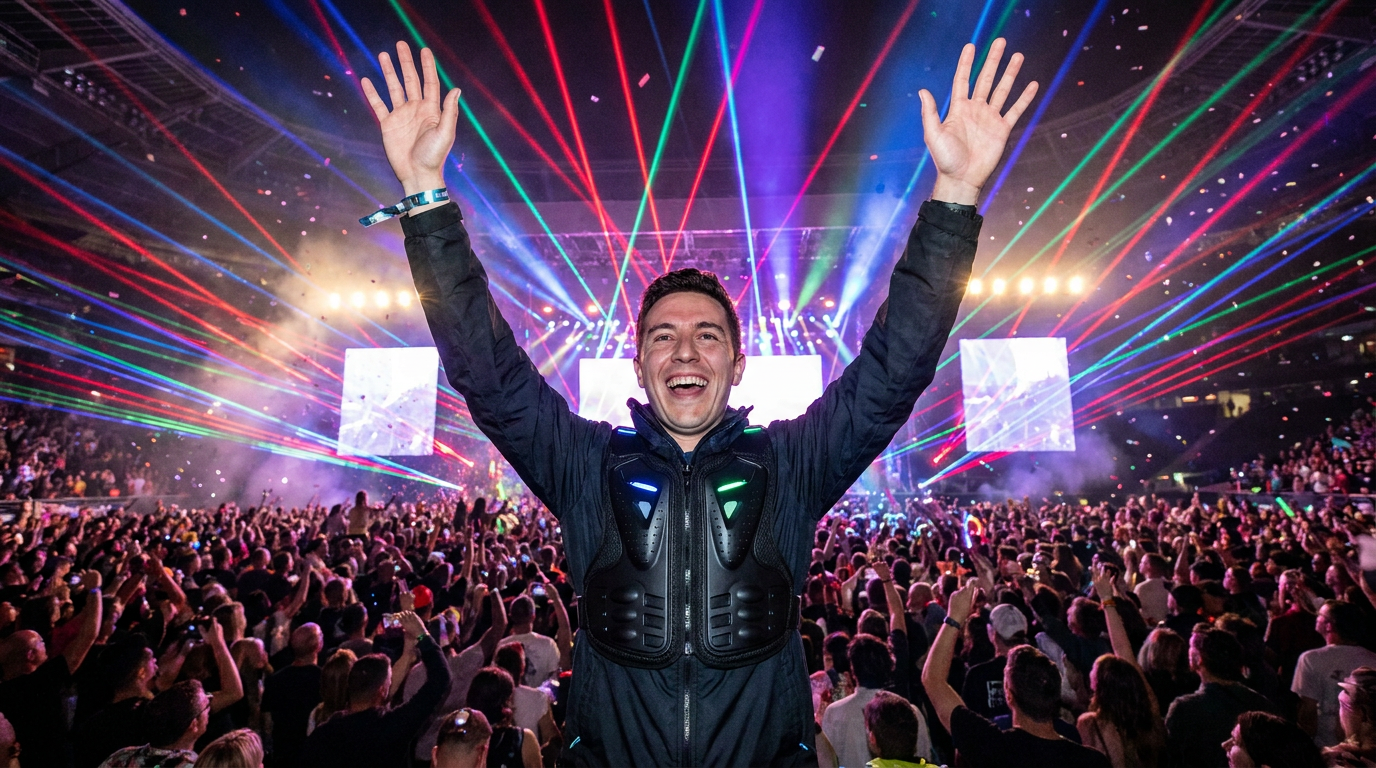
Major music festivals and touring artists have rolled out wearable haptic vests that translate live audio into full-body vibrations, transforming live music into a fully inclusive sensory experience.
By Factlen Editorial Team
- Deaf & Hard-of-Hearing Fans
- Advocate for full sensory inclusion and the right to experience live art on equal footing with hearing attendees.
- Live Music Promoters
- Focus on scaling accessibility tech across massive stadium tours and standardizing the logistics of haptic devices.
- Haptic Audio Engineers
- Treat vibrational translation as a distinct art form, mixing tactile frequencies live alongside the acoustic soundboard.
What's not represented
- · Smaller independent venues that cannot yet afford the haptic hardware infrastructure.
- · Hearing concertgoers who might want to rent the suits for an enhanced sensory experience.
Why this matters
For decades, deaf and hard-of-hearing music fans were largely excluded from the full emotional and physical experience of live concerts. The standardization of haptic suits transforms live music from a purely auditory event into a universal, full-body sensory experience, setting a new benchmark for accessibility in public entertainment.
Key points
- Major music promoters have standardized haptic sensory suits for deaf and hard-of-hearing fans for the 2026 summer concert season.
- The lightweight vests feature up to 24 actuators that translate live audio into a 3D surround-sound physical experience.
- Specialized 'Vibro-DJs' mix the tactile frequencies live, mapping different instruments to specific body parts.
- 5G technology allows the suits to operate with near-zero latency and even translates crowd reactions into vibrations.
- The technology is expanding beyond pop and EDM into classical orchestral performances and Broadway shows.
Summer 2026 marks a watershed moment for live music accessibility. Across major festivals and stadium tours, deaf and hard-of-hearing fans are strapping into haptic sensory suits that translate live audio into a high-fidelity, full-body tactile experience.[4][7]
What was once a bespoke experiment championed by a few artists has now become a standardized offering. Promoters and major entertainment conglomerates have incorporated these wearable devices into their core accessibility programs for the summer season, moving beyond traditional American Sign Language (ASL) interpreters to offer a genuinely immersive physical connection to the music.[7]
The technology, pioneered by organizations like Music: Not Impossible and SUBPAC, relies on lightweight wireless vests equipped with up to 24 independent vibration actuators. These nodes are distributed across the torso, wrists, and ankles, creating a three-dimensional surround-sound experience delivered entirely through the skin.[3][4][8]

Delivering this experience is not merely a matter of amplifying the bass. "Vibro-DJs" or haptic audio engineers sit alongside traditional sound mixers, actively translating different instruments to specific parts of the body. In a classical arrangement, for example, violins might resonate in the ribcage, cellos lower in the abdomen, and horns across the shoulders.[5][6]
The mainstream push began in earnest during Coldplay's multi-year "Music of the Spheres" tour. The band provided SUBPAC vests and dedicated sensory zones for deaf fans across the globe, proving that the logistics of distributing and syncing the hardware could work reliably at a massive stadium scale.[1][2]
The mainstream push began in earnest during Coldplay's multi-year "Music of the Spheres" tour.
For concertgoers, the impact is profound. Fans who previously relied on holding balloons or pressing their hands against speaker cabinets to catch stray vibrations report feeling the emotional nuances of a performance for the first time.[6]
Attendees have described the sensation as feeling the music "all the way up the spine," with one festivalgoer comparing the empowering feeling to being a superhero. The suits allow users to catch the subtleties and syncopations that visual cues and standard hearing aids alone cannot convey.[2][4][8]

Recent technological leaps have eliminated the latency that plagued early haptic prototypes. Using high-speed 5G networks, the suits now receive data in real-time, ensuring that the physical sensation perfectly matches the visual of a drummer striking a cymbal or a guitarist hitting a chord.[3][8]
Innovators have even begun mapping crowd reactions into the haptic matrix. Machine learning algorithms convert the roar of the audience into distinct vibrational patterns, allowing deaf fans to feel the collective energy of the stadium—a crucial element of the live music experience that was previously isolating.[3]
The application is rapidly expanding beyond pop and electronic dance music. At venues like Manhattan's Lincoln Center, the suits have been deployed for orchestral performances, proving that the technology can handle the delicate dynamics of a Gershwin rhapsody just as effectively as a heavy bass drop.[5][6]

The broader live events industry is taking notice of this paradigm shift. Market analysts project the wearable haptics sector for concertgoers to grow exponentially, driven by a generation of fans who prioritize inclusive, multi-sensory entertainment and institutional procurement at scale.[7]
How we got here
September 2018
Music: Not Impossible debuts early haptic vest prototypes at the Life is Beautiful festival in Las Vegas.
Summer 2022
Vodafone and Live Nation debut 5G-enabled haptic suits at the Mighty Hoopla festival in the UK.
2022–2024
Coldplay integrates SUBPAC haptic vests and sign language interpreters into their global 'Music of the Spheres' stadium tour.
July 2023
Lincoln Center hosts classical concerts utilizing haptic suits, proving the technology's viability beyond bass-heavy pop music.
June 2026
Major promoters standardize haptic suits as a baseline accessibility offering for the summer festival season.
Viewpoints in depth
Deaf Community Advocates
Advocates emphasize that experiencing live music is a universal right, not just an auditory privilege.
For decades, deaf and hard-of-hearing concertgoers had to rely on holding balloons or pressing their hands against speaker cabinets to feel the rhythm of a live show. Advocates argue that true accessibility means feeling part of the collective crowd energy, not just reading lyrics on an ASL interpreter's screen. They view the standardization of haptic suits as a civil rights victory in the entertainment space, shifting the burden of accommodation from the individual to the venue.
Haptic Audio Engineers
Engineers treat vibrational translation as a distinct, real-time art form.
Translating a symphony or a rock concert into physical sensations requires more than just turning up the bass. Haptic audio engineers—often called 'Vibro-DJs'—argue that tactile mixing is a new frontier of musical composition. They actively interpret the soundboard, assigning the delicate flutter of a flute to the wrists and the heavy strike of a kick drum to the lower back, ensuring the physical experience is as emotionally nuanced as the acoustic one.
Live Event Promoters
Promoters focus on the logistical triumphs and challenges of scaling the technology.
While artists champion the inclusivity of haptic suits, live event promoters are tasked with the massive logistical challenge of deploying them. Promoters highlight the hurdles they have overcome, from managing 10-hour battery lives to preventing wireless interference in stadiums packed with 80,000 smartphones. They view the successful 2026 rollout as proof that institutional procurement and 5G networks can make high-tech accessibility commercially viable at scale.
What we don't know
- Whether the high cost of the hardware will prevent smaller, independent music venues from adopting the technology.
- How quickly the technology might be adapted for home entertainment systems or personal streaming.
Key terms
- Haptic technology
- Technology that creates an experience of touch by applying forces, vibrations, or motions to the user.
- Vibro-DJ
- An audio engineer who specializes in translating live music into tactile vibrations, mixing the sensory output in real-time.
- Actuator
- A mechanical device within the haptic suit that physically vibrates against the skin to simulate sound waves.
- Latency
- The delay between when a sound is played on stage and when the vibration is felt in the suit; modern 5G suits have reduced this to near zero.
Frequently asked
How do haptic suits work for deaf concertgoers?
The suits use up to 24 wireless vibration actuators distributed across the body to translate live audio into physical sensations, allowing users to feel the music's rhythm and melody.
Are the vibrations just heavy bass?
No. Haptic audio engineers actively mix the vibrations so different instruments are felt in different areas—for example, violins in the ribcage and horns on the shoulders.
Can the suits translate crowd noise?
Yes. Recent 5G-enabled versions use machine learning to convert the roar of the crowd into distinct vibrational patterns, helping deaf fans feel the collective energy of the audience.
Where are these suits being used?
They are becoming standard at major summer festivals, stadium tours, and even classical venues like Lincoln Center.
Sources
Source coverage
8 outlets
3 viewpoints surfaced








[1]CBS NewsLive Music Promoters
Coldplay's inclusive concert elements
Read on CBS News →[2]The Straits TimesDeaf & Hard-of-Hearing Fans
Coldplay concerts in Singapore feature sign language interpreters and Subpacs for deaf fans
Read on The Straits Times →[3]The IndependentHaptic Audio Engineers
The haptic suits letting deaf music fans feel the crowd
Read on The Independent →[4]PC GamerHaptic Audio Engineers
Haptic suits give deaf concertgoers a way to experience music again
Read on PC Gamer →[5]WNYC StudiosDeaf & Hard-of-Hearing Fans
Making Live Music Accessible for the Deaf Community
Read on WNYC Studios →[6]Daily SabahHaptic Audio Engineers
Haptic suits allow deaf, hard of hearing to feel live music
Read on Daily Sabah →[7]Data InteloLive Music Promoters
Wearable Haptics for Concertgoers Market Report
Read on Data Intelo →[8]Vodafone UKLive Music Promoters
Vodafone unveils 5G-enabled haptic suits at Mighty Hoopla Festival
Read on Vodafone UK →

Every angle. Every day.
Get entertainment stories with full source coverage and perspective breakdowns delivered to your inbox.