
How Empty Offices Are Becoming Apartments: The Mechanics of Adaptive Reuse
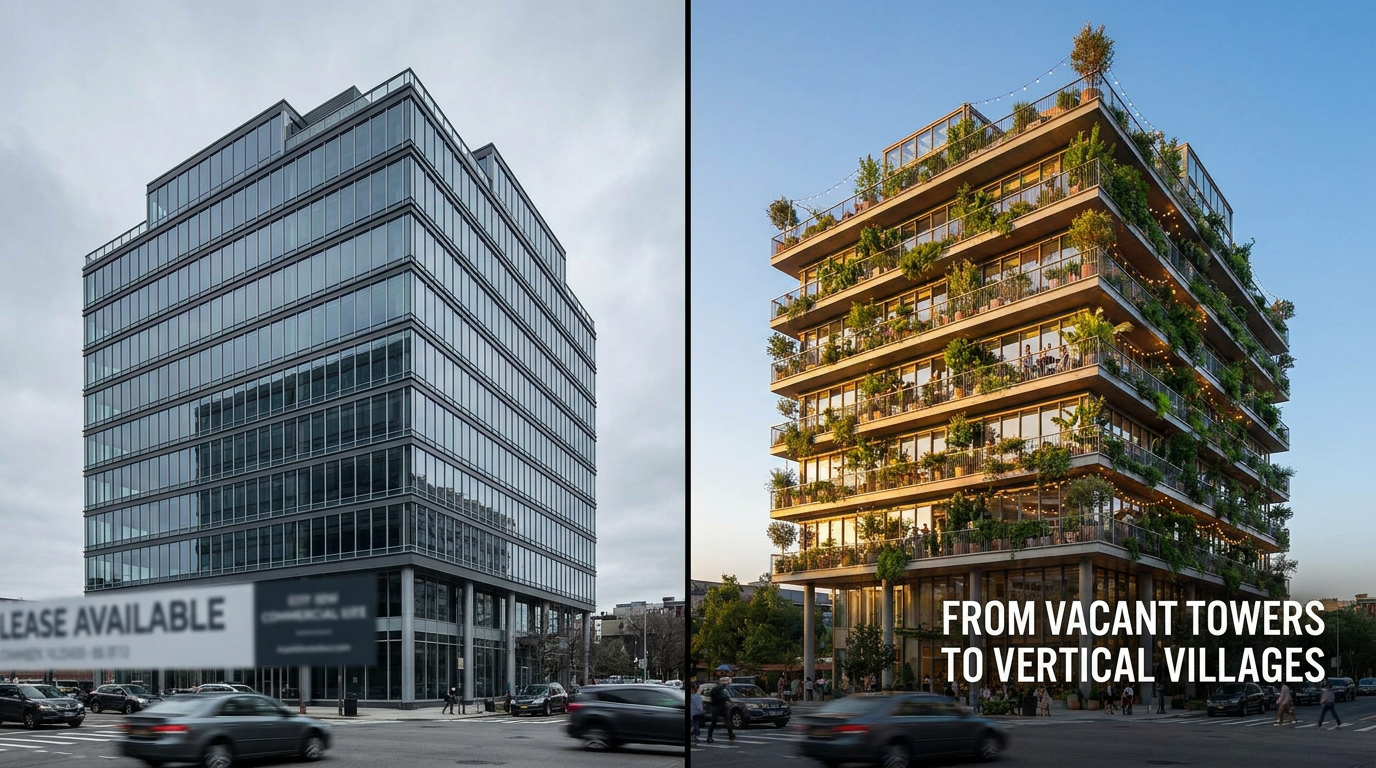
As remote work leaves downtowns hollow and housing shortages persist globally, developers are turning vacant office buildings into residential apartments. Here is how the complex, costly, but highly rewarding process of adaptive reuse actually works.
By Factlen Editorial Team
- Urban Planners & Developers
- Focused on maximizing asset value and revitalizing hollowed-out downtowns.
- Housing Advocates
- Cautiously supportive but concerned about the lack of true affordability.
- Neutral Analysts
- Providing objective data and synthesis on the feasibility and trends of adaptive reuse.
- Environmental Advocates
- Championing conversions as a vital strategy to reduce construction emissions.
What's not represented
- · Commercial Office Landlords
- · Suburban Commuters
Why this matters
The transformation of stranded commercial assets into housing offers a dual solution to two of the decade's biggest urban crises. For residents, it promises a revitalization of 9-to-5 downtowns into vibrant, 24/7 neighborhoods with increased housing supply.
Key points
- Office-to-residential conversions are projected to hit record highs in 2025, driven by permanent hybrid work trends and severe housing shortages.
- National office vacancy rates in the U.S. have surpassed 20 percent, leaving older Class B and C buildings as stranded assets.
- Converting an office is highly complex, requiring massive overhauls to centralized plumbing, electrical, and HVAC systems.
- Because conversion costs can exceed $500 per square foot, developers rely heavily on government tax credits and zoning abatements to make projects profitable.
- Environmental advocates champion adaptive reuse because upcycling existing structures saves the massive carbon emissions associated with new construction.
Across the globe, city centers are grappling with a profound structural contradiction. On one hand, a severe housing shortage has driven residential rents to historic highs, locking millions out of urban living. On the other hand, millions of square feet of commercial office space sit entirely empty, hollowed out by the permanent shift toward hybrid and remote work. For urban planners and real estate developers, the solution to both crises appears to be hiding in plain sight: turning vacant cubicles into apartments.[7]
This process, known as adaptive reuse, has rapidly evolved from a niche architectural experiment into a central pillar of global urban redevelopment. In the United States alone, office-to-residential conversions are expected to reach an all-time high in 2025, with industry estimates projecting over 77,000 offices slated for transformation. In New York City, the pace is staggering; over 4.1 million square feet of conversions commenced in just the first eight months of 2025, surpassing the entirety of the previous year.[1]
The catalyst for this boom is a fundamental recalibration of how the modern workforce operates. The enduring popularity of remote work has pushed national office vacancy rates in the U.S. past 20 percent—a three-decade high. Similar pressures are mounting internationally, with major Australian cities like Melbourne seeing vacancy rates approach 19 percent, and Canadian markets removing millions of square feet from their commercial inventory to stop the financial bleeding.[3][6]

However, the pain in the commercial sector is not distributed equally. Top-tier, modern "Class A" office buildings with premium amenities have largely retained their tenants as companies try to lure workers back to the office. The true distress lies in older "Class B" and "Class C" buildings. These aging structures, often built between the 1960s and 1980s, are rapidly becoming stranded assets. Without a viable path to attract commercial tenants, their owners are increasingly motivated to reposition them for residential use.[3]
Yet, converting a commercial high-rise into a livable residential community is vastly more complicated than simply erecting drywall and installing kitchen appliances. Real estate analysts often point to a "trifecta" of conditions required for a successful conversion: the building's physical form, its geographic location, and the developer's cost basis. If any one of these three pillars is misaligned, a project can quickly become a financial sinkhole.[7]
The most notorious physical hurdle is the "floor plate" problem. Modern office buildings were designed with massive, deep floor plates to maximize the number of interior cubicles. Because residential building codes strictly require bedrooms to have operable windows and natural light, the deep, dark center of an office building becomes unusable for apartments. To solve this, architects must get creative, sometimes carving massive light wells down the center of a skyscraper to create a donut-shaped layout, or repurposing the windowless core for resident gyms, storage units, and home theaters.[7]
Beyond the floor plan, the mechanical, electrical, and plumbing systems present a monumental engineering challenge. A typical commercial floor features one centralized set of bathrooms and a single massive HVAC zone. An apartment floor, by contrast, requires decentralized plumbing for dozens of individual kitchens and bathrooms, along with individualized climate control. Running hundreds of new water and sewer lines requires core-drilling through feet of reinforced concrete, a labor-intensive process that dramatically inflates construction budgets.[7]

Because of these structural realities, older pre-war buildings are often better candidates for conversion than modern glass boxes. Buildings constructed in the early 20th century tend to feature narrower floor plates, higher ceilings, and operable windows—characteristics that naturally lend themselves to residential layouts. Architecture firm Gensler estimates that, when factoring in these physical constraints, only about 30 percent of North American office buildings are actually viable candidates for residential conversion.[7]
Because of these structural realities, older pre-war buildings are often better candidates for conversion than modern glass boxes.
Even when a building is physically suitable, the financial mathematics of adaptive reuse are daunting. Conversion costs typically range from $150 to over $500 per square foot, depending on the extent of the structural modifications required. Because commercial real estate historically generates higher yields per square foot than residential properties, developers cannot simply buy an office building at its peak valuation and afford to convert it. The math only works if the vacant building is acquired at a steep discount, reflecting its obsolescence as a commercial asset.[2][5]
To bridge this financial gap, developers rely heavily on a complex stack of government subsidies and tax incentives. In the United States, the Historic Tax Credit (HTC) is frequently utilized to offset the costs of retrofitting older, eligible structures. At the local level, municipalities are aggressively rolling out bespoke incentives. Boston, for example, offers a property tax abatement of up to 75 percent for conversion projects that dedicate a portion of their units to affordable housing, while Chicago has deployed hundreds of millions in tax increment financing to spur downtown redevelopments.[5]
Federal lawmakers are also attempting to grease the wheels. Proposed legislation like the Revitalizing Downtowns and Main Streets Act aims to create a 20 percent tax credit specifically for the eligible conversion costs of adaptive reuse projects. By offsetting the massive capital expenditure required to overhaul plumbing and electrical systems, policymakers hope to turn stranded commercial assets into productive residential neighborhoods.[3]

The push for adaptive reuse extends far beyond North America. In the United Kingdom, office-to-residential conversions have become a major engine of housing delivery. Thanks to streamlined "permitted development" reforms that bypass certain zoning hurdles, the UK has created nearly 96,000 homes through office conversions in recent years. This regulatory flexibility has proven crucial in accelerating the pipeline of new dwellings in high-demand areas.[6]
Across the European Union, the conversion trend is increasingly framed not just as an economic necessity, but as a cornerstone of the sustainable building movement. The forthcoming European Affordable Housing Plan highlights the repurposing of existing buildings as a primary strategy to address housing deficits without breaching planetary climate boundaries. By utilizing existing structures, European cities are actively avoiding the massive carbon emissions associated with suburban sprawl and new infrastructure development.[4]
This environmental benefit, known as saving "embodied carbon," is one of the most compelling arguments for adaptive reuse. The concrete and steel that make up a building's superstructure account for a massive portion of its lifetime greenhouse gas emissions. By upcycling an existing office tower rather than demolishing it and building anew, developers can drastically reduce construction waste and meet aggressive carbon reduction targets. The greenest building, as architects frequently note, is the one that is already built.[4][7]
Despite the clear environmental and urban benefits, experts caution that adaptive reuse is not a silver bullet for the affordable housing crisis. Because the baseline costs of acquiring and retrofitting a commercial skyscraper are so high, developers are often forced to charge luxury, market-rate rents just to break even. Unless a project is heavily subsidized by government programs like the Low-Income Housing Tax Credit (LIHTC), the resulting apartments rarely serve the low- and middle-income residents who are most acutely affected by the housing shortage.[2][5]

Furthermore, local governments must carefully calibrate their zoning laws to support these transitions. Restrictive zoning that strictly separates commercial and residential uses remains a massive hurdle in many central business districts. Streamlining permitting processes and embracing mixed-use zoning are vital steps if cities want to encourage developers to take on the immense risk of a conversion project.[4]
Ultimately, the surge in office-to-residential conversions represents a generational shift in urban planning. The pandemic exposed the fragility of the traditional "9-to-5" downtown—a monoculture of office workers that empties out at night and on weekends. By injecting permanent residents into these commercial cores, cities are slowly transitioning toward the "15-minute city" model, where people can live, work, and socialize within a short walk.[7]
As the real estate market continues to digest the permanent changes brought about by hybrid work, adaptive reuse will remain a critical tool for urban resilience. It is a complex, expensive, and structurally demanding process, but the payoff is immense. By turning obsolete cubicles into vibrant homes, cities are not just solving a real estate problem; they are fundamentally reimagining the future of the urban experience.[7]
How we got here
Pre-2020
Office real estate enjoys historically low vacancy rates, with central business districts operating as 9-to-5 commercial monocultures.
2020-2022
The COVID-19 pandemic normalizes remote work, causing a sudden and severe drop in daily office attendance and leasing activity.
2023-2024
As hybrid work becomes permanent, office vacancy rates soar past 20%, leaving older Class B and C buildings as stranded assets.
2025-2026
Office-to-residential conversions hit record highs globally, supported by new government tax incentives and streamlined zoning laws.
Viewpoints in depth
Urban Planners & Developers
Focused on maximizing asset value and revitalizing hollowed-out downtowns.
This camp views adaptive reuse as the ultimate free-market solution to the hybrid work era. They argue that cities must aggressively slash zoning red tape and offer tax abatements to make these highly complex, risky projects financially viable. For developers, the goal is to rescue stranded Class B and C assets before they default, turning them into income-generating residential properties that bring foot traffic back to urban cores.
Housing Advocates
Cautiously supportive but concerned about the lack of true affordability.
While housing advocates welcome any increase in residential supply, they frequently point out that the sheer cost of retrofitting commercial buildings forces developers to charge luxury rents. They argue that without strict government mandates and heavy subsidies like the Low-Income Housing Tax Credit (LIHTC), adaptive reuse will only create high-end apartments for the wealthy, doing little to alleviate the housing crisis for low- and middle-income families.
Environmental Advocates
Championing conversions as a vital strategy to reduce construction emissions.
Environmental groups strongly favor adaptive reuse over demolition and new construction. They emphasize the concept of "embodied carbon"—the massive amount of greenhouse gases emitted during the production of concrete and steel. By upcycling existing superstructures, they argue that cities can meet their housing targets while simultaneously adhering to strict climate goals, making adaptive reuse a cornerstone of sustainable urban development.
What we don't know
- Whether the current wave of government tax incentives will be enough to sustain the conversion trend if interest rates remain elevated.
- How the influx of permanent residents will alter the long-term retail and cultural landscape of traditionally commercial downtowns.
Key terms
- Adaptive Reuse
- The process of repurposing an existing building for a use other than what it was originally designed for, such as turning an office into apartments.
- Floor Plate
- The total leasable square footage of a single floor in a building, which dictates how much natural light can reach the interior spaces.
- Class B and C Offices
- Older, less modern commercial buildings with fewer amenities, which are currently experiencing the highest vacancy rates as tenants flee to premium spaces.
- Embodied Carbon
- The total greenhouse gas emissions generated by the manufacturing, transportation, and assembly of a building's original materials, like concrete and steel.
Frequently asked
Can any empty office building be converted into apartments?
No. Architecture experts estimate that only about 30 percent of office buildings have the right physical characteristics—such as narrow floor plates and high ceilings—to make a residential conversion physically and financially viable.
Why is plumbing such a major challenge in these conversions?
Commercial offices typically have one centralized set of bathrooms per floor. Apartments require decentralized plumbing for dozens of individual kitchens and bathrooms, which requires expensive core-drilling through reinforced concrete floors.
Will adaptive reuse solve the affordable housing crisis?
Only partially. Because the structural retrofitting process is so expensive, developers often must charge luxury rents to turn a profit, unless the project receives heavy government subsidies tied to affordability mandates.
Sources
Source coverage
7 outlets
4 viewpoints surfaced







[1]Cushman & WakefieldUrban Planners & Developers
New York City Office-to-Residential Conversions Report
Read on Cushman & Wakefield →[2]Brookings InstitutionHousing Advocates
A community guide to office-to-residential conversion: Part 2, policy levers
Read on Brookings Institution →[3]NAIOPUrban Planners & Developers
Adaptive Reuse and Housing Affordability
Read on NAIOP →[4]European CommissionEnvironmental Advocates
Unlocking affordable homes through office-to-housing conversion
Read on European Commission →[5]J.P. MorganUrban Planners & Developers
Tools for financing office-to-residential conversion
Read on J.P. Morgan →[6]Dewick & AssociatesUrban Planners & Developers
Office-to-residential conversions global trend 2025 2026
Read on Dewick & Associates →[7]Factlen Editorial TeamNeutral Analysts
Synthesis by Factlen editorial team
Read on Factlen Editorial Team →
Every angle. Every day.
Get real estate stories with full source coverage and perspective breakdowns delivered to your inbox.