
How Community-Planted 'Pocket Forests' Are Rapidly Cooling the World's Cities
Using a Japanese planting technique, communities globally are transforming concrete lots into dense, fast-growing microforests that lower urban temperatures and restore biodiversity.
By Factlen Editorial Team
- Urban Ecologists
- Focus on the rapid biodiversity restoration and ecological mechanics of dense native planting.
- Community Organizers
- View pocket forests as a vital tool for civic engagement and combating climate anxiety.
- Municipal Planners
- Treat microforests as scalable, cost-effective green infrastructure to meet climate resilience targets.
What's not represented
- · Commercial Land Developers
- · Traditional Forestry Managers
Why this matters
As cities face record-breaking heat and declining biodiversity, these fast-growing microforests offer a proven, community-driven way to rapidly cool neighborhoods and restore local ecosystems. They transform climate anxiety into tangible, localized action that directly improves public health.
Key points
- Communities worldwide are transforming small urban plots into dense, fast-growing 'pocket forests' using the Japanese Miyawaki method.
- By planting native species densely, these microforests grow up to 10 times faster than conventional plantations and become self-sustaining in three years.
- Projects in Brazil, India, and Australia demonstrate significant localized cooling, with soil temperatures dropping up to 20°C during heatwaves.
- Governments and international bodies are scaling up funding in 2026, including California's new grant program backed by a $10 billion climate bond.
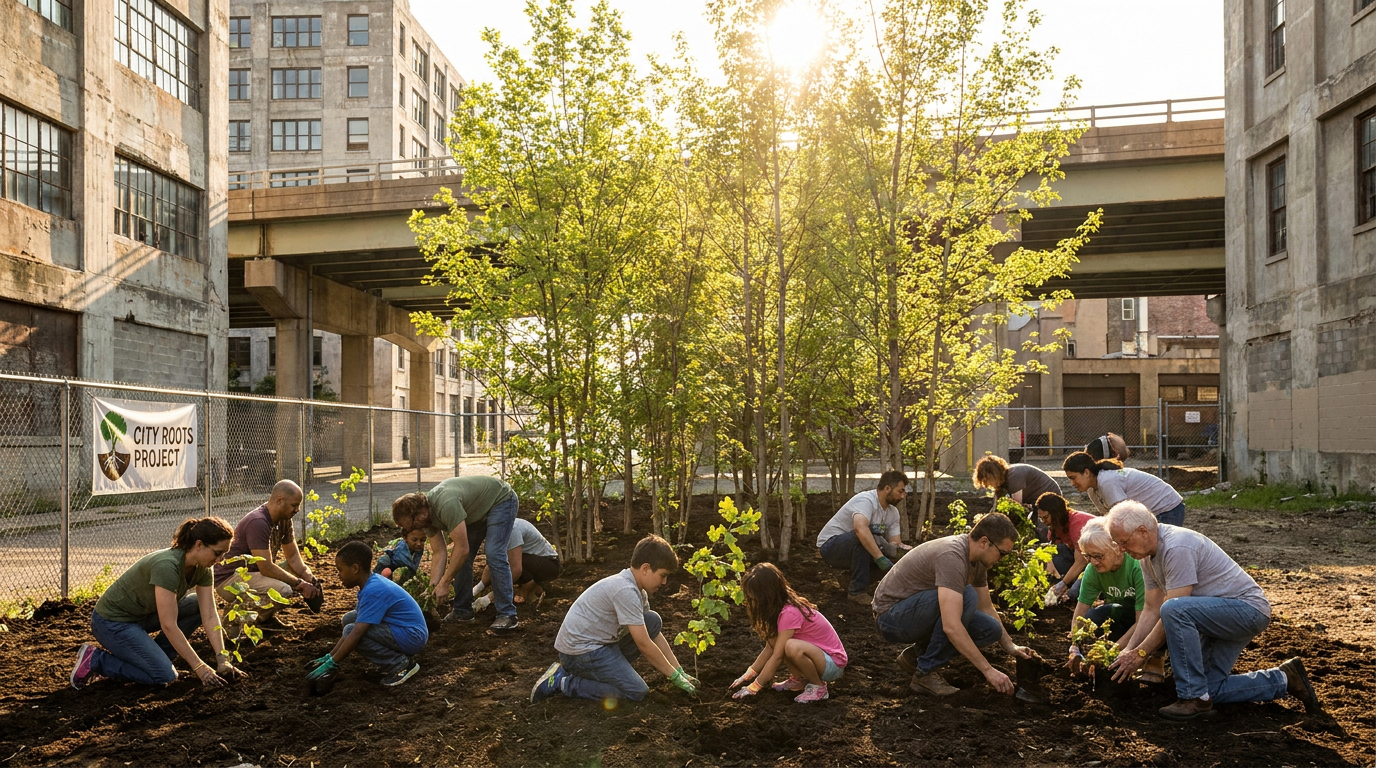
Across the globe, from the dense peripheries of São Paulo to industrial zones in Delhi, a quiet revolution is taking root. Citizens are tearing up pavement and transforming vacant concrete lots into dense, fast-growing "pocket forests."[1][4]
The driving force behind this movement is the Miyawaki method, an unconventional approach to afforestation pioneered by the late Japanese botanist Akira Miyawaki.[1][5]
Instead of planting trees in spaced-out grids, the method relies on identifying "Potential Natural Vegetation"—the indigenous species that would naturally dominate an area without human interference.[1][5]
Volunteers prepare the soil with organic matter and plant a diverse mix of native saplings densely, often three to four per square meter.[5][7]
This density forces the young trees to compete for sunlight, shooting upward rather than branching outward. The result is a forest that grows up to ten times faster than a conventional plantation.[5]

Crucially, these microforests become entirely self-sustaining within just three years, requiring no watering or weeding after the initial establishment phase.[5][7]
For communities grappling with the escalating impacts of climate change, the appeal is immediate and tangible. In São Paulo, the nonprofit formigas-de-embaúba has mobilized roughly 62,000 residents to plant over 50 mini-forests in public schools and community centers.[4]
These spaces serve as outdoor classrooms and vital climate refuges. During recent heatwaves, soil temperatures inside the Brazilian mini-forests were recorded at up to 20 degrees Celsius cooler than the surrounding asphalt.[4]
These spaces serve as outdoor classrooms and vital climate refuges.
Similar transformations are unfolding across India. Cities like Mumbai, Pune, and Delhi have turned to the Miyawaki technique to rehabilitate degraded land and former dumping grounds.[1]
In the Naini industrial area alone, a massive community-backed project saw the planting of 120,000 trees representing 63 native species, aimed at curbing severe air pollution and restoring lost biodiversity.[1]
The movement is also reshaping environmental education. In Perth, Australia, a program led by ecologist Grey Coupland has turned schoolchildren into citizen scientists.[2]

The students remediate soil using compost generated from their own lunch waste, plant the native seedlings, and track the forest's growth, local cooling effects, and returning wildlife.[2]
Experts note that while planting trees is a common climate pledge, the participatory nature of pocket forests ensures higher survival rates. When local residents co-create a green space, they are far more likely to protect and maintain it during its vulnerable early years.[4][7]
Recognizing this success, major institutions and governments are now throwing significant financial weight behind community-led greening in 2026.[3][6]
The United Nations Development Programme (UNDP) recently launched its 2026 Small Grants Programme, specifically targeting community-based organizations catalyzing sustainable urban solutions.[6]

In the United States, California's 2026 Urban Greening Grant Program—fueled by a newly passed $10 billion climate bond—is actively soliciting proposals for neighborhood-level projects that mitigate the urban heat island effect.[3]
The state's criteria explicitly prioritize initiatives that provide direct, meaningful benefits to disadvantaged communities, ensuring that climate resilience reaches the neighborhoods most vulnerable to extreme heat.[3]
How we got here
1970s
Botanist Akira Miyawaki develops his dense, native-species planting method to restore degraded land in Japan.
2004
Miyawaki publishes foundational research advocating for the restoration of urban environments using indigenous forest communities.
2021–2023
The pocket forest movement gains global traction, with pilot projects launching in European, Indian, and South American cities.
December 2025
The UNECE Trees in Cities summit maps the rapid global expansion of the movement and shares best practices among city leaders.
Mid-2026
Major municipal and international funding programs launch to institutionalize and scale community-led urban greening.
Viewpoints in depth
Urban Ecologists
Focus on the rapid biodiversity restoration and ecological mechanics of dense native planting.
Ecologists emphasize that the Miyawaki method is not just about planting trees, but about engineering a self-sustaining ecosystem. By strictly utilizing Potential Natural Vegetation (PNV) and planting at high densities, these microforests rapidly build complex underground mycorrhizal networks. This allows the pocket forests to sequester carbon, filter urban pollutants, and provide critical habitat for pollinators and birds far more efficiently than traditional, spaced-out urban landscaping.
Community Organizers
View pocket forests as a vital tool for civic engagement and combating climate anxiety.
For local organizers and educators, the primary value of a mini-forest lies in its participatory nature. Climate change often feels like an insurmountable, global crisis that leaves individuals feeling powerless. By bringing neighbors and schoolchildren together to prepare the soil, plant the saplings, and monitor the growth, these projects transform anxiety into tangible, localized action. Organizers note that communities who build their own green spaces are fiercely protective of them, leading to near-perfect survival rates for the young forests.
Municipal Planners
Treat microforests as scalable, cost-effective green infrastructure to meet climate resilience targets.
City governments and international funding bodies are increasingly viewing Miyawaki forests through the lens of public health and infrastructure. As urban heat islands become deadlier, planners need rapid, decentralized cooling solutions that can fit into existing concrete landscapes. Because these forests require minimal space and become maintenance-free after three years, they offer a highly cost-effective way for municipalities to meet their climate adaptation and canopy-cover targets, particularly in historically under-resourced neighborhoods.
What we don't know
- How well these microforests will withstand unprecedented, prolonged multi-year droughts without supplemental watering.
- The exact long-term carbon sequestration capacity of urban pocket forests compared to mature, undisturbed natural woodlands.
Key terms
- Miyawaki method
- An afforestation technique that involves densely planting diverse, native species to rapidly create a self-sustaining forest ecosystem.
- Potential Natural Vegetation (PNV)
- The specific plant community that would naturally exist and thrive in a given area without human interference.
- Urban heat island effect
- A phenomenon where cities experience much warmer temperatures than nearby rural areas due to heat-absorbing infrastructure like asphalt and concrete.
- Nature-Based Solutions (NbS)
- Actions that protect, sustainably manage, or restore natural ecosystems to address societal challenges like climate change.
Frequently asked
What is a Miyawaki pocket forest?
It is a small, densely planted urban forest that uses native species to mimic the complexity of a natural woodland, growing rapidly in spaces as small as a tennis court.
How fast do these forests grow?
Because the dense planting forces saplings to compete for sunlight, they can grow up to ten times faster than trees in a conventional plantation.
Do they require a lot of maintenance?
They require weeding and watering for the first two to three years, after which they become entirely self-sustaining ecosystems.
Can a small forest really cool a neighborhood?
Yes. Data from urban forests in Brazil shows that the dense canopy and moisture retention can lower localized soil temperatures by up to 20°C during heatwaves.
Sources
Source coverage
7 outlets
3 viewpoints surfaced






[1]India TimesMunicipal Planners
How a Japanese botanist inspired a global fast growing urban rewilding movement
Read on India Times →[2]UNESCOCommunity Organizers
Miyawaki forests for urban schools
Read on UNESCO →[3]California Natural Resources AgencyMunicipal Planners
2026 Urban Greening Grant Program
Read on California Natural Resources Agency →[4]The Nature of CitiesCommunity Organizers
Urban mini-forests in public schools and community facilities across São Paulo
Read on The Nature of Cities →[5]SUGi ProjectUrban Ecologists
Why we plant pocket forests using the Miyawaki method
Read on SUGi Project →[6]UNDPMunicipal Planners
Global Environment Facility Small Grants Programme 2026
Read on UNDP →[7]Factlen Editorial TeamUrban Ecologists
Synthesis by Factlen editorial team
Read on Factlen Editorial Team →
Every angle. Every day.
Get community stories with full source coverage and perspective breakdowns delivered to your inbox.