
U.S. Government Takes $2 Billion in Equity Stakes to Accelerate Quantum Computing
The Commerce Department is transitioning from traditional grants to venture-style investing, taking equity stakes in nine quantum computing firms to secure domestic infrastructure.
By Factlen Editorial Team

- National Security Advocates
- Viewing quantum computing primarily as a defense and intelligence imperative to protect against decryption threats.
- Commercial Pragmatists
- Focusing on near-term revenue and realistic timelines for enterprise adoption via hybrid cloud services.
- Quantum Hardware Developers
- Prioritizing the engineering transition from bespoke labs to mass manufacturing.
What's not represented
- · Taxpayer Advocacy Groups
- · Classical Supercomputing Providers
Why this matters
The U.S. government's unprecedented move to act as a venture capitalist in the quantum sector signals that the technology is crossing from theoretical physics into commercial reality. This accelerates the timeline for breakthroughs in drug discovery and climate modeling, while compressing the window organizations have to upgrade their cybersecurity against quantum code-breaking.
Key points
- The U.S. Commerce Department is investing $2.01 billion across nine quantum computing companies.
- In a departure from traditional grants, the government is taking minority equity stakes in the firms.
- IBM will receive $1 billion to build America's first dedicated quantum chip foundry in New York.
- Analysts warn that while infrastructure is scaling, widespread enterprise adoption remains years away.
- The investment is heavily driven by national security concerns and the race to achieve quantum-resistant cryptography.
The U.S. government has fundamentally altered its approach to funding emerging technology, committing $2.01 billion in grants and equity stakes across nine quantum computing companies. This move, executed under the CHIPS and Science Act, transitions Washington from a traditional grant-maker to a venture-style investor, ensuring taxpayers share in the financial upside of successful commercialization.[1][3]
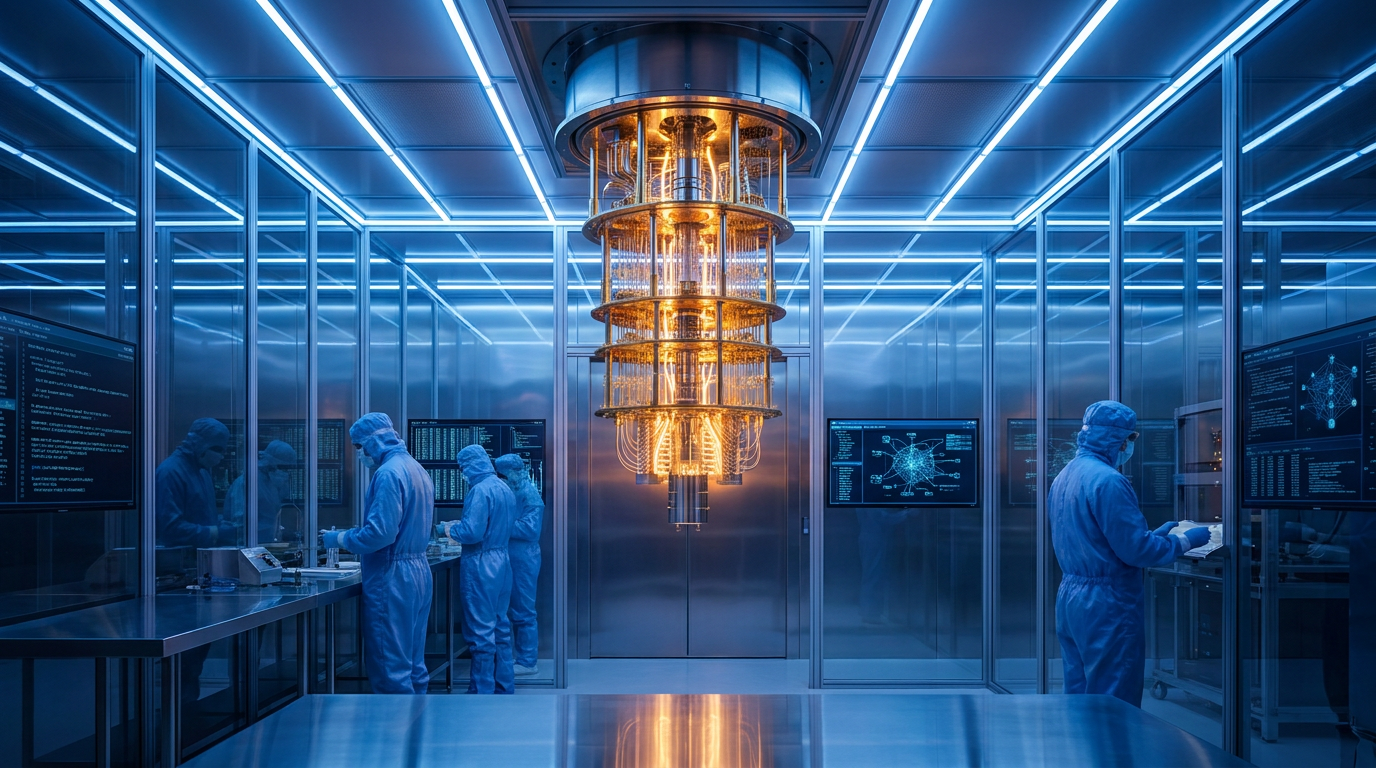
The largest beneficiary of the Commerce Department's initiative is IBM, which secured $1 billion to establish "Anderon" in New Albany, New York. Billed as America's first dedicated quantum chip manufacturing facility, the foundry will operate as a 300-millimeter quantum wafer plant, moving production out of bespoke laboratories and into standardized industrial facilities.[1][7]
GlobalFoundries will receive $375 million to build a domestic factory capable of producing components for multiple quantum modalities. Meanwhile, seven other firms—including Atom Computing, D-Wave, Infleqtion, PsiQuantum, Quantinuum, Rigetti, and Diraq—will receive smaller capital injections ranging from $38 million to $100 million, with the government taking minority, non-controlling equity stakes in each.[1][3]

The core claim driving this massive capital injection is that quantum technology is finally ready for dedicated manufacturing infrastructure. The evidence supporting this shift is strengthening. The establishment of physical foundries like Anderon indicates that the industry is moving past the theoretical physics stage and into the complex, but solvable, realm of engineering and scaling.[5][7]
Historically, quantum processors were bespoke, hand-crafted devices built in research laboratories. The transition toward standardized 300-millimeter wafer production suggests that the fundamental architectures—whether superconducting, trapped-ion, or photonic—are stabilizing enough to warrant mass-manufacturing techniques, leveraging decades of traditional semiconductor expertise.[2][7]
A second major claim is that quantum computing will deliver broad commercial viability by the end of the decade. The evidence here remains mixed and highly dependent on the specific application. Industry analysts note that while the market is growing rapidly, widespread enterprise adoption is not an imminent reality.[4][6]
A second major claim is that quantum computing will deliver broad commercial viability by the end of the decade.
Juniper Research recently concluded that for most enterprise applications, commercialization remains a long way off. Their analysis warns against conflating near-term, noisy intermediate-scale quantum devices with the fully fault-tolerant systems required to simulate complex biology or crack encryption at scale. The gap between these two stages represents significant, unresolved physics hurdles.[6]
Despite these near-term limitations, IDTechEx projects that the market is on a trajectory toward significant commercial scale by the early 2030s. Currently, revenue is heavily concentrated in cloud-based access models rather than on-premise hardware sales, allowing financial and pharmaceutical companies to experiment with hybrid quantum-classical algorithms without prohibitive upfront costs.[4]

The most urgent claim—and the one driving sovereign investment—is that quantum computers pose an imminent threat to global cybersecurity. The evidence supporting this risk is strong enough that federal agencies are actively forcing migrations to new encryption standards. The theoretical "Q-Day," when a quantum computer can break standard public-key cryptography, is compressing timelines globally.[3][5]
Because hostile actors can harvest encrypted data today and decrypt it later when fault-tolerant quantum systems come online, the U.S. government views domestic quantum supremacy as a critical national security imperative. This threat matrix explains the unusual decision to take minority equity stakes, ensuring the government maintains oversight over dual-use technologies.[2][3]
Beyond security, proponents claim that near-term quantum systems will revolutionize drug discovery and materials science. The evidence for this remains promising but preliminary. While quantum mechanics is inherently suited to simulating molecular interactions, current systems are still constrained by high error rates that limit their practical performance.[2][5]
To bridge the gap, the industry is increasingly relying on hybrid computing. Standard supercomputers handle the bulk of an algorithm, outsourcing only the most complex, combinatorial bottlenecks to a quantum processing unit via the cloud. This pragmatic approach has yielded early, documented speedups in highly specific optimization problems.[4][5]

Ultimately, the $2 billion federal injection serves as a massive validation signal for the quantum sector. By spreading its bets across multiple technological approaches—from silicon spin qubits to neutral atoms—the Commerce Department is acknowledging the uncertainty of which architecture will ultimately achieve fault tolerance.[1][3]
The transition over the last two years has definitively moved quantum computing out of the physics lab and into the infrastructure phase. While consumer applications remain science fiction, the foundational manufacturing capacity that will eventually power next-generation logistics, climate modeling, and cryptography is now being poured in concrete.[2][5]
How we got here
2022
The CHIPS and Science Act is signed into law, authorizing massive federal investments in domestic semiconductor and advanced computing manufacturing.
August 2024
The U.S. National Institute of Standards and Technology (NIST) finalizes its first post-quantum cryptographic standards to prepare for future security threats.
May 2026
The Commerce Department announces $2.01 billion in grants and equity stakes across nine quantum computing companies.
Early 2030s
Industry analysts project that quantum computing will reach significant commercial scale and widespread fault tolerance.
Viewpoints in depth
National Security Advocates
Viewing quantum computing primarily as a defense and intelligence imperative.
This camp argues that the race for quantum supremacy is a zero-sum geopolitical contest. Their primary concern is 'Q-Day'—the point at which a fault-tolerant quantum computer can break the RSA encryption securing the global financial system and classified government communications. Because hostile state actors are already harvesting encrypted data to decrypt later, these advocates view the $2 billion federal investment not just as an economic stimulus, but as a critical defense expenditure to ensure the U.S. controls the underlying hardware supply chain.
Commercial Pragmatists
Focusing on near-term revenue and realistic timelines for enterprise adoption.
Market analysts and enterprise CIOs caution against the hype surrounding standalone quantum supremacy. They argue that for the remainder of the 2020s, the only viable commercial path is 'Quantum-as-a-Service' accessed via the cloud. This camp emphasizes that businesses should not expect to replace their classical infrastructure; instead, they will use hybrid systems where supercomputers outsource only highly specific, combinatorial bottlenecks to quantum processors. They view the government's equity stakes as a necessary bridge across a long, expensive 'valley of death' before fault tolerance is achieved.
Quantum Hardware Developers
Prioritizing the engineering transition from bespoke labs to mass manufacturing.
For the engineers and physicists building these systems, the establishment of dedicated foundries like IBM's Anderon represents the true inflection point. They argue that the fundamental physics problems of superposition and entanglement have been sufficiently solved, and the remaining hurdles are purely engineering challenges: error correction, cooling, and wiring density. By moving to standard 300-millimeter wafer production, this camp believes the industry can leverage decades of traditional semiconductor manufacturing expertise to scale qubit counts exponentially.
What we don't know
- Which specific quantum architecture (superconducting, trapped-ion, photonic, or neutral atom) will ultimately prove the most scalable and cost-effective.
- The exact timeline for when a fault-tolerant quantum computer will be capable of breaking standard RSA encryption.
- How much financial return the U.S. government will actually realize from its minority equity stakes in these startups.
Key terms
- Qubit
- The basic unit of quantum information, capable of existing in multiple states simultaneously, unlike traditional binary bits which are strictly 0 or 1.
- Fault Tolerance
- The ability of a quantum computer to detect and correct its own errors, a critical milestone required for solving complex, real-world problems reliably.
- Quantum-as-a-Service (QaaS)
- A cloud computing model where companies rent access to quantum processors over the internet rather than purchasing and maintaining the expensive hardware themselves.
- Post-Quantum Cryptography
- New encryption standards designed to be secure against the massive code-breaking capabilities of future quantum computers.
- Noisy Intermediate-Scale Quantum (NISQ)
- The current era of quantum computing, characterized by processors that have a moderate number of qubits but are still prone to errors from environmental interference.
Frequently asked
Why is the government taking equity stakes instead of just giving grants?
By taking minority equity stakes, the government acts like a venture capitalist, ensuring taxpayers share in the financial upside if the technology succeeds while maintaining oversight over a critical dual-use technology.
What is a quantum foundry?
A quantum foundry is a dedicated manufacturing facility designed to mass-produce the specialized chips and components needed for quantum computers, moving away from hand-crafted laboratory prototypes.
When will quantum computers replace regular computers?
They likely never will. Quantum computers excel at highly specific, complex mathematical problems but are impractical for everyday tasks. The future is hybrid computing, where standard computers outsource specific bottlenecks to quantum processors.
What is Q-Day?
Q-Day is the theoretical future date when a quantum computer becomes powerful enough to break the standard public-key encryption that currently secures the internet, financial systems, and classified data.
Sources
Source coverage
7 outlets
3 viewpoints surfaced







[1]U.S. Department of CommerceNational Security Advocates
Biden-Harris Administration Announces Preliminary Terms with Nine Quantum Computing Leaders
Read on U.S. Department of Commerce →[2]BloombergQuantum Hardware Developers
Why the US Is Investing in Quantum Computing
Read on Bloomberg →[3]Financial TimesNational Security Advocates
US government takes $2bn equity stakes in quantum computing start-ups
Read on Financial Times →[4]IDTechExCommercial Pragmatists
Quantum Computing Market 2026-2036: Commercialization and Timelines
Read on IDTechEx →[5]ForbesCommercial Pragmatists
The Present Condition: Transitioning from Laboratory to Initial Commercial Viability
Read on Forbes →[6]Juniper ResearchCommercial Pragmatists
Quantum Computing: Commercialisation Remains a Long Way Off
Read on Juniper Research →[7]IBM NewsroomQuantum Hardware Developers
IBM to Launch Anderon, America's First Dedicated Quantum Chip Foundry
Read on IBM Newsroom →


Every angle. Every day.
Get technology stories with full source coverage and perspective breakdowns delivered to your inbox.