
Red Light Therapy Masks: What the Clinical Evidence Actually Says
At-home LED masks promise clinical-grade skin rejuvenation, but their effectiveness depends entirely on precise wavelengths, irradiance, and consistent long-term use.
By Factlen Editorial Team
- Clinical Dermatologists
- Focus on the proven cellular mechanisms and advocate for FDA-cleared devices with verified irradiance to ensure patients receive a therapeutic dose.
- Consumer Testers
- Prioritize the practical realities of daily use, arguing that comfortable, flexible masks yield better results because users actually stick to the routine.
- Medical Researchers
- Highlight gaps in the current consumer boom, particularly the lack of phototype-specific guidelines for darker skin tones and the risk of underpowered devices.
What's not represented
- · Regulatory bodies evaluating consumer device standards
- · Manufacturers of budget LED devices
Why this matters
Consumers are spending hundreds of dollars on at-home LED devices based on social media hype. Understanding the clinical science separates medical-grade tools that genuinely boost collagen from underpowered plastic masks that do nothing.
Key points
- Red light therapy stimulates mitochondria to produce more cellular energy, driving collagen and elastin production.
- Clinical trials show significant improvements in skin firmness and acne reduction after 8 to 12 weeks of consistent use.
- Budget masks often lack the required irradiance (power) and precise wavelengths needed to replicate clinical results.
- The benefits are not permanent; skin returns to its baseline state within a month if treatment is stopped.
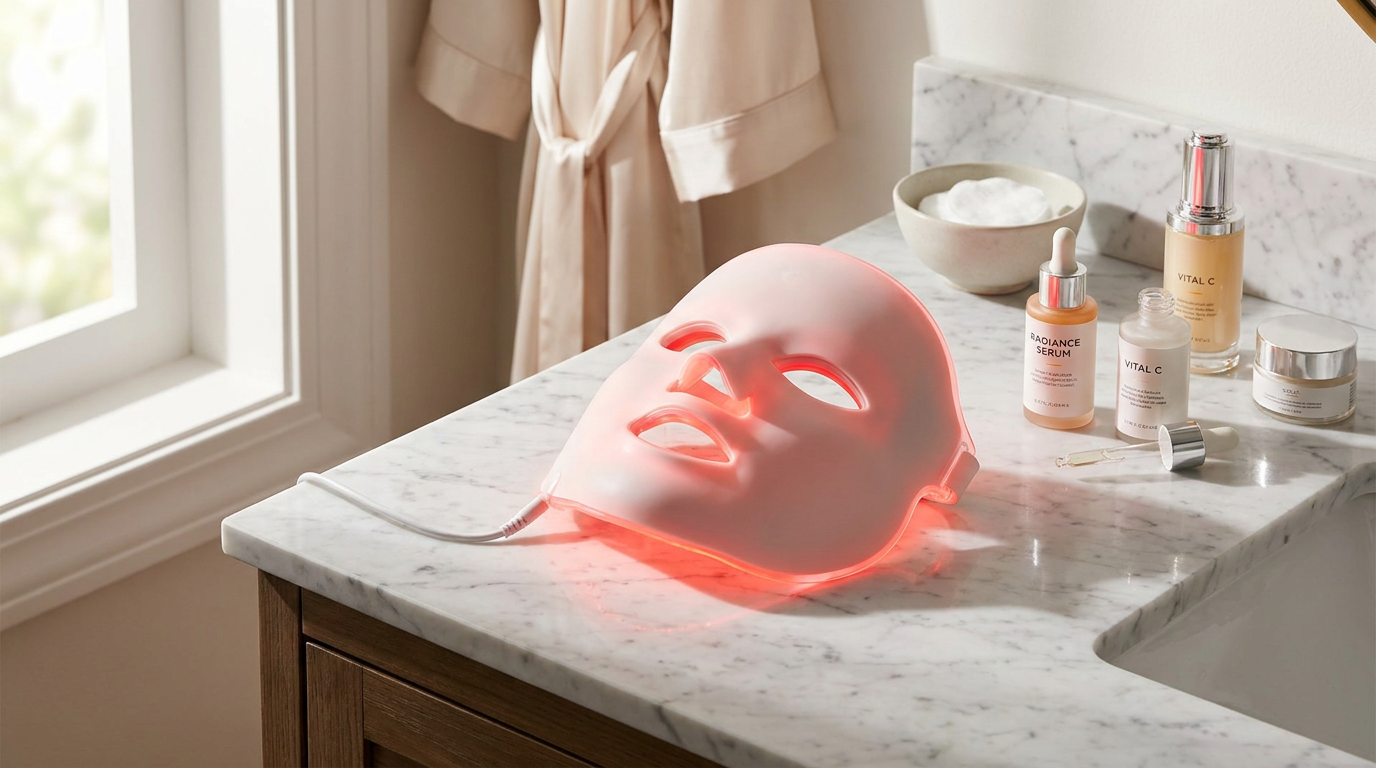
The beauty market is currently flooded with glowing, futuristic face masks promising clinical-grade skin rejuvenation from the comfort of a living room couch. Ranging in price from $40 budget options to $500 premium devices, red light therapy masks have become one of the most heavily reviewed and debated categories in consumer skincare. But beneath the aggressive social media marketing and influencer endorsements lies a genuine, decades-old foundation of photomedicine. For consumers trying to separate medical reality from cosmetic fiction, the question is no longer whether light therapy works in a laboratory, but whether the consumer devices sold online actually deliver the promised results.[7]
To understand the evidence, it is necessary to understand the mechanism. Red light therapy, clinically known as photobiomodulation, does not rely on heat or physical trauma to trigger skin repair, unlike lasers or chemical peels. Instead, it uses specific wavelengths of light to stimulate cellular activity directly. When red and near-infrared light penetrates the skin, it is absorbed by cytochrome c oxidase, an enzyme within the mitochondria of the cells. This absorption enhances the production of adenosine triphosphate (ATP), effectively giving the cells more energy to perform their designated functions, which in the skin primarily means repairing damage and synthesizing structural proteins.[1][2]
The strongest clinical evidence for at-home LED masks centers on anti-aging and structural skin support. According to research compiled by the National Institutes of Health, the increased cellular energy from photobiomodulation directly stimulates fibroblasts—the cells responsible for producing collagen and elastin. A landmark 2023 clinical study tracking women using an LED mask twice a week for 12 weeks recorded a 48 percent increase in collagen density, a 38 percent decrease in crow's feet, and a 24 percent improvement in overall skin firmness. These findings align with earlier ultrasound-based trials that physically measured the thickening of the dermal layer following consistent red light exposure.[1][4]

However, dermatologists emphasize that these structural changes are neither immediate nor permanent. Clinical data indicates that visible improvements in skin texture and tone typically require six to eight weeks of consistent use, as collagen remodeling is a slow biological process. Furthermore, the benefits are entirely dependent on continued treatment. When participants in clinical trials stopped using their LED devices, the improvements in skin elasticity and collagen density began to fade within roughly one month, returning to baseline shortly thereafter.[4]
Beyond anti-aging, the second major claim driving LED mask sales is acne reduction, which relies on a different spectrum of light. While red light calms the inflammatory response associated with breakouts, blue light—typically in the 415 to 465-nanometer range—actively destroys Cutibacterium acnes, the bacteria responsible for inflammatory acne. A March 2025 meta-analysis published in JAMA Dermatology reviewed six studies involving over 200 patients and found that at-home LED devices reduced acne lesions by approximately 45 percent over four to eight weeks.[3]
Beyond anti-aging, the second major claim driving LED mask sales is acne reduction, which relies on a different spectrum of light.
The combination of these two wavelengths appears to be particularly potent. The same meta-analysis highlighted a randomized controlled trial demonstrating that dual-wavelength treatment—combining the antibacterial properties of blue light with the anti-inflammatory effects of red light—reduced inflammatory acne by up to 77 percent. For consumers shopping for acne solutions, devices that offer both verified blue and red light modes carry a significantly stronger evidence base than those relying on red light alone.[3]

The critical disconnect between clinical trials and consumer shopping lies in device specifications, specifically irradiance and wavelength accuracy. Irradiance measures the power output of the light reaching the skin. Clinical trials use precisely calibrated devices that deliver a therapeutic dose of light in a 10- to 20-minute session. Medical experts note that many budget masks sold on massive e-commerce platforms fail to publish their irradiance figures, and independent testing frequently reveals them to be too weak to replicate clinical results, regardless of how long they are worn.[4][7]
Wavelength precision is equally vital. The clinical consensus points to highly specific ranges: 630 to 660 nanometers for red light targeting surface wrinkles, and 810 to 850 nanometers for near-infrared light penetrating deeper into the dermis. Devices that do not strictly adhere to these ranges, or that use broad-spectrum LEDs, will not trigger the targeted mitochondrial response. This is why dermatologists consistently steer consumers toward FDA-cleared devices from established brands like Omnilux, Celluma, and Dr. Dennis Gross, which publicly validate their wavelength and irradiance specifications.[4][5][6]
Usability and comfort also play a surprisingly large role in the actual efficacy of these devices, simply because adherence is the primary driver of results. Consumer testing panels from outlets like Forbes and Good Housekeeping consistently rank flexible, medical-grade silicone masks higher than rigid plastic models. Rigid masks often fail to conform to individual facial contours, creating gaps that reduce the effective irradiance reaching the skin. Furthermore, if a device is heavy, leaves marks, or requires the user to remain tethered to a wall outlet, long-term compliance plummets, rendering the underlying science moot.[5][6]

While the safety profile of red light therapy is exceptionally strong—it contains zero ultraviolet (UV) light, does not damage DNA, and has no associated cancer risk—there are still notable gaps in the clinical literature. Researchers at Stanford Medicine point out that while the therapy is widely considered safe, the exact dosing parameters for optimal results remain somewhat elusive outside of controlled clinical settings. Overexposure does not necessarily cause harm, but it can negate the benefits, as cellular receptors can become oversaturated and stop responding to the light stimulus.[2]
Additionally, there is an urgent need for more inclusive clinical data regarding skin phototypes. The vast majority of photobiomodulation studies have been conducted on lighter skin tones. Because melanin-rich skin has a higher sensitivity to visible light and absorbs photons differently, researchers are calling for phototype-specific protocols to ensure that individuals with darker skin tones receive the optimal therapeutic dose without the risk of hyperpigmentation, a nuance that current consumer device instructions largely ignore.[1]
Ultimately, the evidence supports red light therapy masks as a scientifically valid tool for skin health, provided consumers navigate the market carefully. They are not a replacement for in-office dermatological procedures, nor are they a quick fix for overnight results. But for shoppers willing to invest in a verified, FDA-cleared device and commit to a consistent, months-long routine, the clinical data confirms that these glowing masks offer a measurable, non-invasive way to genuinely alter the cellular behavior of the skin.[4][7]
How we got here
1990s
NASA develops early LED technology to promote plant growth in space and later tests it for wound healing in astronauts.
2014
Landmark ultrasound studies confirm that red light therapy can measurably increase collagen density in human skin.
2023
Systematic reviews confirm the safety profile of photobiomodulation, ruling out cancer risks associated with UV light.
2025
Major meta-analyses establish clear efficacy rates for at-home LED devices in treating inflammatory acne.
Viewpoints in depth
Clinical Dermatologists
Focus on the proven cellular mechanisms and the necessity of medical-grade specifications.
Dermatologists emphasize that photobiomodulation is a precise science, not a cosmetic gimmick. They point to the stimulation of ATP and fibroblasts as undeniable biological responses, but warn that these reactions only occur when the skin receives a specific dose of light. Consequently, they advocate strictly for FDA-cleared devices with verified irradiance and exact wavelengths (like 633nm and 830nm), arguing that cheaper, unverified masks are essentially expensive placebos.
Consumer Testers
Prioritize the practical realities of daily use and long-term adherence.
Product reviewers and consumer testing panels argue that the best device is the one a person will actually use. Because clinical results require months of consistent, multi-day-a-week application, comfort and usability often trump minor technical advantages. They note that flexible, lightweight silicone masks consistently outperform rigid, clinic-style masks in real-world settings simply because users abandon uncomfortable devices before the biological benefits have time to manifest.
Medical Researchers
Highlight gaps in the current consumer boom, particularly regarding skin diversity.
While acknowledging the safety and efficacy of the technology, researchers caution that the consumer market has outpaced nuanced clinical guidelines. They point out a significant lack of phototype-specific protocols for melanin-rich skin, which absorbs visible light differently and has a higher sensitivity to it. Researchers are calling for more inclusive trials to establish optimal dosing parameters that prevent cellular oversaturation and ensure equitable safety across all skin tones.
What we don't know
- The exact optimal dosing parameters (duration and frequency) for at-home devices to prevent cellular oversaturation.
- How different skin phototypes, particularly melanin-rich skin, absorb and react to standard consumer LED protocols over the long term.
- The long-term durability and irradiance degradation rates of consumer LED masks after several years of daily use.
Key terms
- Photobiomodulation
- The clinical term for using specific wavelengths of light to stimulate cellular function and healing.
- Fibroblasts
- Cells within the skin's dermal layer that are responsible for producing structural proteins like collagen and elastin.
- ATP (Adenosine Triphosphate)
- The primary energy-carrying molecule found in the cells of all living things, which increases during red light therapy.
- Irradiance
- The measurement of power output or light intensity reaching the skin, crucial for determining a device's effectiveness.
- Near-Infrared (NIR) Light
- Invisible light wavelengths (typically 810-850 nm) that penetrate deeper into the skin than visible red light to target deep tissue repair.
Frequently asked
Do red light therapy masks use UV light?
No. Red and near-infrared light therapy does not contain ultraviolet (UV) light, meaning it does not damage DNA, cause sunburns, or increase the risk of skin cancer.
How long does it take to see results?
Clinical studies indicate that visible improvements in skin texture and firmness typically take six to eight weeks of consistent use, as collagen production is a gradual biological process.
Are cheap budget LED masks just as effective?
Generally, no. Budget masks often lack the necessary irradiance (power output) and precise wavelengths required to deliver a therapeutic dose of light to the cells.
What happens if I stop using the mask?
The benefits are not permanent. Research shows that improvements in collagen density and skin elasticity begin to fade within about a month of stopping treatment.
Sources
Source coverage
7 outlets
3 viewpoints surfaced







[1]National Institutes of HealthClinical Dermatologists
Biological responses to different wavelengths of light in human skin
Read on National Institutes of Health →[2]Stanford MedicineMedical Researchers
Photobiomodulation: What the science says - and doesn't say
Read on Stanford Medicine →[3]JAMA DermatologyClinical Dermatologists
Efficacy of At-Home Light Therapy for Acne Vulgaris: A Meta-Analysis
Read on JAMA Dermatology →[4]Doctor RogersClinical Dermatologists
Red Light Therapy Masks: A Dermatologist's Guide to the Science
Read on Doctor Rogers →[5]ForbesConsumer Testers
The Best LED Face Masks, Tested And Reviewed
Read on Forbes →[6]Good HousekeepingConsumer Testers
9 Best LED Face Masks, Tested by Skincare Experts
Read on Good Housekeeping →[7]Factlen Editorial TeamMedical Researchers
Synthesis by Factlen editorial team
Read on Factlen Editorial Team →
Every angle. Every day.
Get shopping stories with full source coverage and perspective breakdowns delivered to your inbox.