
How Esports Teams Are Using AI and Data Analytics to Win
Artificial intelligence is revolutionizing competitive gaming, turning raw telemetry data into a decisive advantage. From automating complex draft strategies to democratizing elite coaching for amateur players, machine learning has become the new baseline in esports.

In short
- The global AI in esports performance tracking market is projected to reach $6.67 billion by 2035.
- Professional teams use machine learning to process millions of matches, reducing draft analysis from an hour to a single minute.
- Consumer AI tools are democratizing elite coaching, allowing amateur players to access enterprise-grade analytics for free.
The margin of error in professional esports is no longer measured in human reaction time alone; it is measured in data processing. For years, competitive gaming relied on the intuition of veteran coaches and the grueling manual review of past matches. Today, the industry has crossed a technological threshold. Artificial intelligence and machine learning are fundamentally rewriting how players train, how teams draft, and how the game is understood.[4][6]
The scale of this shift is massive. The global market for AI in esports performance tracking, valued at roughly $455 million in 2025, is projected to surge to $6.67 billion by 2035. This staggering 30% annual growth rate reflects a universal truth across competitive gaming: organizations that fail to adopt data-driven analytics are rapidly being left behind by those that do.[2]
The mechanism driving this revolution is telemetry data. Unlike traditional video review, where a coach watches a screen to spot mistakes, AI systems plug directly into the game's API. They extract raw coordinates, precise reaction times, resource management metrics, and click-rates. This allows algorithms to evaluate a player's efficiency with mathematical certainty, stripping away human bias and highlighting invisible patterns.[1]
Nowhere is this more evident than in the drafting phase. In complex multiplayer games like League of Legends or Dota 2, teams take turns selecting and banning characters. Because certain characters mathematically counter others, a match is often won or lost before the players even spawn. Navigating a roster of over 120 characters and predicting the opponent's strategy is an analytical nightmare for a human brain.[5]
To solve this, tier-one organizations have turned to enterprise-grade AI. Team Liquid, one of the most successful franchises in esports history, recently integrated advanced machine learning models to overhaul their drafting process. Their proprietary AI draft bot processes an astonishing 1.6 terabytes of game data, encompassing more than 6 million professional and amateur matches, to suggest optimal character combinations.[4]
The efficiency gains from this automation are transformative. What previously required 60 minutes of intense manual calculation by a team of analysts can now be executed by the AI in a single minute. Across a competitive season, this transition saves Team Liquid an estimated 10,000 analyst hours, allowing the coaching staff to focus entirely on execution rather than data gathering.[4]
Beyond the pre-game draft, AI is reshaping mid-game tactics. Advanced models continuously analyze opponent tendencies, identifying behavioral patterns that human observers might miss. By providing real-time situational prompts and predictive modeling during practice scrimmages, teams utilizing AI-driven analytics have recorded up to an 11% increase in mid-game conversion rates.[2]
However, the most significant development in 2026 is the democratization of these tools. Enterprise-grade analytics are no longer restricted to multi-million-dollar organizations. The gap between professional-tier data and the tools available to everyday ranked climbers has effectively closed, empowering a new generation of players to train smarter.[5]
Consumer-facing platforms like Mobalytics, Blitz.gg, and iTero Standalone now offer robust AI coaching overlays, often entirely for free. These tools run alongside the game, calculating a Gamer Performance Index that diagnoses specific mechanical weaknesses. If a player consistently mismanages their in-game economy or reacts too slowly to flanking maneuvers, the AI flags the issue and prescribes targeted training exercises.[3][5]
Professional organizations are taking note of this consumer tech boom. In a bid to build comprehensive technology ecosystems, major esports franchises are acquiring these startups outright. GIANTX's recent acquisition of iTero Gaming highlights a growing trend of professional teams internalizing public AI tools to refine their own proprietary training pipelines.[3]
This accessibility is also revolutionizing the scholastic and collegiate esports landscape. High schools and universities are increasingly treating competitive gaming as a legitimate athletic pursuit, complete with varsity rosters and substantial scholarship programs. AI coaching platforms are becoming the standard infrastructure for these developing programs.
A prime example is the 2026 partnership between scholastic esports network Stay Plugged In and the AI coaching platform Omnic AI. The collaboration provides student-athletes with AI-tracked game portfolios. Instead of relying solely on win-loss records, college recruiters can now evaluate a high school player's verified mechanical improvement, decision-making speed, and learning trajectory over time.
The precision of esports analytics has become so advanced that traditional physical sports are beginning to take notes. For decades, traditional sports relied on basic statistical tracking, but the high-fidelity spatial modeling pioneered in competitive gaming offers a new frontier for athletic analysis.[1]
Top-tier football clubs in the English Premier League are already partnering with esports analytics firms. By adapting the computer vision algorithms originally designed to track digital avatars on a virtual map, these clubs can track physical player positioning, passing patterns, and real-time decision-making on a grass pitch with unprecedented accuracy.[1]
As AI becomes deeply embedded in competitive gaming, tournament organizers face new regulatory challenges. The line between acceptable post-match analysis and unfair live-match assistance is heavily scrutinized. While AI tools are universally permitted for VOD review and practice, live overlays that dictate real-time strategy are strictly regulated or banned in professional-tier tournaments to preserve competitive integrity.[5]
Ultimately, the rise of AI does not replace the human coach; it elevates them. With algorithms handling the grueling mathematical calculations and pattern recognition, human coaches are freed to focus on the intangibles of competition. Their roles are shifting toward psychological support, fostering team cohesion, and managing the intense emotional pressure of stage matches.[6]
Artificial intelligence has permanently raised the baseline of competitive gaming. By turning raw telemetry into actionable insights, AI is empowering players at every level—from high school hopefuls to world champions—to push the boundaries of human performance and redefine what is possible in esports.[6]
Definitions
- Telemetry Data
- Raw, real-time data extracted directly from the game engine, including player coordinates, reaction times, and resource management.
- Drafting
- The pre-match phase where teams select and ban characters, aiming to build a composition that mathematically counters the opponent.
- VOD Review
- Video on Demand review; the traditional process of re-watching past matches to analyze mistakes and optimize future gameplay.
- Gamer Performance Index (GPI)
- A comprehensive metric used by analytics platforms to evaluate a player's mechanical skill, decision-making, and overall efficiency.
Questions & answers
Do I need to pay for AI coaching tools to climb the ranked ladder?
No. Many top-tier AI tools like Mobalytics and Blitz.gg offer robust free tiers that provide enough data for most amateur players to improve.
Are AI overlays allowed in official esports tournaments?
It depends on the tier. While post-match analytics are universally allowed, live in-game overlays are often restricted in professional play to maintain competitive integrity.
How does AI help with drafting?
AI processes millions of historical matches to calculate win probabilities for specific character matchups, reducing a 60-minute manual analysis to seconds.
Can traditional sports use esports AI?
Yes. Premier League football clubs and other traditional sports teams are already adopting computer vision and machine learning models pioneered in esports to track player positioning.
Analysis by camp
Professional Organizations
Focused on maximizing efficiency, automating tedious analysis, and gaining micro-advantages at the highest level of play.
For tier-one teams, AI is primarily an efficiency engine. Organizations like Team Liquid view machine learning as a way to automate the grueling hours analysts previously spent manually reviewing VODs and calculating draft probabilities. By offloading data processing to AI, professional coaches can redirect their energy toward high-level strategy, team psychology, and emotional regulation—elements that algorithms cannot replicate.
Amateur and Collegiate Players
Focused on accessibility, personalized skill development, and democratizing the tools needed to reach the professional tier.
At the grassroots level, AI coaching is viewed as a great equalizer. Platforms like Mobalytics and Omnic AI provide amateur players with the kind of bespoke, data-driven feedback that was once exclusive to heavily funded professional organizations. In the collegiate space, these tools are increasingly used to build objective performance portfolios, helping young players secure scholarships based on verified mechanical improvement rather than just raw win-loss records.
Traditional Sports Analysts
Focused on adapting the high-fidelity spatial and probabilistic models developed in esports for physical athletics.
Traditional sports organizations see esports as a testing ground for advanced analytics. Because video games generate perfect, real-time telemetry data, the AI models built to analyze them are highly sophisticated. Analysts in football, basketball, and motorsports are now reverse-engineering these esports algorithms—using computer vision to track physical players on a pitch with the same precision that an AI tracks digital avatars on a map.
- Professional Organizations
- Prioritize efficiency, macro-strategy, and automating manual data analysis.
- Amateur & Collegiate Players
- Value accessible, personalized coaching tools to improve individual rank and secure scholarships.
- Traditional Sports Analysts
- Look to esports as a proving ground for advanced computer vision and predictive modeling.
- Data & Integrity Advocates
- Focus on maintaining fair play, preventing cheating, and securing player data.
Perspectives this story doesn't cover
- Game Developers (balancing games against AI optimization)
- Tournament Referees (enforcing AI restrictions live)
Sources
Source coverage
6 outlets
4 viewpoints surfaced






- [1]PlaybookTraditional Sports Analysts
Top 5 Ways Traditional Sports Can Learn from AI in Esports
Read on Playbook → - [2]Market.usData & Integrity Advocates
AI in Esports Performance Tracking Market Size | CAGR of 30%
Read on Market.us → - [3]Esports InsiderProfessional Organizations
GIANTX upgrades AI coaching tool with iTero Standalone
Read on Esports Insider → - [4]SAPProfessional Organizations
AI in esports: How generative AI + data analytics help Team Liquid win
Read on SAP → - [5]EnebaAmateur & Collegiate Players
Esports AI Tools: 8 Best Picks for Ranked Climbers in 2026
Read on Eneba → - [6]Factlen Editorial TeamProfessional Organizations
Synthesis by Factlen editorial team
Read on Factlen Editorial Team →
More in Gaming & Esports
See all →Tournament Formats
Why Esports Grand Finals Are Killing the Bracket Reset for Map Advantages
3 sources
VCT Champions
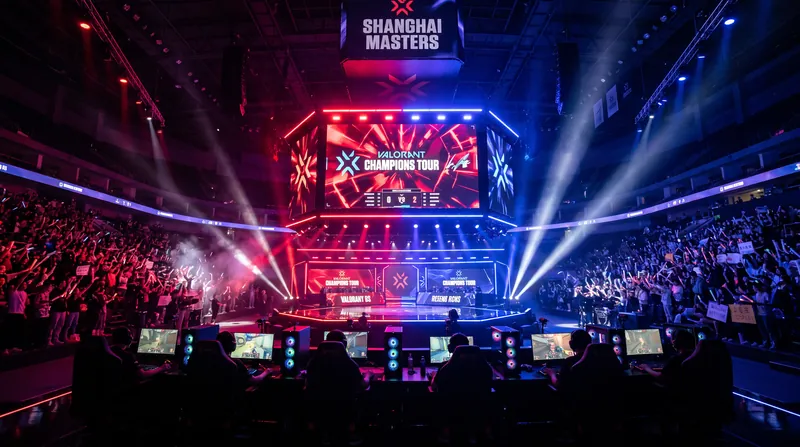
VALORANT Champions 2026 Kicks Off in Shanghai as Final Tournament of Franchised VCT Era
6 sources
Esports Business
Complexity Gaming Ceases Operations After 23 Years as Founder Jason Lake Cites Financial Strain
5 sources
Franchise Quarterbacks
Caleb Williams and Jayden Daniels Suffer Week 2 Injuries, Shaking Up NFL Landscape
3 sources
Comments
Every angle. Every day.
Get Gaming & Esports stories with full source coverage and perspective breakdowns, free every day.