
How Neuroaesthetics and Biophilic Design Are Rewiring Our Homes for Mental Health
Interior design is undergoing a scientific revolution as researchers use brain imaging to prove that room shapes, lighting, and natural elements directly alter our biology and reduce stress.
By Factlen Editorial Team
- Neuroaesthetics Researchers
- Scientists focused on gathering empirical, biometric data to prove how spatial geometry, light, and texture alter brain chemistry and hormone levels.
- Design Practitioners & Analysts
- Practitioners applying scientific findings to create empathetic, human-centered spaces that move beyond visual trends to actively support mental health.
- Commercial Developers
- Industry leaders investing in wellness-certified buildings to capture market growth, improve tenant retention, and boost workplace productivity.
What's not represented
- · Low-income housing advocates, who face significant barriers to implementing expensive neuroaesthetic and biophilic technologies.
- · Environmental ecologists, who evaluate the sustainability and carbon footprint of sourcing advanced biophilic materials and indoor ecosystems.
Why this matters
People in developed nations spend over 90% of their lives indoors. Understanding how our built environments physically alter our brain chemistry empowers us to design homes and workspaces that actively fight anxiety, boost focus, and improve long-term health.
Key points
- Neuroaesthetics uses brain imaging to measure how interior design physically alters human biology.
- Well-designed spaces can lower heart rates, reduce cortisol, and increase serotonin.
- Biophilic design integrates nature into homes, reducing stress hormones by up to 20%.
- Curved furniture and organic room shapes activate the brain's pleasure centers more than sharp angles.
- Circadian lighting and haptic textures are becoming essential tools for regulating mood and sleep.
- The market for indoor biophilic design is expected to reach $56.8 billion by 2033.
For decades, interior design was treated primarily as an exercise in aesthetics and status. A room was judged by its adherence to passing trends, the pedigree of its furniture, or its visual symmetry. But as people in developed nations now spend upwards of 90 percent of their lives inside built environments, a quiet scientific revolution is reframing how we think about the spaces we inhabit. The focus has shifted from what a room looks like to how a room physically alters the human brain.[3][8]
This shift is being driven by "neuroaesthetics," a rapidly growing discipline that merges neuroscience with architecture and design. Originally coined in the 1990s by neurobiologist Semir Zeki to describe how the brain processes visual art, the field has expanded to measure our biological responses to physical spaces. Using functional magnetic resonance imaging (fMRI) and biometric sensors, researchers can now watch the nervous system react to a room's lighting, geometry, and textures in real time.[4][6]
The findings are dismantling the idea that design is purely subjective. When human beings enter a thoughtfully designed space, the biological response is immediate and measurable. Heart rates slow, blood pressure drops, and the brain increases its release of serotonin and dopamine—neurotransmitters associated with mood regulation and pleasure. Simultaneously, levels of cortisol, the body's primary stress hormone, measurably decrease.[4]
According to researchers at the Penn Center for Neuroaesthetics, the visual brain harbors hidden sensitivities to architectural interiors. Their studies suggest that human aesthetic responses to rooms boil down to three key psychological dimensions: coherence, fascination, and hominess. Coherence dictates how easily the brain can organize and comprehend the scene, fascination measures the informational richness that generates interest, and hominess reflects the feeling of personal ease and comfort. When a space successfully balances these three elements, it triggers a neurological reward system.[3]

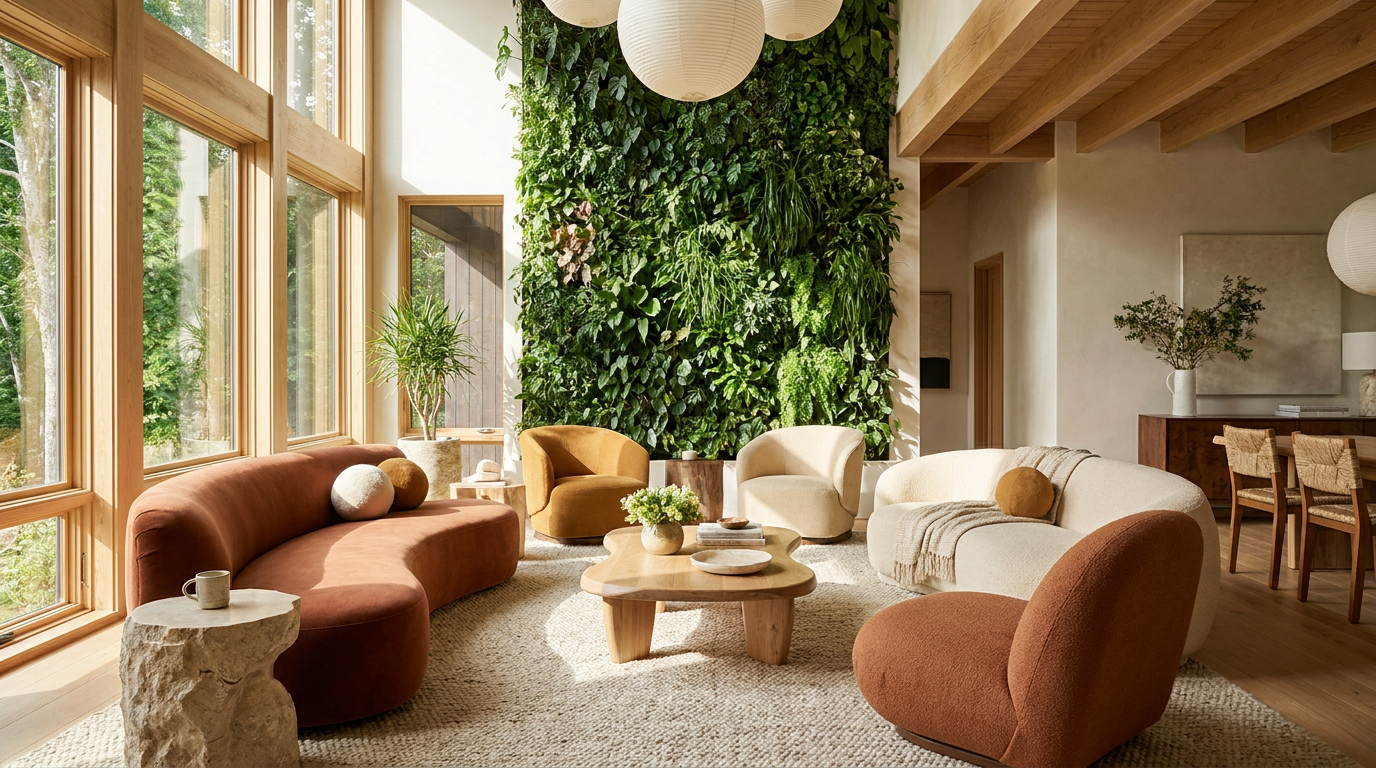
One of the most potent triggers for this reward system is "biophilic design"—the evidence-based practice of integrating nature into the built environment. Biophilia is rooted in the evolutionary hypothesis that humans possess an innate, biological need to connect with the natural world. In modern interior design, this goes far beyond placing a potted plant in a corner. It involves creating immersive indoor ecosystems that engage multiple senses.[5][7]
The empirical evidence supporting biophilic design is striking. Studies have documented a 15 to 20 percent reduction in stress hormones when individuals are placed in spaces that thoughtfully incorporate natural elements. In commercial settings, employees working in biophilic offices report a 15 percent increase in productivity and significantly lower rates of mental fatigue. Even indirect exposure to nature—such as wood grain textures, stone surfaces, or biomorphic patterns that mimic organic geometry—can lower anxiety and improve working memory.[4][7]
The empirical evidence supporting biophilic design is striking.
Geometry itself plays a surprising role in our neurological comfort. fMRI and EEG studies have revealed that curvilinear spaces and rounded furniture activate the brain's pleasure centers far more effectively than sharp angles and rigid, rectilinear layouts. The presence of organic, sweeping forms unconsciously signals safety to the brain, mimicking the natural environments where human vision evolved.[7]
Lighting is another critical pillar of neuroaesthetic design. The industry is moving rapidly toward circadian lighting systems that mimic the natural progression of the sun. Bright, cool-toned light in the morning suppresses melatonin and boosts alertness, while warm, dimming light in the evening signals the brain to prepare for sleep. By aligning indoor lighting with human biology, designers can actively regulate occupants' sleep-wake cycles, profoundly impacting long-term mental health.[1][6]
The sensory experience of a room also extends to acoustics and touch, an area known as haptic design. Unpredictable or echoing noise elevates cortisol and keeps the nervous system in a state of hyper-vigilance. To combat this, neuroaesthetic spaces utilize sound-absorbing acoustic panels, soft textiles, and intentional spatial zoning. Tactile materials like natural linen, raw wood, and textured stone further ground the occupant, evoking feelings of comfort and reducing physiological stress.[4][6]
The tech industry has been instrumental in validating these concepts. In a landmark 2019 exhibition in Milan called "A Space for Being," Google partnered with architects and scientists to build a series of distinct rooms. Visitors wore custom biometric wristbands that tracked their heart rate, breathing, and skin temperature as they moved through the spaces. The data proved that different aesthetic environments provoked vastly different physiological states, proving that our bodies react to design even when our conscious minds are distracted.[6]

This scientific validation is driving massive economic shifts. The indoor biophilic design market is currently experiencing explosive growth, projected to surge from $22.4 billion in 2025 to nearly $56.8 billion by 2033. Real estate developers, healthcare facilities, and corporate campuses are investing heavily in wellness-certified buildings, recognizing that environments optimized for human biology yield higher tenant retention, faster patient recovery times, and lower employee burnout.[5]
However, the rapid commercialization of neuroaesthetics brings challenges. Industry experts warn against "greenwashing"—where developers slap a moss wall into a poorly lit, poorly ventilated office and market it as a wellness space. True neuroaesthetic design requires a holistic approach that balances air quality, acoustic comfort, lighting, and spatial flow. A superficial application of natural textures cannot override the stress induced by a fundamentally hostile architectural layout.[2][8]

Despite these hurdles, the democratization of neuroaesthetics is accelerating. As the science becomes more accessible, everyday homeowners are adopting these principles to turn their living spaces into sanctuaries of mental restoration. The shift from "what looks good" to "what feels biologically right" is empowering people to design homes that actively nurture their psychological resilience.[1][8]
Ultimately, the convergence of neuroscience and interior design represents a profound paradigm shift. It challenges the industry to move beyond intuition and trend-chasing, demanding a practice rooted in empathy, evidence, and human biology. By proving that beauty and wellness are biologically inseparable, neuroaesthetics is transforming the spaces we inhabit into active participants in our health.[2][4]
How we got here
1990s
Neurobiologist Semir Zeki coins the term 'neuroaesthetics' while studying how the brain processes visual art.
2013
Dr. Anjan Chatterjee publishes 'The Aesthetic Brain', bringing neuroaesthetics to a wider audience and expanding its application to architecture.
2019
Google's 'A Space for Being' exhibition in Milan uses biometric wristbands to prove that different interior designs provoke distinct physiological responses.
2025
The indoor biophilic design market reaches $22.4 billion as commercial developers prioritize wellness-certified buildings.
2026
Neuroaesthetics transitions from a niche commercial concept to a mainstream residential design standard focused on mental health.
Viewpoints in depth
Neuroaesthetics Researchers
Scientists focused on the empirical, biological evidence of how design affects the human body.
For neuroscientists, the conversation around interior design has moved entirely out of the realm of subjective taste and into the laboratory. Researchers at institutions like the Penn Center for Neuroaesthetics use fMRI and biometric sensors to track exact physiological changes—such as heart rate variability and cortisol reduction—when subjects are exposed to different spatial geometries. Their goal is to establish a rigorous, evidence-based framework that proves human beings have universal, biological reactions to concepts like coherence, fascination, and hominess in the built environment.
Design Practitioners & Analysts
Practitioners applying scientific findings to create empathetic, human-centered spaces.
The design community views neuroaesthetics as a powerful validation of their profession's impact. Rather than relying solely on intuition or chasing fleeting visual trends, architects and interior designers are using this data to advocate for empathetic, human-centered spaces. By understanding the mechanisms of circadian lighting, acoustic dampening, and haptic feedback, designers can craft environments that actively heal. They argue that designing for mental health is no longer a luxury add-on, but a fundamental responsibility of the profession.
Commercial Developers
Industry leaders investing in wellness-certified buildings to capture market growth and boost productivity.
For the commercial real estate sector, neuroaesthetics and biophilic design represent a massive economic opportunity. With the biophilic market projected to hit $56.8 billion by 2033, developers are heavily investing in wellness certifications like the WELL Building Standard. They focus on the measurable return on investment: environments optimized for human biology yield 15 percent higher employee productivity, lower absenteeism, and faster patient recovery times in healthcare settings. For this camp, biological design is a critical business differentiator.
What we don't know
- How long the physiological benefits of a neuroaesthetic space last once an individual leaves the environment.
- Whether prolonged exposure to highly optimized indoor ecosystems diminishes our biological need for actual outdoor wilderness.
- How to effectively standardize neuroaesthetic design principles across vastly different cultural definitions of 'comfort' and 'beauty'.
Key terms
- Neuroaesthetics
- A discipline that combines neuroscience and aesthetics to study how the human brain and body respond to art, beauty, and built environments.
- Biophilic Design
- An approach to architecture and interior design that seeks to connect occupants more closely to nature through lighting, plants, and natural materials.
- Circadian Lighting
- Artificial lighting systems designed to mimic the natural daily cycle of sunlight, helping to regulate human sleep-wake cycles and mood.
- Haptic Design
- The use of tactile elements and varied textures in a space to engage the sense of touch, which can evoke feelings of comfort and reduce stress.
- Cortisol
- The body's primary stress hormone, which has been shown to decrease when individuals are in environments optimized for human well-being.
Frequently asked
What is neuroaesthetics?
Neuroaesthetics is the scientific study of how the brain responds to beauty, art, and physical spaces. It uses tools like brain scans to measure how design choices affect our biology and emotions.
How does room shape affect the brain?
Studies show that curvilinear spaces and rounded furniture activate the brain's pleasure centers more effectively than sharp angles, as organic forms unconsciously signal safety and comfort.
What is biophilic design?
Biophilic design is an architectural framework that integrates natural elements—like plants, natural light, and organic textures—into indoor spaces to satisfy the human biological need to connect with nature.
Can interior design really lower stress?
Yes. Empirical research demonstrates that thoughtfully designed spaces utilizing natural light, biophilic elements, and acoustic control can reduce stress hormones like cortisol by 15 to 20 percent.
Sources
Source coverage
8 outlets
3 viewpoints surfaced








[1]ArchDailyDesign Practitioners & Analysts
Neuroaesthetics and Neuroarchitecture: Designing for the Mind
Read on ArchDaily →[2]BIFMACommercial Developers
A New Frontier in Design Thinking: Neuroaesthetics
Read on BIFMA →[3]National Institutes of HealthNeuroaesthetics Researchers
The visual brain harbours hidden sensitivities to architectural interiors
Read on National Institutes of Health →[4]Science in DesignNeuroaesthetics Researchers
Neuroaesthetics: The Convergence of Science and Design
Read on Science in Design →[5]Accio Market ResearchCommercial Developers
Indoor Biophilic Design Market Expected to Reach $56.80 Billion by 2033
Read on Accio Market Research →[6]Connections by FinsaDesign Practitioners & Analysts
What is neuroaesthetics and how can it be applied in interior design?
Read on Connections by Finsa →[7]Pearl AcademyDesign Practitioners & Analysts
Neuroaesthetics: How Beauty Shapes Spatial Behavior
Read on Pearl Academy →[8]Factlen Editorial TeamDesign Practitioners & Analysts
Synthesis by Factlen editorial team
Read on Factlen Editorial Team →
Every angle. Every day.
Get lifestyle stories with full source coverage and perspective breakdowns delivered to your inbox.