
Trump Secures G7 Backing for Tentative US-Iran Peace Deal Amid Domestic and Regional Backlash
President Trump announced a memorandum of understanding to end the war with Iran, reopen the Strait of Hormuz, and lift sanctions in exchange for nuclear concessions. However, the pact faces fierce criticism from Republican hawks and is threatened by ongoing Israeli strikes in Lebanon.
By Factlen Editorial Team
- Trump Administration
- Views the deal as a pragmatic victory that prevents a nuclear Iran and reopens global trade without further U.S. expenditure.
- European Allies
- Relieved by the de-escalation and the reopening of maritime routes, but cautious about implementation and regional stability.
- Republican Hawks
- Argues the deal abandons initial war objectives and gives unearned concessions to Tehran without addressing ballistic missiles.
- Israeli Leadership
- Distrusts the pact and insists on maintaining unilateral military pressure on Hezbollah in Lebanon and Iran's nuclear sites.
What's not represented
- · Lebanese civilians displaced by the conflict
- · Gulf state leaders funding the reconstruction
Why this matters
This tentative agreement aims to end a devastating regional war and reopen a critical artery for global oil supplies, directly impacting energy prices worldwide. However, its fragility means the Middle East remains on the brink of wider conflict if the ceasefire collapses.
Key points
- President Trump secured G7 backing for a tentative peace deal to end the war with Iran.
- The agreement reopens the Strait of Hormuz and lifts U.S. sanctions in exchange for Iran abandoning nuclear weapons.
- A $300 billion reconstruction fund, financed by Gulf states, is included in the pact.
- Israel has distanced itself from the deal, continuing military strikes in Lebanon against Hezbollah.
- Conservative U.S. lawmakers are criticizing the deal for failing to address Iran's ballistic missiles.
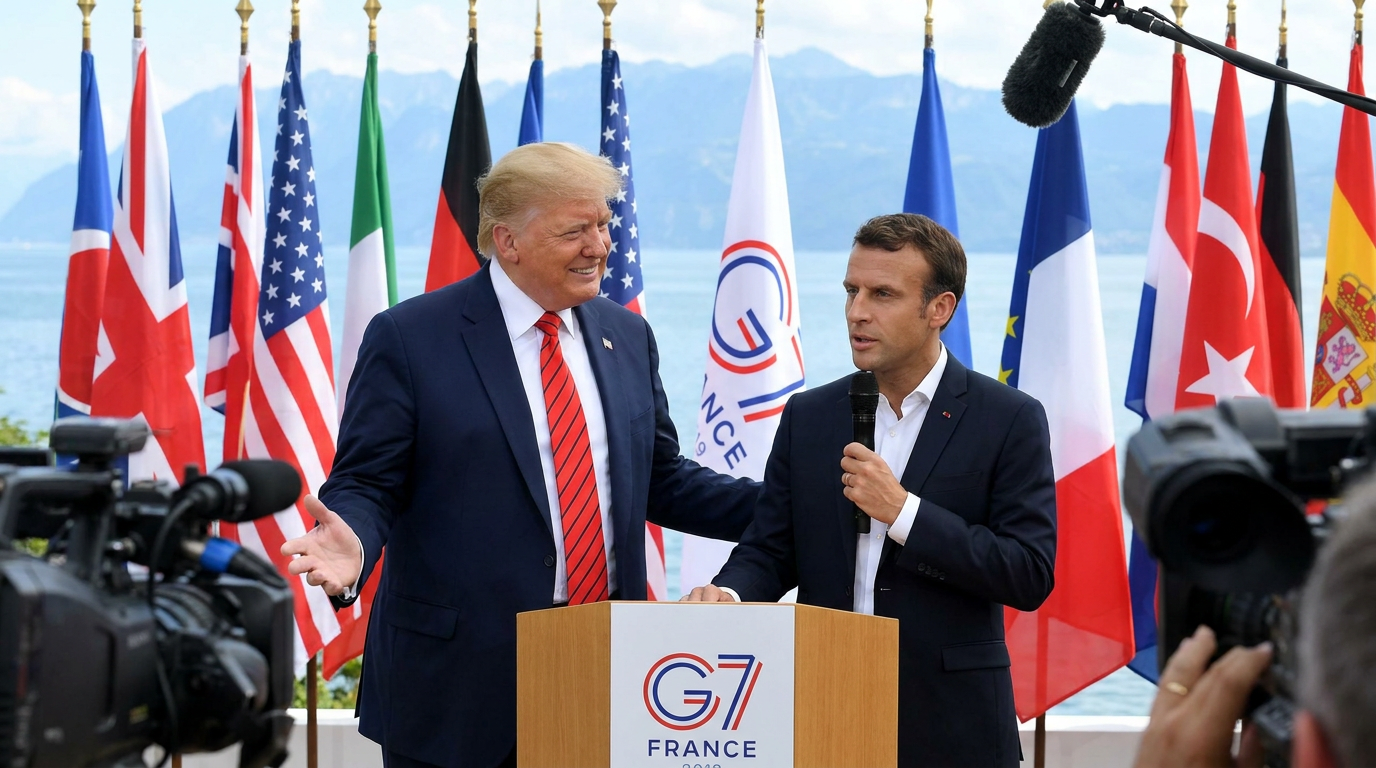
U.S. President Donald Trump has secured the backing of the Group of Seven (G7) for a tentative peace agreement with Iran, aiming to end a devastating regional war and reopen the critical Strait of Hormuz. Gathering at a lakeside resort in Evian-les-Bains, France, global leaders issued a joint statement on Wednesday describing the memorandum of understanding (MOU) as a "historic opportunity." The pact, which Trump says is already signed by key officials, promises to lift crippling U.S. sanctions in exchange for a permanent Iranian pledge to abandon its nuclear weapons ambitions. The diplomatic breakthrough comes after months of intense conflict, signaling a potential shift toward stabilization in the Middle East.[1][2][3][4]
The announcement marks a dramatic pivot in a conflict that has killed more than 7,000 people and severely disrupted global energy markets over the past several months. While the full text of the MOU remains under wraps ahead of a formal signing ceremony in Switzerland on Friday, leaked details and official statements outline a framework heavily focused on immediate economic relief and maritime security. The agreement initiates a 60-day window for negotiators to hammer out a final, comprehensive settlement regarding the technical dismantling of Iran's nuclear infrastructure. During this period, both sides are expected to adhere to a strict ceasefire, though the exact mechanisms for monitoring compliance remain a subject of intense international debate.[1][2][6]
The most immediate global impact of the deal is the reopening of the Strait of Hormuz, a narrow maritime chokepoint that handles a significant portion of the world's daily oil supply. Trump announced that the strait is already "partially opened" and will be fully operational by the end of the week, allowing commercial ships to pass toll-free. In response to the news of restored maritime trade, global oil prices plummeted, with Brent crude futures dropping below $80 a barrel—their lowest level since the opening salvos of the conflict. This economic relief is a central selling point for the Trump administration, which has touted the plummeting energy costs as a direct victory for American consumers and global markets.[1][2][4][5][6][7]

To enforce this maritime reopening and ensure the safety of commercial vessels, the G7 leaders endorsed a joint naval initiative led by the United Kingdom and France. This European coalition will deploy specialized task forces to hunt for naval mines and escort tankers through the strait, an operation that implicitly requires Iranian consent to avoid further clashes. NATO Secretary General Mark Rutte praised the planned reopening as a "massive step forward" for global economic stability. Meanwhile, G7 leaders pledged to accelerate investments in diversifying future energy supply routes, acknowledging that the global economy's heavy dependence on the Strait of Hormuz remains a critical vulnerability even in times of peace.[1][2][6]
Inside Iran, the economic incentives embedded in the pact are staggering. The MOU reportedly mandates the immediate lifting of U.S. sanctions on Iranian oil exports and a raft of related industries, effectively ending a naval and financial blockade that had pushed the nation's economy to the brink of collapse. Furthermore, the agreement establishes a massive $300 billion reconstruction fund designed to rebuild Iranian infrastructure damaged during the war. U.S. officials have repeatedly stressed that this fund will be financed entirely by neighboring Gulf states, ensuring that no American taxpayer money is spent on the rebuilding effort, a crucial detail for Trump's domestic political messaging.[1][2][4][5]
In exchange for this massive economic lifeline, Iran has agreed to a binding, permanent commitment never to develop, purchase, or acquire a nuclear weapon. Trump emphasized that the U.S. is not looking to physically confiscate Iran's existing stockpile of highly enriched uranium, but rather to destroy it in place, noting that the nuclear sites remain under intense, round-the-clock satellite surveillance. "If they do [pursue a weapon], they suffer unbelievable consequences," Trump warned reporters during a press conference in France, adding that the repercussions would be "ultimate." The administration insists that these monitoring capabilities are sufficient to guarantee Iranian compliance without requiring an ongoing American military presence on the ground.[3][5][7]

In exchange for this massive economic lifeline, Iran has agreed to a binding, permanent commitment never to develop, purchase, or acquire a nuclear weapon.
Despite the G7's enthusiastic endorsement, the diplomatic breakthrough is immediately threatened by ongoing hostilities in the Levant. The G7 joint statement urgently demanded an "immediate robust ceasefire" in Lebanon, where Israeli forces continue to conduct heavy military operations against Hezbollah militants. The Israeli strikes, which have displaced over a million people and caused massive civilian casualties, remain the most volatile wild card in the U.S.-Iran peace process. European leaders have expressed deep concern that the violence in Lebanon could easily spill over, dragging the United States and Iran back into direct confrontation before the ink on the memorandum is even dry.[1][2][3]
Israeli Prime Minister Benjamin Netanyahu has publicly distanced his government from the American negotiations, signaling a deep fracture in the U.S.-Israel alliance. While not outright denouncing the MOU, Netanyahu asserted that Israel has its own distinct security interests and will not withdraw its forces from occupied territory in southern Lebanon despite the ceasefire framework. He also reiterated that Israel retains the sovereign right to unilaterally strike Iran if Israeli intelligence detects any movement toward nuclear weaponization, regardless of the diplomatic agreements signed in Geneva. This independent stance complicates the U.S. effort to present a unified Western front.[2][3][5]
This Israeli defiance has triggered a rare and highly public rift between Washington and Jerusalem. Trump openly criticized Netanyahu's continued bombing of Beirut, stating that the Israeli Prime Minister needs to be "more responsible with respect to Lebanon" and warning that the aggression is jeopardizing the broader peace effort. The U.S. president's frustration highlights the delicate balancing act of winding down a war that Israel views as an existential necessity, even as the American public and the Trump administration actively seek a rapid exit strategy from Middle Eastern entanglements.[3][5][7]

Tehran has eagerly seized on this friction, warning that the entire peace deal is strictly contingent on Israel halting its military operations. Iran's foreign ministry stated categorically that any further military attacks by the "Zionist regime" on Lebanon, or the continued occupation of Lebanese territory, will be considered a direct violation of the MOU by the United States and its allies. This creates a precarious dynamic where a localized escalation between Israeli forces and Hezbollah fighters could instantly unravel the broader U.S.-Iran detente, placing the fate of the global agreement in the hands of regional actors.[2][3][5]
Beyond the immediate geopolitical hurdles in the Middle East, Trump faces a fierce political backlash at home. Conservative hawks within the Republican Party are sharply criticizing the agreement, arguing that it abruptly abandons the original objectives of the war and offers unearned, sweeping concessions to a hostile regime. Critics point out that the leaked MOU drafts make absolutely no mention of restricting Iran's ballistic missile program or dismantling its financial support for proxy militias like Hezbollah and Hamas—issues that have long been non-negotiable red lines for U.S. conservatives and national security analysts.[1][2][4]
Vice President JD Vance, who signed the preliminary agreement alongside Iranian Parliament Speaker Mohammad-Bagher Ghalibaf, has unexpectedly become the political face of the controversial deal. Vance's prominent involvement has drawn the ire of the GOP's interventionist wing, with conservative commentators accusing the administration of backsliding into an "Obama kind of GOP" by prioritizing a negotiated settlement over a decisive military victory. The internal party friction sets the stage for a highly contentious debate as the administration attempts to sell the pact to a skeptical American public ahead of the upcoming midterm elections.[3][4][6]

In a calculated bid to outmaneuver his domestic critics, Trump announced he plans to submit the MOU to Congress for formal review, a step he was not legally required to take. Framing the move as a political trap for Democrats, Trump suggested that his opponents would reflexively vote against the peace deal simply because his administration negotiated it, thereby putting them on record as opposing peace. "Whatever I say, they want to do the opposite," he remarked, indicating his confidence that he can leverage intense partisan polarization to secure the agreement's survival and isolate his Republican detractors.[5]
As the G7 summit concludes in France, the international focus shifts to the formal signing ceremony scheduled for Friday at a highly secure resort on Switzerland's Lake Lucerne. The event will officially trigger the 60-day negotiation period meant to finalize the complex technical details of Iran's nuclear disarmament and the mechanics of the international sanctions relief. While European allies and global markets are breathing a sigh of relief at the prospect of restored maritime trade, the path to a lasting peace remains fraught with regional tripwires, Israeli opposition, and domestic political landmines.[1][2][3][4][6]
How we got here
Early 2026
The U.S.-Israel war against Iran escalates, leading to the closure of the Strait of Hormuz and heavy regional casualties.
June 15, 2026
President Trump announces at the G7 summit that a tentative peace deal with Iran has been signed.
June 17, 2026
G7 leaders issue a joint statement backing the agreement and demanding an immediate ceasefire in Lebanon.
June 19, 2026
Scheduled formal signing ceremony of the memorandum in Switzerland, initiating a 60-day negotiation window.
Viewpoints in depth
The Trump Administration
Views the deal as a pragmatic victory that prevents a nuclear Iran and reopens global trade.
The administration argues that the memorandum achieves the primary strategic goal of the conflict: ensuring Iran never acquires a nuclear weapon. By securing a commitment from Tehran and maintaining intense satellite surveillance of nuclear sites, the U.S. claims it can enforce compliance without a permanent military footprint. Furthermore, officials emphasize that reopening the Strait of Hormuz provides immediate relief to global energy markets, and the $300 billion reconstruction fund will be entirely financed by Gulf states, sparing American taxpayers.
European Allies (G7)
Welcomes the de-escalation and the reopening of the Strait of Hormuz, but remains cautious about regional stability.
European leaders, who largely opposed the initial escalation of the war, have expressed profound relief at the prospect of a negotiated settlement. Their primary focus is the restoration of global maritime trade, evidenced by the UK and France stepping up to lead a naval coalition to secure the Strait of Hormuz. However, they remain deeply concerned about the fragility of the ceasefire, particularly the ongoing violence in Lebanon, which they fear could easily drag the region back into a broader conflict.
Republican Hawks
Criticizes the agreement for abandoning initial war objectives and offering massive sanctions relief.
Conservative critics within the U.S. argue that the deal represents a capitulation to Tehran. They point out that the leaked drafts of the agreement fail to address Iran's ballistic missile program or its financial support for proxy militias like Hezbollah and Hamas. By lifting crippling sanctions and allowing Iran to access a $300 billion reconstruction fund, these hawks argue the administration is providing unearned concessions that will ultimately empower the regime to destabilize the Middle East in the future.
The Israeli Government
Distances itself from the U.S.-Iran pact, maintaining its right to strike Iranian nuclear facilities.
Prime Minister Benjamin Netanyahu has made it clear that Israel is not bound by the American diplomatic framework. Viewing Iran and its proxy network as an existential threat, the Israeli government insists on maintaining military pressure on Hezbollah in southern Lebanon, despite the G7's demands for a ceasefire. Furthermore, Israeli leadership has reiterated that it will unilaterally strike Iran if it detects any movement toward nuclear weaponization, creating a significant point of friction with the Trump administration's peace efforts.
What we don't know
- Whether Israel will agree to halt its military operations in Lebanon to preserve the broader U.S.-Iran deal.
- The exact technical mechanisms that will be used to verify Iran's compliance with its nuclear pledges.
- If the U.S. Congress will attempt to block the sanctions relief outlined in the memorandum.
Key terms
- Memorandum of Understanding (MOU)
- A formal agreement between two or more parties that outlines the terms and details of an understanding, often preceding a final, binding treaty.
- Strait of Hormuz
- A critical maritime chokepoint between the Persian Gulf and the Gulf of Oman, through which a significant portion of the world's oil supply passes.
- Group of Seven (G7)
- An intergovernmental political and economic forum consisting of seven major advanced economies: Canada, France, Germany, Italy, Japan, the UK, and the US.
- Enriched Uranium
- A type of uranium in which the percent composition of uranium-235 has been increased, a necessary step for both civilian nuclear power and nuclear weapons.
Frequently asked
What is the $300 billion reconstruction fund?
It is a proposed fund financed by neighboring Gulf states, not the U.S., designed to rebuild Iranian infrastructure damaged during the war.
Will the Strait of Hormuz reopen?
Yes, the agreement mandates the immediate reopening of the strait, with a UK and France-led naval coalition helping to secure commercial shipping.
Does the deal address Iran's ballistic missiles?
No, leaked drafts of the memorandum do not include restrictions on Iran's ballistic missile program or its proxy militias, which has drawn heavy criticism from U.S. conservatives.
How has Israel reacted?
Prime Minister Benjamin Netanyahu has distanced Israel from the deal, stating Israel will not withdraw from Lebanon and retains the right to strike Iran's nuclear facilities.
Sources
Source coverage
7 outlets
4 viewpoints surfaced







[1]ReutersEuropean Allies
G7 leaders demand ceasefire in Lebanon, welcome Iran deal
Read on Reuters →[2]The GuardianEuropean Allies
Joint statement welcomes Trump's deal with Iran to end war
Read on The Guardian →[3]AP NewsIsraeli Leadership
Trump to wrap G7 summit facing skepticism at home and jitters overseas over his plan to end Iran war
Read on AP News →[4]Washington PostRepublican Hawks
Leaders at the Group of Seven summit have backed U.S. President Donald Trump's tentative agreement with Iran
Read on Washington Post →[5]Fox NewsTrump Administration
Trump vows 'ultimate consequences' for Iran violations for reneging on ending nuclear aspirations
Read on Fox News →[6]CBS NewsTrump Administration
Trump in G7 summit in France as he touts signing of Iran memorandum
Read on CBS News →[7]NPRIsraeli Leadership
Trump's Iran agreement takes center stage at G7 summit
Read on NPR →
More in news politics
See all 5 stories →US-Iran Truce
US and Iran Reach Ceasefire Agreement as G7 Leaders Back Framework to Reopen Strait of Hormuz
7 sources
Electoral Reform
Evidence Pack: Does Ranked-Choice Voting Actually Reduce Political Polarization?
9 sources
Cognitive Defense
The Science of Prebunking: How Psychological Inoculation is Defending Elections Against Deepfakes
8 sources

Every angle. Every day.
Get news politics stories with full source coverage and perspective breakdowns delivered to your inbox.