
Women's Club Soccer Shatters Global Attendance Records as Purpose-Built Stadiums Fuel Growth
Driven by massive investments in dedicated infrastructure and expansion franchises, women's professional soccer leagues across the U.S. and Europe are posting unprecedented attendance and viewership numbers in 2026.
By Factlen Editorial Team
- Club Ownership Groups
- Focused on the financial returns and enterprise value unlocked by controlling stadium infrastructure.
- Supporters & Fan Groups
- Focused on the cultural validation and improved matchday experience that dedicated venues provide.
- Sports Economists
- Focused on the structural health of the leagues and the widening gap between top clubs and the rest of the table.
What's not represented
- · Players' Unions
- · Local Municipal Governments Funding Stadiums
Why this matters
The transition from renting oversized men's venues to owning purpose-built stadiums is fundamentally changing the economics of women's sports. By controlling their own ticketing, sponsorships, and matchday experiences, women's clubs are proving they are highly profitable, standalone entertainment properties.
Key points
- The NWSL's Denver Summit FC broke the U.S. professional women's sporting event attendance record with 63,004 fans in March 2026.
- Ownership groups are pivoting from renting men's venues to investing hundreds of millions in purpose-built stadiums.
- Denver's ownership is investing $450 million into the franchise, including a 14,500-seat dedicated stadium and mixed-use district.
- In Europe, the UEFA Women's Champions League generated 947 million social media views, a 50% year-over-year increase.
- Arsenal Women now account for 41% of all attendance in the English Women's Super League after moving matches to the Emirates Stadium.
The landscape of women's professional soccer has crossed a permanent threshold in 2026. Across the United States and Europe, clubs are no longer just breaking attendance records—they are fundamentally rewriting the economic model of the sport.[6]
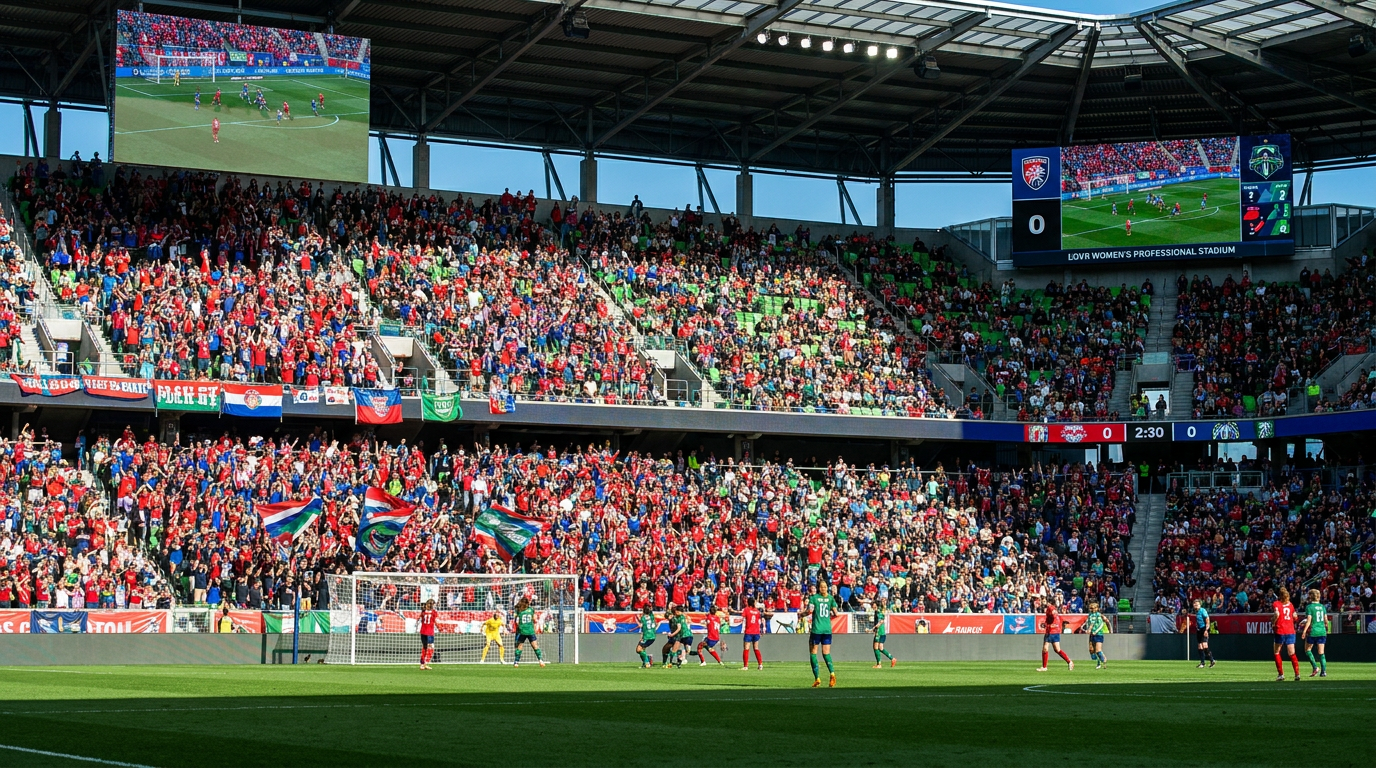
The most visible symbol of this shift arrived in March, when the National Women's Soccer League (NWSL) kicked off its 2026 season. The league's newest expansion franchise, Denver Summit FC, drew a staggering 63,004 fans to Empower Field at Mile High Stadium for their inaugural match against the Washington Spirit.[1][3]
That figure shattered the previous U.S. professional women's sporting event attendance record by more than 23,000 tickets, a milestone that had been set just months prior by Bay FC in San Francisco.[1][3]
But the massive crowd in Denver was not an isolated stunt. Across the NWSL, opening weekend drew nearly 130,000 fans across eight matches, averaging over 16,000 per game. Boston Legacy FC, the league's other 2026 expansion side, welcomed over 30,000 fans for its own debut.[1][6]

The true engine behind this sustained growth is a strategic, league-wide pivot toward infrastructure. For decades, women's teams were treated as secondary tenants, forced to rent oversized men's stadiums or play in inadequate suburban training facilities that suppressed ticket sales and broadcast quality.[6]
That dynamic shifted permanently with the Kansas City Current, who opened CPKC Stadium—the world's first stadium purpose-built for a women's professional sports team. The overwhelming success of that venue proved that controlling the matchday experience unlocks massive, previously untapped revenue streams.[2][6]
Denver Summit FC is now taking that blueprint and scaling it up. Controlling owner Rob Cohen has committed roughly $450 million to the club's launch, a figure that includes a record $110 million expansion fee and a massive real estate development.[2]
Denver Summit FC is now taking that blueprint and scaling it up.
The centerpiece of Denver's plan is a 14,500-seat purpose-built stadium at Santa Fe Yards, supported by a $50 million commitment from the city. Scheduled for completion in 2028, the complex will anchor a 14-acre mixed-use district designed to generate year-round revenue through retail and dining.[2][3]

"This will be the largest overall investment in a women's professional sports team in history," Cohen noted during the project's unveiling, emphasizing that the modern ownership model relies heavily on venue control and the lucrative sponsorship inventory created by owning the stadium outright.[2]
The infrastructure and attendance boom is equally pronounced in Europe, where the 2025/26 UEFA Women's Champions League season recently concluded with record-breaking engagement metrics.[4]
The Champions League final, held at a sold-out Ullevaal Stadion in Norway, saw FC Barcelona defeat OL Lyonnes. Beyond the stadium gates, the competition generated 947 million video views across social media—a 50% year-over-year increase that underscores the massive digital appetite for the women's game.[4]
In England, the Women's Super League (WSL) continues to see concentrated but explosive growth. Arsenal Women, who recently moved all their home matches to the 60,000-capacity Emirates Stadium, now account for a staggering 41% of the entire league's attendance.[5]

This transition to primary stadiums is creating a virtuous cycle. Better broadcast slots, such as Sky's new dedicated 12 p.m. window for WSL matches, are driving higher television viewership, which in turn fuels ticket sales, merchandise revenue, and higher broadcast rights valuations.[5]
Analysts note that the current influx of capital is not a speculative bubble, but rather a long-overdue market correction. Women's soccer was dramatically undervalued for decades, and the current investment simply reflects the actual consumer demand for the product.[6]
As the 2026 season progresses, the focus is shifting from simply proving that women's soccer has an audience to optimizing the multi-million dollar businesses that have sprung up around it. With more purpose-built stadiums breaking ground, the sport's financial foundation has never been stronger.[6]
How we got here
August 2025
Bay FC sets the NWSL single-game attendance record with 40,091 fans in San Francisco.
January 2026
Denver is officially awarded the 16th NWSL franchise, committing to a $450 million investment plan.
March 2026
Denver Summit FC shatters the U.S. professional women's attendance record, drawing 63,004 fans to their inaugural match.
May 2026
The UEFA Women's Champions League final sets an all-time attendance record for women's football in Norway.
Viewpoints in depth
Club Ownership Groups
Investors view purpose-built stadiums as the key to long-term profitability and valuation growth.
For ownership groups, the transition from renting to owning is entirely about unit economics. When clubs control their own venues, they capture 100% of the revenue from naming rights, concessions, parking, and premium seating. Investors like Denver's Rob Cohen expect to reach operating break-even within five years, recouping massive nine-figure infrastructure investments through franchise appreciation and the year-round returns generated by surrounding mixed-use real estate developments.
Supporters & Fan Groups
Fans emphasize that dedicated stadiums provide a sense of permanence and respect that the women's game has long been denied.
For the supporters who have championed women's soccer through its leaner years, the current boom is deeply validating. Fan groups point out that playing in purpose-built stadiums eliminates the scheduling conflicts and subpar pitch conditions that plagued teams when they rented men's facilities. The record-breaking crowds in Denver and London demonstrate that when fans are offered a premium, accessible matchday experience, they will show up in numbers that rival or exceed men's club fixtures.
Sports Economists
Analysts caution that while top-tier clubs are thriving, the wealth gap within leagues is widening.
While celebrating the macro-level growth, sports economists note a growing disparity within the leagues. In the English WSL, for example, Arsenal's massive crowds at the Emirates Stadium account for over 40% of the league's total attendance. Economists warn that unless broadcast revenues and infrastructure investments are distributed more evenly, leagues risk developing a top-heavy structure where a few mega-clubs dominate both the financial landscape and the on-field competition.
What we don't know
- Whether mid-market and smaller clubs will be able to secure the municipal funding required to build their own dedicated stadiums.
- How the massive attendance disparity in leagues like the English WSL will impact competitive balance over the next five years.
Key terms
- Purpose-built stadium
- A sports venue designed and constructed specifically for a particular team or sport, rather than a multi-purpose or rented facility.
- Expansion franchise
- A newly created team added to a professional sports league to increase the total number of clubs.
- Mixed-use development
- A real estate project that blends residential, commercial, cultural, or institutional uses into one space, often built around a stadium to generate year-round revenue.
- WSL
- The Women's Super League, the highest league of women's professional football in England.
Frequently asked
What is the attendance record for a U.S. women's pro sporting event?
The record is 63,004 fans, set by the NWSL's Denver Summit FC during their inaugural home match at Empower Field at Mile High Stadium in March 2026.
Why are women's soccer teams building their own stadiums?
Owning a purpose-built stadium allows clubs to control their own scheduling and capture all matchday revenue, including concessions, parking, and stadium sponsorships, which is crucial for long-term profitability.
How much is being invested in the new Denver NWSL franchise?
Controlling owner Rob Cohen is investing roughly $450 million into the club's launch, which includes a $110 million expansion fee and the construction of a 14,500-seat purpose-built stadium and training complex.
Is women's soccer attendance growing in Europe as well?
Yes. The 2025/26 UEFA Women's Champions League final set an all-time attendance record in Norway, and in England, clubs like Arsenal are regularly drawing massive crowds to their primary stadiums.
Sources
Source coverage
6 outlets
3 viewpoints surfaced






[1]Equalizer SoccerSupporters & Fan Groups
Expansion side history: Summit break NWSL attendance record
Read on Equalizer Soccer →[2]Sports Business JournalClub Ownership Groups
Denver's $450M NWSL launch sets new standard for purpose-built venues
Read on Sports Business Journal →[3]The GuardianSupporters & Fan Groups
NWSL newcomers attracted more than 60,000 fans to Mile High Stadium
Read on The Guardian →[4]UEFASports Economists
2025/26 Women's Champions League sets new attendance and digital records
Read on UEFA →[5]Women's Sport TrustSports Economists
A crucial year for attendance in the women's game
Read on Women's Sport Trust →[6]Factlen Editorial TeamClub Ownership Groups
Synthesis by Factlen editorial team
Read on Factlen Editorial Team →
Every angle. Every day.
Get sports stories with full source coverage and perspective breakdowns delivered to your inbox.