
How the 2026 Winter Olympics Finally Solved the 'White Elephant' Stadium Problem
By relying on temporary structures and retrofitting 70-year-old arenas, the Milano Cortina Games proved that mega-events no longer need to leave behind billions in abandoned infrastructure.
By Factlen Editorial Team
- Olympic Organizers
- Argue that the Milano-Cortina model proves mega-events can be sustainable and cost-effective by prioritizing existing infrastructure.
- Environmental Advocates
- Praise the 2026 Games for avoiding the ecological damage of past events through circular economy practices and clean energy.
- Economic Skeptics
- Maintain that while 2026 was a vast improvement, the Olympics still carry massive implicit costs and security budgets that burden host cities.
What's not represented
- · Local taxpayers in Milan and Cortina
- · Future Summer Olympic bidding committees
Why this matters
For decades, hosting the Olympics meant saddling local taxpayers with billions in debt for stadiums that would eventually rot. The 2026 Winter Games successfully road-tested a sustainable, circular model that could save future host cities from financial ruin while drastically cutting carbon emissions.
Key points
- 85% of the 2026 Winter Olympic venues were either pre-existing or temporary structures.
- The Cortina Curling Stadium, originally built in 1956, was retrofitted and reused 70 years later.
- Organizers borrowed 24,000 pieces of furniture from the Paris 2024 Games to eliminate manufacturing waste.
- Snow-making power consumption was reduced by 30% using GPS targeting and renewable energy.
- The estimated $6.2 billion cost of the 2026 Games is a fraction of the $51 billion spent on the 2014 Sochi Games.
For the better part of the 21st century, the phrase "Olympic legacy" became synonymous with financial ruin and ecological waste. Host cities routinely spent billions to construct sprawling, specialized mega-stadiums, only to watch them decay into derelict "white elephants" the moment the closing ceremonies ended. The 2004 Athens Games left behind a trail of abandoned aquatic centers and baseball diamonds that contributed to the Greek debt crisis, while the 2014 Sochi Winter Olympics racked up an estimated $51 billion price tag, carving massive concrete footprints into previously untouched wetlands.[2][5]
This cycle of extravagant spending and subsequent abandonment created an existential crisis for the International Olympic Committee (IOC). As the implicit costs of hosting skyrocketed—with the 2016 Rio de Janeiro Games experiencing a reported $2 billion loss and leaving behind heavily indebted infrastructure—democratic nations simply stopped bidding. Voters in cities like Denver, Boston, and Oslo repeatedly rejected referendums to host the Games, refusing to foot the bill for temporary global prestige.[2]
But the Milano Cortina 2026 Winter Olympics, which concluded this past February, fundamentally rewrote the playbook. Rather than pouring millions of tons of new concrete, Italian organizers embraced a radically different philosophy: making the most of what already exists. An unprecedented 85 percent of the competition venues used for the 2026 Games were either pre-existing buildings or temporary structures, marking one of the highest reuse rates in Olympic history.[1][6]

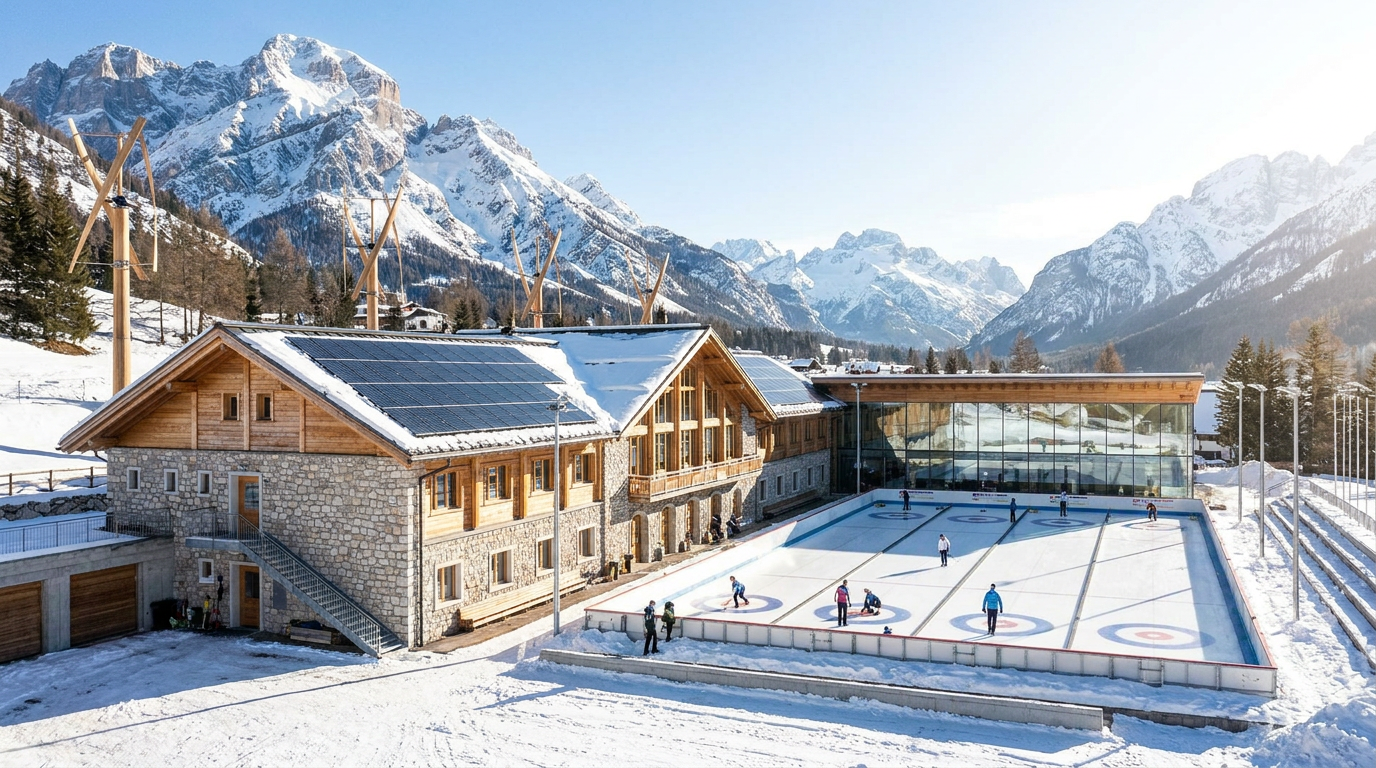
The centerpiece of this strategy was the art of retrofitting. Instead of building a glittering new ice arena from scratch, organizers looked to the Cortina Curling Olympic Stadium. Originally constructed for the 1956 Winter Games, the 70-year-old venue was simply cleaned, modernized for energy efficiency, and upgraded with new elevators and accessible seating. By preserving the historic structure, the organizing committee saved mountains of steel and concrete while maintaining elite performance standards.[6]
Where existing sports facilities fell short, the 2026 Games turned to modular, temporary architecture. At the Fiera Milano exhibition center, a massive commercial pavilion was temporarily transformed into the Rho Ice Rink. Because the venue was designed to be dismantled and returned to its original commercial use immediately after the Games, it left no permanent scars on the urban landscape and required zero long-term maintenance budgets from the city of Milan.[3]

Where existing sports facilities fell short, the 2026 Games turned to modular, temporary architecture.
This commitment to a "circular economy" extended far beyond the buildings themselves. In a remarkable display of cross-border cooperation, the Milano Cortina organizers borrowed 24,000 pieces of furniture—including chairs, desks, tables, and shelving—directly from the Paris 2024 Summer Olympics. Instead of manufacturing thousands of new items destined for a landfill, the equipment was shipped across the Alps, given a second life, and kept entirely out of the waste stream.[7]
The environmental logistics of the 2026 Games also tackled one of winter sports' most carbon-intensive challenges: making snow. Artificial snow production typically requires massive amounts of electricity and water. To combat this, the Milano Cortina team deployed advanced IT tools, including GPS and snow-depth sensors, to map the exact requirements of the ski courses. This precision targeting prevented overproduction and reduced the power consumption of their snow-making systems by roughly 30 percent.[1][7]
Furthermore, the energy powering those snow machines—and almost all of the competition venues—came exclusively from certified renewable sources. The organizers relied on solar, wind, and hydropower, entirely eliminating coal and gas from the primary venue grids. For the limited number of temporary generators required for emergency backup, the Games utilized a specialized hydrotreated vegetable oil (HVO) biofuel developed by Enilive, which was engineered to operate flawlessly in temperatures as low as -28°C.[1][4]

Transportation, historically a massive source of Olympic carbon emissions, was similarly overhauled. Because Milano Cortina was the most geographically spread-out Winter Games in history, organizers prioritized a low-carbon transport plan heavily reliant on existing train networks and electric shuttles. The official vehicle fleet was reduced by 20 percent compared to the 2006 Torino Games, and wherever possible, the remaining vehicles were fueled by the same arctic-grade HVO biofuel used in the generators.[1][4]
The financial results of this restraint are striking. While final audits are still pending, the estimated total cost for the Milano Cortina Games hovered around $6.2 billion. While still a massive sum, it represents a fraction of the $51 billion spent by Sochi or the $23.6 billion spent by Rio de Janeiro. More importantly, because the vast majority of the infrastructure was either temporary or pre-existing, the long-term maintenance debt saddled on Italian taxpayers will be negligible.[2][5]

There are, of course, open questions about whether this austere model can be perfectly replicated for the Summer Olympics. The Summer Games require housing for over 10,000 athletes and stadium capacities that dwarf those needed for curling or bobsledding. The sheer scale of a Summer Olympics makes it inherently more difficult to rely entirely on retrofitted exhibition halls and borrowed furniture.[2][7]
Yet, the psychological barrier has been broken. As Christophe Dubi, the IOC's Executive Director of the Olympic Games, noted during the event, sustainability is no longer just a buzzword—it is an operational mandate. By proving that a world-class global spectacle can be hosted in 70-year-old arenas and temporary pavilions, the 2026 Winter Olympics may have finally cured the mega-event world of its edifice complex.[1][4]
How we got here
2004
The Athens Summer Olympics leave behind billions in abandoned infrastructure, contributing to Greece's debt crisis.
2014
The Sochi Winter Olympics become the most expensive Games in history, costing an estimated $51 billion.
2016
The Rio de Janeiro Games experience a $2 billion loss, further souring the public appetite for hosting mega-events.
2024
The Paris Summer Olympics pioneer a leaner hosting model, heavily utilizing existing urban landmarks.
Feb 2026
The Milano Cortina Winter Olympics successfully execute a Games where 85% of venues are existing or temporary.
Viewpoints in depth
Olympic Organizers' View
Mega-events can be sustainable and cost-effective if cities prioritize existing infrastructure over vanity projects.
The International Olympic Committee and the Milano Cortina organizing committee view the 2026 Games as a definitive proof-of-concept for the future of global sports. By successfully hosting an elite, multi-national event using 85 percent existing or temporary venues, they argue that the era of the 'white elephant' is officially over. Officials emphasize that sustainability is no longer an abstract goal but a strict operational mandate that dictates everything from venue selection to the use of HVO biofuels for transport.
Economic Skeptics' View
While 2026 was a vast improvement, the Olympics still carry massive implicit costs that burden host cities.
Economists who study mega-events acknowledge that Milano Cortina's $6.2 billion price tag is a massive improvement over Sochi's $51 billion. However, they caution that the Olympics still require staggering implicit investments. Security costs alone routinely exceed $1 billion, and the logistical strain of upgrading regional transit networks to handle a sudden influx of tourists often runs over budget. Skeptics argue that while temporary venues solve the long-term maintenance problem, the sheer disruption of hosting still makes the Games a risky financial bet for most municipalities.
Environmental Advocates' View
The 2026 Games set a new ecological standard by avoiding the massive carbon footprint of new concrete construction.
Climate and sustainability advocates praise the 2026 Games for tackling the hidden ecological costs of sports infrastructure. Because concrete and steel production are massive drivers of global carbon emissions, the decision to retrofit a 1956 curling stadium rather than build a new one represents a major victory. Advocates also highlight the circular economy practices—such as borrowing 24,000 pieces of furniture from Paris and running generators on renewable biofuel—as scalable solutions that all future mega-events, from the World Cup to the Super Bowl, must adopt.
What we don't know
- Whether the temporary venue model can successfully scale to the much larger capacity requirements of the Summer Olympics.
- The final, fully audited financial footprint of the Milano Cortina Games, including all implicit infrastructure upgrades.
Key terms
- White Elephant
- A massive, expensive infrastructure project that becomes a financial burden because its cost of upkeep far exceeds its usefulness.
- Circular Economy
- An economic model focused on sharing, leasing, reusing, repairing, and recycling existing materials and products as long as possible to eliminate waste.
- HVO Biofuel
- Hydrotreated Vegetable Oil, a renewable diesel alternative made from waste fats and vegetable oils that significantly reduces carbon emissions compared to fossil fuels.
- Retrofitting
- The process of adding new technology, features, or energy-efficient systems to older buildings to modernize them without requiring total demolition and reconstruction.
Frequently asked
What is a 'white elephant' stadium?
A 'white elephant' is an expensive, highly specialized stadium built for a mega-event that is abandoned or rarely used after the event concludes, costing the host city millions in upkeep.
How much did the Milano Cortina 2026 Olympics cost?
The estimated total cost was roughly $6.2 billion, which is significantly lower than the $51 billion spent on the 2014 Sochi Winter Games.
Did the 2026 Winter Olympics build new venues?
Very few. Approximately 85 percent of the competition venues were either pre-existing structures (like the 1956 Cortina Curling Stadium) or temporary pavilions.
How did the 2026 Games reduce snow-making emissions?
Organizers used GPS and snow-depth sensors to avoid overproducing artificial snow, cutting power consumption by 30 percent, and powered the machines with certified renewable electricity.
Sources
Source coverage
7 outlets
3 viewpoints surfaced







[1]Olympics.comOlympic Organizers
Milano Cortina 2026 advances sustainability through venue reuse, clean energy and circularity
Read on Olympics.com →[2]Council on Foreign RelationsEconomic Skeptics
The Economics of Hosting the Olympic Games
Read on Council on Foreign Relations →[3]CGTNEnvironmental Advocates
Milano Cortina 2026 aims for accessible and sustainable Winter Games
Read on CGTN →[4]Inside the GamesOlympic Organizers
Milano Cortina 2026 highlights sustainability efforts ahead of Winter Olympics
Read on Inside the Games →[5]Athlon SportsEconomic Skeptics
8 Most Expensive Stadiums in Summer Olympics History
Read on Athlon Sports →[6]CSR CompanyOlympic Organizers
Milano Cortina 2026 sustainability praised by Prince Albert II
Read on CSR Company →[7]Factlen Editorial TeamEnvironmental Advocates
Synthesis by Factlen editorial team
Read on Factlen Editorial Team →
Every angle. Every day.
Get sports stories with full source coverage and perspective breakdowns delivered to your inbox.