
Penn Researchers Unveil Hybrid Light-Matter Particle to Power AI Computing
Scientists at the University of Pennsylvania have created an 'exciton-polariton' particle that allows AI to process data entirely with light, drastically reducing energy consumption.
By Factlen Editorial Team
- Photonic Computing Researchers
- Focuses on the technical elegance of solving the nonlinear activation problem entirely within the optical domain.
- AI Infrastructure Providers
- Views the breakthrough as a necessary solution to the thermal wall and massive energy demands of modern data centers.
- Hardware Scaling Skeptics
- Acknowledges the scientific achievement but cautions that mass-manufacturing atomically thin semiconductors remains a monumental hurdle.
What's not represented
- · Semiconductor Manufacturing Engineers
- · Data Center Energy Grid Operators
Why this matters
As AI models grow, the energy required to power them is pushing electrical grids to their limits. This breakthrough proves that computing can be done with light instead of electricity, offering a path to ultra-fast, zero-heat AI systems that consume a fraction of the power.
Key points
- Researchers at the University of Pennsylvania have created a hybrid light-matter particle called an exciton-polariton.
- The breakthrough allows AI computing to be performed entirely with light, bypassing the need for electronic transistors.
- All-optical switching was achieved using just four femtojoules of energy, a fraction of what current hardware requires.
- The technology could eventually eliminate the massive heat generation and energy bottlenecks facing modern AI data centers.
The artificial intelligence boom is colliding with a fundamental law of physics: the friction of the electron. As AI models grow exponentially in size and capability, the data centers required to train and run them are consuming power at the scale of small cities. Inside the silicon chips powering these systems, electrons must physically move through materials to process data. Because electrons carry an electrical charge, their movement generates resistance and heat, creating a thermal wall that threatens to halt the progress of computing.[1][3]
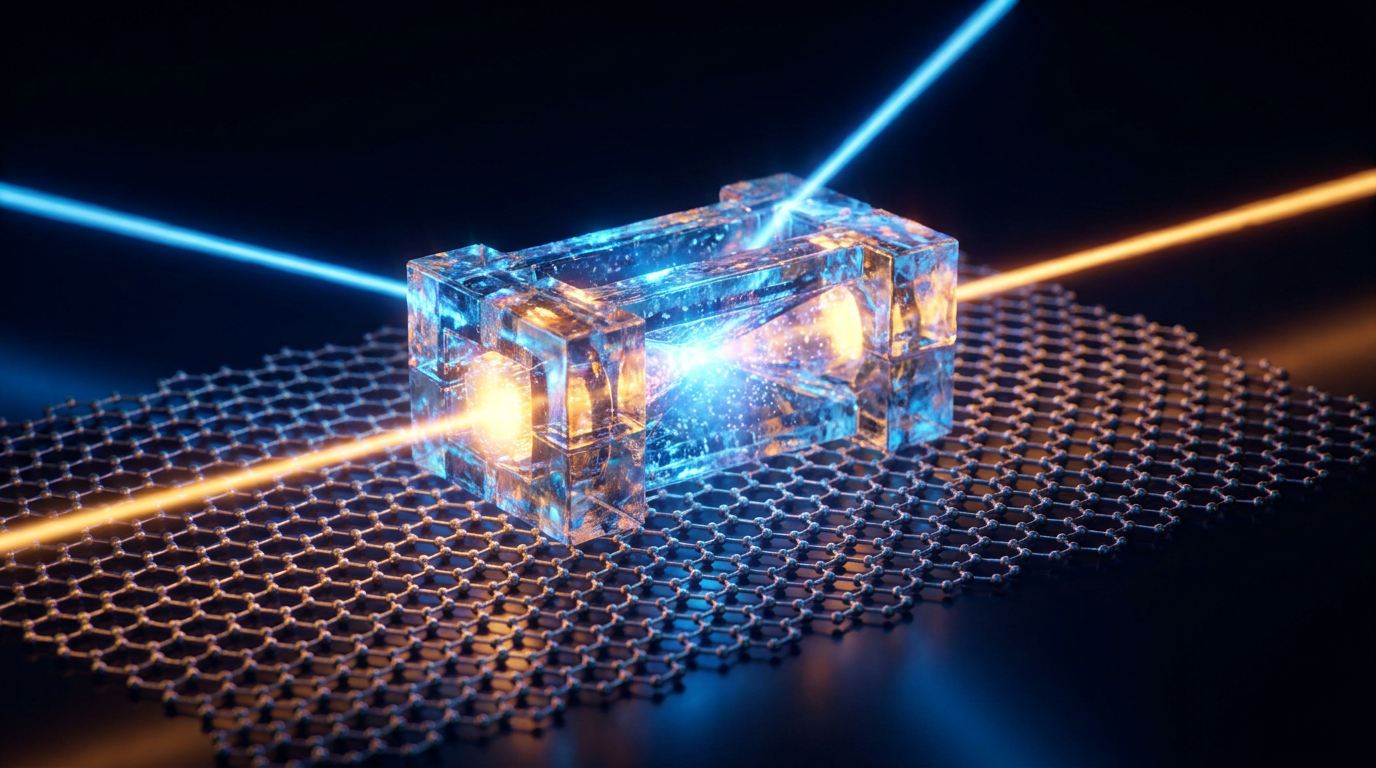
Now, researchers at the University of Pennsylvania have unveiled a breakthrough that could bypass the electron entirely. By creating a hybrid particle that is half-light and half-matter, the team has demonstrated a way to perform complex AI computations using only photons. The discovery points toward a future where AI systems operate at the speed of light, consuming a fraction of the energy required by today's most advanced hardware.[1][2][5]
The breakthrough represents a poetic full circle for the University of Pennsylvania. Eighty years ago, Penn researchers J. Presper Eckert and John Mauchly developed ENIAC, the world's first general-purpose electronic computer. That machine launched the modern computing era by using streams of electrons to solve complex mathematical problems. Today, as the architecture they pioneered reaches its physical limits, a new generation of Penn scientists is working to replace the electron with the photon.[1][5]
The appeal of light-based, or photonic, computing is clear. Photons have zero rest mass and carry no electrical charge. This allows them to transport information across long distances at the speed of light with virtually no energy loss or heat generation—a property that already makes them the backbone of global fiber-optic internet cables. If the internal logic of a computer chip could run on light, the energy savings would be astronomical.[2][3]

However, the very properties that make photons excellent for transmitting data make them terrible for processing it. Because photons are charge-neutral, they do not naturally interact with one another. In computing, "switching"—the process of one signal altering the path or state of another—is the fundamental building block of logic. In AI neural networks, these nonlinear activation steps are what allow the model to make decisions. Without interaction, photons cannot perform these crucial operations.[1][4]
However, the very properties that make photons excellent for transmitting data make them terrible for processing it.
To get around this limitation, existing experimental photonic AI chips have relied on a clumsy workaround. They use light to perform simple, linear calculations at high speeds, but whenever the AI needs to make a nonlinear decision, the chip must convert the optical signal back into an electronic one. This repeated conversion between light and electricity introduces delays and consumes massive amounts of power, effectively canceling out the benefits of using light in the first place.[2][6]
A research team led by Penn physicist Bo Zhen and postdoctoral researcher Li He has solved this bottleneck by inventing a new way for light to interact. Instead of trying to force pure photons to switch, the team created a specialized quasiparticle called an "exciton-polariton." This hybrid entity is formed by trapping photons inside a nanoscale optical cavity and strongly coupling them with electrons inside an atomically thin semiconductor material.[1][4][5]
The resulting exciton-polariton possesses the best traits of both its parents. Because it is part photon, it can travel at the speed of light. Because it is part electron, it possesses the interaction capabilities of matter. This dual nature allows the hybrid particles to interact with their environment and perform the complex signal-switching logic that computers depend on, entirely within the optical domain.[2][5]

The energy efficiency of this all-optical switching is staggering. In their demonstration, the Penn researchers successfully executed nonlinear switching operations using only about four quadrillionths of a joule—or four femtojoules—of energy. To put that in perspective, this is orders of magnitude less energy than is required to power a single traditional electronic transistor, and far below the energy needed to briefly illuminate a microscopic LED.[1][2][3]
If this technology can be successfully scaled from the laboratory to commercial manufacturing, the implications for AI infrastructure are profound. Future photonic processors could ingest optical data directly from cameras and sensors, process the information through an AI neural network, and output a result without ever converting the signal into electricity. This would eliminate the thermal bottlenecks that currently force tech giants to build massive liquid-cooling systems for their data centers.[2][3][6]

Despite the immense promise, the path to commercialization is steep. The Penn team's demonstration relied on atomically thin monolayer semiconductors, which are notoriously difficult to manufacture at scale. Modern electronic GPUs pack tens of billions of transistors onto a single chip; replicating that density with nanoscale optical cavities and exciton-polaritons will require years of material science and engineering breakthroughs.[4][6]
Nevertheless, the creation of the exciton-polariton marks a fundamental shift in the trajectory of computing hardware. As the AI industry races toward increasingly complex models, the ability to process information without the friction and heat of the electron offers a viable path forward. Beyond AI, the researchers note that these hybrid particles exhibit quantum coherence properties, suggesting that the chips of the future might not just run on light, but could eventually support the foundations of quantum computing.[1][2][5]
How we got here
1945
Researchers at the University of Pennsylvania develop ENIAC, the world's first general-purpose electronic computer.
Early 2020s
The generative AI boom pushes traditional electron-based silicon chips to their thermal and energy limits.
April 2026
The Penn research team publishes their breakthrough on exciton-polaritons in Physical Review Letters.
May 2026
The all-optical switching demonstration gains widespread attention as a potential solution to AI's energy crisis.
Viewpoints in depth
Photonic Computing Researchers
Focuses on the technical elegance of solving the nonlinear activation problem entirely within the optical domain.
For physicists and optical engineers, the exciton-polariton represents the holy grail of photonic computing. For decades, the inability of photons to interact with one another meant that light could only be used to transmit data, not process it. By successfully coupling photons with electrons in a nanoscale cavity, researchers have proven that nonlinear logic gates can exist without the thermal penalty of pure electronics. This keeps the entire computational pipeline in the optical domain, preserving the speed of light from input to output.
AI Infrastructure Providers
Views the breakthrough as a necessary solution to the thermal wall and massive energy demands of modern data centers.
The technology industry is currently facing an existential energy crisis. Training frontier AI models requires tens of thousands of GPUs, which consume megawatts of power and require vast amounts of water for cooling. Infrastructure providers view the four-femtojoule switching capability of the exciton-polariton as a roadmap out of this bottleneck. If AI chips can run on light, data centers could theoretically scale their computing power exponentially without requiring dedicated power plants or risking grid collapse.
Hardware Scaling Skeptics
Acknowledges the scientific achievement but cautions that mass-manufacturing atomically thin semiconductors remains a monumental hurdle.
While the physics community celebrates the breakthrough, semiconductor veterans emphasize the massive gulf between a lab experiment and a commercial product. The Penn demonstration relied on gate-tunable monolayer semiconductors—materials that are only a single atom thick. Manufacturing these delicate structures at the scale of billions of transistors per chip, with the reliability required for commercial hardware, is an engineering challenge that could take a decade or more to solve. Until then, the industry remains tethered to silicon.
What we don't know
- How long it will take to scale the manufacturing of atomically thin semiconductors to commercial production levels.
- Whether these photonic chips can be seamlessly integrated into existing electronic computer architectures.
Key terms
- Exciton-polariton
- A hybrid quasiparticle created by coupling photons with electrons, combining the speed of light with the interaction capabilities of matter.
- Nonlinear activation
- A mathematical operation in an AI neural network that allows the system to make complex decisions, traditionally requiring electronic transistors.
- All-optical switching
- The ability to route and process data entirely using light, without ever converting the signals back into electricity.
- Femtojoule
- A unit of energy equal to one quadrillionth of a joule, representing an extraordinarily small amount of power.
- Quasiparticle
- A concept in physics used to describe the collective behavior of particles in a solid medium as if they were a single, distinct particle.
Frequently asked
What is an exciton-polariton?
It is a hybrid quasiparticle that is half-light and half-matter, allowing it to travel at the speed of light while interacting strongly enough to perform computing logic.
Why can't we just use normal light for AI chips?
Normal photons are charge-neutral and don't interact with each other, making them incapable of performing the "switching" or decision-making steps required by AI neural networks.
How much energy does this new method save?
The Penn team demonstrated all-optical switching using just 4 quadrillionths of a joule (4 femtojoules) per operation, which is orders of magnitude less than traditional electronic transistors.
When will these optical chips be in our computers?
The technology is currently a lab-scale breakthrough. Scaling it up to mass-manufactured commercial chips with billions of optical switches will likely take years of engineering.
Sources
Source coverage
6 outlets
3 viewpoints surfaced





[1]ScienceDailyHardware Scaling Skeptics
Penn scientists may have found a way to power the future of AI with light instead of electricity
Read on ScienceDaily →[2]SciTechDailyAI Infrastructure Providers
Physicists Created a New Hybrid Light-Matter Particle That Could Revolutionize Future Computation
Read on SciTechDaily →[3]The DebriefHardware Scaling Skeptics
Physicists Created a New Hybrid Light-Matter Particle That Could Revolutionize Future Computation
Read on The Debrief →[4]Physical Review LettersPhotonic Computing Researchers
Strongly Nonlinear Nanocavity Exciton Polaritons in Gate-Tunable Monolayer Semiconductors
Read on Physical Review Letters →[5]Penn TodayPhotonic Computing Researchers
Making 'light' work of computing
Read on Penn Today →[6]AI DoseAI Infrastructure Providers
Penn Researchers Build Hybrid Light-Matter Particle to Slash AI Energy Use
Read on AI Dose →



Every angle. Every day.
Get ai stories with full source coverage and perspective breakdowns delivered to your inbox.