
Induction Cooktops vs. Gas and Electric: An Evidence-Based Review
Clinical studies and energy assessments reveal that induction cooktops offer significant advantages in indoor air quality, boiling speed, and energy efficiency over traditional gas and electric stoves.
By Factlen Editorial Team
- Public Health Advocates
- Focuses on the urgent need to remove indoor combustion sources to lower nitrogen dioxide exposure and prevent childhood asthma.
- Culinary & Appliance Reviewers
- Prioritizes practical cooking performance, boiling speed, temperature precision, and long-term appliance reliability.
- Energy Efficiency Researchers
- Analyzes the physics of heat transfer, grid impact, and the reduction of wasted ambient energy in residential homes.
What's not represented
- · Professional restaurant chefs transitioning to electric kitchens
- · Electricians handling residential panel upgrades for 240-volt appliances
Why this matters
Replacing a gas or traditional electric stove with an induction cooktop fundamentally changes your home's indoor air quality and energy consumption. Understanding the scientific evidence helps you make a healthier, more efficient choice for your next major kitchen appliance.
Key points
- Induction cooktops use magnetic fields to heat pots directly, eliminating open flames and hot electric coils.
- Clinical studies show gas stoves routinely emit harmful levels of nitrogen dioxide indoors, while induction emits none.
- Induction transfers up to 90% of its energy to the food, compared to roughly 40% for gas stoves.
- Consumers must ensure their cookware is magnetic (like cast iron or stainless steel) for the technology to work.
For decades, the American kitchen was divided into two distinct camps, each with its own set of compromises. On one side were the culinary enthusiasts who insisted on the fiery precision and instant feedback of gas burners, willing to overlook the excess heat and open flames. On the other side were those who settled for the sluggish, glowing coils of traditional electric stoves, which were safer but notoriously difficult to control. This binary choice defined kitchen renovations and appliance shopping for generations, leaving consumers to choose between performance and convenience.[7]
But a third technology has rapidly moved from a niche European luxury to the center of the American appliance market, promising to eliminate the old compromises. Induction cooking, which utilizes the principles of electromagnetism rather than thermal conduction or open combustion, is fundamentally rewriting the rules of kitchen performance. As prices have slowly begun to fall and environmental awareness has risen, induction is no longer just a futuristic concept; it is becoming the gold standard for both professional chefs and everyday home cooks looking to upgrade their living spaces.[7]
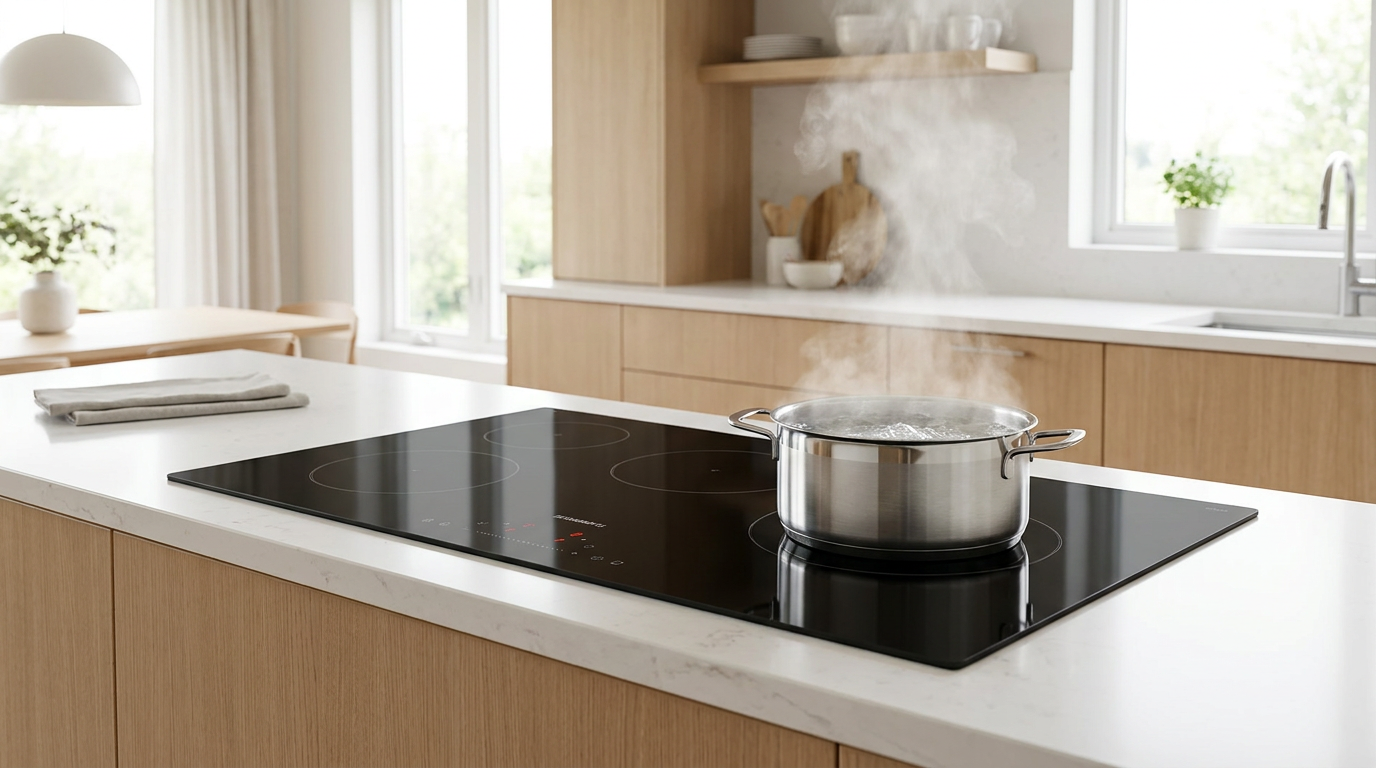
Unlike traditional electric ranges that heat a glass or ceramic surface, or gas burners that ignite fossil fuels to create a flame, induction cooktops generate an oscillating magnetic field beneath the glass. This invisible field interacts directly with the iron molecules in a pot or pan, causing the cookware itself to become the primary heat source. The glass surface only gets warm from the residual heat of the pan resting on it. The result is a cooking method that is remarkably faster, significantly safer for households with children, and vastly cleaner for the indoor environment.[7]
The most compelling evidence driving the modern transition to induction centers squarely on human health and the quality of the air we breathe indoors. For years, the respiratory impacts of cooking with combustible gas inside a sealed home were largely ignored by the general public. However, a recent wave of clinical and environmental studies has brought the issue of indoor air pollution into sharp focus, revealing that the blue flame on a gas stove is a significant source of invisible, harmful emissions.[1][2][6]
When a gas stove is ignited, the combustion process releases a complex mixture of chemical byproducts, most notably nitrogen dioxide and fine particulate matter. Research compiled by the Home Energy Efficiency Team indicates that a poorly ventilated gas stove can push indoor nitrogen dioxide levels past the Environmental Protection Agency’s outdoor safety standard of 100 parts per billion within just a few minutes of operation. These pollutants are strongly associated with an increased risk of developing asthma and can trigger acute respiratory symptoms in sensitive groups.[6]

The Cooking Energy and Ventilation Impacts on Children's Asthma study, which rigorously monitored homes in California's San Joaquin Valley, provided stark real-world data on these exposures. The researchers found that homes using standard gas ranges experienced acute, dangerous spikes in nitrogen dioxide during routine meal preparation. In contrast, homes equipped with electric induction stoves maintained nitrogen dioxide levels that were roughly equivalent to the background outdoor air, demonstrating a clear and immediate health benefit to removing combustion from the kitchen.[2]
Journalists and researchers at KQED replicated these scientific findings in a controlled residential test to see how quickly pollution accumulates in a standard home. Boiling a pot of water on a single gas burner with the exhaust hood turned off sent nitrogen dioxide levels soaring past World Health Organization guidelines almost immediately, with the gases quickly spreading to adjacent bedrooms. When the exact same boiling test was performed using a portable induction cooktop, emissions of nitrogen dioxide and benzene remained completely flat, proving the technology's clean operation.[1]
Beyond the profound respiratory health benefits, the underlying physics of induction offer a massive leap forward in household energy efficiency. Because the electromagnetic heat is generated directly inside the metal of the cookware, very little thermal energy escapes into the surrounding kitchen environment. Anyone who has boiled a large pot of pasta on a gas stove during the summer knows how quickly the kitchen heats up; induction eliminates this ambient heat waste entirely, keeping the kitchen cool and reducing the strain on home air conditioning systems.[3]
Beyond the profound respiratory health benefits, the underlying physics of induction offer a massive leap forward in household energy efficiency.
A comprehensive technical assessment conducted by the American Council for an Energy-Efficient Economy precisely quantified this thermal advantage. The study found that induction technology successfully transfers up to 90 percent of its consumed electrical energy directly to the food being cooked. In stark contrast, traditional electric resistance coils transfer only about 74 percent of their energy, while gas stoves are notoriously inefficient, transferring a mere 32 to 40 percent of their heat to the pot, with the majority of the energy literally vanishing into thin air.[3]

This remarkable energy efficiency translates directly into raw cooking speed, fundamentally changing the rhythm of meal preparation. Appliance testing from organizations like Consumer Reports consistently shows that induction cooktops can boil a large pot of water 20 to 40 percent faster than their most powerful traditional electric or gas counterparts. For busy families trying to get dinner on the table after a long workday, shaving several minutes off the time it takes to boil water for rice or pasta is a highly tangible, everyday benefit.[5]
Furthermore, the energy research highlighted a critical flaw in traditional electric coils: they suffer massive efficiency drops when mismatched with cookware. The efficiency of a standard electric burner falls to as low as 42 percent when a small pan is placed on a large heating element, as the exposed coil radiates wasted heat. Induction systems, however, only activate the magnetic field exactly where the metal makes contact with the glass, automatically sizing the heat zone to the pan and maintaining peak efficiency regardless of the cookware's dimensions.[3]
For culinary professionals and dedicated home chefs, the ultimate appeal of induction lies in its incredibly precise temperature control. Gas has long been favored in professional kitchens because a physical flame can be adjusted instantly by the eye. Induction matches this instant responsiveness perfectly, cutting off the heat the exact millisecond the digital dial is turned down. This immediate thermal drop prevents delicate sauces from breaking, stops milk from boiling over, and allows for a perfectly sustained, ultra-low simmer that gas burners often struggle to maintain without flickering out.[4][5]
Despite the overwhelming scientific evidence supporting its performance, efficiency, and health benefits, the transition to induction cooking is not without friction for the average consumer. The most immediate and widely discussed barrier for shoppers considering the switch is cookware compatibility. Because the technology relies entirely on magnetic fields to generate heat, pots and pans must contain a sufficient amount of ferromagnetic materials to function.[7]
Fortunately, many home cooks already own compatible pots without realizing it. Heavy cast iron skillets, enameled cast iron Dutch ovens, and most high-quality, multi-clad stainless steel pans work perfectly on an induction surface. However, pure aluminum, solid copper, and glass cookware are entirely invisible to the magnetic field and will not heat up. The simplest, foolproof test is to place a standard refrigerator magnet on the bottom of a pan; if the magnet sticks firmly, the pan is ready for an induction stove.[5][7]

Upfront financial costs also remain a significant hurdle for widespread adoption. While retail prices have steadily fallen over the last decade, full-size induction ranges are still generally more expensive than baseline gas or traditional electric models. Additionally, homeowners switching from a gas range to an induction model may require a licensed electrician to install a dedicated 240-volt circuit in the kitchen, a necessary infrastructure upgrade that can add several hundred dollars to the total installation cost.[7]
There is also some lingering uncertainty regarding the long-term reliability of the complex electronics housed inside these appliances. While the magnetic cooking elements themselves are highly durable and the flat glass surface is exceptionally easy to clean, the digital control boards required to manage the magnetic fields can be sensitive to power surges and heat. Consumer Reports notes that while induction ranges generally perform exceptionally well in their rigorous lab tests, some budget-friendly models have experienced higher rates of circuit board failures during their first few years of operation compared to simpler electric stoves.[5]
For those who are hesitant to commit thousands of dollars to a full kitchen renovation, appliance reviewers offer a highly practical, low-risk gateway into the technology. Outlets like Wirecutter strongly recommend purchasing a portable, single-burner induction cooktop as a starting point. These compact units, which typically cost around one hundred dollars and plug directly into a standard 120-volt wall outlet, allow skeptical cooks to experience the speed, safety, and precision of magnetic cooking firsthand without having to replace their primary household stove.[4]

Ultimately, the evidence pack surrounding induction technology is remarkably robust and difficult to ignore. From eliminating toxic indoor emissions that threaten respiratory health to maximizing energy transfer and slashing cooking times, the data clearly suggests that electromagnetism is the future of the kitchen. While the upfront costs and cookware requirements require some initial adjustment, induction stands as a fundamental, evidence-backed upgrade to the way we prepare our food.[7]
How we got here
Early 1900s
The first patents for magnetic induction cooking are filed, though the technology remains impractical for home use.
1970s
Westinghouse introduces the first modern induction range in the US, but high costs prevent widespread adoption.
2010s
Induction technology becomes highly popular in Europe due to high energy costs and strict environmental regulations.
2022
Major public health studies link gas stove emissions to childhood asthma, accelerating US consumer interest in induction.
2026
Induction cooktops become a standard recommendation by major appliance reviewers for both health and culinary performance.
Viewpoints in depth
Public Health Advocates
Focuses on the urgent need to remove indoor combustion sources to lower nitrogen dioxide exposure.
Medical professionals and environmental health researchers view the transition away from gas stoves as a critical public health intervention. Citing studies that link indoor nitrogen dioxide and particulate matter to elevated rates of childhood asthma, this camp argues that gas stoves are the only unvented combustion appliances legally allowed inside modern homes. For these advocates, the superior boiling speed of induction is merely a bonus; the primary goal is eliminating toxic emissions from the kitchen entirely.
Culinary & Appliance Reviewers
Prioritizes practical cooking performance, boiling speed, temperature precision, and long-term appliance reliability.
Product testers and professional chefs evaluate cooktops based on how well they actually cook food. This group praises induction for its unparalleled ability to boil water rapidly and its instant temperature responsiveness, which rivals or beats professional gas ranges. However, reviewers also caution consumers about the practical realities of the switch, noting the need to replace incompatible aluminum or copper cookware and highlighting data that shows some budget-friendly induction models suffer from circuit board failures.
Energy Efficiency Researchers
Analyzes the physics of heat transfer, grid impact, and the reduction of wasted ambient energy in residential homes.
Engineers and energy analysts focus on the sheer physics of magnetic cooking. Because induction transfers up to 90 percent of its electrical energy directly into the metal of the pan, it drastically reduces the amount of wasted heat that escapes into the kitchen. This camp emphasizes that widespread adoption of induction not only lowers individual household energy bills but also reduces the summer cooling load on home air conditioning systems, making it a vital tool for overall residential energy conservation.
What we don't know
- Whether the long-term reliability of digital induction control boards will eventually match the decades-long lifespan of simple electric coils.
- How quickly the secondary market for used induction-compatible cookware will grow to offset the upfront costs for lower-income households.
Key terms
- Induction cooking
- A cooking method that uses an oscillating magnetic field to generate heat directly inside ferromagnetic cookware, rather than heating the surface of the stove.
- Nitrogen dioxide (NO2)
- A toxic gas produced by burning fossil fuels, including natural gas on a stovetop, which is strongly linked to respiratory issues and asthma.
- Ferromagnetic
- Materials, such as iron or certain steel alloys, that have a high susceptibility to magnetization, which is required for induction cooktops to function.
- Particulate matter (PM2.5)
- Microscopic particles released during combustion that are small enough to penetrate deep into the lungs and enter the bloodstream.
Frequently asked
Do I need to buy all new pots and pans for an induction stove?
Not necessarily. If a magnet sticks firmly to the bottom of your current pots, they will work on an induction cooktop. Cast iron and most stainless steel are compatible, while aluminum and copper are not.
Does induction cooking emit any harmful gases?
No. Because induction uses electromagnetism rather than combustion, it produces zero nitrogen dioxide or carbon monoxide, significantly improving indoor air quality.
Are induction cooktops more expensive to run?
They are generally cheaper to operate than traditional electric or gas stoves because they transfer up to 90 percent of their energy directly to the food, minimizing wasted heat.
Sources
Source coverage
7 outlets
3 viewpoints surfaced







[1]KQEDPublic Health Advocates
We Tested Indoor Air Pollution From Gas Stoves. Here’s What We Found
Read on KQED →[2]ResearchGatePublic Health Advocates
The Cooking Energy and Ventilation Impacts on Children's Asthma (CEVICA) study
Read on ResearchGate →[3]ACEEEEnergy Efficiency Researchers
Technical Assessment of Induction Cooking
Read on ACEEE →[4]WirecutterCulinary & Appliance Reviewers
The Best Portable Induction Cooktop
Read on Wirecutter →[5]Consumer ReportsCulinary & Appliance Reviewers
Induction Ranges and Cooktops Review
Read on Consumer Reports →[6]HEETPublic Health Advocates
Research on emissions from burned gas
Read on HEET →[7]Factlen Editorial Team
Synthesis by Factlen editorial team
Read on Factlen Editorial Team →

More in shopping
See all 6 stories →Summer Retail Sales
Major Retailers Launch Sweeping Summer Price Cuts on Thousands of Everyday Essentials
6 sources

Kitchen Tech
How 120-Volt Battery Stoves Are Finally Making Induction Cooking Accessible
7 sources
Health Tech
Smart Ring vs. Smartwatch: How to Choose the Right Health Tracker in 2026
7 sources

Home Networking
Wi-Fi 7 in 2026: The Complete Guide to the New Wireless Standard
6 sources
Every angle. Every day.
Get shopping stories with full source coverage and perspective breakdowns delivered to your inbox.