
US and Iran Reach Ceasefire Agreement as G7 Leaders Back Framework to Reopen Strait of Hormuz
The United States and Iran have signed a memorandum of understanding to halt hostilities and reopen the Strait of Hormuz, initiating a 60-day window for final negotiations. The framework gained backing from G7 leaders, though domestic US critics and European allies warn that significant regional security issues remain unresolved.
By Factlen Editorial Team
- US Administration
- Argues the deal successfully averted a global economic depression by reopening the Strait of Hormuz and freezing Iran's nuclear ambitions.
- European Allies
- Supports the ceasefire but demands inclusion in future talks and insists on a multinational naval force to secure maritime shipping.
- Regional Skeptics
- Warns that the deal fails to address Iran's ballistic missiles or proxy networks, leaving allied nations vulnerable to future attacks.
- Post-War Rebuilders
- Focuses on immediate humanitarian relief and long-term economic reconstruction as the primary path to regional stability.
What's not represented
- · Iranian Civilians
- · Lebanese Civilians
- · Global Shipping Operators
Why this matters
This ceasefire directly impacts global energy markets by reopening the Strait of Hormuz, averting a potential spike in fuel prices and widespread economic disruption. However, the fragile nature of the truce and unresolved proxy conflicts mean the threat of renewed regional instability remains high.
Key points
- The US and Iran have signed a memorandum of understanding to halt a three-month war and reopen the Strait of Hormuz.
- The agreement lifts the US naval blockade on Iran and establishes a $300 billion reconstruction fund financed by Gulf states.
- G7 leaders backed the framework but demanded an immediate ceasefire in Lebanon and called for talks on Iran's ballistic missiles.
- The preliminary deal initiates a 60-day window for diplomats to negotiate a final, binding settlement regarding Iran's nuclear program.
- China has pledged new humanitarian aid to Iran and Lebanon, positioning itself for a major role in post-war reconstruction.
After three months of devastating military conflict that choked global energy markets and triggered widespread geopolitical anxiety, the United States and Iran have reached a fragile ceasefire. The agreement, structured as a memorandum of understanding, aims to formally halt a war that began in late February and effectively closed the Strait of Hormuz to commercial shipping. The sudden cessation of hostilities brings immediate relief to a global economy that had been bracing for prolonged energy shortages, but it also introduces a highly complex diplomatic roadmap fraught with regional tripwires. Negotiators now face the daunting task of translating a temporary military pause into a durable political settlement.[1][2]
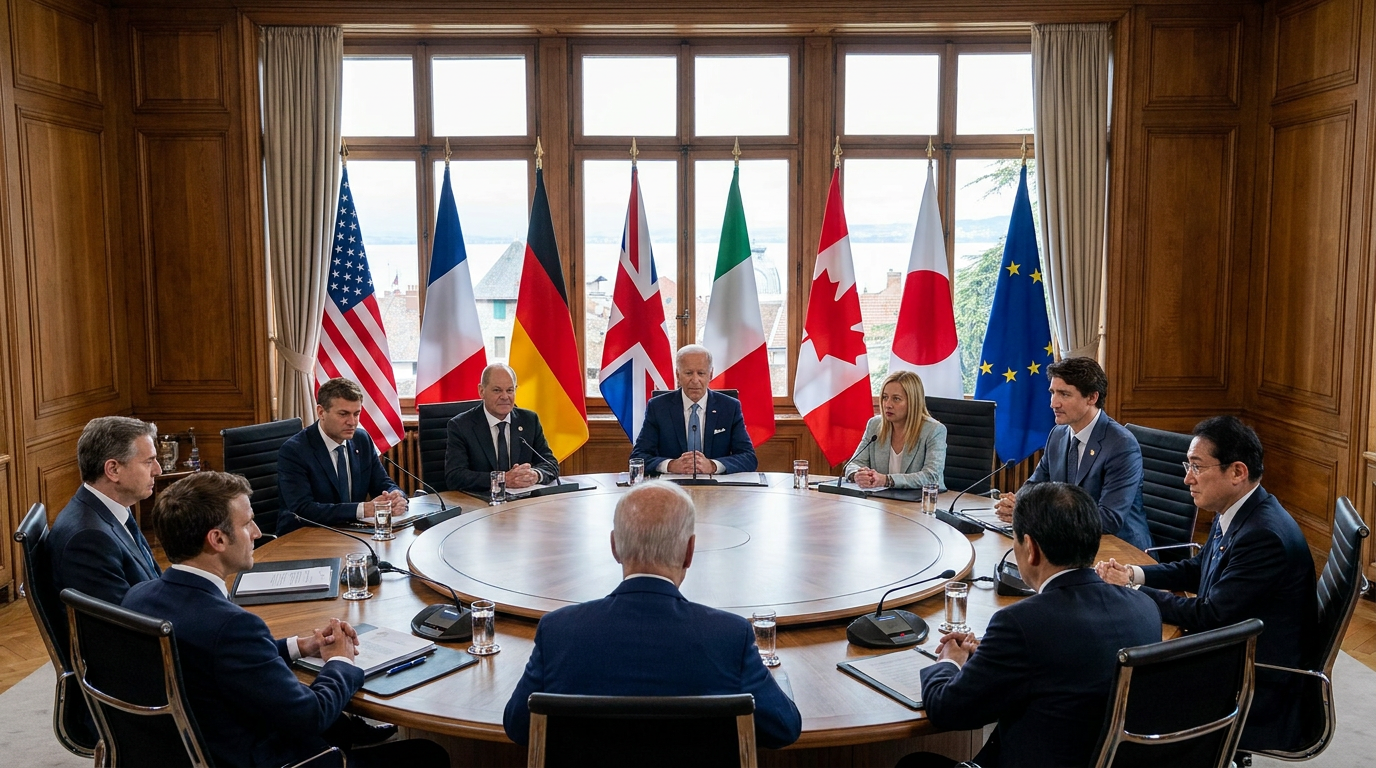
The diplomatic breakthrough was formally announced as world leaders gathered for the Group of Seven summit in the alpine resort town of Evian-les-Bains, France. US President Donald Trump presented the framework to allied nations, declaring that the rapid execution of the deal had successfully averted a "worldwide depression" by stabilizing volatile oil prices and reopening critical maritime trade routes. The summit provided the US administration with a high-profile platform to rally international backing for the truce, even as the specific mechanics of the agreement were still being finalized behind closed doors in Washington and Tehran.[1][2]
Under the immediate terms of the memorandum, the United States has agreed to lift its naval blockade on Iranian ports, a move that will allow Tehran to immediately resume its lucrative oil and fuel exports. In exchange, the Iranian government has committed to ceasing all direct military operations and guaranteeing the free flow of navigation through the Strait of Hormuz. This narrow waterway serves as a vital global chokepoint, handling roughly a fifth of the world's daily oil trade, and its reopening is widely viewed as the most critical economic deliverable of the preliminary peace framework.[1]
Beyond the immediate unblocking of maritime trade, the agreement outlines significant financial maneuvers, including the unfreezing of billions of dollars in Iranian assets held abroad. Furthermore, the framework establishes a massive $300 billion reconstruction fund, which is expected to be financed primarily by neighboring Arab Gulf states. However, US officials have been quick to emphasize that the release of these frozen funds will not be instantaneous; rather, it will be strictly tied to Iran meeting a series of verifiable commitments during the upcoming diplomatic window, ensuring that economic relief is metered against concrete compliance.[1][3]

Officials on all sides acknowledge that the current memorandum of understanding is not a finalized peace treaty, but rather the starting gun for a rigorous 60-day period of intense negotiations. During this critical window, international diplomats are expected to hammer out a comprehensive, binding settlement that addresses the long-term future of Iran's nuclear program and the broader security architecture of the Middle East. The success of these forthcoming talks will determine whether the current ceasefire hardens into a lasting peace or simply serves as a tactical pause to rearm.[2][3]
A formal signing ceremony for the preliminary agreement is scheduled to take place this Friday at the Burgenstock resort in Switzerland. The high-stakes event is expected to be attended by US Vice President JD Vance and Iranian Parliament Speaker Mohammad-Bagher Ghalibaf, marking a rare moment of direct, high-level diplomatic engagement between the two adversaries. Yet, even before the ink dries on the initial documents, the immense complexities and contradictions of implementing the truce are becoming starkly apparent to the international community.[2]
At the G7 summit, European leaders issued a carefully calibrated joint statement that welcomed the cessation of hostilities while highlighting significant unresolved security issues. The leaders of Britain, France, Germany, Italy, Japan, and Canada underscored the urgent need to address Iran's advanced ballistic missile capabilities—a highly contentious topic that was notably absent from the initial US-brokered memorandum. This omission has fueled anxiety among European capitals that the deal may prioritize immediate economic relief over long-term strategic disarmament.[1][3]
European allies are also actively maneuvering to secure a prominent seat at the table for the next phase of negotiations. Having been largely sidelined during the intense bilateral talks between Washington and Tehran, European governments are eager to shape the final settlement and protect their own strategic interests in the Middle East. They argue that a durable peace requires a multilateral approach, one that incorporates the perspectives and security guarantees of the broader international community rather than relying solely on bilateral US-Iran dynamics.[1]
European allies are also actively maneuvering to secure a prominent seat at the table for the next phase of negotiations.
Maritime security remains a paramount concern for the G7 nations, who rely heavily on the unencumbered flow of global shipping. To that end, the joint statement endorsed a multinational, independent naval initiative spearheaded by France and Britain to facilitate the safe resumption of traffic in the Strait of Hormuz. This European-led initiative aims to protect merchant vessels, reassure nervous commercial shipping operators, and provide independent verification that all naval mines have been successfully cleared from the strategic waterway.[6]

Domestically, the Trump administration is facing fierce and vocal pushback from Republican lawmakers and national security hawks who view the framework with deep suspicion. Critics argue that the memorandum represents a series of major, unearned concessions that leave Iran's core power projection capabilities largely intact. They contend that by lifting the naval blockade and unfreezing assets upfront, the United States has surrendered its most potent leverage before securing binding commitments on Iran's most dangerous military programs.[1][3]
Skeptics specifically point out that the preliminary agreement does not dismantle Iran's sophisticated ballistic missile arsenal, nor does it sever Tehran's financial and logistical support for proxy militias operating across the region. Senator Lindsey Graham and other prominent conservative voices have publicly demanded thorough congressional briefings, warning that the deal, as currently described by Iranian officials, fails to neutralize the long-term existential threat posed by the regime and leaves allied nations vulnerable to future coercion.[1][5]
The geopolitical ripple effects of the truce extend far beyond the corridors of Washington and Tehran, deeply entangling neighboring nations. In the Middle East, the survival of the US-Iran agreement is heavily contingent on the trajectory of the parallel conflict in Lebanon, where intense Israeli military operations against Hezbollah forces continue unabated. The interconnected nature of these conflicts means that a breakdown in one theater could easily trigger a collapse of the broader regional ceasefire.[1][3]
Iranian officials and Hezbollah representatives have explicitly linked the finalization of the nuclear and regional deal to a complete and verifiable Israeli military withdrawal from Lebanon. Recognizing the fragility of the situation, the G7 leaders used their joint statement to formally demand an immediate ceasefire in Lebanon, warning that continued hostilities there threaten to unravel the entire diplomatic framework and plunge the region back into a state of active, multi-front warfare.[3]
For the Arab Gulf states, the ceasefire offers a desperately needed, albeit cautious, reprieve from months of heightened vulnerability. Having borne the brunt of regional instability, drone strikes, and severe economic disruption, these nations are reportedly willing to bankroll the massive $300 billion reconstruction fund. In exchange for this financial commitment, the Gulf states are seeking ironclad security guarantees and a permanent halt to the asymmetric proxy attacks that have long threatened their domestic infrastructure and economic stability.[3][5]

As Western powers debate the intricate mechanics and security implications of the deal, China is rapidly and strategically positioning itself as a central player in the region's post-war future. Beijing swiftly announced a new, comprehensive batch of humanitarian aid destined for both Iran and Lebanon, framing its immediate involvement as a steadfast commitment to civilian recovery, infrastructure reconstruction, and long-term economic development in the war-torn areas.[4][7]
The Chinese Foreign Ministry emphasized its role as a "responsible major power" and a "good friend of Middle Eastern countries," drawing a subtle contrast with the military-first approach of Western nations. By stepping in with immediate, unconditional relief supplies, China is effectively laying the groundwork for lucrative long-term infrastructure contracts and expanding its geopolitical influence in a resource-rich region that has traditionally been dominated by the United States' security architecture.[4]
The upcoming 60-day negotiation window will serve as the ultimate test for the durability of the memorandum of understanding. Diplomats must find a way to bridge the massive chasm between Washington's demand for absolute, verifiable nuclear compliance and Tehran's unwavering insistence on maintaining its regional leverage and securing permanent sanctions relief. The margin for error is razor-thin, and any perceived violation by either side could quickly scuttle the fragile progress made thus far.[2][3]
Ultimately, the current US-Iran ceasefire represents a pragmatic, economically driven pause rather than a permanent resolution to decades of entrenched hostility. While the agreement successfully reopens the vital arteries of global energy trade and averts an immediate economic crisis, the underlying structural conflicts—from asymmetric proxy warfare to advanced missile proliferation—remain unresolved, leaving the Middle East in a precarious state of heavily armed anticipation.[5]
How we got here
Feb 2026
US and Israel initiate military operations against Iran, leading to the closure of the Strait of Hormuz.
June 15, 2026
US and Iranian officials electronically sign a Memorandum of Understanding to halt hostilities.
June 17, 2026
G7 leaders issue a joint statement in France backing the framework while demanding a ceasefire in Lebanon.
June 19, 2026
Formal signing ceremony scheduled to take place at the Burgenstock resort in Switzerland.
Viewpoints in depth
US Administration's View
The deal is a necessary economic victory that averts a global depression.
Proponents within the US administration argue that the primary objective of the conflict—preventing a catastrophic global economic collapse—has been achieved by reopening the Strait of Hormuz. They maintain that freezing Iran's nuclear ambitions while lifting the naval blockade strikes a pragmatic balance, prioritizing immediate global economic stability over protracted, unwinnable military engagements.
European Allies' View
The ceasefire is welcome, but long-term security requires a multilateral approach.
European capitals view the bilateral US-Iran memorandum as a positive first step but remain deeply concerned about its narrow scope. They argue that a durable peace must address Iran's ballistic missile program and require the active participation of European powers in future negotiations. Furthermore, they insist on maintaining an independent naval presence in the region to verify the safety of commercial shipping routes.
Regional Skeptics' View
The agreement concedes too much leverage without dismantling Iran's core military capabilities.
National security hawks and allied nations in the Middle East warn that the framework provides Iran with immediate economic relief without neutralizing its most potent threats. By failing to dismantle Tehran's ballistic missile arsenal or sever its support for proxy militias like Hezbollah, skeptics argue the deal merely allows Iran to rebuild its economy and rearm for future asymmetric conflicts.
What we don't know
- Whether the 60-day negotiation window will result in a finalized, binding treaty regarding Iran's nuclear program.
- If Israel will agree to a ceasefire and military withdrawal in Lebanon, which Iran has set as a condition for the final deal.
- How the US Congress will respond to the unfreezing of Iranian assets and the lifting of the naval blockade.
Key terms
- Strait of Hormuz
- A critical maritime chokepoint between the Persian Gulf and the Gulf of Oman, through which roughly a fifth of the world's oil passes.
- Memorandum of Understanding (MOU)
- A formal agreement between parties that establishes a framework for future negotiations, though often lacking the binding enforcement of a finalized treaty.
- G7 (Group of Seven)
- An intergovernmental political and economic forum consisting of seven major advanced economies, including the US, UK, France, Germany, Italy, Canada, and Japan.
Frequently asked
Is the war between the US and Iran completely over?
Not entirely. The current agreement is a memorandum of understanding that establishes a 60-day ceasefire to negotiate a final settlement, but underlying tensions and proxy conflicts remain active.
Why are US politicians criticizing the deal?
Many lawmakers argue the framework provides Iran with immediate economic relief without dismantling its ballistic missile program or ending its support for regional proxy groups.
What role is China playing in the aftermath?
China has pledged immediate humanitarian aid to Iran and Lebanon, positioning itself to play a major role in the region's post-war economic reconstruction and expanding its geopolitical influence.
Sources
Source coverage
7 outlets
4 viewpoints surfaced







[1]The GuardianEuropean Allies
First Thing: Trump backs G7 statement on Iran deal as domestic criticism grows
Read on The Guardian →[2]CBS NewsUS Administration
Trump arrives in France for G7 summit as administration announces signing of truce with Iran
Read on CBS News →[3]The Jerusalem PostRegional Skeptics
US-Iran deal gains G7 support as leaders call for Hezbollah disarmament, Lebanon ceasefire
Read on The Jerusalem Post →[4]XinhuaPost-War Rebuilders
China decides to provide new batch of humanitarian aid to Iran, Lebanon: spokesperson
Read on Xinhua →[5]Center for Strategic and International StudiesRegional Skeptics
How Arab Gulf States View the Emerging Iran Deal
Read on Center for Strategic and International Studies →[6]Nippon.comEuropean Allies
G7 Leaders Agree to Cooperate on Hormuz Safe Passage
Read on Nippon.com →[7]Al JazeeraPost-War Rebuilders
China pledges new humanitarian aid packages for Lebanon and Iran
Read on Al Jazeera →

Every angle. Every day.
Get news politics stories with full source coverage and perspective breakdowns delivered to your inbox.