
Decoding the SpaceX Mega-IPO: How the $85 Billion Debut Rewrote Options Market History
Following its historic $85 billion initial public offering, SpaceX's entry into the options market shattered trading records, highlighting a massive shift in how retail and institutional investors approach space-economy assets.
By Factlen Editorial Team
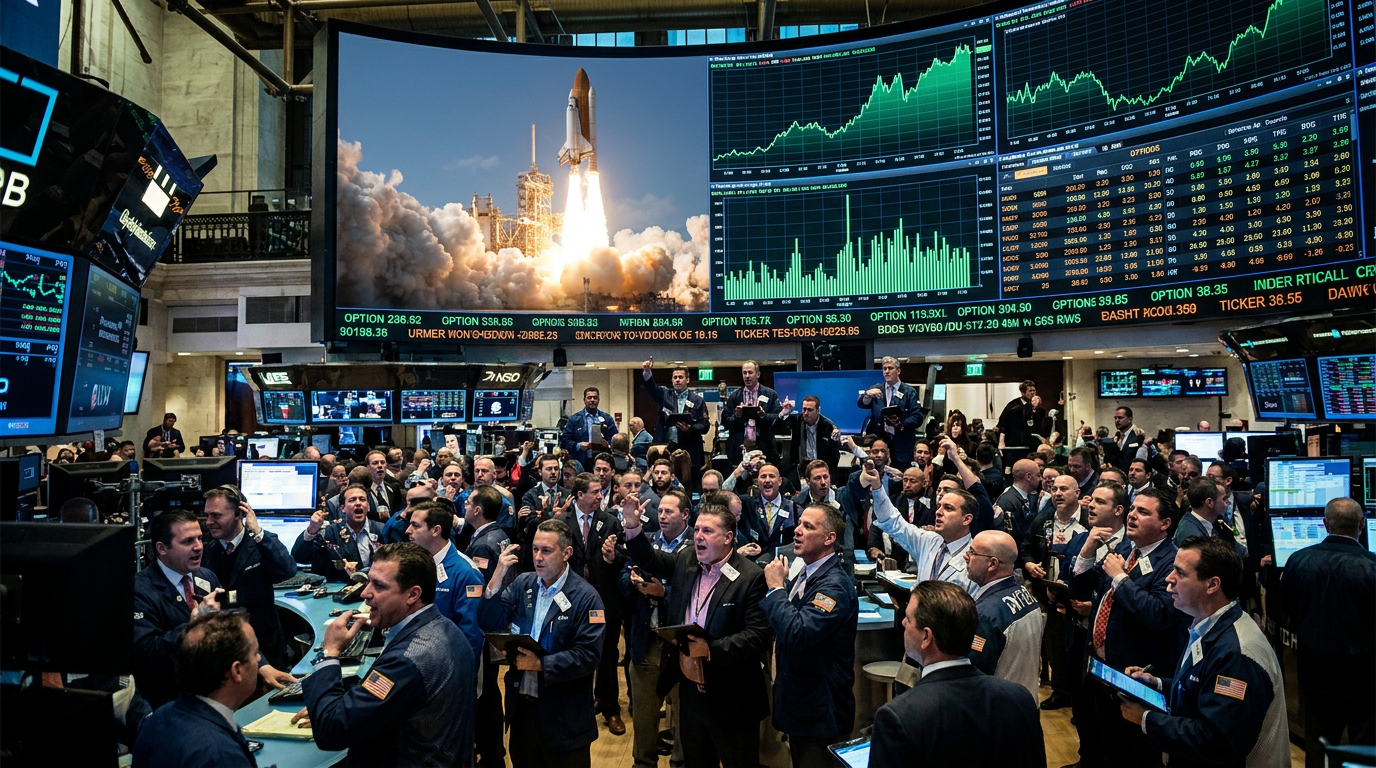
- Retail Speculators
- Focused on utilizing options for leveraged upside in a generational growth story.
- Institutional Hedgers
- Utilizing the derivatives market to protect massive capital deployments.
- Market Regulators
- Prioritizing system stability, liquidity provision, and retail investor education.
What's not represented
- · Traditional Aerospace Competitors
- · Venture Capital Backers
Why this matters
Understanding the mechanics of options trading is crucial as mega-IPOs increasingly dominate the market. By grasping how these derivatives function, investors can better navigate the risks and opportunities of the commercial space sector's financial frontier.
Key points
- SpaceX raised a record-breaking $85 billion in its initial public offering, the largest in U.S. equity history.
- The company's debut on the options market shattered previous volume records, driven by massive retail and institutional demand.
- Options contracts require a brief seasoning period after an IPO to establish baseline volatility for accurate pricing.
- Retail traders utilized call options for leveraged upside, while institutions heavily purchased put options for portfolio insurance.
On Friday, the financial landscape shifted as SpaceX executed the largest initial public offering in the history of the United States equity market, raising an unprecedented $85 billion. The sheer scale of the offering immediately transformed the aerospace manufacturer into a cornerstone of institutional portfolios and a primary target for retail enthusiasm. But the true test of the market's appetite arrived on Tuesday, when derivatives tied to the newly public company officially began trading. The resulting surge of activity did not just meet expectations; it shattered the record for the largest debut in the history of the U.S. options market.[1]
To understand why Tuesday's options debut was so monumental, it is necessary to look beneath the surface of the headline numbers and examine the mechanics of how modern capital markets digest a mega-cap listing. When a company of this magnitude goes public, it does not merely issue shares; it spawns an entire ecosystem of financial instruments. The options market serves as the high-speed, high-leverage engine of that ecosystem, allowing participants to speculate on future price movements or protect their existing investments.[4]

There is a deliberate, structural reason why SpaceX options did not begin trading the moment the opening bell rang on Friday. Exchanges and regulatory bodies require a brief seasoning period—typically a few trading days—after an IPO before derivatives can be listed. This window allows the underlying stock to establish a baseline of price discovery and trading volume. Without this initial period of stabilization, market makers would lack the historical volatility data required to accurately price the complex mathematical models that govern options contracts.[3][4]
At their core, options are derivative instruments, meaning their financial value is entirely dependent on the performance of an underlying asset—in this case, SpaceX common stock. The U.S. Securities and Exchange Commission defines an option as a contract that gives the buyer the right, but not the obligation, to buy or sell a security at a fixed price within a specific timeframe. Because they offer flexibility and leverage, these contracts are traded heavily by a diverse mix of institutional investors, professional traders, and retail participants.[2]
The explosive volume witnessed on Tuesday was largely driven by call options. A call option gives the purchaser the right to buy 100 shares of the underlying stock at a predetermined price, known as the strike price, before the contract's expiration date. If an investor believes SpaceX shares will climb significantly in the coming weeks, purchasing a call option allows them to capture the upside of 100 shares for a fraction of the cost of buying the equity outright. This embedded leverage is a powerful magnet for retail investors looking to maximize their exposure to a high-conviction thesis.[1][2]

Conversely, the market also saw massive volume in put options, which grant the buyer the right to sell shares at the strike price. While retail traders often use puts to bet against a company, institutional investors typically deploy them as a form of portfolio insurance. A mutual fund that acquired billions of dollars worth of SpaceX equity during Friday's IPO might simultaneously purchase put options. If the stock price were to suddenly collapse, the puts would increase in value, offsetting the losses in the equity portfolio and hedging the institution's downside risk.[2][4]
Facilitating this unprecedented volume requires a robust infrastructure provided by entities like Cboe Global Markets. Exchanges must ensure that there is sufficient liquidity—meaning enough buyers and sellers—so that orders can be executed swiftly and at fair prices. Market makers play a crucial role here, constantly quoting both buy and sell prices for thousands of different SpaceX option contracts, varying by strike price and expiration date, ensuring that the market functions smoothly even under the stress of record-breaking demand.[3]
Facilitating this unprecedented volume requires a robust infrastructure provided by entities like Cboe Global Markets.
However, the leverage that makes options so attractive also introduces substantial risk, a factor that regulators continuously emphasize. Unlike holding common stock, which theoretically has an infinite lifespan, options contracts are decaying assets. They have strict expiration dates. If a SpaceX call option reaches its expiration day and the stock is trading below the agreed-upon strike price, the contract expires completely worthless, and the investor loses their entire premium paid.[2]
Because of this binary risk profile, the SEC and the Financial Industry Regulatory Authority mandate strict guardrails around who can trade these instruments. Investors cannot simply open a brokerage account and immediately begin buying complex derivatives. Broker-dealers require clients to fill out specific options agreements detailing their net worth, trading experience, and investment objectives. Based on this data, brokers assign clients to one of several trading levels—typically ranging from level one to level five—which dictate the complexity and risk of the strategies they are permitted to execute.[2]

The premium—or the price—of an option is dictated by several variables, but the most critical in the wake of an IPO is implied volatility. Implied volatility represents the market's expectation of how wildly a stock's price will swing in the future. Because newly public companies lack a long track record of public market behavior, their implied volatility is inherently high. Consequently, the premiums for SpaceX options on Tuesday were exceptionally expensive, reflecting the market's anticipation of significant price turbulence in the coming months.[4]
The moonshot psychology surrounding SpaceX further amplifies this dynamic. Unlike traditional software or consumer goods companies, SpaceX represents a foundational bet on the commercialization of orbital infrastructure and interplanetary logistics. This unique narrative creates a highly polarized trading environment. Bulls are willing to pay exorbitant premiums for call options, convinced that the company's valuation will compound rapidly, while bears and hedgers are equally aggressive in pricing downside protection.[1][4]
The sheer gravity of an $85 billion IPO also creates a liquidity vacuum that affects the broader financial ecosystem. When billions of dollars are suddenly redirected into a single new asset and its derivative markets, capital is inevitably drained from other sectors. Analysts are closely monitoring how the absorption of this massive supply of equity and options will impact the trading volumes and capital availability for other high-growth technology and aerospace equities.[1][4]
For the commercial space sector, the successful launch of SpaceX's options market is a watershed moment. It proves that the public markets can not only absorb a space-economy mega-cap but can also support a highly liquid, sophisticated derivatives market around it. This validation is likely to encourage other mature aerospace and satellite companies to consider public listings, knowing that the infrastructure exists to support complex institutional trading strategies.[4]

Ultimately, the record-shattering events of the past week serve as a masterclass in modern market mechanics. They highlight the delicate interplay between retail enthusiasm seeking leveraged upside and institutional prudence demanding robust risk management. As SpaceX transitions from a private behemoth to a publicly traded bellwether, its options market will remain the primary arena where the financial world debates the future value of the space economy, one contract at a time.[4]
The educational mandate for investors navigating this new landscape has never been more urgent. As the SEC's Office of Investor Education continuously points out, understanding the precise mechanics of expiration dates, strike prices, and intrinsic versus extrinsic value is the only reliable defense against the rapid capital erosion that options can inflict. The allure of participating in a generational company's public debut must be balanced against the unforgiving mathematics of derivative decay.[2]
Looking forward, the stabilization of SpaceX's options chain will provide a real-time barometer for the company's perceived execution risk. If implied volatility begins to contract in the coming weeks, it will signal that institutional investors are growing comfortable with the company's public reporting cadence and operational stability. Until then, the options market will likely remain a highly turbulent, record-breaking frontier, mirroring the very industry it seeks to financialize.[4]
How we got here
Friday
SpaceX executes the largest initial public offering in U.S. equity market history, raising $85 billion.
Monday
The underlying stock undergoes its initial period of price discovery and volatility baselining.
Tuesday
Options contracts for SpaceX officially list, shattering all previous volume records for a derivatives debut.
Viewpoints in depth
Retail Speculators
Focused on utilizing options for leveraged upside in a generational growth story.
For retail traders, the options market is primarily a vehicle for capital efficiency. By purchasing out-of-the-money call options, they can gain exposure to massive potential price swings in SpaceX stock without tying up the tens of thousands of dollars required to buy the underlying shares outright. This camp views the high implied volatility not as a deterrent, but as a feature that amplifies their potential returns.
Institutional Hedgers
Utilizing the derivatives market to protect massive capital deployments.
Large-scale asset managers and mutual funds approach the options chain with a focus on risk mitigation. Having absorbed a significant portion of the $85 billion IPO, these institutions use put options to establish a floor on their potential losses. They are willing to pay expensive premiums for these contracts, viewing the cost as a necessary insurance policy against the inherent unpredictability of newly public mega-caps.
Market Regulators
Prioritizing system stability, liquidity provision, and retail investor education.
Regulatory bodies and exchange operators view the record-shattering volume through the lens of market integrity. Their primary concern is ensuring that market makers can provide continuous liquidity without systemic failure, and that retail investors fully understand the binary risks of derivative decay. They emphasize strict adherence to brokerage trading levels to prevent undercapitalized participants from taking on catastrophic risk.
What we don't know
- How quickly SpaceX's implied volatility will contract as the market grows accustomed to its public reporting cadence.
- The long-term impact of this massive capital absorption on the liquidity of other aerospace and technology equities.
Key terms
- Derivative
- A financial instrument whose value is entirely based on the performance of an underlying asset, such as a stock.
- Call Option
- A contract giving the buyer the right to purchase 100 shares of a stock at a specific price before a certain date.
- Put Option
- A contract giving the buyer the right to sell 100 shares of a stock at a specific price before a certain date, often used as insurance.
- Strike Price
- The predetermined price at which an option contract allows the underlying stock to be bought or sold.
- Implied Volatility
- The market's forecast of a likely movement in a security's price, which heavily influences the cost of an option.
Frequently asked
Why couldn't I trade SpaceX options on the day of the IPO?
Exchanges require a few days of trading data to establish a baseline for the stock's volatility. This data is mathematically necessary for market makers to accurately price the options contracts.
What happens if my call option expires and the stock is below the strike price?
The option contract expires completely worthless, and you lose the entire premium you paid to purchase it. Unlike stock, options have a finite lifespan.
Are options riskier than buying the stock directly?
Yes. Because options are decaying assets with strict expiration dates, it is possible to lose 100% of your investment if the stock does not move in the direction you anticipated within the required timeframe.
How does my broker decide if I can trade options?
Brokers require you to fill out an options agreement detailing your net worth, income, and trading experience. Based on this, they assign you a trading level (typically 1 through 5) that dictates which strategies you are permitted to use.
Sources
Source coverage
4 outlets
3 viewpoints surfaced




[1]MarketWatchRetail Speculators
Investors pile into moonshot SpaceX bets as first-day options trading shatters records
Read on MarketWatch →[2]U.S. Securities and Exchange CommissionMarket Regulators
Investor Bulletin: An Introduction to Options
Read on U.S. Securities and Exchange Commission →[3]Cboe Global MarketsMarket Regulators
US Company Listings and Options Mechanics
Read on Cboe Global Markets →[4]Factlen Editorial TeamInstitutional Hedgers
Synthesis by Factlen editorial team
Read on Factlen Editorial Team →

More in finance
See all 5 stories →SpaceX IPO
SpaceX Shatters Wall Street Records With $85.7 Billion IPO and Unprecedented Options Debut
7 sources

Wealth Protection
The One-Page Pledge That Forces Your Financial Advisor to Put You First
6 sources

Financial Advice
The One-Page Pledge That Forces Your Financial Adviser to Put You First
6 sources

Every angle. Every day.
Get finance stories with full source coverage and perspective breakdowns delivered to your inbox.