
SpaceX Shatters Wall Street Records With $85.7 Billion IPO and Unprecedented Options Debut
Elon Musk's aerospace company executed the largest public offering in history, followed immediately by the busiest first day of options trading ever recorded for a newly listed stock.
By Factlen Editorial Team
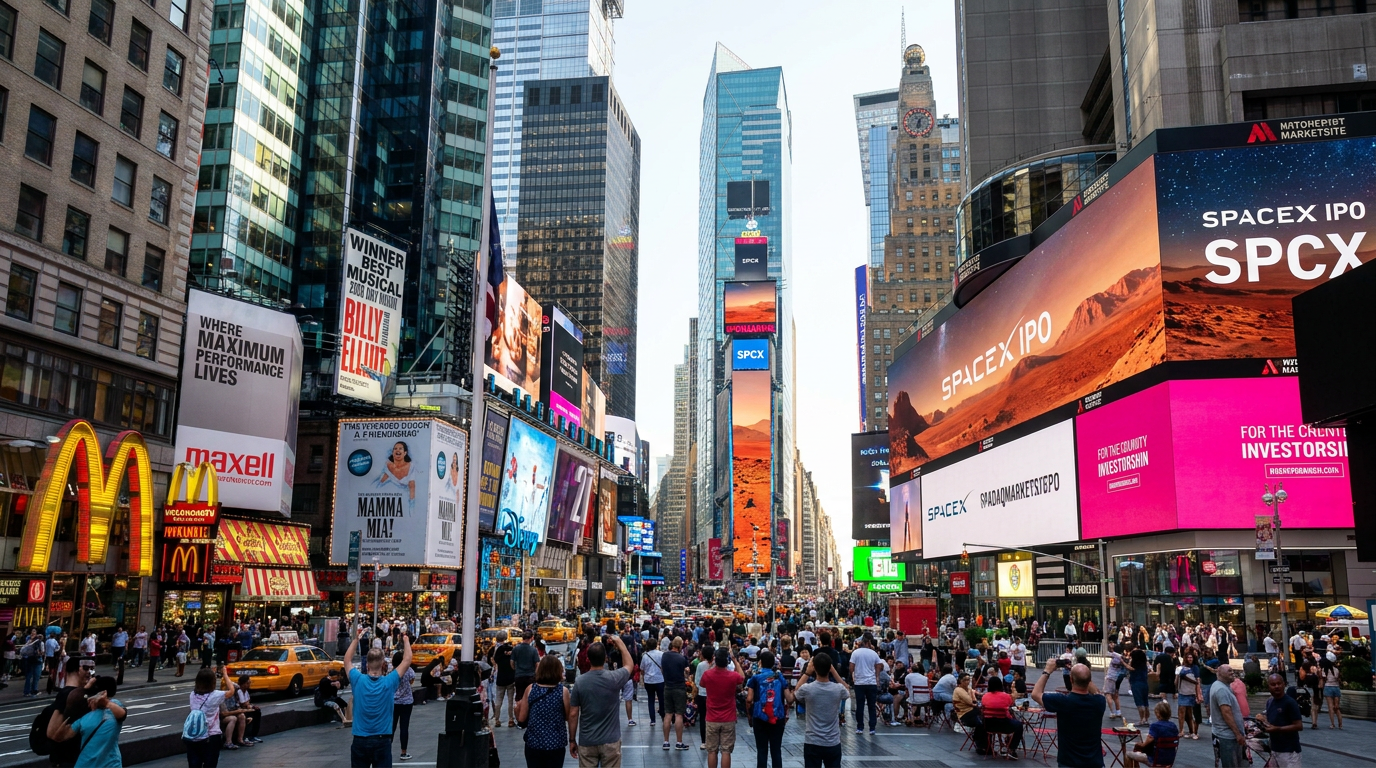
- Retail & Momentum Investors
- Viewing the IPO as a generational wealth-building opportunity and betting heavily on future upside.
- Institutional Risk Managers
- Navigating the unprecedented market mechanics of a massive valuation combined with a tiny public float.
- Passive Index Funds
- Grappling with the forced portfolio rebalancing required to absorb a $2 trillion company overnight.
- Market Infrastructure Providers
- Managing the unprecedented volume and logistical challenges of the largest listing in history.
What's not represented
- · Early SpaceX Employees
- · Competitors in Aerospace
Why this matters
The sheer scale of SpaceX's public debut is forcing a rewiring of global capital markets, impacting everything from retail brokerage platforms to the passive index funds that hold everyday retirement accounts.
Key points
- SpaceX raised a record-breaking $85.7 billion in its initial public offering, valuing the company at over $1.77 trillion.
- The stock surged nearly 50% in its first few trading sessions, pushing its market capitalization past the $2 trillion mark.
- Options trading debuted with 1.8 million contracts changing hands on day one, obliterating the previous record set by Meta in 2012.
- The massive valuation officially made CEO Elon Musk the world's first trillionaire, with an estimated net worth of $1.3 trillion.
- Passive index funds are facing unprecedented rebalancing challenges as Nasdaq fast-tracks the stock while the S&P 500 delays inclusion.
SpaceX's arrival on the public markets has rewritten the record books of modern finance. After executing the largest initial public offering in global history on Friday, the aerospace and artificial intelligence conglomerate followed up on Tuesday by shattering the record for the busiest options trading debut ever recorded for a newly listed company.[1]
The sheer scale of the capital raise eclipsed all previous benchmarks. Following the formal execution of the underwriters' overallotment—or "greenshoe"—option, the final capital raised reached $85.7 billion. This figure easily surpassed the previous global record held by Saudi Aramco's 2019 listing.[2][4]
Priced initially at $135 per share, the offering valued SpaceX at $1.77 trillion before a single share traded publicly. By the close of its second trading session, relentless demand had pushed the stock up 49.5% to $201.80, catapulting the company's market capitalization well past the $2 trillion threshold and placing it among the five most valuable corporate entities globally.[4][5]

The momentum carried directly into the derivatives market. When options contracts tied to the SPCX ticker officially launched on Tuesday, investors traded approximately 1.8 million contracts. This volume obliterated the previous record for a newly listed company—roughly 364,000 contracts set by Meta Platforms during its 2012 debut.[1][4]
In dollar terms, analysts estimate that roughly $2.8 billion worth of options premium changed hands during the inaugural session. The activity was so intense that early trading saw approximately 10,000 contracts executed per minute, according to derivatives market intelligence from Cboe Global Markets.[4][5]

Retail investors, who received an unprecedented 30% allocation of the IPO, drove much of the speculative frenzy. The put-call ratio for SpaceX stood at a heavily bullish 0.7, meaning trading volume in puts—bets on a price decline—was 30% lower than activity in calls, which are bets on a price increase.[5][6]
The most actively traded contracts were call options tied to aggressive upside targets. Contracts with strike prices of $220, $300, and even $380 saw massive volume. One conspicuously large bullish bet involved a single trader purchasing 7,000 call options with a $325 strike price expiring in July, a position that requires the stock to surge another 50% just to wind up in the money.[4][5]
The most actively traded contracts were call options tied to aggressive upside targets.
However, derivatives experts note that not all of this volume represents pure speculation. Given the massive institutional interest and the stock's low initial float, many of these contracts are likely being utilized for complex risk management. With only about 4% of total SpaceX shares currently available for public trading, the scarcity of the underlying stock has magnified price movements and forced institutions to use options to hedge their exposure.[5][6]
Pricing these options presented a unique challenge for market makers. A newly listed options chain on a stock with no pricing history is structurally untethered from the usual anchors of earnings patterns or historical volatility. On day one, the implied volatility for near-term SpaceX options opened at an extreme 169%, reflecting the market's uncertainty about how wildly the low-float stock might swing.[7]

The smooth execution of the listing itself was a massive logistical feat. The transaction bypassed traditional IPO mechanics in favor of a fixed-price model, a structure championed by CEO Elon Musk to streamline the process for a massive, internationally dispersed investor pool.[3]
The market debut demonstrated the structural depth of the exchange infrastructure, processing unprecedented share volume without operational interruptions. On the first day alone, trading volume surpassed 500 million shares, yet price stability remained fluid enough to avoid triggering any volatility pauses.[3]
The macroeconomic ripple effects of the listing are already forcing a rewiring of passive investment vehicles. Both Nasdaq and FTSE Russell rewrote their eligibility rules to fast-track SpaceX into their major indices. This inclusion forces passive index funds tracking the Nasdaq-100 and Russell 1000 to sell billions of dollars of other technology giants simply to make room for the new heavyweight.[6]
Notably, S&P Dow Jones Indices rejected a proposal to fast-track the megacap IPO into the S&P 500, maintaining its strict 12-month seasoning and GAAP profitability requirements. As a result, funds tracking the S&P 500 will sit on the sidelines until at least mid-2027, creating a stark divergence in performance between competing index products.[6]

The broader financial ecosystem is also rushing to capitalize on the momentum. A bevy of leveraged and actively managed space-themed exchange-traded funds made their debut alongside the IPO, experiencing a massive influx of cash as investors sought alternative ways to gain exposure to the aerospace sector.[5][6]
The historic valuation has also triggered a massive wealth effect. The trading debut swelled Elon Musk's personal stake in the company, increasing his net worth by an estimated $165 billion in a single day. This surge officially made Musk the world's first trillionaire, with a fortune estimated at $1.3 trillion—putting him roughly $1 trillion ahead of his closest peers.[2]
As the initial euphoria settles, Wall Street is already looking toward the company's next milestones. Analysts note that the true test of SpaceX's $2 trillion valuation will come in December, when early investors, employees, and executives are freed from their lock-up agreements and can begin selling their shares on the open market. Until then, the combination of a tiny float, massive retail enthusiasm, and forced index buying suggests the stock's historic volatility is just beginning.
How we got here
May 2026
SpaceX publicly discloses its IPO paperwork, targeting a $75 billion raise at $135 per share.
June 4, 2026
S&P Dow Jones Indices rejects a proposal to fast-track SpaceX into the S&P 500, citing profitability rules.
June 12, 2026
SpaceX makes its public debut on the Nasdaq, raising an initial $75 billion.
June 15, 2026
Underwriters exercise the greenshoe option, pushing the total raise to a record $85.7 billion as the stock surges.
June 16, 2026
Options trading begins, shattering records with 1.8 million contracts traded on the first day.
Viewpoints in depth
Retail & Momentum Investors
Viewing the IPO as a generational wealth-building opportunity and betting heavily on future upside.
For the retail crowd—who secured an unprecedented 30% of the IPO allocation—SpaceX represents the ultimate moonshot. Unfazed by traditional valuation metrics or the company's lack of GAAP profitability, these investors are aggressively buying out-of-the-money call options. They view the company's multiplanetary ambitions and its integration of artificial intelligence as a paradigm shift that justifies a multi-trillion-dollar premium, driving the massive early volume in $300 and $380 strike calls.
Institutional Risk Managers
Navigating the unprecedented market mechanics of a massive valuation combined with a tiny public float.
Institutional desks are approaching the SPCX phenomenon with a focus on structural mechanics rather than pure directional bets. Because only about 4% of the company's shares are freely trading, the stock is highly susceptible to violent price swings. Market makers and hedge funds are utilizing the record-breaking options market not just to speculate, but to execute complex multi-leg hedging strategies, managing the extreme 169% implied volatility that comes with a newly listed, low-float megacap.
Passive Index Funds
Grappling with the forced portfolio rebalancing required to absorb a $2 trillion company overnight.
The index tracking industry is sharply divided by the listing. Managers tracking the Nasdaq-100 and Russell indices are forced buyers, required to liquidate billions of dollars in other technology holdings to purchase SpaceX shares at whatever price the market dictates. Conversely, S&P 500 trackers are structurally locked out until 2027 due to strict profitability rules, creating anxiety that their funds will severely underperform benchmark competitors during the stock's initial growth phase.
What we don't know
- How the stock will react in December when early investors and employees are released from their lock-up agreements and can sell shares.
- Whether the extreme implied volatility in the options market will stabilize as the stock establishes a longer trading history.
- How the massive influx of $85.7 billion in fresh capital will alter SpaceX's timeline for its Mars ambitions and AI integration.
Key terms
- Initial Public Offering (IPO)
- The process by which a private company offers shares to the public for the first time to raise capital.
- Options Contract
- A financial derivative that gives an investor the right, but not the obligation, to buy (call) or sell (put) a stock at a specific price before a certain date.
- Greenshoe Option
- A provision that allows underwriters to sell more shares than originally planned if investor demand exceeds expectations.
- Free Float
- The portion of a company's shares that are in the hands of public investors and available to trade, excluding locked-in shares held by insiders.
- Implied Volatility
- A metric that captures the market's forecast of a likely movement in a security's price, heavily influencing the cost of options.
- Put-Call Ratio
- An indicator of market sentiment calculated by dividing the volume of put options (bearish bets) by call options (bullish bets).
Frequently asked
How much did SpaceX raise in its IPO?
SpaceX raised a total of $85.7 billion after underwriters exercised their option to sell additional shares, making it the largest IPO in global history.
Why did the options market break records?
Investors traded 1.8 million options contracts on the first day, driven by massive retail demand for bullish call options and institutional needs to hedge against the stock's low availability.
Is SpaceX in the S&P 500?
Not yet. While Nasdaq and Russell fast-tracked the company into their indices, the S&P 500 requires 12 months of trading history and GAAP profitability, delaying inclusion until at least 2027.
How did the IPO impact Elon Musk's wealth?
The massive valuation and subsequent stock surge pushed Elon Musk's net worth to an estimated $1.3 trillion, making him the world's first trillionaire.
Sources
Source coverage
7 outlets
4 viewpoints surfaced







[1]MarketWatchRetail & Momentum Investors
Investors pile into moonshot SpaceX bets as first-day options trading shatters records
Read on MarketWatch →[2]ForbesRetail & Momentum Investors
SpaceX Says Historic IPO Raised More Than $85 Billion
Read on Forbes →[3]NasdaqMarket Infrastructure Providers
SpaceX Makes History, Raising $85.7 Billion through Nasdaq Listing
Read on Nasdaq →[4]Fortune IndiaRetail & Momentum Investors
SpaceX options shatter trading records on debut
Read on Fortune India →[5]MorningstarInstitutional Risk Managers
Trading volume in SpaceX options shattered records when they made their debut on Tuesday
Read on Morningstar →[6]SpotGamma ResearchPassive Index Funds
SPCX Options Begin Trading June 16 — and the Gamma Story Starts
Read on SpotGamma Research →[7]SaxoInstitutional Risk Managers
Trading the SPCX options chain
Read on Saxo →

More in finance
See all 9 stories →Credit Building
How Young Adults Can Build a Credit Score From Scratch
6 sources

Stablecoin Adoption
Stablecoins and Tokenized Assets Graduate to Core Global Financial Infrastructure
7 sources

Wealth Transfer
The Great Wealth Transfer: How to Shield Inherited IRAs from the 10-Year Tax Trap
8 sources

Adviser Standards
The Fiduciary Difference: How a One-Page Pledge Could Save Your Retirement
5 sources

Every angle. Every day.
Get finance stories with full source coverage and perspective breakdowns delivered to your inbox.