
How Hall Effect Sensors Finally Solved Controller Stick Drift
After years of replacing gamepads due to mechanical failure, the gaming industry is adopting frictionless magnetic joysticks that permanently eliminate stick drift.
By Factlen Editorial Team
- Hardware Repair Advocates
- Focusing on the environmental and consumer rights benefits of durable hardware.
- Competitive Gamers
- Prioritizing raw input precision and zero-deadzone performance.
- Peripheral Manufacturers
- Balancing premium features with cost and tactile feel.
- Industry Analysts
- Tracking the market shift from first-party dominance to third-party innovation.
What's not represented
- · First-party console manufacturers (Sony, Microsoft, Nintendo)
Why this matters
Stick drift has forced gamers to spend hundreds of dollars replacing otherwise functional controllers. The widespread adoption of Hall Effect technology not only saves consumers money but significantly reduces global e-waste by bulletproofing the hardware's most vulnerable component.
Key points
- Traditional gaming controllers use mechanical potentiometers, which inevitably wear down from friction and cause stick drift.
- Hall Effect joysticks use magnets and electrical fields to track movement without any physical contact, eliminating friction-based wear.
- While the technology existed in the 1999 Sega Dreamcast, it was abandoned for cheaper components until a recent third-party hardware renaissance.
- In 2026, Hall Effect technology has trickled down to budget controllers, forcing the industry to elevate hardware standards.
- New engineering solutions, like adjustable tension rings, have solved the 'loose' feeling that early frictionless sticks suffered from.
It is a uniquely modern frustration: you are holding a perfect angle in a competitive shooter, your thumbs are perfectly still, and yet your character inexplicably begins to creep to the left. You have not moved the joystick, but the controller is sending a signal anyway. This is "stick drift," the silent killer of gaming hardware that has ruined countless matches and sent millions of otherwise perfectly functional gamepads to the landfill. For years, gamers have treated this degradation as an inevitable tax on their hobby, replacing expensive controllers every twelve to eighteen months.[1]
But in 2026, the era of the disposable controller is rapidly coming to a close. A wave of hardware manufacturers has resurrected a decades-old technology to solve the problem permanently. The solution is the Hall Effect sensor—a magnetic mechanism that eliminates the physical friction responsible for hardware failure. By replacing mechanical scraping with magnetic fields, the industry is finally offering a permanent cure to gaming's most persistent hardware disease.[1]
To understand why Hall Effect joysticks are revolutionary, one must first understand why traditional controllers fail. For the past two console generations, the vast majority of first-party controllers—including the PlayStation DualSense, Xbox Wireless Controller, and Nintendo Switch Joy-Cons—have relied on a standardized component known as a potentiometer.[2][3]
A potentiometer is a mechanical sensor that measures the physical position of the joystick. Inside the module, a tiny metal wiper is attached to the stick's axis. As you move your thumb, this metal wiper physically scrapes back and forth across a resistive carbon track. The controller measures the electrical resistance along that track to determine exactly how far, and in what direction, the stick has been pushed.[2][4]

The fatal flaw of the potentiometer is basic physics: friction. Every time the metal wiper drags across the carbon track, it shaves off microscopic amounts of material. Over months of heavy use, the track physically wears down, and carbon dust builds up inside the housing. Eventually, the sensor can no longer accurately read the stick's true center, resulting in phantom inputs and the dreaded stick drift. It is not a manufacturing defect; it is a mechanical inevitability.[2][3]
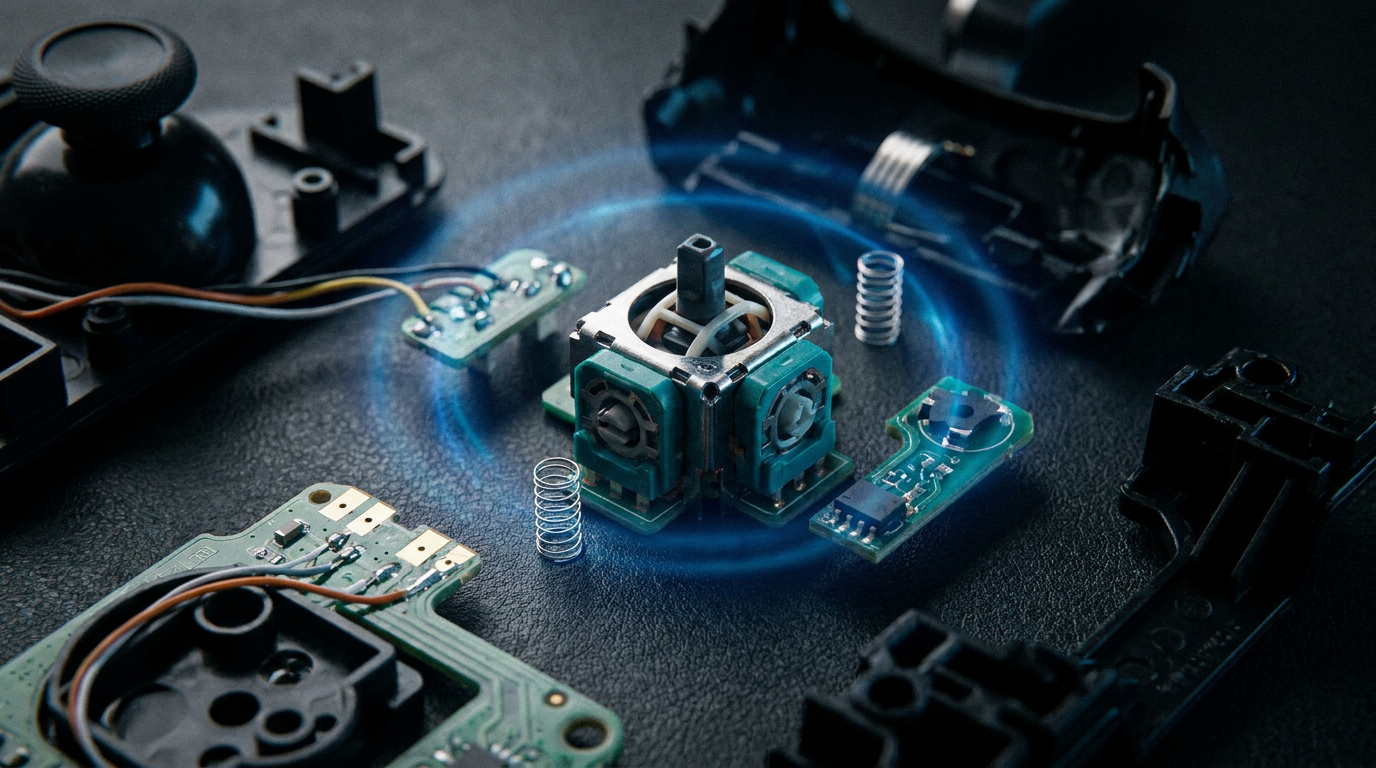
Hall Effect joysticks bypass this mechanical failure point entirely by utilizing a principle of physics discovered by Edwin Hall in 1879. The Hall Effect describes how a magnetic field can induce a measurable voltage in an electrical conductor. In the context of a modern gaming controller, this principle is used to track movement without any physical contact between the moving parts.[1][4]
Inside a Hall Effect joystick module, a small, permanent magnet is mounted directly to the base of the joystick shaft. Positioned just below this magnet, on the controller's circuit board, sits a stationary Hall Effect sensor. As the player tilts the joystick, the magnet shifts its position relative to the sensor, altering the strength and angle of the magnetic field.[3][4]
The sensor detects these microscopic changes in the magnetic field and converts them into precise voltage signals, which the controller's firmware translates into X and Y coordinates. Because the magnet and the sensor never physically touch, there is zero friction. Without friction, there is no physical wear, no carbon dust, and no mechanical degradation. A traditional potentiometer might survive two to three million cycles before failing; a Hall Effect sensor is rated for upwards of five million cycles, effectively lasting the lifetime of the device.[3][6]

Because the magnet and the sensor never physically touch, there is zero friction.
Ironically, this "next-generation" solution is actually retro technology. The Sega Dreamcast controller famously utilized Hall Effect sensors back in 1999, and Sony incorporated similar magnetic sticks into the PlayStation 3's DualShock 3. However, as the industry standardized its supply chains to cut costs, manufacturers reverted to cheaper, mass-produced potentiometers for the PS4 and Xbox One eras, trading long-term durability for short-term margins.[2]
The landscape has shifted dramatically in 2026. Hall Effect technology is no longer restricted to niche, premium gamepads. Driven by consumer frustration and intense competition from third-party manufacturers, magnetic sensors have trickled down to the budget tier. Today, players can purchase drift-proof, competitive-grade controllers for under $50, forcing the entire industry to elevate its hardware standards.[5][7]
Brands like GameSir, 8BitDo, and Flydigi have aggressively captured market share by making Hall Effect sticks their baseline offering. Controllers like the GameSir T4 Kaleid and the 8BitDo Ultimate provide 1000Hz polling rates and magnetic sensors at a fraction of the cost of first-party alternatives. This democratization of premium hardware means that gamers no longer have to pay a premium simply to guarantee their equipment will function properly a year from now.[5][7]

However, the transition to frictionless sensors has introduced a unique engineering challenge: the "loose" feeling. Because traditional potentiometers rely on physical contact, that friction provides a natural, subtle resistance that many gamers have grown accustomed to. Without that friction, early Hall Effect sticks felt overly light or slippery, making micro-adjustments difficult for players used to the stiffer tension of an Xbox controller.[5]
Hardware engineers have quickly adapted to solve this tactile discrepancy. The latest flagship controllers, such as the Flydigi Vader 4 Pro, feature adjustable tension rings built directly into the joystick housing. By physically twisting a dial around the base of the stick, players can manually tighten or loosen the mechanical spring resistance, perfectly simulating the heavy tension of a classic controller while maintaining the frictionless durability of the magnetic sensor.[5][7]
For players unwilling to abandon their official first-party controllers, a robust repair ecosystem has emerged. Independent repair shops and DIY advocates now offer Hall Effect upgrade kits for standard PS5 and Xbox gamepads. The process is highly technical—requiring the desoldering of 14 microscopic pins to remove the old potentiometer and the precise installation and software calibration of the new magnetic module—but it effectively bulletproofs the controller's most vulnerable component.[2][4]

Beyond the immediate benefit to the consumer's wallet, the widespread adoption of Hall Effect technology represents a massive win for environmental sustainability. Gaming peripherals are a significant contributor to global e-waste. Millions of complex, battery-powered devices are discarded annually simply because a ten-cent carbon track wore out. By eliminating the primary point of failure, magnetic sensors keep controllers in players' hands and out of landfills.[2]
The competitive advantages are equally profound. Because Hall Effect sensors do not degrade, players can safely reduce their software "deadzones"—the programmed area in the center of the stick that ignores small inputs to mask drift—down to zero. This allows for raw, instantaneous input translation, giving competitive players a level of precision and responsiveness that remains perfectly consistent from the first match to the thousandth.[6][7]
As the industry looks forward, even newer technologies like TMR (Tunnel Magnetoresistance) are beginning to surface, promising even higher resolution tracking and lower power consumption than standard Hall sensors. Yet, the core philosophy remains the same: the removal of physical friction from the input equation.[1]
The normalization of Hall Effect joysticks in 2026 marks a rare, definitive victory for the consumer. It is a testament to how vocal community pushback and competitive third-party engineering can force an industry to abandon planned obsolescence. For the first time in over a decade, gamers can finally purchase a controller with the confidence that their aim will remain true, long after the warranty expires.[1]
How we got here
1999
Sega releases the Dreamcast, featuring a controller with early Hall Effect magnetic sensors.
2006
Sony incorporates magnetic sensors into the PlayStation 3's DualShock 3 controller.
2013
The industry largely reverts to cheaper, mass-produced potentiometers for the PS4 and Xbox One generation.
2023-2025
Third-party manufacturers begin aggressively marketing Hall Effect sticks to combat widespread stick drift complaints.
2026
Hall Effect technology becomes the baseline standard for both premium and budget third-party controllers.
Viewpoints in depth
Hardware Repair Advocates
Focusing on the environmental and consumer rights benefits of durable hardware.
Repair communities and right-to-repair advocates view Hall Effect sensors as a critical victory against planned obsolescence. By replacing the single most common point of failure in modern gaming peripherals, magnetic sensors drastically reduce the amount of e-waste generated by discarded controllers. These groups argue that first-party manufacturers have a responsibility to adopt frictionless technology to protect both consumers' wallets and the environment.
Competitive Gamers
Prioritizing raw input precision and zero-deadzone performance.
For the competitive esports community, the appeal of Hall Effect technology goes beyond mere longevity. Because magnetic sensors do not degrade, players can lower their software deadzones to absolute zero without fear of phantom inputs. This allows for raw, unfiltered translation of thumb movement into the game, providing a consistent mechanical baseline that traditional potentiometers simply cannot maintain over a competitive season.
Peripheral Manufacturers
Balancing premium features with cost and tactile feel.
Third-party hardware manufacturers have seized upon Hall Effect technology as a primary differentiator to compete with Sony and Microsoft. However, they acknowledge the engineering challenges involved. Because magnetic sticks lack the natural friction of potentiometers, manufacturers have had to innovate with adjustable tension rings and custom springs to recreate the 'heavy' feel that many traditional console gamers prefer.
What we don't know
- Whether first-party manufacturers like Sony, Microsoft, and Nintendo will fully transition to Hall Effect sensors for their next-generation base controllers.
- How the emerging TMR (Tunnel Magnetoresistance) technology will impact the pricing and adoption of standard Hall Effect sensors.
- The long-term durability of the mechanical centering springs used in Hall Effect modules, which remain the only physical point of stress.
Key terms
- Potentiometer
- A mechanical sensor that measures position using a physical wiper scraping across a resistive carbon track.
- Hall Effect
- A physical phenomenon where a magnetic field induces a voltage in a conductor, used to measure position without physical contact.
- Stick Drift
- A hardware failure where a controller registers movement even when the joystick is untouched, usually caused by internal wear.
- Deadzone
- A software setting that ignores small joystick movements to compensate for minor stick drift or loose centering.
- Polling Rate
- How often a controller reports its inputs to the console or PC, measured in Hertz (Hz).
Frequently asked
What exactly causes stick drift?
Stick drift is caused by physical friction. Inside traditional controllers, a metal wiper scrapes against a carbon track to measure movement, eventually wearing down the track and creating false inputs.
Do Hall Effect controllers ever drift?
Because they use magnets instead of physical contact, they are immune to friction-based wear. While extreme magnetic interference or physical spring failure could theoretically cause issues, they effectively eliminate standard drift.
Can I upgrade my current PS5 or Xbox controller?
Yes, but it requires advanced microsoldering. You must desolder the 14 pins holding the original potentiometer module and solder in a new Hall Effect replacement, followed by software calibration.
Why didn't Sony and Microsoft use Hall Effect originally?
Potentiometers were cheaper to mass-produce, standardized across the global supply chain, and provided a familiar physical tension that early magnetic sticks lacked.
Sources
Source coverage
7 outlets
4 viewpoints surfaced







[1]Factlen Editorial TeamIndustry Analysts
Synthesis by Factlen editorial team
Read on Factlen Editorial Team →[2]Controller RepairsHardware Repair Advocates
Potentiometer vs. Hall Effect: The Permanent Solution to Stick Drift
Read on Controller Repairs →[3]Turtle BeachPeripheral Manufacturers
Do Hall Effect Controllers Eliminate Stick Drift?
Read on Turtle Beach →[4]ELO EsportsHardware Repair Advocates
How Hall Effect Joysticks Work
Read on ELO Esports →[5]Gamepad TesterCompetitive Gamers
Best Hall Effect Controllers (Drift Proof) in 2026
Read on Gamepad Tester →[6]LenovoPeripheral Manufacturers
Gaming Controller with Hall Effect Joystick: A Comprehensive Guide
Read on Lenovo →[7]AdellionIndustry Analysts
Best Gaming Controllers 2026: Xbox, PlayStation, and Pro Picks Tested
Read on Adellion →
Every angle. Every day.
Get gaming esports stories with full source coverage and perspective breakdowns delivered to your inbox.