
Electric Vehicles vs. Plug-in Hybrids: Which Is Right for You in 2026?
As battery ranges expand and charging networks mature, the choice between a pure electric vehicle and a plug-in hybrid depends entirely on your daily driving habits. We break down the costs, maintenance, and trade-offs of both technologies to help you decide.
By Factlen Editorial Team
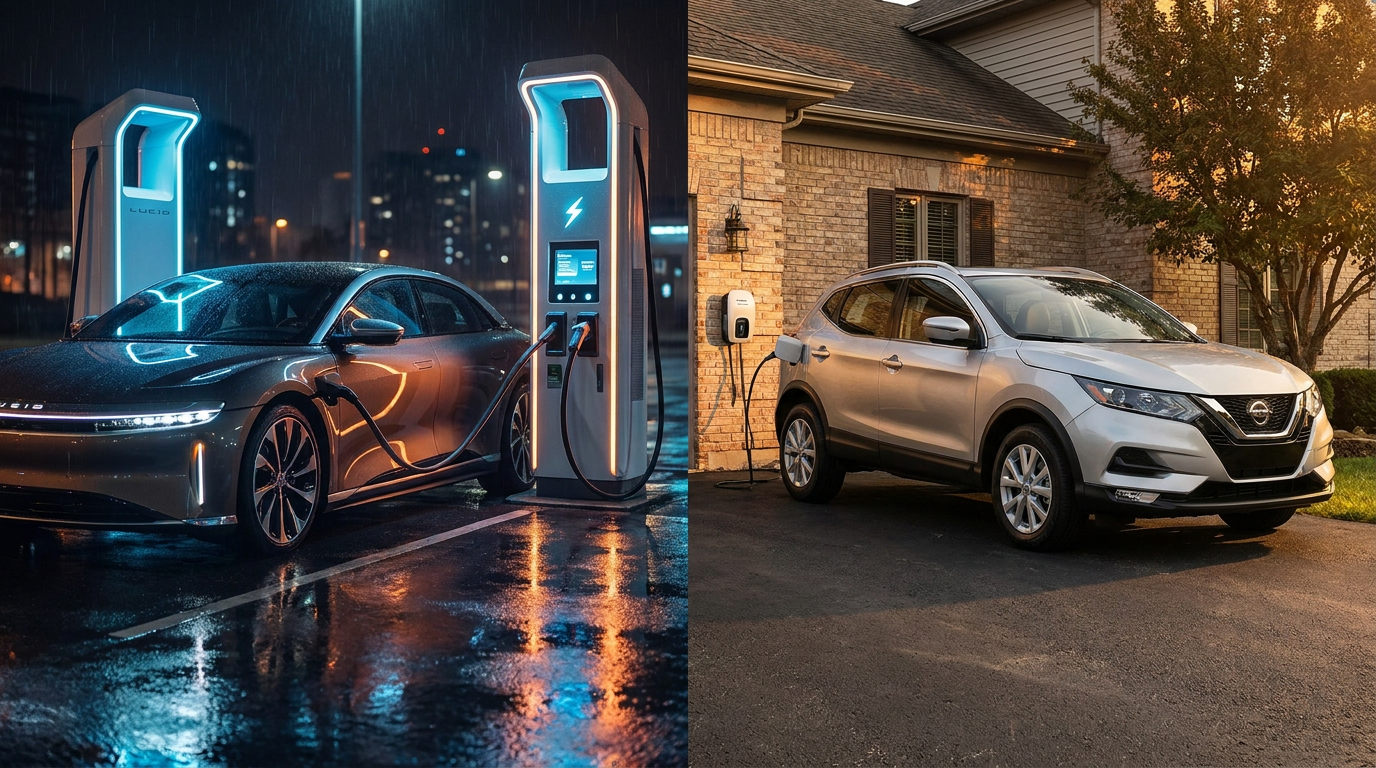
- Pure EV Advocates
- Argue that pure electric vehicles are the only long-term solution and offer superior financial savings.
- PHEV Proponents
- View plug-in hybrids as the ultimate pragmatic bridge, offering zero-emission daily driving without infrastructure anxiety.
- Infrastructure Analysts
- Focus on the physical realities of the charging network and the necessity of home charging access.
What's not represented
- · Used car dealership owners
- · Independent auto mechanics
Why this matters
Choosing the wrong electrified vehicle can saddle you with unnecessary maintenance costs or frustrating charging logistics. Understanding the precise trade-offs between pure EVs and plug-in hybrids ensures you invest in a car that actually fits your lifestyle and budget.
Key points
- Pure EVs offer the lowest operating and maintenance costs due to a mechanically simple drivetrain.
- Modern 2026 PHEVs can travel over 50 miles on electricity alone, covering most daily commutes.
- PHEVs eliminate range anxiety for long trips but require maintaining both a gas engine and an electric motor.
- Access to reliable home charging is the single most important factor when choosing either technology.
- Public fast-charging networks have expanded massively, making pure EVs viable for cross-country travel.
The transition to electrified driving has moved past the early-adopter phase. In 2026, the question for most car buyers is no longer whether to abandon the traditional internal combustion engine, but rather how far to take the leap. The choice generally narrows down to two distinct paths: the pure Battery Electric Vehicle (EV) and the Plug-in Hybrid Electric Vehicle (PHEV). Both technologies have matured significantly over the past few years, offering compelling alternatives to gasoline. Yet, they serve entirely different lifestyles, driving habits, and risk tolerances. Deciding between them requires looking past the marketing gloss and examining the hard numbers of daily ownership.[1]
To understand the trade-offs, it helps to define the core mechanics. A pure EV operates entirely on battery power. It has no gas tank, no tailpipe, and a remarkably simple drivetrain consisting of roughly twenty moving parts. You plug it in, charge the battery, and drive until it depletes. A PHEV, by contrast, is a mechanical bridge between two eras. It houses both a battery-powered electric motor and a traditional gasoline engine. The battery is smaller than an EV's but large enough to handle short daily commutes purely on electricity. Once that battery is drained, the gasoline engine seamlessly takes over, eliminating any fear of being stranded.[1][7]
The most dramatic shift in the 2026 landscape is the sheer capability of modern batteries. Pure EVs are now routinely clearing the 400-mile benchmark on a single charge, with some premium models pushing even further. For the vast majority of drivers, this covers a week of typical commuting without ever needing to plug in. Meanwhile, PHEVs have quietly undergone their own range revolution. Just a few years ago, a plug-in hybrid might offer a meager 15 miles of electric range. Today, vehicles like the 2026 Mercedes-Benz GLC 350e 4MATIC deliver an EPA-rated 54 miles of electric-only driving, while the 2026 Toyota RAV4 Plug-in Hybrid offers up to 52 miles.[4][5]

This expanded PHEV range fundamentally changes the value proposition. If your daily commute is under 50 miles and you plug the car in every night, you can theoretically drive a PHEV for months without burning a single drop of gasoline. It functions as an electric vehicle for the daily grind, while retaining the gasoline engine as a safety net for spontaneous weekend road trips or cross-country travel. For one-car households that frequently venture into rural areas where charging infrastructure remains sparse, the PHEV offers a compelling 'best of both worlds' scenario.[1][8]
However, that dual nature comes with a significant hidden cost: mechanical complexity. A PHEV is arguably the most complex vehicle on the road today. Because it carries both an electric powertrain and a combustion engine, owners are still on the hook for traditional maintenance. You still need oil changes, spark plug replacements, transmission servicing, and exhaust system checks, all while managing a high-voltage battery system. In contrast, the pure EV wins the maintenance battle decisively. With no oil to change and regenerative braking that drastically extends the life of brake pads, EVs cost significantly less to keep on the road over a five-year period.[7][8]
When it comes to daily operating costs, the pure EV also holds a commanding lead. According to recent data, charging an EV at home during off-peak hours is roughly 70 percent cheaper than fueling a comparable gas car. The American Automobile Association notes that the operating costs per mile for a medium-sized SUV are twice as high for a traditional gas vehicle compared to a pure EV. PHEVs sit somewhere in the middle. If driven primarily on electricity, their costs mirror an EV. But if an owner neglects to plug it in—a surprisingly common phenomenon—they are essentially driving a heavy gasoline car, which drastically reduces fuel efficiency.[3][8]

When it comes to daily operating costs, the pure EV also holds a commanding lead.
The infrastructure supporting these vehicles has also seen a massive transformation. In 2025 and early 2026, thousands of new fast-charging ports came online across North America and Europe, supported by both private investment and public funding. The International Energy Agency projects that public charging capacity will rise to nearly 30 gigawatts by 2035. For pure EV drivers, this means that 'range anxiety' is rapidly becoming a relic of the past along major travel corridors and in metropolitan areas. The network is broader, more reliable, and increasingly visible.[2][6]
Yet, infrastructure growth remains uneven. While urban centers and interstate highways are well-covered, rural gaps persist. Drivers navigating remote stretches of the American Midwest or the Australian Outback still face logistical hurdles that require deliberate route planning. This is where the PHEV's gasoline engine proves its worth. It allows drivers to bypass the charging network entirely when venturing off the beaten path, offering a level of spontaneity that pure EVs cannot yet match in every geography.[6]
Access to home charging is the ultimate deciding factor for both vehicle types. Industry analysts stress that home charging—whether in a driveway, garage, or dedicated apartment space—remains the preferred and most affordable way to power an electric vehicle. For an EV, home charging is highly convenient but not strictly mandatory if you live near a reliable fast-charger. For a PHEV, however, home charging is absolutely essential. Without the ability to plug in overnight, a PHEV loses its primary advantage, becoming nothing more than an overpriced, overweight gasoline hybrid.[2][8]

Environmental regulations are also beginning to tip the scales. Many global cities are implementing Zero-Emission Zones to combat urban pollution. While pure EVs are granted free access to these areas, PHEVs are increasingly facing restrictions or entry fees if they are operating on their gasoline engines. This regulatory shift is already impacting the secondary market. In 2026, pure EVs from reputable brands are holding their resale value remarkably well, as buyers look to future-proof their investments against tightening environmental laws.[8]
The case for the pure EV is built on simplicity, long-term savings, and environmental purity. The evidence is clear: with only a fraction of the moving parts of a combustion engine, maintenance costs plummet, and electricity remains significantly cheaper than gasoline. However, the case against the EV centers on the occasional inconvenience of public charging during long trips and the higher initial purchase price. A pure EV fits perfectly when you have reliable home charging, predictable daily commutes, and a desire to eliminate tailpipe emissions entirely. It does not fit well when you frequently tow heavy loads over long distances or live in an apartment with zero access to overnight charging.[1][3][8]
Conversely, the case for the PHEV is built on flexibility and transition. The evidence supporting PHEVs highlights their ability to cover 90 percent of daily driving on electricity while retaining a gas engine that completely eliminates range anxiety. The case against the PHEV focuses on its mechanical complexity; you are essentially maintaining two separate powertrains, which keeps servicing costs high. A PHEV fits perfectly when you are a one-car household that needs an efficient daily commuter but also takes frequent, spontaneous road trips into rural areas. It does not fit well when you lack a dedicated place to plug in at home, as driving a PHEV solely on gasoline defeats the purpose of the technology.[1][7]

Ultimately, the 2026 landscape offers no single winner without conditions. Both technologies have matured to the point where the hardware is exceptionally reliable, leaving the decision entirely up to your personal infrastructure and driving habits. Quantifying your daily mileage, assessing your home charging capabilities, and being honest about your road-trip frequency will reveal which electrified path makes the most financial and practical sense for your driveway.[1]
How we got here
2012
Early plug-in hybrids enter the market, offering limited electric ranges of 10 to 15 miles.
2020
Pure EVs begin to cross the 300-mile range threshold, making them viable for a broader segment of drivers.
2024
Major automakers adopt standardized charging ports, significantly expanding access to fast-charging networks.
2026
Next-generation PHEVs hit the market with electric-only ranges exceeding 50 miles, covering almost all daily commutes.
Viewpoints in depth
Pure EV Advocates
Argue that pure electric vehicles are the only long-term solution and offer superior financial savings.
This camp emphasizes the sheer mechanical simplicity of pure electric vehicles. By eliminating the internal combustion engine entirely, drivers bypass oil changes, transmission failures, and exhaust system repairs. Advocates point to the rapidly expanding fast-charging network as evidence that range anxiety is an outdated concern. They argue that purchasing a PHEV in 2026 is merely delaying the inevitable, saddling buyers with the maintenance costs of a dying gasoline technology while failing to fully capitalize on the aerodynamic and spatial benefits of a dedicated EV platform.
PHEV Proponents
View plug-in hybrids as the ultimate pragmatic bridge, offering zero-emission daily driving without infrastructure anxiety.
Proponents of plug-in hybrids focus on the reality of human behavior and infrastructure gaps. They note that the vast majority of daily driving falls well under the 50-mile electric range offered by modern PHEVs, meaning owners can achieve EV-level efficiency for their commutes. However, by retaining a gas tank, PHEVs completely eliminate the logistical stress of long-distance travel, particularly in rural areas where fast chargers are scarce or broken. This camp argues that PHEVs are the perfect solution for one-car households that cannot afford to compromise on flexibility.
Infrastructure Analysts
Focus on the physical realities of the charging network and the necessity of home charging access.
Analysts looking at the macro picture stress that the EV transition is fundamentally an infrastructure challenge. While public charging capacity is projected to hit 30 gigawatts by 2035, the current rollout remains highly concentrated in urban corridors. This camp highlights a critical dividing line: access to home charging. They argue that without a dedicated driveway or garage charger, the economic and practical benefits of both EVs and PHEVs collapse, making the transition significantly harder for apartment dwellers and urban residents.
What we don't know
- Exactly how quickly rural fast-charging gaps will close in the late 2020s.
- How future battery degradation will affect the long-term resale value of 2026 PHEVs compared to pure EVs.
Key terms
- Battery Electric Vehicle (EV)
- A vehicle powered entirely by an electric battery and motor, with no gasoline engine or tailpipe emissions.
- Plug-in Hybrid Electric Vehicle (PHEV)
- A vehicle that combines a battery-powered electric motor with a traditional gasoline engine, allowing it to run on electricity for short trips and gas for longer ones.
- Regenerative Braking
- A system in electrified vehicles that captures the kinetic energy normally lost during braking and uses it to recharge the battery.
- Level 2 Charger
- A 240-volt home or public charging station that can typically fully recharge an EV overnight or a PHEV in a few hours.
- Range Anxiety
- The fear that an electric vehicle will run out of battery power before reaching a charging station.
Frequently asked
What happens if I never plug in my PHEV?
If you never charge the battery, a PHEV operates like a heavy, less-efficient gasoline hybrid. You lose all the financial and environmental benefits of the electric motor.
Are EVs really cheaper to maintain than PHEVs?
Yes. Pure EVs have roughly twenty moving parts in their drivetrain and require no oil changes or spark plugs. PHEVs have both an electric motor and a gas engine, meaning you must maintain both systems.
Can I take a pure EV on a cross-country road trip?
Absolutely, but it requires planning. Modern EVs offer 400+ miles of range, and fast-charging networks span most major highways, though rural gaps still exist.
Do PHEVs qualify for the same tax credits as pure EVs?
It depends on the battery size and local regulations. In many regions, PHEVs receive smaller incentives than pure EVs, and some zero-emission zones now charge PHEVs a fee if they run on gas.
Sources
Source coverage
8 outlets
3 viewpoints surfaced








[1]Factlen Editorial TeamInfrastructure Analysts
Synthesis by Factlen editorial team
Read on Factlen Editorial Team →[2]International Energy AgencyInfrastructure Analysts
Global EV Outlook 2026: Charging Infrastructure
Read on International Energy Agency →[3]AAAInfrastructure Analysts
Your Driving Costs: Annual Report
Read on AAA →[4]TopSpeedPHEV Proponents
The 2026 Mercedes-Benz GLC 350e 4Matic Is The Benchmark For Electric-Range In PHEVs
Read on TopSpeed →[5]Capital One AutoPHEV Proponents
7 Plug-in Hybrid SUVs for 2026
Read on Capital One Auto →[6]GreenCarsInfrastructure Analysts
EV charging improved in 2026 with more fast-charging ports
Read on GreenCars →[7]ZenithPure EV Advocates
EV vs PHEV: What's the difference?
Read on Zenith →[8]MobileStudio24hPure EV Advocates
EV vs PHEV Which One Better: 2026 Comparison
Read on MobileStudio24h →

Every angle. Every day.
Get guides stories with full source coverage and perspective breakdowns delivered to your inbox.