
Mastering the Maillard Reaction: The Science of Browning in Everyday Cooking
The Maillard reaction is the chemical process responsible for the golden-brown crust on a seared steak and the rich aroma of baked bread. Understanding how to manipulate this reaction can elevate everyday home cooking from guesswork to science.
By Factlen Editorial Team
- Culinary Scientists
- Focus on the molecular mechanisms, pH manipulation, and the precise chemical pathways that generate flavor.
- Home Cooking Educators
- Focus on practical kitchen applications, emphasizing moisture control and temperature management.
- Health & Nutrition Researchers
- Focus on the physiological impacts of Maillard reaction products, balancing antioxidant benefits with potential risks.
What's not represented
- · Industrial Flavor Chemists
- · Commercial Food Manufacturers
Why this matters
Understanding the chemistry behind browning allows home cooks to consistently achieve restaurant-quality flavors and textures without relying on specialized equipment. By controlling heat and moisture, you can unlock the deepest, most savory potential hidden within your everyday ingredients.
Key points
- The Maillard reaction is a chemical process between amino acids and reducing sugars that creates complex flavors and browning.
- The reaction typically requires temperatures between 280°F and 330°F (140°C to 165°C) to occur rapidly.
- Surface moisture prevents the reaction because water boils at 212°F, capping the temperature of the food.
- Unlike caramelization, which only involves sugars, the Maillard reaction requires the presence of proteins.
- Pushing temperatures too high can lead to pyrolysis (burning) and the creation of bitter, potentially harmful compounds.
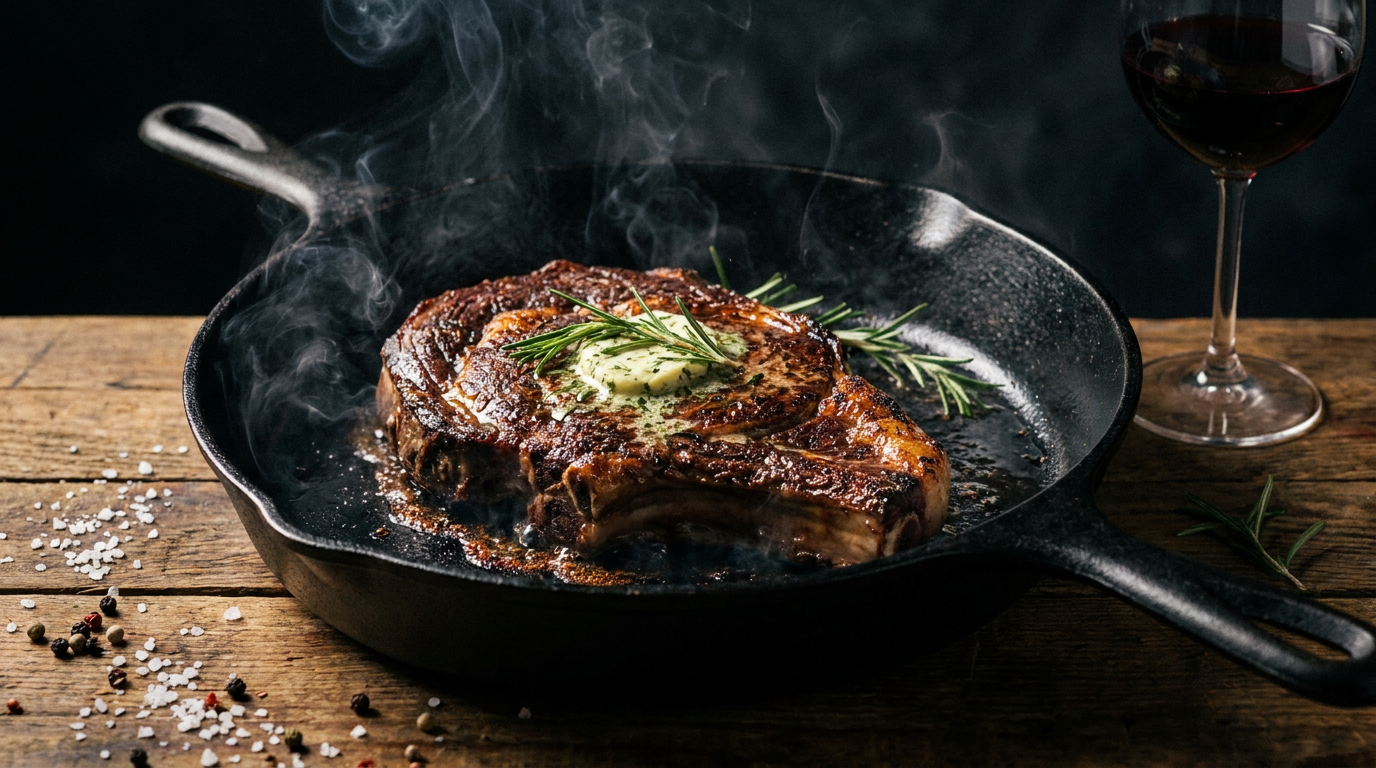
The aroma of a bakery at dawn, the aggressive sizzle of a ribeye hitting a cast-iron skillet, and the deep, roasted notes of a morning espresso all share a single chemical origin. It is the Maillard reaction, a complex cascade of molecular transformations that turns raw, pale ingredients into culinary masterpieces. Often casually referred to as the "browning reaction," this process is the fundamental difference between a boiled sausage and a charred bratwurst, or a soft slice of sandwich bread and a piece of golden toast. For home cooks, understanding the mechanics of this reaction is the closest thing to a culinary superpower, unlocking restaurant-quality depth and complexity in everyday meals.[1][3]
The phenomenon is named after Louis-Camille Maillard, a French chemist who first described the process in 1912. Interestingly, Maillard was not attempting to revolutionize the culinary arts; he was studying biological protein synthesis and cellular metabolism. During his experiments, he observed that heating amino acids and sugars together produced a distinct brown color and a rich, savory aroma. While his initial findings were rooted in pure chemistry, food scientists and chefs eventually realized that Maillard had inadvertently documented the most widely practiced chemical reaction in the world of cooking.[1][6]
At its core, the Maillard reaction is a non-enzymatic browning process that occurs when amino acids—the fundamental building blocks of proteins—collide with reducing sugars, such as glucose or fructose. When subjected to heat, the reactive carbonyl group of the sugar interacts with the nucleophilic amino group of the amino acid. This initial collision forms an unstable intermediate compound known as a glycosylamine. From this single interaction, a sprawling, chaotic family tree of chemical reactions begins to branch out, fundamentally altering the molecular structure of the food.[4][6]
Temperature is the critical catalyst for this molecular dance. While the Maillard reaction can technically occur at room temperature over extended periods—such as the slow darkening of aged balsamic vinegar or soy sauce—it requires significant heat to happen rapidly enough for cooking. The reaction typically kicks into high gear between 280°F and 330°F (140°C to 165°C). At these temperatures, the chemical bonds break and reform at a blistering pace, generating the complex aromas and flavors we associate with roasting, baking, and searing.[4][6]

Because of this temperature threshold, moisture is the ultimate enemy of the Maillard reaction. Water boils and evaporates at 212°F (100°C). As long as there is liquid water on the surface of a piece of meat or a vegetable, the surface temperature cannot exceed that boiling point. The thermal energy from the pan is entirely consumed by the process of turning water into steam, leaving the food steaming rather than searing. This is why culinary educators relentlessly advise home cooks to thoroughly pat their proteins dry with a paper towel before placing them in a hot pan.[3][4]
Once the moisture is banished and the temperature climbs into the optimal zone, the unstable glycosylamine undergoes a structural shift known as the Amadori rearrangement, transforming into a ketosamine. This is where the magic truly begins. The ketosamines break down and recombine into hundreds of distinct, highly volatile flavor molecules. Because different foods contain different ratios of specific amino acids and sugars, the resulting flavor compounds are entirely unique to the ingredient being cooked.[1][2]
The ketosamines break down and recombine into hundreds of distinct, highly volatile flavor molecules.
The specific flavor molecules generated by the Maillard reaction read like a catalog of savory delights. Pyrazines provide the nutty, roasted notes found in coffee and toasted bread. Furans deliver sweet, meaty, and caramel-like aromas, while thiophenes contribute the distinct savory depth of roasted meat. These molecules are incredibly potent, often detectable by the human nose in parts-per-billion concentrations. This is why the Maillard reaction is more accurately described by food scientists as a "flavor reaction" rather than merely a browning one.[1][3]

The visual hallmark of the reaction—the rich, golden-brown crust—arrives in the final stages of the chemical cascade. As the smaller flavor molecules continue to react, they eventually link together to form massive, complex polymer chains called melanoidins. These large molecules reflect light in a way that our eyes perceive as brown. Melanoidins are responsible for the dark crust on a loaf of sourdough, the amber hue of a roasted turkey, and the deep color of a dark roux used in gumbo.[1][6]
A common point of confusion in the kitchen is the distinction between the Maillard reaction and caramelization. While both processes require heat and result in browning, their chemical requirements are fundamentally different. Caramelization is a pyrolytic process—the thermal decomposition of sugars alone, requiring no amino acids or proteins. Furthermore, caramelization generally requires significantly higher temperatures to activate, typically starting around 320°F (160°C) depending on the specific type of sugar. When you sear a steak, you are triggering the Maillard reaction; when you melt sugar for a flan, you are caramelizing.[2][4]
The Maillard reaction is also highly sensitive to the pH level of its environment, accelerating rapidly in alkaline conditions. When the environment is basic, the amino acids are deprotonated, making them more reactive. Bakers and chefs frequently exploit this chemical quirk. Dipping pretzel dough in a lye or baking soda bath before baking ensures a deep mahogany crust, while adding a tiny pinch of baking soda to a pan of onions can cut the time required to brown them by more than half.[3][6]

However, there is a strict upper limit to the benefits of high heat. If the temperature pushes past 355°F (180°C), the Maillard reaction gives way to pyrolysis, commonly known as burning. Pyrolysis destroys the delicate flavor compounds, replacing them with harsh, bitter, and acrid notes. Beyond ruining the taste of the meal, excessive charring can lead to the formation of acrylamide, a chemical compound that health researchers have identified as a probable carcinogen. Mastering the Maillard reaction means walking the fine line between deep browning and destructive burning.[1][5]
The applications of this science extend far beyond the dinner plate. The global beverage and snack industries are entirely dependent on the Maillard reaction. It is the reason raw, green coffee beans are transformed into aromatic dark roasts, why fermented cacao beans develop their signature chocolate notes during roasting, and why malted barley gives stout beers their characteristic roasted profile. Flavor scientists even synthesize Maillard reaction products in laboratories to create artificial savory and meaty flavorings for plant-based foods.[1][4]
Ultimately, cooking is applied chemistry, and the Maillard reaction is its most delicious curriculum. By understanding the science—managing surface moisture, controlling pan temperatures, and occasionally manipulating pH—home cooks can stop relying on guesswork and start cooking with intent. The difference between a mediocre meal and an unforgettable one often comes down to those few crucial minutes in the pan, where amino acids and sugars are allowed to perform their transformative molecular dance.[4][7]
How we got here
1912
French chemist Louis-Camille Maillard first describes the reaction between amino acids and sugars while studying protein synthesis.
1953
Chemist John E. Hodge publishes a definitive paper outlining the complex chemical pathways and mechanisms of the Maillard reaction.
2002
Researchers discover that acrylamide, a potential carcinogen, can form in certain foods when the Maillard reaction is pushed to excessively high temperatures.
Present Day
The Maillard reaction is universally recognized as the foundational chemical process in both industrial food science and modernist culinary techniques.
Viewpoints in depth
Culinary Scientists
Focus on the molecular mechanisms, pH manipulation, and the precise chemical pathways that generate flavor.
For food scientists and modernist chefs, the Maillard reaction is a chemical equation to be optimized. They focus on the Amadori rearrangement and the specific volatile compounds—like pyrazines and furans—that dictate aroma. By manipulating variables such as pH levels with baking soda or utilizing pressure cookers to raise the boiling point of water, culinary scientists can force the Maillard reaction to occur in environments where it traditionally wouldn't, such as in wet soups or stocks.
Home Cooking Educators
Focus on practical kitchen applications, emphasizing moisture control and temperature management.
Culinary instructors and recipe developers view the Maillard reaction through the lens of practical technique. Their primary goal is teaching home cooks how to overcome the physical barriers to browning, primarily surface moisture. They advocate for techniques like dry-brining meat in the refrigerator, thoroughly patting ingredients dry, and ensuring pans are properly preheated. For this camp, the science is a means to an end: achieving a restaurant-quality sear without specialized equipment.
Health & Nutrition Researchers
Focus on the physiological impacts of Maillard reaction products, balancing antioxidant benefits with potential risks.
Nutritionists and toxicologists study the end products of the Maillard reaction—specifically melanoidins and Advanced Glycation End products (AGEs). While some Maillard products exhibit beneficial antioxidant properties, researchers caution against excessive browning and charring. At temperatures exceeding 350°F, the reaction can produce acrylamide, a probable carcinogen. This camp advocates for moderate cooking temperatures and warns against the overconsumption of heavily charred or deep-fried foods.
What we don't know
- The exact molecular structure of all the thousands of distinct flavor compounds generated by the reaction across different foods.
- The full long-term health implications of consuming high levels of Advanced Glycation End products (AGEs) formed during browning.
Key terms
- Maillard reaction
- A chemical reaction between amino acids and reducing sugars under heat that gives browned food its distinctive flavor.
- Melanoidins
- Large, complex polymer molecules formed at the end of the Maillard reaction that give cooked foods their brown color.
- Reducing sugars
- Sugars, such as glucose and fructose, that have a free reactive group allowing them to interact with proteins during cooking.
- Pyrazines
- A class of flavor compounds produced by the Maillard reaction that contribute nutty and roasted aromas to food.
- Caramelization
- The pyrolytic breakdown of sugars under high heat, producing sweet, nutty flavors without the involvement of proteins.
- Pyrolysis
- The thermal decomposition of organic material at very high temperatures, commonly known in cooking as burning or charring.
Frequently asked
Why doesn't boiled meat turn brown?
Water boils at 212°F (100°C). Because the Maillard reaction requires temperatures between 280°F and 330°F to occur rapidly, the presence of liquid water prevents the food from getting hot enough to brown.
Is the Maillard reaction the same as caramelization?
No. Caramelization is the breakdown of sugars alone under high heat. The Maillard reaction requires both reducing sugars and amino acids (proteins) to create its complex savory flavors.
Can I speed up the browning process?
Yes. You can accelerate the Maillard reaction by thoroughly drying the surface of your food, ensuring your pan is hot, or slightly raising the pH by adding a tiny pinch of baking soda.
Is burnt food just heavily browned food?
No. Burning, or pyrolysis, is a different chemical reaction that occurs at higher temperatures (above 355°F). It destroys flavor compounds and creates bitter, potentially harmful chemicals like acrylamide.
Sources
Source coverage
7 outlets
3 viewpoints surfaced







[1]BBC Science Focus MagazineHealth & Nutrition Researchers
What is the Maillard reaction?
Read on BBC Science Focus Magazine →[2]Food RepublicHome Cooking Educators
The Real Difference Between The Maillard Reaction And Caramelization
Read on Food Republic →[3]Modernist CuisineCulinary Scientists
The Maillard Reaction
Read on Modernist Cuisine →[4]MasterClassHome Cooking Educators
Maillard Reaction Explained: What Is the Maillard Reaction?
Read on MasterClass →[5]PMCCulinary Scientists
Food Processing and Maillard Reaction Products: Effect on Human Health and Nutrition
Read on PMC →[6]WikipediaHealth & Nutrition Researchers
Maillard reaction
Read on Wikipedia →[7]Factlen Editorial TeamHome Cooking Educators
Synthesis by Factlen editorial team
Read on Factlen Editorial Team →
Every angle. Every day.
Get food drink stories with full source coverage and perspective breakdowns delivered to your inbox.