
Laser Phase Plate Breakthrough Allows Electron Microscopes to See the Smallest Human Proteins
A monumental engineering achievement has integrated a high-powered laser into cryo-electron microscopes, dramatically boosting image contrast. The breakthrough allows scientists to visualize the atomic structures of small proteins that make up 90% of the human body, opening new frontiers in drug discovery.
By Factlen Editorial Team
- Structural Biologists
- Focused on unlocking the remaining 90% of the human proteome to understand fundamental disease mechanisms.
- Microscopy Engineers
- Focused on the extreme technical difficulty of maintaining a high-powered laser inside an electron microscope.
- Biomedical Innovators
- Focused on the potential to accelerate drug discovery by revealing the exact shapes of elusive drug targets.
What's not represented
- · Commercial Microscope Manufacturers
- · Computational Biologists
Why this matters
Because the shape of a protein dictates how it functions and how drugs interact with it, the inability to see the vast majority of human proteins has been a major bottleneck in medicine. This technology provides the atomic blueprints needed to design highly specific treatments for previously untreatable diseases.
Key points
- Conventional cryo-electron microscopes struggle to image proteins smaller than 70 kilodaltons, leaving 90% of human proteins invisible.
- Researchers have successfully integrated a high-powered laser into an electron microscope to act as a phase plate.
- The laser shifts the phase of unscattered electrons, dramatically boosting the contrast of small, faint biological samples.
- The breakthrough could unlock the atomic blueprints of thousands of new drug targets, accelerating pharmaceutical research.
For decades, structural biologists have operated in the dark when it comes to the vast majority of the human body's molecular machinery. While conventional cryo-electron microscopy (cryo-EM) revolutionized the field and won a Nobel Prize, it has a glaring blind spot: it struggles to clearly image proteins smaller than 70 kilodaltons.[1][7]
This limitation is not a niche academic problem. More than 90% of the proteins found inside human cells fall below this size threshold. Because the shape of a protein dictates its function—and how a drug might bind to it—this visual barrier has severely bottlenecked pharmaceutical research and our fundamental understanding of cellular biology.[3][5]
Now, a major engineering breakthrough promises to illuminate this microscopic dark matter. Two independent research teams—one at UC Berkeley and another at the Chan Zuckerberg Biohub—have successfully developed and deployed a "laser phase plate" (LPP) inside a state-of-the-art electron microscope.[1][2]
The core claim of this new technology is that it dramatically enhances the contrast of weak biological specimens without destroying the high-resolution data. By integrating an intensely focused laser beam into the path of the microscope's electrons, researchers have successfully imaged proteins that sit at the absolute lower limits of conventional cryo-EM capabilities.[2][4]

To understand the breakthrough, one must understand the physics of electron microscopy. Cryo-EM works by firing a beam of electrons through a rapidly frozen biological sample. However, biological molecules are composed of light elements like carbon, nitrogen, and oxygen, which barely scatter the passing electrons.[7]
For large protein complexes, this weak scattering is sufficient to computationally reconstruct a three-dimensional shape from thousands of noisy two-dimensional images. But for small proteins, the signal is simply too faint; the molecules wash out against the background noise of the surrounding ice.[3][5]
In optical light microscopy, a similar problem was solved nearly a century ago. In the 1930s, Dutch physicist Frits Zernike invented the phase-contrast microscope, which uses a physical glass plate to shift the phase of unscattered light, creating interference patterns that make transparent cells visible.[3][4]
Translating Zernike's Nobel-winning concept to electron microscopes has been a 70-year struggle. Physical phase plates made of carbon or other materials have been tested in electron microscopes, but they rapidly accumulate electrostatic charge from the electron beam. This charging scrambles the electron wave, ruining the high-resolution data required to see atomic structures.[2][6]
Translating Zernike's Nobel-winning concept to electron microscopes has been a 70-year struggle.
The solution, first proposed more than 15 years ago by UC Berkeley physicists Holger Müller and Robert Glaeser, was to replace the physical material with light. Because photons do not carry an electric charge, a laser beam intersecting the electron path could theoretically shift the electrons' phase without accumulating static electricity.[3][6]
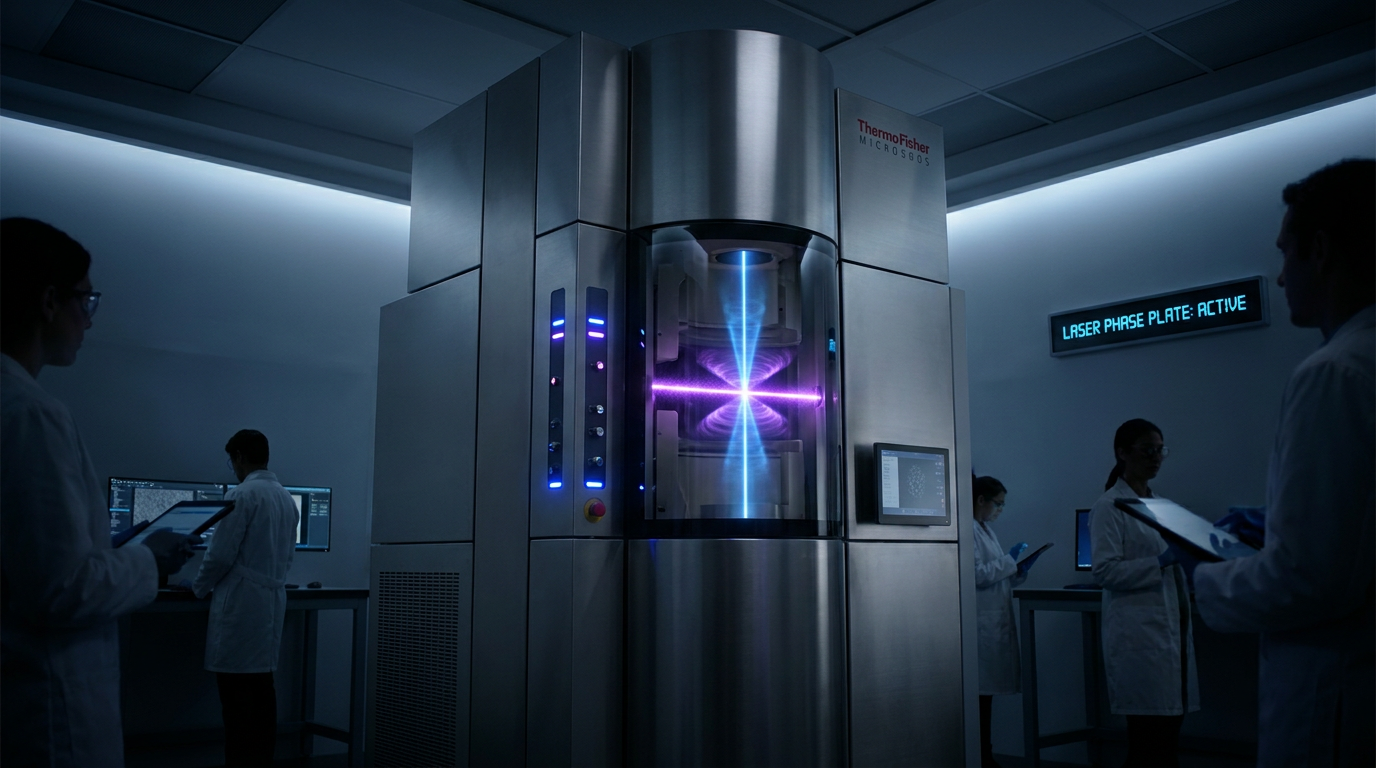
Moving from theory to practice required an extraordinary feat of optical engineering. The UC Berkeley team had to build a continuous-wave laser cavity inside the vacuum of a 14-foot-tall Thermo Fisher Krios microscope. The system generates 75 kilowatts of circulating laser power—more intense than industrial welding lasers—focused down to a spot just a few microns wide.[3][5]

The evidence that this monumental effort succeeded was published this week in the journal Science. The Berkeley team demonstrated their laser phase plate by imaging hemoglobin, a blood protein weighing roughly 64 kilodaltons. Hemoglobin is notoriously difficult to capture and is often used as a benchmark for the lower limits of cryo-EM; the laser phase plate resolved its structure with a 44% improvement in resolution compared to conventional imaging.[2][5]
Parallel evidence comes from the Biohub team, which developed a second-generation "crossed laser phase plate" (xLPP). Described in a recent preprint, this system uses two intersecting laser beams in an X-shaped configuration rather than a single beam.[5][6]
The dual-beam approach offers distinct advantages. By splitting the optical power between two cavities, it reduces the thermal stress on the highly polished mirrors, lowering the risk of catastrophic hardware failure. Crucially, the crossed beams also suppress "ghost images"—faint, duplicate optical artifacts that can obscure the genuine biological signal.[5][6]
The Biohub team provided compelling evidence of the xLPP's capabilities by imaging apoferritin, a standard calibration protein, down to a resolution of 1.8 angstroms. This approaches the theoretical atomic resolution limit of the technology, proving that the laser phase plate does not trade away high-resolution detail in exchange for its massive boost in low-frequency contrast.[5][7]
The implications for structural biology are profound. If the laser phase plate can routinely resolve proteins in the 30-to-70 kilodalton range, it will unlock the structures of thousands of previously invisible drug targets. Pharmaceutical researchers could design highly specific molecules to bind to these proteins, potentially accelerating treatments for a wide array of diseases.[1][3]

Furthermore, the technology is poised to revolutionize cryo-electron tomography (cryo-ET). Unlike single-particle cryo-EM, which looks at purified proteins in isolation, cryo-ET captures three-dimensional views of proteins operating in their native, crowded environment inside intact cells. The contrast boost provided by the laser phase plate is considered essential for distinguishing small proteins against the dense background of the cellular cytoplasm.[3][4]
Despite the overwhelming optimism, transparent uncertainties remain regarding the technology's immediate accessibility. The current laser phase plate systems are bespoke, highly customized machines that require constant tuning by expert physicists. Maintaining a 75-kilowatt laser cavity inside a sensitive electron microscope introduces immense thermal management and mechanical stability challenges.[5][7]
It is also unclear how quickly commercial microscope manufacturers can miniaturize and stabilize the laser optics to make the technology a standard, plug-and-play upgrade for existing cryo-EM facilities around the world.[5]
Nevertheless, the successful demonstration of the laser phase plate marks a definitive turning point. After 15 years of being dismissed by many as practically impossible, the technology has achieved "first light," fundamentally expanding the boundaries of what humanity can see at the molecular scale.[5][7]
How we got here
1953
Frits Zernike wins the Nobel Prize in Physics for inventing the phase-contrast light microscope.
2010
Physicists Holger Müller and Robert Glaeser first propose using a laser as a phase plate for electron microscopes.
2017
Cryo-electron microscopy (cryo-EM) wins the Nobel Prize in Chemistry for revolutionizing structural biology.
2019
Early prototypes demonstrate that a continuous-wave laser can manipulate electron phases without charging issues.
June 2026
Researchers publish the first successful biological structures resolved using a laser phase plate integrated into a modern cryo-EM system.
Viewpoints in depth
Structural Biologists
Focused on unlocking the remaining 90% of the human proteome to understand fundamental disease mechanisms.
For structural biologists, the laser phase plate is the equivalent of turning on the lights in a pitch-black room. Because conventional cryo-EM relies on electrons scattering off atoms, small proteins simply do not generate enough signal to be seen against the background noise of the ice they are frozen in. By shifting the phase of the electron beam, the LPP converts invisible phase differences into stark amplitude contrast. This allows researchers to finally map the atomic architecture of the small, elusive proteins that drive the majority of cellular processes and diseases.
Microscopy Engineers
Focused on the extreme technical difficulty of maintaining a high-powered laser inside an electron microscope.
From an engineering perspective, building the laser phase plate was long considered practically impossible. The system requires maintaining a continuous-wave laser cavity with 75 kilowatts of circulating power—more intense than industrial welding lasers—inside the ultra-high vacuum of an electron microscope. Engineers had to design highly polished mirrors that could withstand immense thermal stress without expanding or warping, as even a microscopic misalignment would ruin the electron beam. The successful integration of this optical cavity into a 14-foot-tall microscope represents a triumph of precision engineering.
Biomedical Innovators
Focused on the potential to accelerate drug discovery by revealing the exact shapes of elusive drug targets.
Pharmaceutical researchers view the LPP as a massive accelerator for drug discovery. The vast majority of disease-causing proteins and potential drug targets fall below the 70-kilodalton size threshold that conventional cryo-EM struggles to resolve. Without knowing the exact 3D shape of a target protein, designing a drug to bind to it is largely a process of trial and error. By providing clear, atomic-level blueprints of these small molecules, the laser phase plate allows innovators to design highly specific, effective therapeutics with far less guesswork.
What we don't know
- How quickly commercial microscope manufacturers can miniaturize the laser optics to make the technology a standard, plug-and-play upgrade.
- Whether the extreme thermal output of the 75-kilowatt laser cavity will limit the lifespan of the highly polished mirrors inside the microscope.
- The exact timeline for when this technology will become widely available to pharmaceutical companies for routine drug discovery.
Key terms
- Cryo-electron microscopy (cryo-EM)
- A technique that fires electrons at rapidly frozen biological samples to determine their 3D atomic structure.
- Phase contrast
- An optical trick that converts slight delays in a wave passing through a transparent object into visible differences in brightness.
- Kilodalton (kDa)
- A unit of mass used by biologists to measure the size of proteins and molecules.
- Proteome
- The entire set of proteins expressed by a genome, cell, tissue, or organism.
- Cryo-electron tomography (cryo-ET)
- An advanced imaging technique that captures 3D views of proteins in their natural environment inside intact cells.
Frequently asked
Why couldn't we see these small proteins before?
Small proteins don't scatter enough electrons to create a visible shadow, making them blend into the background noise of conventional electron microscopes.
How does a laser help an electron microscope?
The intense electromagnetic field of the laser slows down the unscattered electrons just enough to shift their phase, creating high-contrast interference patterns without adding static charge.
Will this technology cure diseases?
While not a cure itself, seeing the exact shape of disease-causing proteins allows researchers to design drugs that fit into them perfectly, accelerating medical breakthroughs.
Sources
Source coverage
7 outlets
3 viewpoints surfaced







[1]NatureStructural Biologists
An innovative technology boosts image quality for protein structures
Read on Nature →[2]ScienceStructural Biologists
Laser phase plate improves structure determination of small proteins by cryo-EM
Read on Science →[3]UC Berkeley NewsMicroscopy Engineers
With a laser phase plate, electron microscopes can see smaller proteins
Read on UC Berkeley News →[4]Chan Zuckerberg InitiativeBiomedical Innovators
A Pulsed Laser Phase Plate for High-Resolution Cryo-electron Tomography
Read on Chan Zuckerberg Initiative →[5]LabCriticsMicroscopy Engineers
Laser phase plate achieves 'first light' in cryo-EM
Read on LabCritics →[6]bioRxivStructural Biologists
Crossed laser phase plates for transmission electron microscopy
Read on bioRxiv →[7]Factlen Editorial TeamBiomedical Innovators
Synthesis by Factlen editorial team
Read on Factlen Editorial Team →
More in science
See all 7 stories →Cognitive Longevity
The Science of SuperAgers: How Some Brains Defy Cognitive Decline
6 sources

Etruscan Archaeology
Archaeologists Uncover Second Intact 2,600-Year-Old Etruscan Tomb in Italy
6 sources

Cognitive Longevity
The Science of 'SuperAgers': How Some Brains Resist the Decay of Time
6 sources

Climate Refugia
Scientists Identify 166,000 Square Kilometers of Coral Reefs Capable of Surviving Climate Change
7 sources

Every angle. Every day.
Get science stories with full source coverage and perspective breakdowns delivered to your inbox.