
Lab-Grown vs. Natural Diamonds: The 2026 Price and Trade-Off Comparison
As lab-grown diamonds capture over 55% of the market, the price gap has widened to 80%, forcing buyers to weigh massive upfront savings against long-term resale value.
By Factlen Editorial Team
- Value & Design Pragmatists
- Prioritizes identical chemistry, larger carat sizes, and massive cost savings over geologic origin.
- Heritage & Scarcity Advocates
- Values the billion-year geologic history, rarity, and stable resale floor of mined diamonds.
- Eco-Conscious Analysts
- Focuses on the nuanced environmental data, demanding renewable energy for lab-grown stones.
What's not represented
- · Pawn shop owners
- · Diamond mining communities in developing nations
Why this matters
With lab-grown diamonds now capturing over half the engagement ring market, the price gap between manufactured and mined stones has reached 80%. Understanding the hidden trade-offs in resale value and environmental impact is essential for making an informed, regret-free purchase.
Key points
- Lab-grown diamonds now account for over 55% of all engagement ring sales in 2026.
- Both types are chemically and optically identical, requiring advanced spectroscopic equipment to tell apart.
- A premium 1-carat lab-grown diamond costs 80% to 90% less than a comparable natural stone.
- Natural diamonds retain 50% to 60% of their value at resale, while lab-grown stones retain only 10% to 30%.
- The carbon footprint of a lab-grown diamond depends entirely on whether the facility uses renewable energy or fossil fuels.
The diamond market in 2026 has reached a historic structural divide. Lab-grown diamonds have crossed a major threshold, now representing over 55% of all engagement ring sales globally. The industry has effectively bifurcated into two distinct lanes: a technology-driven product scaling rapidly through manufacturing efficiency, and a traditional mined product relying on geologic scarcity.[2]
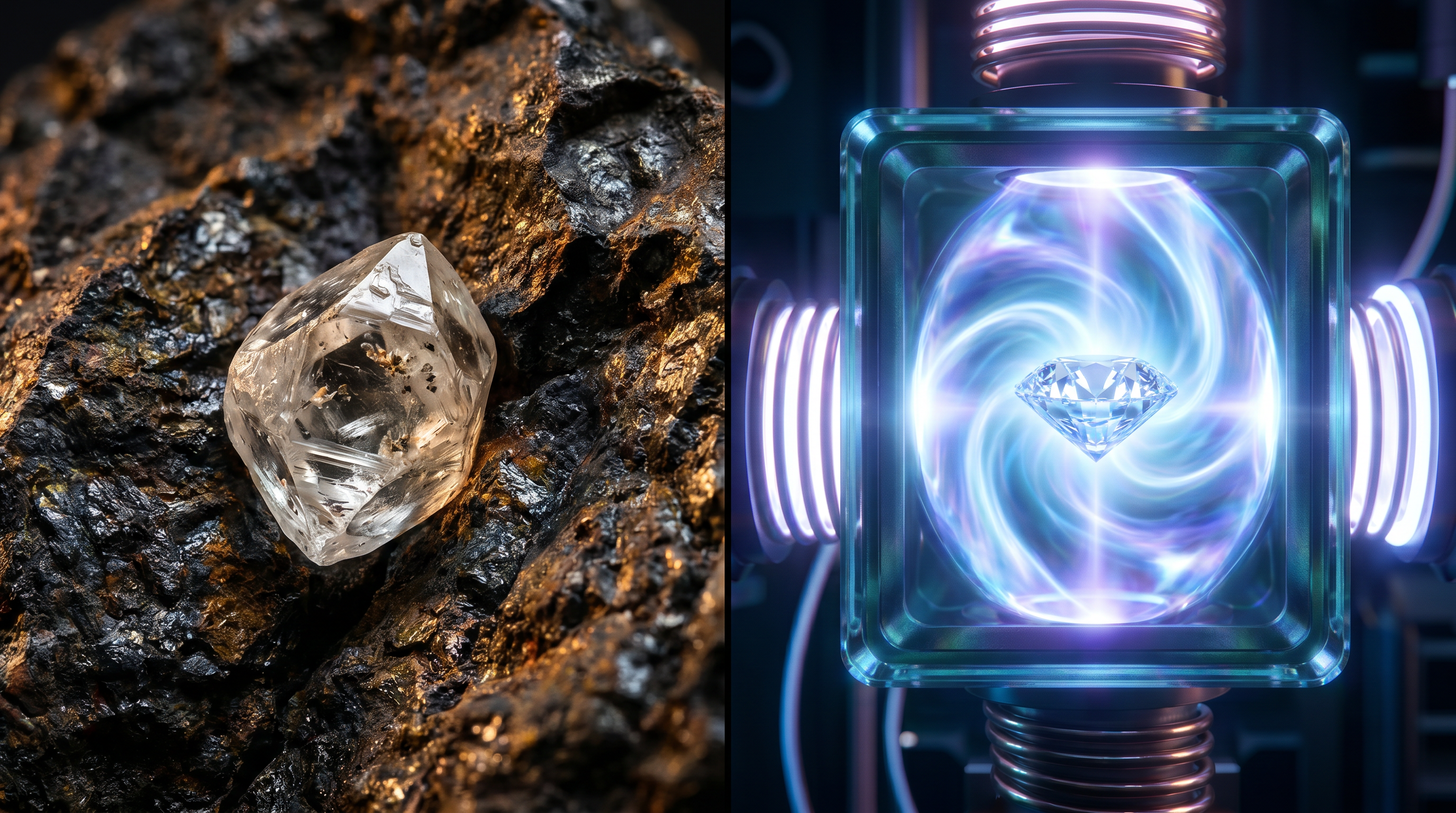
To understand the debate, buyers must first understand the chemistry. The Federal Trade Commission and the Gemological Institute of America (GIA) classify both as real diamonds. They share identical pure carbon structures, score a perfect 10 on the Mohs hardness scale, and exhibit the exact same optical brilliance and fire. To the naked eye—and even to a trained jeweler using a standard magnifying loupe—they are entirely indistinguishable.[1]
Because the chemical makeup is identical, gemological laboratories must rely on sophisticated spectroscopic devices to tell them apart. Machines like the GIA iD100 are required to detect the absence of nitrogen—which is common in natural stones—and to analyze the distinct growth morphology. This equipment reveals whether the crystal formed over billions of years in the Earth's mantle or over a few weeks inside a high-tech plasma reactor.[1]
The most dramatic divergence between the two products is financial. As of mid-2026, lab-grown diamonds retail for 80% to 90% less than their natural equivalents. A premium 1-carat natural diamond with high color and clarity grades averages between $4,500 and $6,000 in the United States. The exact same specification in a lab-grown stone now retails for $700 to $1,500, with some direct-to-consumer brands pushing the floor as low as $305.[3][4][8]

This massive price gap has fundamentally shifted consumer behavior, giving rise to the "3-Carat Standard." Because lab-grown prices do not scale exponentially with weight the way natural diamonds do, budgets that previously accommodated a modest 1-carat mined diamond now easily stretch to 2.5 or 3-carat lab-grown center stones. For many modern buyers, maximizing visual impact and design flexibility outweighs the geological origin of the gem.[2][7]
However, the primary argument against lab-grown diamonds is their steep financial depreciation. Because production capacity has surged globally and manufacturing costs continue to drop by 15% to 20% annually, the secondary market is flooded. In 2026, a lab-grown diamond typically resells for only 10% to 30% of its original retail price, and many traditional jewelers refuse to buy them back at all.[5][7]
Natural diamonds fare significantly better on the secondary market, though they are still not profitable investments for the average consumer. A standard commercial-quality natural diamond generally retains 50% to 60% of its original retail value. The finite nature of diamond mines and the legacy appeal of natural stones maintain a stable price floor, but buyers still face a substantial initial loss when walking out of the store.[4][5]
Natural diamonds fare significantly better on the secondary market, though they are still not profitable investments for the average consumer.
Beyond price, environmental claims heavily influence the market. Lab-grown diamonds are frequently marketed as the eco-friendly choice, primarily because they eliminate the massive land disruption, habitat destruction, and water usage associated with open-pit mining. Natural diamond extraction consumes up to 3,900 liters of water per carat, whereas lab-grown facilities use 85% less water through advanced closed-loop cooling systems.[6]
Yet, the "green" label comes with a significant energy catch. Creating the immense heat and pressure required to grow a diamond consumes roughly 250 to 750 kWh of electricity per carat. If a production facility relies on coal-fired electrical grids—as many in China and India do—the emissions can reach up to 511 kg of CO2 per carat. This far exceeds the estimated 160 kg of CO2 emitted by mining a natural diamond.[6]

The environmental calculus flips entirely when lab facilities utilize renewable energy. Producers operating on solar, wind, or hydroelectric power can reduce their carbon footprint to under 20 kg of CO2 per carat. Sustainability certifications, such as the SCS-007 standard, have become crucial for buyers wanting to verify that their lab-grown diamond is genuinely a low-carbon product rather than just a land-saving one.[6]
Regardless of origin, independent certification remains essential. The GIA remains the undisputed gold standard for natural diamonds, offering strict, universally trusted grading. For lab-grown diamonds, the International Gemological Institute (IGI) has captured a massive market share, offering reliable grading that caters to the rapid turnover and specific needs of the synthetic market.[1][8]
When analyzing the trade-offs, the case for natural diamonds rests on legacy and value retention. The evidence shows they retain 50% to 60% of their retail price and offer the emotional weight of a billion-year-old geologic artifact. The argument against them centers on their exorbitant cost—upwards of $4,500 for a premium 1-carat stone—and the severe land disruption caused by open-pit mining.[4][5][6][8]

Conversely, the case for lab-grown diamonds is built on accessibility and identical physical properties. The evidence proves they offer the exact same chemical makeup and optical brilliance at an 80% to 90% discount, allowing buyers to afford significantly larger stones. The argument against them is their catastrophic depreciation, with resale values plummeting to 10% to 30% as infinite manufacturing supply continually drives down wholesale costs.[3][5][7]
Ultimately, the natural diamond fits well when the buyer values tradition, views the stone as a multi-generational heirloom, and desires the emotional weight of a rare geologic artifact. It is the right choice for those who prioritize a stable resale floor and are willing to sacrifice carat size to stay within a specific budget. It does not fit when the buyer is strictly focused on maximizing visual size per dollar.[4][7]
The lab-grown diamond fits well when the buyer prioritizes maximum visual impact, flawless clarity, and larger carat size for their budget. It is ideal for consumers who view the ring as a permanent, 'forever' piece that will never be sold, rendering the poor resale value irrelevant. It does not fit when the buyer expects the jewelry to act as a financial asset, a store of value, or a traditional investment.[3][5][8]
How we got here
1950s
The first synthetic diamonds are successfully created in laboratories, primarily for industrial cutting and drilling purposes.
Early 2010s
Gem-quality lab-grown diamonds begin entering the consumer jewelry market in meaningful quantities.
July 2019
The GIA stops using the term 'synthetic' on grading reports, aligning with FTC guidelines that recognize lab-grown stones as real diamonds.
2023
Global lab-grown diamond production capacity surges by over 300%, leading to a massive oversupply and collapsing wholesale prices.
Mid-2026
Lab-grown diamonds capture over 55% of the engagement ring market, establishing a stable, heavily discounted price floor compared to natural stones.
Viewpoints in depth
Value & Design Pragmatists
Consumers and designers who prioritize visual impact and budget efficiency over geologic origin.
This camp argues that since lab-grown and natural diamonds are chemically and optically identical, paying a 500% premium for 'dirt-grown' stones is irrational. They point to the '3-carat standard' emerging in 2026, where buyers use the massive price discount to purchase significantly larger, higher-clarity center stones. For these buyers, poor resale value is irrelevant because they view engagement rings as permanent sentimental items, not financial assets to be liquidated.
Heritage & Scarcity Advocates
Traditional jewelers and buyers who value the billion-year history and stable legacy of mined diamonds.
Proponents of natural diamonds emphasize that true luxury is rooted in scarcity. They argue that a diamond's emotional weight comes from its billion-year geologic journey, not just its carbon structure. Furthermore, they point to the collapsing secondary market for lab-grown stones as evidence that synthetic diamonds are closer to consumer electronics—depreciating rapidly as manufacturing technology improves—whereas natural diamonds retain 50% to 60% of their value as legacy assets.
Eco-Conscious Analysts
Environmental watchdogs who demand nuance in the 'sustainable' marketing of lab-grown diamonds.
This perspective challenges the blanket assumption that all lab-grown diamonds are green. While they acknowledge that lab stones eliminate the severe habitat destruction and water consumption of open-pit mining, they highlight the massive energy requirements of plasma reactors. They argue that a lab-grown diamond produced on a coal-heavy grid in India or China can emit up to three times more CO2 than a mined diamond. They advocate exclusively for lab stones certified by standards like SCS-007, which verify the use of 100% renewable energy.
What we don't know
- Whether the secondary market for lab-grown diamonds will eventually stabilize or if resale values will drop to zero as manufacturing costs continue to fall.
- How the long-term closure of major natural diamond mines will impact the scarcity premium of mined stones over the next decade.
Key terms
- Chemical Vapor Deposition (CVD)
- A method of growing diamonds in a lab by breaking down carbon-rich gases into atoms that crystallize onto a diamond seed.
- High Pressure High Temperature (HPHT)
- A lab-grown diamond production method that mimics the extreme heat and pressure found deep within the Earth's mantle.
- Mohs Scale
- A scale used to measure the hardness of minerals. Both natural and lab-grown diamonds score a perfect 10, making them the hardest known materials.
- SCS-007 Certification
- A sustainability standard that verifies a lab-grown diamond was produced using renewable energy and has a net-zero carbon footprint.
- Growth Morphology
- The specific shape and structural pattern in which a diamond crystal grows, which differs between billion-year natural formation and rapid lab creation.
Frequently asked
Can a jeweler tell the difference by looking at it?
Not with the naked eye or a standard jeweler's loupe. Because they are chemically identical, identifying a lab-grown diamond requires advanced spectroscopic equipment like the GIA iD100.
Do lab-grown diamonds get cloudy over time?
No. Lab-grown diamonds are pure crystallized carbon, exactly like natural diamonds. They will not fade, cloud, or change color over time.
Why is the resale value of lab-grown diamonds so low?
Because they can be manufactured in unlimited quantities and production costs drop 15-20% annually. Jewelers prefer to buy new, cheaper inventory rather than buy back pre-owned stones.
Are lab-grown diamonds actually better for the environment?
It depends entirely on the energy source. They use 85% less water and cause no land disruption, but if the lab runs on coal power, the carbon emissions can exceed those of a mined diamond.
Sources
Source coverage
8 outlets
3 viewpoints surfaced






[1]Gemological Institute of AmericaHeritage & Scarcity Advocates
Is There a Difference Between Natural and Laboratory-Grown Diamonds?
Read on Gemological Institute of America →[2]Tashvi AI Market ReportValue & Design Pragmatists
Lab Grown vs Natural Diamonds 2026: Market Share and Pricing
Read on Tashvi AI Market Report →[3]Regal StudioValue & Design Pragmatists
Lab Grown Diamond Price Drop 2026: The Shocking Truth
Read on Regal Studio →[4]OM JewelsHeritage & Scarcity Advocates
How Diamond Prices Have Changed in 2025–2026
Read on OM Jewels →[5]SilvadiHeritage & Scarcity Advocates
Do Lab-Grown Diamonds Hold Their Resale Value in 2026?
Read on Silvadi →[6]Taylor Kenney JewelryEco-Conscious Analysts
Lab-Grown vs. Mined Diamonds: Environmental Impact
Read on Taylor Kenney Jewelry →[7]Vanhess JewelryValue & Design Pragmatists
Lab-Grown vs Natural Diamonds: 2026 Prices & How to Choose
Read on Vanhess Jewelry →[8]MadisonDiaValue & Design Pragmatists
1 Carat Diamond Price 2026: Expert Guide to Natural vs. Lab-Grown
Read on MadisonDia →
More in shopping
See all 48 stories →Nursery Tech
Smart Bassinets vs. Traditional Sleepers: The Complete Trade-Off Analysis
8 sources

Kitchen Upgrades
Induction vs. Gas Cooktops: The 2026 Trade-Off Analysis
8 sources

Camera Tech
How AI Autofocus and Global Shutters Are Revolutionizing Cameras in 2026
8 sources
Wearable Tech
Smart Ring vs. Smartwatch: Which Wearable Wins the 2026 Health Tracking Debate?
6 sources
Every angle. Every day.
Get shopping stories with full source coverage and perspective breakdowns delivered to your inbox.