
How Vertical-Scrolling Webtoons Rewrote the Rules of the Global Comic Industry
Optimized for smartphones and fueled by a freemium model, webtoons have transformed from a South Korean niche into a $14 billion global publishing juggernaut.
By Factlen Editorial Team
- Independent Creators
- Artists who leverage the platform to bypass traditional publishing gatekeepers.
- Entertainment Conglomerates
- Streaming and publishing giants viewing webtoons as a pipeline for lucrative intellectual property.
- Labor & Rights Advocates
- Voices pushing back against grueling schedules and restrictive platform contracts.
What's not represented
- · Traditional comic book shop retailers navigating the shift to digital.
- · Parents and educators evaluating the screen-time impact of serialized digital comics.
Why this matters
The shift from print pages to vertical screens has lowered the barrier to entry for aspiring creators worldwide, allowing independent artists to bypass traditional publishers and build million-dollar franchises directly from their phones.
Key points
- Webtoons are digital comics optimized for vertical scrolling on smartphones.
- The global market is projected to reach $14.02 billion in 2026.
- A freemium model allows readers to access content for free while paying for early releases.
- Streaming giants like Netflix are heavily investing in webtoons as a source of new IP.
- The industry faces growing pains regarding creator burnout and intellectual property rights.
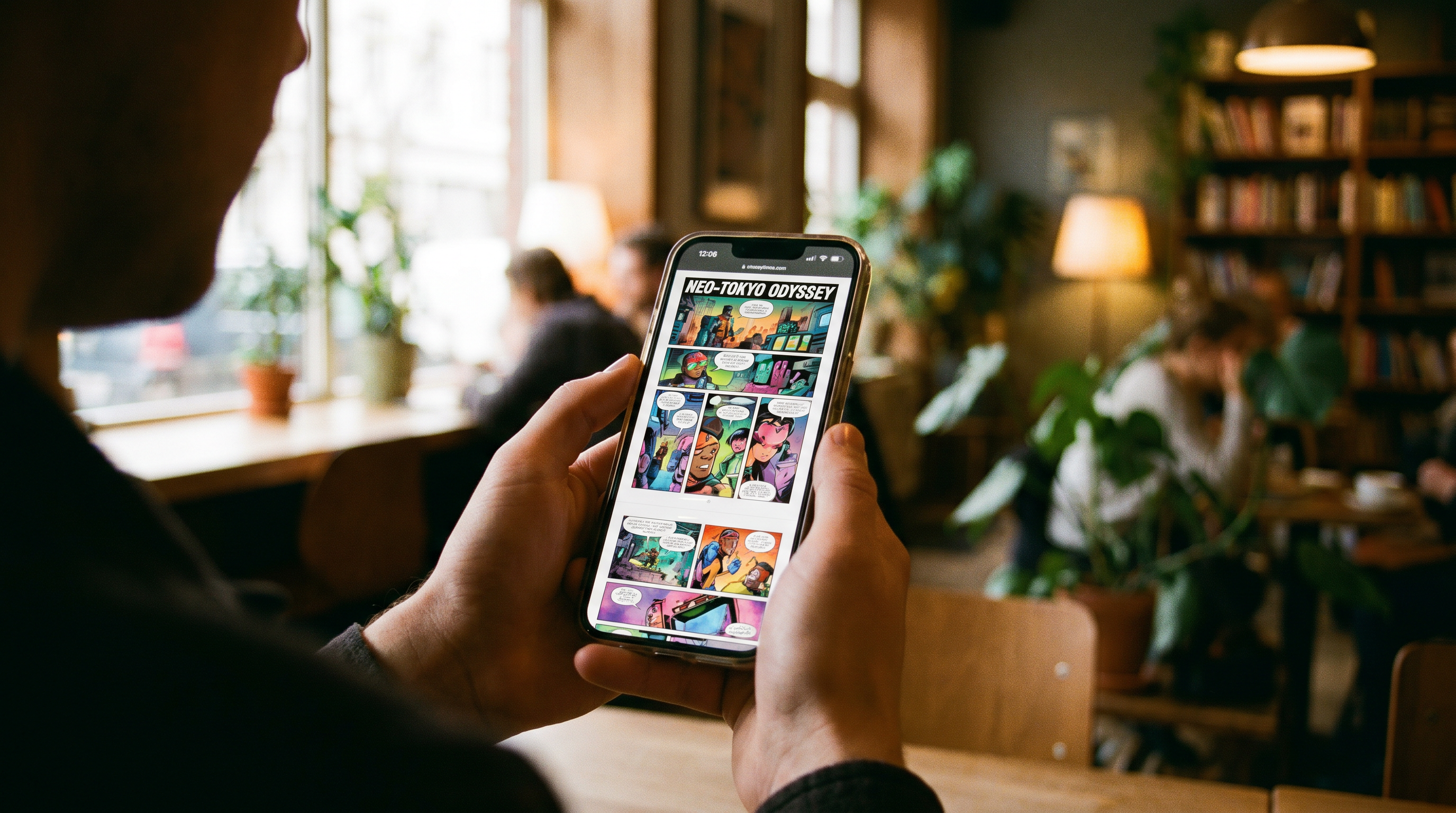
For decades, the word "comic" conjured a very specific physical experience: the smell of fresh ink on glossy paper, the rustle of turning a page, and the Wednesday ritual of visiting a local comic shop. Today, for millions of readers around the world, that experience has been entirely replaced by a silent, infinite vertical scroll on a glowing smartphone screen. Webtoons—digital-first comics optimized for mobile devices—have quietly orchestrated one of the most profound shifts in the history of publishing. By discarding the constraints of the printed page, the medium has not only changed how stories are consumed but has radically democratized who gets to tell them.[6]
The format was born out of necessity in South Korea during the early 2000s. Following the Asian financial crisis, the domestic print comic industry was struggling, prompting tech companies and internet portals like Daum and Naver to experiment with digital alternatives. Early iterations simply scanned horizontal pages onto a screen, which proved clunky and frustrating for readers. The breakthrough came when creators realized that the digital canvas was theoretically infinite. By stacking panels vertically, they created a format that perfectly matched the natural scrolling motion of a computer mouse, and later, the swipe of a thumb on a smartphone.[1][6]
This structural shift fundamentally altered the mechanics of visual storytelling. In a traditional comic book, the reader's eye is forced to zig-zag across a complex grid of panels, taking in an entire page's composition at a glance. Webtoons, by contrast, offer a highly controlled, cinematic pacing. Creators use the "gutter"—the empty space between panels—to dictate the speed of the narrative. A long stretch of blank space requires the reader to physically scroll for several seconds, simulating the passage of time, building suspense, or emphasizing a moment of emotional isolation. It is a deeply interactive experience that print simply cannot replicate.[6]
What began as a regional innovation has exploded into a global economic juggernaut. The financial metrics surrounding the format are staggering. According to industry analysis, the global webtoon market is projected to reach $14.02 billion in 2026, up from $10.75 billion in 2025. This represents a compound annual growth rate of over 30%, making it one of the fastest-growing segments in the entire entertainment sector. While the Asia-Pacific region still commands the lion's share of the market, North America and Europe are rapidly accelerating, driven by a generation of readers who view their smartphones as their primary entertainment console.[1]

The engine driving this massive growth is a highly effective "freemium" monetization model, pioneered by platforms like WEBTOON and Tapas. Unlike the traditional publishing model, where a reader must pay upfront for a physical book, webtoon platforms lower the barrier to entry to zero. The vast majority of content is available for free, with new episodes typically released on a strict weekly schedule. This accessibility allows series to build massive, highly engaged audiences organically, turning casual scrollers into dedicated fans without requiring a credit card.[3][6]
Monetization occurs once that audience is hooked. Platforms utilize micro-transactions—often branded as a "Fast Pass" or "Coins"—that allow impatient readers to pay a small fee to unlock upcoming chapters before their scheduled free release date. For a highly anticipated cliffhanger, hundreds of thousands of readers might pay a few cents each to find out what happens next. When combined with in-app advertising revenue that is shared with the creators, this model has proven incredibly lucrative, transforming digital comics from a hobbyist pursuit into a multi-billion-dollar industry.[3]
Perhaps the most revolutionary aspect of the webtoon boom is its democratization of the creation process. Historically, breaking into the comic industry required navigating a labyrinth of editors, publishers, and physical distribution networks. Today, the gatekeepers have been largely bypassed. Anyone with a digital drawing tablet and an internet connection can upload their work to open-publishing tiers like WEBTOON CANVAS. If a story resonates with readers, the platform's algorithm will amplify it, regardless of the creator's geographic location, formal training, or industry connections.[3][6]
Perhaps the most revolutionary aspect of the webtoon boom is its democratization of the creation process.
This direct-to-consumer pipeline has minted a new class of digital millionaires. Top-tier creators on major platforms are now earning six- and sometimes seven-figure incomes solely from their digital publishing revenue. Because creators generally retain the rights to their intellectual property, they are not merely gig workers for a publisher; they are independent franchise owners. This financial viability has attracted a diverse array of voices and artistic styles that might have been deemed too niche or risky by traditional print publishers, resulting in a vibrant, varied ecosystem of stories.[3]

As webtoons have amassed audiences in the tens of millions, the broader entertainment industry has recognized them as a goldmine of pre-validated intellectual property. A comic that generates a hundred million views online is no longer just a digital curiosity; it is a built-in audience waiting for a television adaptation. Streaming giants, desperate for fresh content to feed their algorithms, have increasingly turned to webtoons as the foundation for their next blockbuster series, bypassing traditional novels and comic books entirely.[2][5]
Netflix has been particularly aggressive in this arena. Recognizing that webtoon adaptations routinely dominate their global top-ten lists, the streaming giant has moved to secure the pipeline. In 2025, Netflix signed a landmark $420 million strategic partnership with Naver Webtoon, ensuring first-look rights to the platform's most popular titles. This synergy creates a powerful feedback loop: a hit webtoon becomes a hit television show, which in turn drives millions of new readers back to the original digital comic, exponentially increasing the value of the intellectual property.[2]
Even the legacy publishing world, which initially viewed digital comics with skepticism, has been forced to adapt to the new reality. The 2026 Frankfurt Book Fair—the world's largest trade fair for books—acknowledged this paradigm shift by launching a dedicated Comics Business Centre. Organizers explicitly cited the explosive growth of webtoons as the catalyst, noting that international rights managers and literary agents now view vertical-scrolling comics not as an experimental format, but as a primary source material for cross-media exploitation and lucrative print syndication deals.[5]

However, the rapid maturation of the industry has not been without significant friction. The digital utopia of independent creation is often underpinned by grueling labor conditions. The algorithm demands consistency, and readers expect full-color, lengthy episodes every single week. For a solo creator, or even a small team, producing 60 to 80 panels of fully rendered art every seven days is an exhausting marathon. Reports of severe artist burnout, repetitive strain injuries, and mental health crises have become increasingly common, prompting difficult conversations about the sustainability of the weekly release model.[4][6]
Tensions have also flared over the legal and financial frameworks governing the platforms. As webtoons have become more valuable, the contracts offered to creators have come under intense scrutiny. In 2024, a major controversy erupted when creators publicly criticized the terms of platform "Originals" contracts, alleging that exclusivity periods were becoming overly restrictive and that platforms were taking overly aggressive cuts of secondary media rights. This pushback highlighted the growing pains of an industry transitioning from a decentralized creator community into a highly corporatized media pipeline.[4]
Despite these challenges, the format continues to evolve and expand its demographic reach. While the early global boom was heavily driven by the romance and fantasy genres—which cultivated a massive, highly engaged female readership that traditional comics had long neglected—the medium is rapidly diversifying. Action, thriller, and science-fiction titles are currently experiencing the fastest growth rates, drawing in a broader cross-section of readers and proving that the vertical scroll can accommodate any narrative tone or genre.[2]

Looking ahead, the technological boundaries of the webtoon are poised to expand even further. Industry analysts predict that the next phase of growth will involve the integration of augmented reality and interactive elements directly into the scrolling experience. Some platforms are already experimenting with haptic feedback, where the reader's phone vibrates in time with an on-screen explosion, or dynamic soundtracks that shift in tone as the reader scrolls deeper into a scene, further blurring the line between reading a comic and playing a video game.[1][6]
Ultimately, the rise of the webtoon is a testament to the power of adapting to consumer behavior rather than fighting it. By recognizing that the modern reader's primary interface with the world is a vertical screen, creators and platforms forged a new visual language. They removed the friction of the comic shop, lowered the financial barrier to entry, and handed the tools of production directly to the artists. In doing so, they didn't just change how comics are read; they ensured the survival and explosive growth of the medium for the digital age.[6]
How we got here
Early 2000s
Webtoons originate in South Korea on portals like Daum and Naver as a response to declining print sales.
2014
LINE WEBTOON launches globally, introducing the vertical scroll format to Western audiences.
2021
Webtoon adaptations begin dominating streaming platforms, proving the format's viability as an IP incubator.
2024
Public debates erupt over platform contracts, highlighting tensions between corporate platforms and independent creators.
2025
Netflix signs a landmark $420 million strategic partnership to adapt top webtoon titles.
Oct 2026
The Frankfurt Book Fair launches a dedicated Comics Business Centre to handle the surge in webtoon cross-media rights.
Viewpoints in depth
Digital-First Creators
Independent artists who view webtoons as a democratizing force.
For many independent artists, the vertical format represents a liberation from the gatekeeping of traditional print publishers. By uploading directly to platforms like WEBTOON CANVAS, creators can build an audience organically. They value the direct-to-consumer relationship, where immediate feedback via comments and the ability to monetize through micro-transactions provide a viable path to a full-time career without needing a corporate backer.
Traditional Publishers
Legacy comic and book publishers adapting to the digital shift.
Legacy publishers initially viewed webtoons as a niche overseas trend, but the sheer volume of readers has forced a strategic pivot. Rather than competing directly with the digital platforms, traditional houses are now acting as secondary distributors, acquiring the print rights to viral webtoons. They see the digital space as a massive, risk-free incubator where intellectual property is pre-validated by millions of readers before a single physical book is printed.
Creator Rights Advocates
Industry watchdogs concerned about platform monopolies and burnout.
As platforms consolidate power, labor advocates and creator coalitions are raising alarms about the sustainability of the model. They point to the grueling weekly deadlines required by platform algorithms, which frequently lead to artist burnout and physical strain. Furthermore, advocates argue that as platforms pivot toward multimedia licensing, standard contracts are becoming more aggressive in claiming a share of a creator's intellectual property for film and television adaptations.
What we don't know
- Whether the rapid 30% annual growth rate can be sustained as the market reaches saturation.
- How emerging technologies like augmented reality might disrupt the established vertical-scroll format.
- Whether creator unions or collective bargaining will emerge to standardize platform contracts.
Key terms
- Webtoon
- A digital comic designed specifically to be read on a smartphone by scrolling vertically.
- Freemium Model
- A pricing strategy where basic content is provided for free, but users pay for premium features or early access.
- Fast Pass
- A micro-transaction system allowing readers to pay a small fee to unlock upcoming chapters before their free release date.
- The Gutter
- The blank space between comic panels, which webtoon creators use to control pacing and simulate the passage of time as the reader scrolls.
- Transmedia Storytelling
- The technique of telling a single story or expanding a universe across multiple platforms, such as comics, television, and video games.
Frequently asked
Do I need a special app to read webtoons?
While dedicated apps like WEBTOON and Tapas offer the best experience, most webtoons can also be read directly through a standard web browser.
How do webtoon creators make money?
Creators earn revenue through a combination of ad-sharing, reader micro-transactions for early access, and eventually through merchandise and media licensing.
Are webtoons replacing traditional comic books?
They are not entirely replacing print, but they are capturing the vast majority of new, younger readers. Many successful webtoons are eventually printed as physical graphic novels.
Sources
Source coverage
6 outlets
3 viewpoints surfaced






[1]The Business Research CompanyEntertainment Conglomerates
Webtoons Global Market Report 2026
Read on The Business Research Company →[2]Mordor IntelligenceEntertainment Conglomerates
Webtoons Market Analysis 2026-2031
Read on Mordor Intelligence →[3]ForbesIndependent Creators
Empowering Creators: How WEBTOON Is Changing The Comic Industry
Read on Forbes →[4]Comics BeatLabor & Rights Advocates
A look at the WEBTOON Originals contracts controversy
Read on Comics Beat →[5]The New Publishing StandardEntertainment Conglomerates
Frankfurt Book Fair 2026: Comics Take Centre Stage with New Business Centre and Webtoon Expansion
Read on The New Publishing Standard →[6]Factlen Editorial Team
Synthesis by Factlen editorial team
Read on Factlen Editorial Team →
More in entertainment
See all 28 stories →Streaming Bundles
The Great Re-Bundling: Major Streaming Services Launch 'Super Bundles' to Combat Subscription Fatigue
7 sources

Game Accessibility
Gaming Accessibility Reaches Historic Milestone as Nintendo Joins Summer Game Fest Showcase
7 sources

Digital Minimalism
Why Gen Z is Trading Smartphones for Flip Phones and Digital Cameras
8 sources

Classic IP Revival
Konami Hands 'Castlevania' Reins to 'Dead Cells' Creators in Major Win for Indie-AAA Partnerships
8 sources
Every angle. Every day.
Get entertainment stories with full source coverage and perspective breakdowns delivered to your inbox.