
How Vacuum Ice Tech and Snow Farming Are Saving the Ski Industry
Facing warmer winters, ski resorts are deploying temperature-independent snowmaking and summer snow-storage techniques to guarantee their seasons.
By Factlen Editorial Team
- Resort Operators
- Focuses on the economic necessity of guaranteeing early-season openings to protect local jobs and revenue.
- Sustainable Innovators
- Focuses on decarbonizing the snowmaking process through efficiency, renewable energy, and recycled water.
- Ecological Researchers
- Focuses on the localized environmental impacts, water usage, and life-cycle costs of artificial snow.
What's not represented
- · Local municipalities sharing water resources
- · Skiers adjusting to technical snow conditions
Why this matters
As climate change threatens the multi-billion-dollar winter sports economy, these engineering breakthroughs prove that industries can adapt sustainably, offering a blueprint for climate resilience that extends far beyond the slopes.
Key points
- Ski resorts are increasingly relying on 'snow farming' to store snow over the summer, reducing early-season electricity use by up to 85%.
- Temperature-Independent Snow (TIS) systems use vacuum ice technology to produce snow even when ambient temperatures reach 25°C.
- Modern snow guns are up to 75% more efficient than older models, requiring only about 1 kWh of energy per cubic meter of snow.
- Resorts are adopting circular sustainability practices, such as powering snowmaking with renewable hydroelectricity and using highly treated recycled wastewater.
For decades, the global ski industry has operated at the mercy of the weather, anxiously watching the skies each November. But as global temperatures rise and natural snowfall becomes increasingly erratic, winter sports are facing an existential crisis. Rather than surrendering to shorter seasons and receding snowlines, resorts worldwide are fundamentally re-engineering how winter is made. Through a combination of advanced industrial refrigeration, recycled water systems, and a practice known as "snow farming," the industry is proving that human ingenuity can outmaneuver a warming climate.[7]
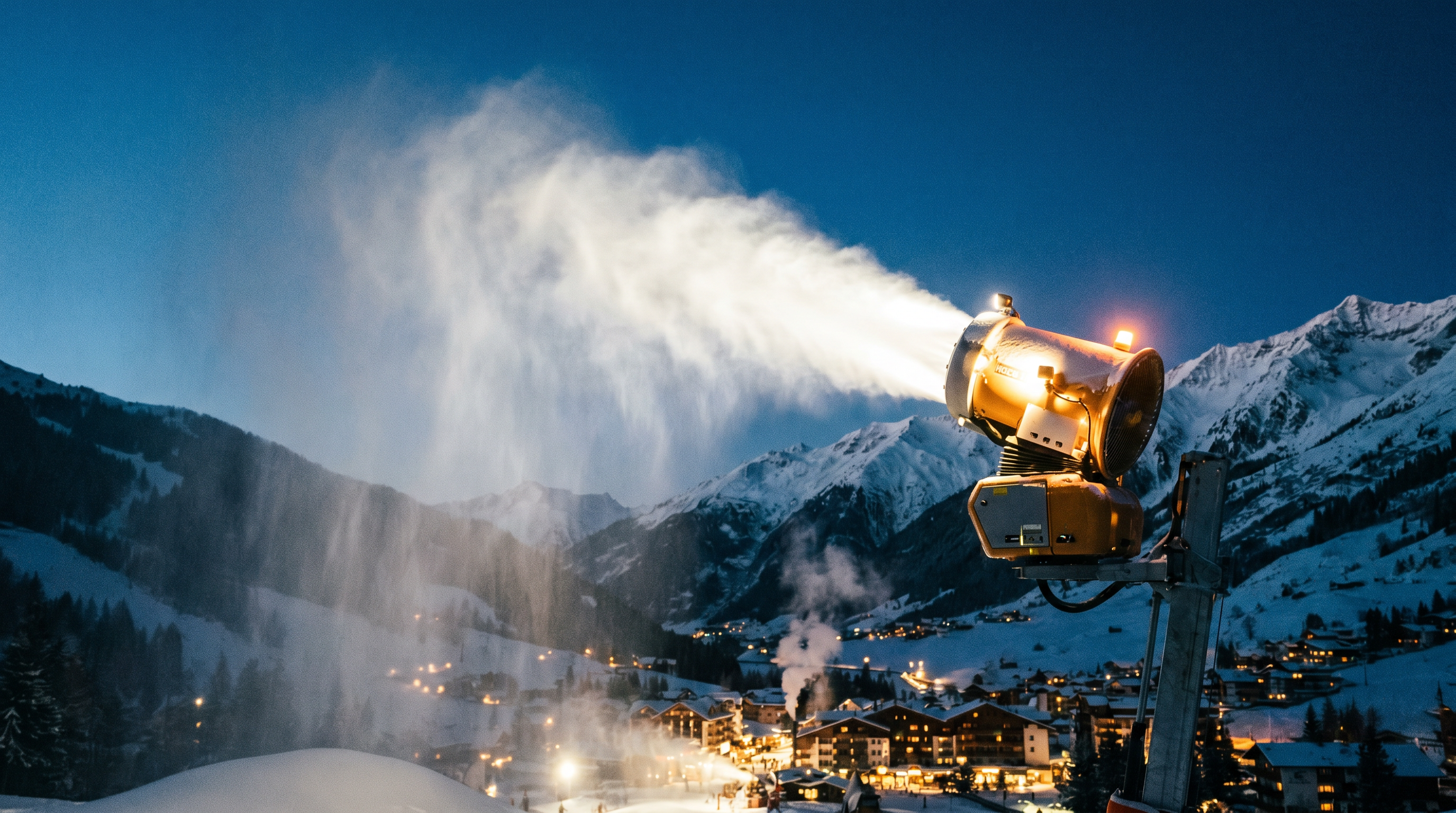
The shift represents a massive technological pivot. Historically, resorts relied on traditional snow cannons, which spray water and compressed air into the atmosphere to freeze as it falls. However, these systems are entirely dependent on the "wet-bulb temperature"—a metric combining air temperature and humidity. If the wet-bulb temperature doesn't drop below roughly -2.5 degrees Celsius, traditional guns simply produce rain. To guarantee early-season openings, resorts needed a way to decouple snow production from the ambient temperature entirely.[4]
Enter Temperature-Independent Snow (TIS) systems, often referred to as all-weather snowmaking. Unlike traditional cannons that rely on cold winter air, TIS systems utilize industrial refrigeration enclosed within massive mobile plants. Companies like Israel-based IDE Technologies and Italy's TechnoAlpin have pioneered systems that can produce high-quality snow even when outside temperatures soar to 25 degrees Celsius, fundamentally altering the calculus of early-season resort operations.[6]
The mechanism behind IDE's Vacuum Ice Maker (VIM) technology reads more like aerospace engineering than traditional ski resort maintenance. Inside the massive VIM freezer units, incoming water is exposed to a remarkably deep vacuum environment. This extreme pressure drop forces a small portion of the water to evaporate almost instantly. Because evaporation is an endothermic process, it rapidly extracts heat from the remaining surrounding water, causing it to freeze into a thick water-ice mixture commonly known as a slurry. This entire thermodynamic sequence occurs without the need for any chemical refrigerants.[6]

This icy slurry is then pumped out of the vacuum chamber and into a specialized ice concentrator, which mechanically separates the liquid water from the solid ice crystals. The result is a dry, granular snow that closely mimics the coveted "spring skiing" conditions favored by many athletes. Because this entire freezing process happens inside a controlled, enclosed vacuum chamber rather than being sprayed into the open air, the system is completely immune to external weather variables like high winds, humidity, and warm temperatures. A single commercial VIM unit can produce over 1,700 cubic meters of high-quality snow per day.[4][6]
However, all-weather snowmaking is highly energy-intensive and requires significant capital, with large systems costing several million dollars. For resorts lacking that budget, an ancient technique has been resurrected and modernized: snow farming. Pioneered in Scandinavia and Canada, snow farming involves stockpiling massive reserves of snow at the end of the winter and preserving it through the heat of summer to be deployed the following autumn.[1][4]
The process begins in April or May, when snow groomers push leftover snow into massive, concentrated mounds. These piles are then covered with thick layers of insulating material. While traditional methods used sawdust or wood chips, modern resorts are increasingly utilizing specialized reflective geotextiles and closed-cell insulation boards like Finnfoam to create a highly efficient thermal barrier.[4]

The process begins in April or May, when snow groomers push leftover snow into massive, concentrated mounds.
This thermal armor protects the snow from solar radiation and summer heat, minimizing melt to a remarkable degree. When November arrives, the insulation is peeled back, and the preserved snow is spread across the slopes to form a guaranteed base layer. The environmental benefits of snow farming are profound. By reusing snow from the previous season, resorts can reduce the electricity consumption associated with early-season snowmaking by up to 85 percent, while simultaneously conserving local water resources.[1][4]
Yet, even with snow farming, the sheer volume of snow required to operate a modern mega-resort necessitates active snowmaking. This raises a critical environmental debate: how can an industry threatened by climate change justify the massive energy and water consumption required to fight it? The answer lies in a radical, industry-wide push toward efficiency and circular resource management.[5][7]
Over the past two decades, the efficiency of snow guns has skyrocketed. Modern fan guns and lances are up to 75 percent more efficient than their predecessors. While older systems required up to 4.3 kilowatt-hours of electricity to produce a single cubic meter of snow, the best modern systems operate at closer to 1 kilowatt-hour per cubic meter, allowing resorts to produce vastly more snow in much shorter cold-weather windows.[4]

To address the water footprint, resorts are turning to municipal recycling. In Montana, Big Sky Resort recently announced a groundbreaking initiative to convert treated wastewater into skiable snow. The project will utilize up to 23 million gallons of highly purified, reclaimed water annually from the local treatment facility, ensuring that the resort's snowmaking operations do not drain local aquifers or natural streams.[2]
The water undergoes an extensive, state-regulated reclamation process, resulting in a product that is entirely safe and odorless. By utilizing recycled water, Big Sky joins a growing coalition of resorts in Switzerland, Australia, and Canada that are closing the loop on their water consumption, turning a municipal waste product into a vital economic asset for the region.[2]
The final piece of the sustainability puzzle is the energy grid. Austria's ski industry has provided a blueprint for decarbonizing snowmaking by integrating it with the country's robust alpine hydroelectric network. By powering their pump stations and snow cannons with renewable energy, Austrian resorts have effectively neutralized the carbon cost of artificial snow, proving that the environmental impact is tied to the grid, not the snow gun.[3]
The results of this renewable integration are striking. A 2026 study from the University of Innsbruck found that Austria's total annual snowmaking emissions equated to roughly 120 to 140 grams of carbon dioxide per skier visit. For context, studies of resorts relying on fossil-fuel-heavy grids have shown emissions nearly 50 times higher per visit. This demonstrates that sustainable, large-scale snowmaking is entirely achievable.[3]

Despite these advances, researchers caution that technical snow is not a perfect ecological substitute for natural snowfall. Studies from the Technical University of Munich highlight that the life-cycle impact of snow farming and artificial snowmaking still involves heavy machinery and localized ecological disturbances. Furthermore, the introduction of technical snow can alter the bacterial composition and hydrology of alpine soils when the dense snowpack eventually melts in the spring.[5]
Nevertheless, the ski industry's proactive adaptation offers a hopeful narrative. Rather than accepting defeat, mountain communities are leveraging cutting-edge thermodynamics, circular water systems, and renewable energy to preserve their local economies and the sport itself. The pristine, white slopes of the future will not just be a product of nature, but a testament to sustainable human engineering.[7]
How we got here
1970s
Early experiments with snow farming begin at resorts lacking major water sources, like Banff Sunshine in Alberta.
2011
IDE Technologies installs one of the first Vacuum Ice Maker (VIM) all-weather snow systems at the Zermatt resort in Switzerland.
2025
Austria's Lech Bergbahnen produces 750,000 cubic meters of technical snow, proving the massive scale of modern snowmaking.
October 2025
Big Sky Resort in Montana announces a groundbreaking initiative to convert treated wastewater into skiable snow.
Viewpoints in depth
Resort Operators
Focuses on the economic necessity of guaranteeing early-season openings.
For mountain communities, snow is the foundational economic engine. Resort operators argue that investing millions in all-weather snowmaking and snow farming is not a luxury, but a survival imperative. By guaranteeing opening dates regardless of the autumn weather, resorts can secure advance bookings, protect local jobs, and maintain the financial stability required to fund further climate adaptation measures.
Sustainable Innovators
Focuses on decarbonizing the snowmaking process through efficiency and circular resource management.
Engineers and sustainability advocates view the ski industry as a testing ground for climate resilience. They emphasize that the environmental cost of snowmaking is not inherent to the technology itself. By pairing highly efficient modern fan guns with renewable alpine hydroelectric grids and recycled wastewater systems, they argue that technical snow can become a circular, zero-emission process.
Ecological Researchers
Focuses on the localized environmental impacts and life-cycle costs of artificial snow.
Environmental scientists caution against viewing technological fixes as a panacea. They point out that all-weather snowmaking still requires massive industrial infrastructure, and snow farming relies on heavy diesel machinery to move the snow. Furthermore, researchers are studying how the dense, water-heavy composition of technical snow alters alpine soil hydrology and local bacterial ecosystems when it melts in the spring.
What we don't know
- Whether the high capital costs of all-weather snowmaking will force smaller, independent ski hills out of business, leading to industry consolidation.
- The long-term ecological impact of covering alpine soils with highly concentrated, insulated snow mounds during the summer months.
Key terms
- Snow Farming
- The practice of stockpiling and insulating snow over the summer to use as a base layer for the next ski season.
- All-Weather Snowmaking
- Temperature-independent systems that use industrial refrigeration to produce snow even when ambient temperatures are above freezing.
- Vacuum Ice Maker (VIM)
- A technology that exposes water to a deep vacuum, forcing a portion to evaporate while the rest freezes into an ice slurry.
- Wet-Bulb Temperature
- A metric combining air temperature and humidity, which dictates whether traditional snow cannons will produce snow or rain.
- Technical Snow
- The industry term for machine-made snow, distinguishing it from natural precipitation.
Frequently asked
What exactly is snow farming?
Snow farming is the practice of collecting leftover snow at the end of the ski season and covering it with thick thermal insulation, allowing it to survive the summer heat so it can be used the following autumn.
How can machines make snow when it's warm outside?
Temperature-Independent Snow (TIS) systems use industrial refrigeration and vacuum chambers to freeze water internally, completely bypassing the need for cold outside air.
Is artificial snow bad for the environment?
It can be highly energy-intensive, but resorts are increasingly mitigating this by powering their snow guns with renewable hydroelectricity and utilizing recycled wastewater.
Does recycled wastewater smell when used for snow?
No. The water undergoes an extensive, state-regulated reclamation and purification process, resulting in snow that is completely odorless and safe.
Sources
Source coverage
7 outlets
3 viewpoints surfaced







[1]CBC NewsResort Operators
Climate change means ski hills can't always count on snow. Snow farming can help
Read on CBC News →[2]Outside OnlineResort Operators
This Ski Resort Is Making Snow Out of Recycled Wastewater
Read on Outside Online →[3]SnowBrainsSustainable Innovators
Sustainable Snowmaking — The Argument Austria Is Winning
Read on SnowBrains →[4]Earth.orgEcological Researchers
7 Ways Ski Resorts Are Adapting to Climate Change
Read on Earth.org →[5]Technical University of MunichEcological Researchers
Life cycle assessment of snow farming: a case study on climate change adaptation
Read on Technical University of Munich →[6]PR NewswireSustainable Innovators
IDE is Offering VIM All Weather Snow Maker: A Sustainable Solution for Snowmaking
Read on PR Newswire →[7]Factlen Editorial TeamSustainable Innovators
Synthesis by Factlen editorial team
Read on Factlen Editorial Team →

More in sports
See all 317 stories →NBA Finals
Knicks Erase 29-Point Deficit Against Spurs in Largest Comeback in NBA Finals History
6 sources

Olympic Governance
The End of the 'Bigger, Bigger, Bigger' Olympics: Inside the IOC's 'Fit for the Future' Reset
8 sources

NBA Finals
Knicks Complete Largest Comeback in NBA Finals History to Take 3-1 Lead Over Spurs
6 sources

Freestyle Chess
How Freestyle Chess is Rescuing the Game from Supercomputer Memorization
6 sources

Every angle. Every day.
Get sports stories with full source coverage and perspective breakdowns delivered to your inbox.