
How Next-Generation Geothermal Energy Works—and Why It Could Power the Future
By borrowing advanced drilling techniques from the oil and gas industry, enhanced geothermal systems (EGS) are unlocking the Earth's heat to provide 24/7 clean energy anywhere on the planet.
By Factlen Editorial Team
- Clean Energy Advocates
- View EGS as the missing firm-power puzzle piece for a 100% renewable grid.
- Hyperscale Tech Buyers
- View geothermal as the critical baseload power needed for AI data centers.
- Fossil Fuel Transitioners
- See geothermal as a seamless transition for oil and gas technology and workforce.
What's not represented
- · Local communities near drilling sites concerned about induced seismicity
- · Traditional nuclear advocates who view geothermal as too geographically constrained
Why this matters
As artificial intelligence and electrification drive global energy demand to record highs, the grid desperately needs power that is both carbon-free and available 24/7. Next-generation geothermal could solve the intermittency problem of wind and solar, providing a virtually limitless supply of firm clean energy.
Key points
- Next-generation geothermal technologies allow developers to create artificial underground reservoirs, bypassing the need for natural hot springs.
- Enhanced Geothermal Systems (EGS) utilize horizontal drilling and hydraulic fracturing techniques pioneered by the oil and gas industry.
- Unlike wind and solar, geothermal provides 'firm' baseload power that runs 24/7, making it highly attractive to tech companies powering AI data centers.
- Fervo Energy's Cape Station project in Utah is set to deliver its first 100 megawatts of continuous clean power to the grid by 2026.
The transition to a clean energy economy has long been haunted by a simple, stubborn fact: the sun sets, and the wind stops blowing. To power modern civilization—and increasingly, the massive data centers required for artificial intelligence—the grid requires "firm" power that runs twenty-four hours a day, seven days a week.[1]
For decades, the default answers to this baseload problem have been coal, natural gas, or nuclear power. But fossil fuels drive climate change, and nuclear energy is famously expensive and heavily regulated.[1]
Beneath our feet lies a virtually infinite battery. The Earth's core is as hot as the surface of the sun, and that heat radiates outward, warming the planet's crust. Geothermal energy has the potential to meet global energy demand thousands of times over, yet it currently provides a tiny fraction of the world's electricity.[3][4]
The limitation has always been geology. Conventional geothermal power requires a rare trifecta of natural conditions: high underground heat, naturally occurring fluid, and permeable rock that allows that fluid to flow. Because these three elements rarely align, traditional geothermal plants have been geographically confined to volcanic regions, geysers, and hot springs, such as those in Iceland or California.[2][3]

That geographic lottery is finally being bypassed. A suite of breakthroughs known as "next-generation geothermal" is decoupling geothermal energy from natural reservoirs. Instead of hunting for the perfect underground conditions, engineers are now manufacturing them.[1][4]
The most prominent of these technologies is the Enhanced Geothermal System (EGS). In an EGS, developers drill deep into hot, dry, impermeable rock. They then use hydraulic stimulation—injecting high-pressure water—to create a web of tiny fractures in the stone.[3]
Once the rock is fractured, cold water is pumped down an injection well, forced through the newly created artificial reservoir where it absorbs the Earth's heat, and then drawn back up through a production well. At the surface, that superheated fluid is used to spin a turbine and generate electricity.[1][2]
Ironically, the clean energy breakthrough of the 2020s owes its existence to the fossil fuel boom of the 2010s. EGS relies heavily on horizontal drilling and hydraulic fracturing—the exact technologies perfected by the oil and gas industry during the shale revolution.[6]
By adapting polycrystalline diamond compact (PDC) drill bits and advanced fiber-optic sensors, geothermal startups are drilling deeper, faster, and through much harder rock than was previously possible. This technology transfer has allowed the geothermal industry to absorb thousands of displaced oil and gas workers, utilizing their specialized skills to produce zero-carbon power.[1]

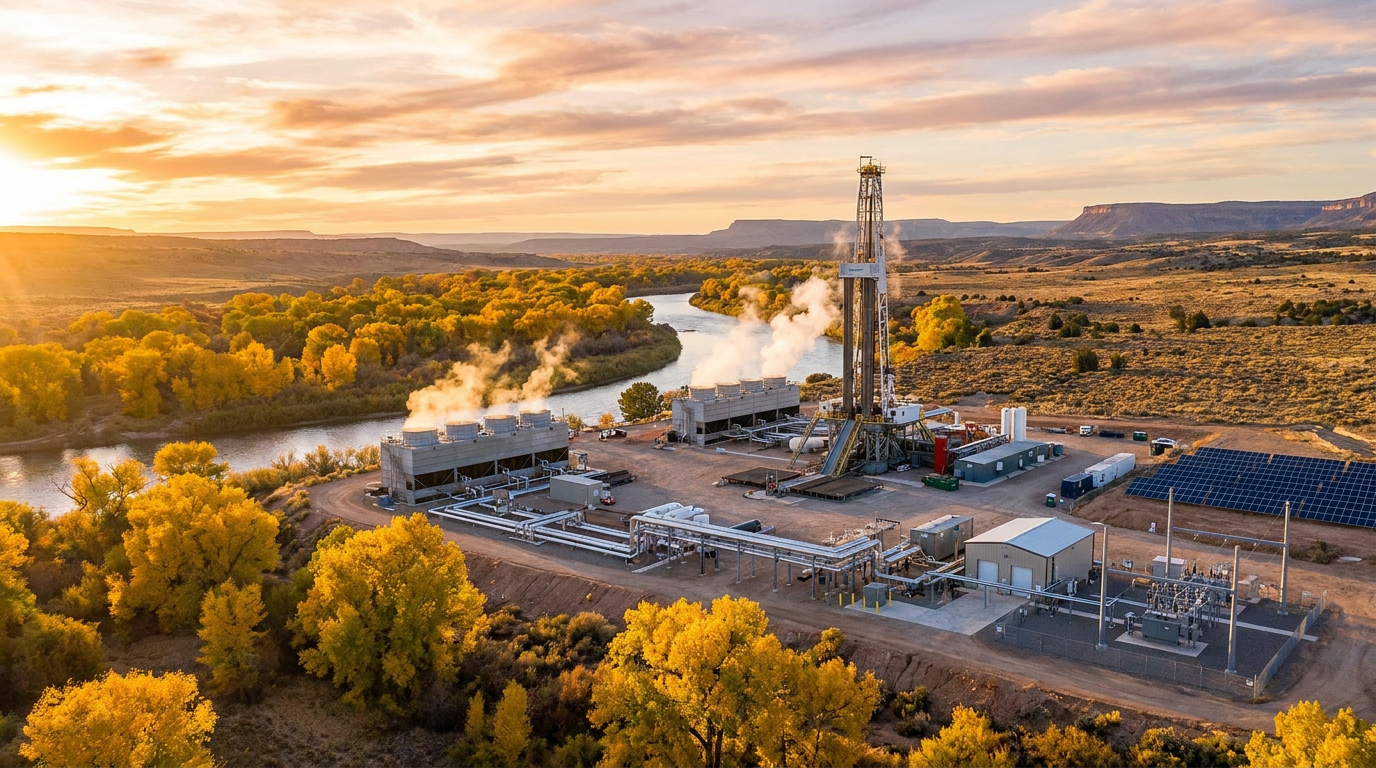
The commercial viability of EGS is no longer theoretical. In southwest Utah, a startup called Fervo Energy is building Cape Station, the world's largest enhanced geothermal project. Operating nearly 7,000 feet below ground, the site has successfully maintained continuous seismic monitoring in extreme temperatures reaching 338°F.[6][8]
In southwest Utah, a startup called Fervo Energy is building Cape Station, the world's largest enhanced geothermal project.
Cape Station is permitted to eventually produce 2 gigawatts of continuous power. The project is scheduled to begin delivering its first 100 megawatts of electricity to the grid by 2026, proving that engineered reservoirs can operate safely and efficiently at a utility scale.[7][8]
The financial markets are taking notice. In early 2026, Fervo Energy secured $255 million in new equity and debt funding to accelerate its deployment, and subsequently filed for an initial public offering. This influx of capital signals that Wall Street views next-generation geothermal not as a science experiment, but as a bankable infrastructure asset.[6][7]
Beyond EGS, another frontier is emerging: Advanced Geothermal Systems (AGS), often referred to as closed-loop geothermal. In an AGS, the working fluid never actually touches the underground rock. Instead, it circulates through a sealed, continuous loop of pipes, absorbing heat via conduction—much like a giant underground radiator.[1][4]

Both EGS and AGS typically utilize "binary cycle" power plants at the surface. Unlike older geothermal plants that release steam into the air, binary systems are entirely closed-loop. The hot geothermal fluid passes through a heat exchanger, transferring its thermal energy to a secondary organic fluid with a lower boiling point.[1]
This secondary fluid vaporizes, spins the turbine, and is then condensed back into a liquid to repeat the cycle. The cooled geothermal water is simultaneously reinjected back into the earth. The result is a highly efficient power plant with zero atmospheric emissions and virtually no water consumption during operation.[1]
The scale of this opportunity is staggering. A recent analysis by Princeton University suggests that enhanced geothermal could supply up to 20% of the electricity in the United States by 2050. The U.S. Department of Energy estimates that next-generation geothermal could provide up to 120 gigawatts of firm capacity nationwide.[2][4][5]

Furthermore, geothermal energy boasts the lowest land-use intensity of all renewable energy technologies. Because the vast majority of the infrastructure is located thousands of feet underground, a geothermal plant requires a fraction of the surface acreage needed for a sprawling solar farm or wind turbine array.[3][4]
The primary hurdle remaining is cost. Geothermal development is highly capital-intensive, with next-generation projects historically requiring significantly more upfront investment per megawatt than onshore wind or solar. Drilling deep into hard granite is expensive, and the financial risks are front-loaded before the resource is fully proven.[2][4]
However, experts anticipate a steep learning curve. Just as the cost of solar panels plummeted over the last decade, the cost of EGS is expected to drop as companies drill more wells, refine their techniques, and benefit from economies of scale.[2]
The ultimate catalyst for this industry may be the tech sector. Hyperscale companies building massive AI data centers are desperate for clean, firm power. By signing long-term power purchase agreements, these tech giants are providing the guaranteed revenue that geothermal startups need to secure financing, effectively underwriting the birth of a new era in global energy.[1][7]
How we got here
19th Century
Conventional geothermal energy is first harnessed for industrial processes and electricity, limited to natural hot springs.
2010s
The US shale boom perfects horizontal drilling and hydraulic fracturing, laying the technological groundwork for EGS.
Jan 2023
Fervo Energy begins a landmark experiment at its pilot plant in Nevada, proving the commercial viability of engineered reservoirs.
Mid-2025
Princeton University publishes a major analysis showing EGS could supply 20% of US electricity by 2050.
Early 2026
Fervo Energy files for an IPO and secures $255 million to scale its 2 GW Cape Station project in Utah.
Viewpoints in depth
The Clean Energy Advocates
View EGS as the missing puzzle piece for a 100% renewable grid.
For decades, the Achilles' heel of renewable energy has been intermittency—the sun sets, and the wind stops blowing. Clean energy advocates and grid modelers see next-generation geothermal as the ultimate 'firm' power source. Because it runs 24/7, it can replace coal and natural gas baseload plants without the radioactive waste concerns or regulatory hurdles of nuclear power. They argue that scaling EGS is critical to meeting net-zero targets.
The Fossil Fuel Transitioners
See geothermal as a lifeline for oil and gas workers.
The irony of the geothermal boom is that it relies almost entirely on technology perfected by the fossil fuel industry. Horizontal drilling, hydraulic fracturing, and polycrystalline diamond compact (PDC) drill bits were developed for shale oil and gas. Industry veterans view EGS as a massive opportunity to transition roughnecks, petroleum engineers, and drilling companies into the green economy, utilizing their exact skill sets to produce zero-carbon energy.
The Hyperscale Tech Companies
Desperate for 24/7 clean power to fuel AI data centers.
Tech giants like Google and Microsoft have made ambitious '24/7 carbon-free' pledges, but the explosive energy demands of artificial intelligence have made those goals nearly impossible to hit with just wind and solar. These companies are aggressively funding and signing power purchase agreements (PPAs) for next-generation geothermal, viewing it as the only scalable way to power gigawatt-scale data centers around the clock without burning natural gas.
What we don't know
- How quickly the high upfront capital costs of deep drilling will fall as the industry scales and moves down the learning curve.
- Whether regulatory frameworks and permitting processes will be streamlined fast enough to allow geothermal to meet 2050 grid targets.
- The long-term operational lifespan and thermal degradation rates of artificially engineered underground reservoirs at a commercial scale.
Key terms
- Enhanced Geothermal Systems (EGS)
- A technology that creates artificial underground reservoirs by injecting fluid into hot, impermeable rock to extract heat.
- Advanced Geothermal Systems (AGS)
- Also known as closed-loop geothermal, a system where fluid circulates in sealed underground pipes to absorb heat without touching the rock.
- Binary Cycle Power Plant
- A facility where hot geothermal fluid heats a secondary liquid with a lower boiling point, which turns to vapor and spins a turbine.
- Firm Power
- Electricity generation that can be reliably dispatched at any time, 24/7, regardless of weather conditions.
- Hydraulic Stimulation
- The process of injecting high-pressure fluids into deep wells to create or open tiny fractures in rock, allowing water to flow.
Frequently asked
Can next-generation geothermal be built anywhere?
In theory, yes, because the Earth's crust is hot everywhere if you drill deep enough. In practice, early commercial projects are targeting areas where hot rock is relatively close to the surface to keep drilling costs down.
Does EGS cause earthquakes?
Because EGS involves fracturing underground rock, it can cause micro-seismicity. However, modern projects use advanced continuous seismic monitoring to manage reservoir pressure and prevent felt earthquakes.
Does it use as much water as traditional fracking?
No. While water is used to create the initial fractures, most modern geothermal plants use closed-loop binary systems where the fluid is continuously recycled, resulting in near-zero water consumption during operation.
Sources
Source coverage
8 outlets
3 viewpoints surfaced








[1]Factlen Editorial TeamClean Energy Advocates
Synthesis by Factlen editorial team
Read on Factlen Editorial Team →[2]Princeton UniversityClean Energy Advocates
Enhanced geothermal systems: An underground tech surfaces as a serious clean energy contender
Read on Princeton University →[3]World Resources InstituteClean Energy Advocates
The Promise of Next-Generation Geothermal
Read on World Resources Institute →[4]BloombergNEFFossil Fuel Transitioners
Geothermal. Possible game changer.
Read on BloombergNEF →[5]U.S. Department of EnergyFossil Fuel Transitioners
Pathways to Commercial Liftoff: Next-Generation Geothermal Power
Read on U.S. Department of Energy →[6]Sightline ClimateHyperscale Tech Buyers
Fervo Energy quietly filed for an IPO
Read on Sightline Climate →[7]ESG NewsHyperscale Tech Buyers
Fervo Energy Secures $255 Million to Build World's Largest Geothermal Power Development
Read on ESG News →[8]Highways TodayHyperscale Tech Buyers
Unlocking the Subsurface for Scalable Energy
Read on Highways Today →
More in guides
See all 23 stories →Digital Security
How to Transition to Passkeys (and Finally Leave Passwords Behind)
7 sources

Local AI
How to Run AI Models Locally: A Complete Guide to Privacy-First LLMs
7 sources

Metabolic Health
The Science of Zone 2 Cardio: Why Slowing Down is the Key to Metabolic Health
6 sources

Local AI
How to Run a Local AI Model on Your PC for Total Privacy
8 sources

Every angle. Every day.
Get guides stories with full source coverage and perspective breakdowns delivered to your inbox.