
How Stratospheric Balloons Are Redefining Luxury Space Tourism for 2026
Aerospace startups are preparing to launch commercial passengers to the edge of space in pressurized, low-carbon balloons, trading rocket propulsion for Michelin-starred serenity.
By Factlen Editorial Team
- Stratospheric Operators
- Companies building the balloons emphasize safety, accessibility, and environmental sustainability.
- Luxury & Wellness Curators
- The high-end travel industry views these flights as the ultimate frontier for transformational hospitality.
- Aerospace Analysts
- Industry watchers track the testing progress, regulatory hurdles, and market viability of balloon-based space tourism.
What's not represented
- · Aviation Regulators (FAA/EASA) on the airspace integration challenges of massive slow-moving balloons.
- · Traditional rocket-based space tourism companies on the definition of 'space travel'.
Why this matters
For decades, space tourism was restricted to highly trained astronauts or billionaires willing to endure explosive rocket launches. The arrival of luxury stratospheric balloons opens the edge of space to a much broader demographic, transforming a physically grueling ordeal into an accessible, low-carbon hospitality experience.
Key points
- Commercial stratospheric balloon flights are targeted to begin in 2026.
- Passengers will ascend to 100,000 feet, above 98% of the Earth's atmosphere.
- The six-hour flights require no physical training and involve zero G-forces.
- Capsules feature luxury amenities, including Michelin-starred meals and Wi-Fi.
- The flights are designed to be low-carbon alternatives to rocket tourism.
The billionaire space race of the early 2020s was defined by roaring rockets, crushing G-forces, and brief minutes of weightlessness. But a new era of space tourism is taking a decidedly different approach, trading explosive propulsion for serene, low-carbon luxury.[3]
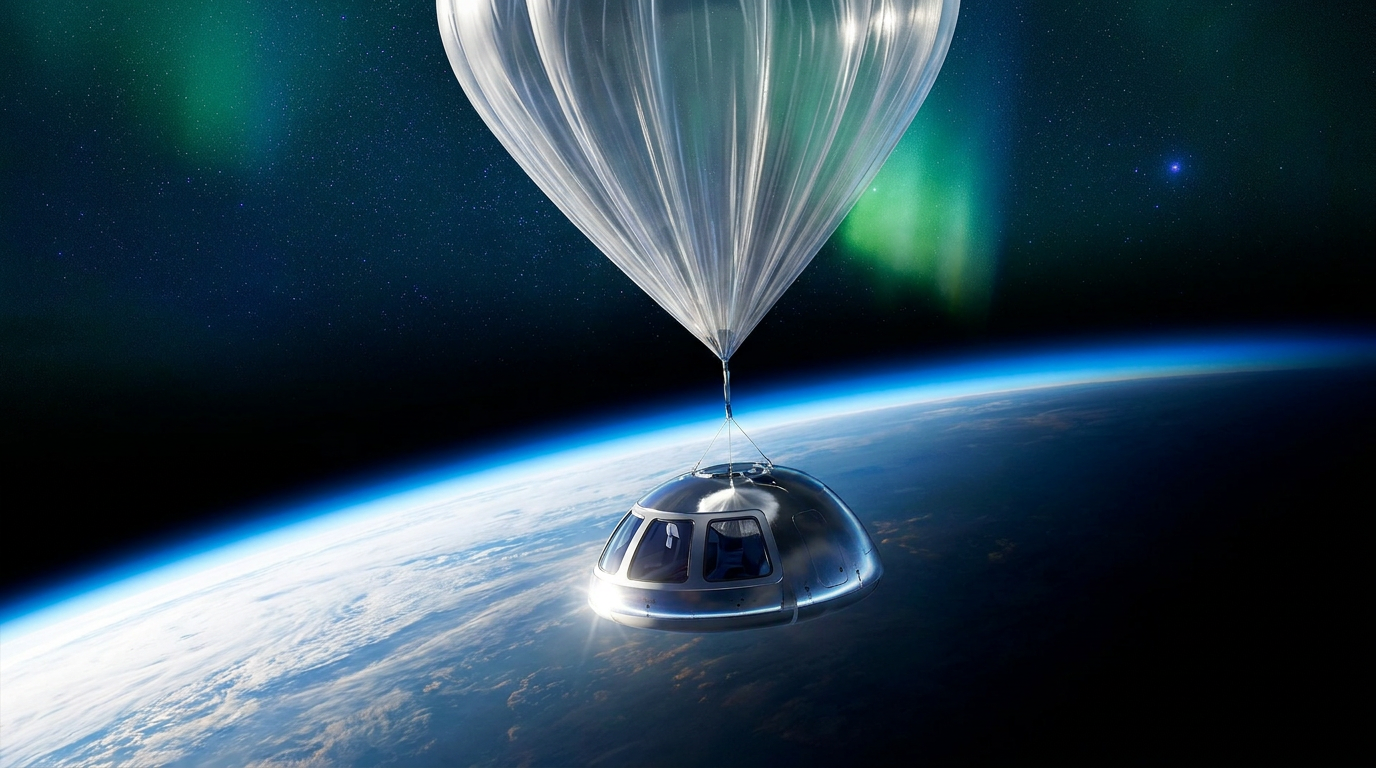
In 2026, a handful of aerospace startups are preparing to launch commercial passengers to the edge of space using massive, high-tech stratospheric balloons. The promise is a gentle, six-hour round trip complete with Michelin-starred meals, cocktails, and panoramic windows, all without the physical toll of a traditional rocket launch.[1][2][4]
The mechanism behind this new frontier relies on buoyancy rather than thrust. Companies like Florida-based Space Perspective and France's Zephalto utilize giant balloons filled with hydrogen or helium to lift pressurized, climate-controlled capsules high above the clouds.[4][5]
Ascending at a leisurely pace of 10 to 15 miles per hour, the balloons reach an apogee of 15 to 19 miles (25 to 30 kilometers) above sea level. While technically below the Kármán line—the internationally recognized boundary of space—this altitude places passengers above 98 percent of Earth's atmosphere.[3][6]

At this height, the sky turns a cosmic black, and the curvature of the Earth is clearly visible against the thin blue line of the atmosphere. Because the ascent is so gradual, there are no heavy G-forces, meaning passengers require no specialized physical training or spacesuits.[1][3]
The technology is rapidly moving from concept to reality. Space Perspective recently completed a full uncrewed test flight of its "Spaceship Neptune-Excelsior," reaching 100,000 feet before executing a controlled descent and splashing down safely in the Gulf of Mexico.[2][5]
Inside the capsules, operators are aiming for an ultra-premium hospitality experience. Zephalto's "Céleste" capsule features interiors by French designer Joseph Dirand, known for his work on high-end Parisian boutiques and restaurants. The minimalist design is intended to provide comfort without distracting from the extraterrestrial views.[4][6]
Inside the capsules, operators are aiming for an ultra-premium hospitality experience.
Space Perspective, meanwhile, equips its eight-passenger capsule with a "Space Lounge" featuring Wi-Fi, a world-class beverage service, and a fully equipped restroom dubbed the "Space Spa."[5]

Beyond the luxury amenities, operators are leaning heavily into the psychological impact of the journey. The primary draw is the "Overview Effect"—a profound cognitive shift regarding Earth's fragility and interconnectedness, historically reported only by astronauts.[1][3]
To maximize this impact, Zephalto recently partnered with luxury travel company Sabbatical.Travel to offer a comprehensive transformational program. Before the flight, passengers participate in a retreat featuring coaching from astronauts and philosophers to prepare their mindset.[1]
Following the six-hour flight, guests attend a "Reconnection Retreat" designed to help them integrate their newfound perspective into their daily lives and professional endeavors.[1]
Environmental sustainability is another major selling point. Unlike the massive carbon footprint associated with rocket launches, these balloon flights are marketed as low-carbon or entirely carbon-neutral. Zephalto estimates its flights produce just 26.6 kilograms of CO2 per passenger—roughly equivalent to a short road trip.[5][6]

Despite the optimism and successful test flights, the industry still faces hurdles. Commercial aerospace is notoriously prone to delays, and operators must secure stringent regulatory approvals from aviation authorities and coast guards. Additionally, flights are highly dependent on pristine weather and atmospheric conditions, meaning passengers will need flexible travel windows.[3][5]
Nevertheless, the demand for stratospheric tourism is already proven. Space Perspective has sold over 1,800 tickets at $125,000 each, while Zephalto's premium packages can reach upwards of $170,000. If the current testing schedules hold, 2026 will mark the year the edge of space officially opens for leisure.[1][2][4]
How we got here
2019
Space Perspective is founded with the goal of creating a carbon-neutral balloon-based spaceflight experience.
April 2023
French startup Zephalto announces plans to offer Michelin-starred dining in the stratosphere by 2025.
September 2024
Space Perspective successfully completes a full uncrewed test flight of its Spaceship Neptune-Excelsior capsule, reaching 100,000 feet.
February 2025
Zephalto partners with Sabbatical.Travel to bundle stratospheric flights with psychological coaching and wellness retreats.
2026
The targeted launch window for the first commercial passenger flights by both Space Perspective and Zephalto.
Viewpoints in depth
Stratospheric Operators
Companies building the balloons emphasize safety, accessibility, and environmental sustainability.
For the engineers and founders behind companies like Space Perspective and Zephalto, balloon-based travel is the key to democratizing the edge of space. They argue that by removing the explosive thrust and heavy G-forces of traditional rocket launches, space tourism can be opened to anyone medically fit to fly on a commercial airliner. Furthermore, they heavily promote the low-carbon footprint of their operations, contrasting their gentle helium and hydrogen ascents with the massive emissions generated by suborbital rocket tourism.
Luxury & Wellness Curators
The high-end travel industry views these flights as the ultimate frontier for transformational hospitality.
Travel agencies and luxury designers are less focused on the aerospace engineering and more concerned with the passenger experience. For this camp, the six-hour flight is a canvas for ultra-premium hospitality—featuring Michelin-starred meals, bespoke interior design by renowned architects, and curated wellness programs. By pairing the physical journey with psychological coaching, they aim to turn the 'Overview Effect' into a marketable, life-changing retreat rather than just a brief sightseeing tour.
What we don't know
- Exactly how weather-dependent the commercial flight schedules will be, and how often passengers might face weather-related delays.
- Whether the targeted 2026 commercial launch dates will hold, given the strict regulatory approvals required by the FAA and international aviation bodies.
- How the broader public will respond to the safety profile of stratospheric balloons once crewed commercial operations begin.
Key terms
- Stratosphere
- The second major layer of Earth's atmosphere, extending up to about 31 miles (50 km) high, where passengers will float above 98 percent of the atmosphere.
- Overview Effect
- A profound cognitive shift reported by astronauts upon viewing the Earth from space, characterized by a deep sense of interconnectedness and an understanding of the planet's fragility.
- Apogee
- The highest altitude reached during the balloon's flight before it begins its controlled descent back to Earth.
- Kármán Line
- The internationally recognized boundary of space, located 62 miles (100 km) above sea level, which these balloons do not cross.
Frequently asked
Will passengers experience weightlessness on the balloon flight?
No. Because the balloon ascends slowly and does not enter orbit or freefall, passengers will experience normal Earth gravity throughout the entire journey.
Do you need physical training to fly on a space balloon?
No specialized training is required. The gentle ascent involves no heavy G-forces, making the flight accessible to anyone who is medically fit to fly on a standard commercial airliner.
How does the balloon safely return to Earth?
The balloon slowly releases its lifting gas to initiate a controlled, gentle descent. Depending on the operator, the capsule will either splash down in the ocean for a boat recovery or land softly on solid ground.
Is the balloon flight bad for the environment?
Unlike traditional rocket launches, these balloon flights are designed to be low-carbon or carbon-neutral, with some operators estimating emissions as low as 26.6 kg of CO2 per passenger.
Sources
Source coverage
6 outlets
3 viewpoints surfaced






[1]GlobetrenderLuxury & Wellness Curators
Sabbatical.Travel and Zephalto launch stratospheric experience
Read on Globetrender →[2]Space.comAerospace Analysts
Space Perspective completes first full flight test of Spaceship Neptune
Read on Space.com →[3]South China Morning PostAerospace Analysts
How stratospheric balloon flights could be about to redefine space tourism
Read on South China Morning Post →[4]Robb ReportLuxury & Wellness Curators
New Luxury Space Balloon Will Carry You To The Cosmos In 2025
Read on Robb Report →[5]PR NewswireStratospheric Operators
Space Perspective Successfully Completes Development Flight 2
Read on PR Newswire →[6]ZephaltoStratospheric Operators
The low-carbon journey to space
Read on Zephalto →
Every angle. Every day.
Get travel stories with full source coverage and perspective breakdowns delivered to your inbox.